Jump to ratings and reviews
Rate this book

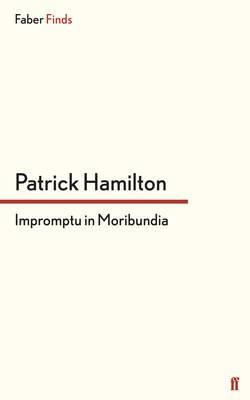
Impromptu in Moribundia

Rate this book
A satirical fable about one (nameless) man's trespass (through a fantastical machine called the 'Asteradio') into a parallel universe on a far-off planet where the 'miserably dull affairs of England' are mirrored and transformed into an apparent idyll of bourgeois English imagination.

194 pages, Hardcover

First published January 1, 1939

2 people are currently reading
55 people want to read

About the author

Patrick Hamilton

90 books292 followers
Librarian Note: There is more than one author in the Goodreads database with this name.

He was born Anthony Walter Patrick Hamilton in the Sussex village of Hassocks, near Brighton, to writer parents. Due to his father's alcoholism and financial ineptitude, the family spent much of Hamilton's childhood living in boarding houses in Chiswick and Hove. His education was patchy, and ended just after his fifteenth birthday when his mother withdrew him from Westminster School.

After a brief career as an actor, he became a novelist in his early twenties with the publication of Monday Morning (1925), written when he was nineteen. Craven House (1926) and Twopence Coloured (1928) followed, but his first real success was the play Rope (1929, known as Rope's End in America).

The Midnight Bell (1929) is based upon Hamilton's falling in love with a prostitute, and was later published along with The Siege of Pleasure (1932) and The Plains of Cement (1934) as the semi-autobiographical trilogy 20,000 Streets Under the Sky (1935).

Hamilton disliked many aspects of modern life. He was disfigured badly when he was run over by a car in the late 1920s: the end of his novel Mr. Stimpson and Mr. Gorse (1953), with its vision of England smothered in metal beetles, reflects his loathing of the motor car. However, despite some distaste for the culture in which he operated, he was a popular contributor to it. His two most successful plays, Rope and Gas Light (1938, known as Angel Street in the US), made Hamilton wealthy and were also successful as films: the British-made Gaslight (1940) and the 1944 American remake, and Alfred Hitchcock's Rope (1948).

Hangover Square (1941) is often judged his most accomplished work and still sells well in paperback, and is regarded by contemporary authors such as Iain Sinclair and Peter Ackroyd as an important part of the tradition of London novels. Set in Earls Court where Hamilton himself lived, it deals with both alcohol-drinking practices of the time and the underlying political context, such as the rise of fascism and responses to it. Hamilton became an avowed Marxist, though not a publicly declared member of the Communist Party of Great Britain. During the 1930s, like many other authors, Hamilton grew increasingly angry with capitalism and, again like others, felt that the violence and fascism of Europe during the period indicated that capitalism was reaching its end: this encouraged his Marxism and his novel Impromptu in Moribundia (1939) was a satirical attack of capitalist culture.

During his later life, Hamilton developed in his writing a misanthropic authorial voice which became more disillusioned, cynical and bleak as time passed. The Slaves of Solitude (1947), was his only work to deal directly with the Second World War, and he preferred to look back to the pre-war years. His Gorse Trilogy—three novels about a devious sexual predator and conman—are not generally well thought of critically, although Graham Greene said that the first was 'the best book written about Brighton' and the second (Mr. Stimpson and Mr. Gorse) is regarded increasingly as a comic masterpiece. The hostility and negativity of the novels is also attributed to Hamilton's disenchantment with the utopianism of Marxism and depression. The trilogy comprises The West Pier (1952); Mr. Stimpson and Mr. Gorse (1953), dramatized as The Charmer in 1987; and in 1955 Hamilton's last published work, Unknown Assailant, a short novel much of which was dictated while Hamilton was drunk. The Gorse Trilogy was first published in a single volume in 1992.

Hamilton had begun to consume alcohol excessively while still a relatively young man. After a declining career and melancholia, he died in 1962 of cirrhosis of the liver and kidney failure, in Sheringham, Norfolk.

Ratings & Reviews

What do you think?
Rate this book

Friends & Following

Create a free account to discover what your friends think of this book!

Community Reviews

5 stars
6 (10%)
4 stars
12 (21%)
3 stars
27 (47%)
2 stars
11 (19%)
1 star
1 (1%)
Displaying 1 - 9 of 9 reviews
Profile Image for Nigeyb.
1,508 reviews412 followers
January 9, 2020
I adore Patrick Hamilton's 'Hangover Square' (1941) - my favourite novel of all time; 'The Slaves of Solitude' (1947) is superb; I also really enjoyed the first two Gorse novels - 'The West Pier' (1952); and 'Mr Stimpson and Mr Gorse' (1953); and 'Craven House' (1926). I felt 'Twopence Coloured' was slightly less successful that these titles. All of these books benefit from a knowledge of Patrick Hamilton's life, and consequently I would also heartily recommend the biography of Patrick Hamilton, 'Through A Glass Darkly: The Life of Patrick Hamilton' by Nigel Jones.

Since reading 'Hangover Square', I have been working my way through all of Patrick Hamilton's work and, with that in mind, have just completed 'Impromptu in Moribundia'.

Impromptu in Moribundia was published in 1939 and is something of an anomaly within the literary oeuvre of Patrick Hamilton. In common with his other novels he uses the book to comment on the 'cupidity, ignorance, complacence, meanness, ugliness, short-sightedness, cowardice, credulity, hysteria and, when the occasion called for it ... cruelty and blood-thirstiness' of contemporary society - in particular 'the sickening stench of the decaying genteels'. However, unlike his other books, which are firmly rooted in the "real world" (of early 20th century southern England), this satirical story takes place on the planet Moribundia. Moribundia is a thinly disguised, albeit comically exaggerated, version of the England of Hamilton's time. By reversing place names, people's names, and other labels, Patrick Hamilton comments on contemporary life. For example, Aldous Huxley becomes 'Yelxuh', Marxists are 'Stsixram', and so on. Life on Moribundia is predominantly split into two distinct classes - the 'Yenkcoc" and the bowler-hatted 'Little Men' who are the self-appointed guardians of the moral law of society (and it transpires based on a popular Daily Express cartoon of the era).

Moribundians are so conditioned by brand advertising that they frequently think and talk in the language of popular advertisements. This tendency is further exaggerated by people revealing some of their thoughts in comic book-style thought and speech bubbles. Moribundia is also populated by other stereotypes e.g. large women with their hen pecked husbands, and even bizarre visual images to represent illness e.g. a dripping tap instead of a nose.

The 1930s was the age of the political novel, and this book was Patrick Hamilton's experimental and innovative response. By using allegory and surrealism, and through the adventures of his nameless narrator's celebrated visit to the planet, Patrick Hamilton holds a mirror up to contemporary English pre-WW2 society. He wrote this book as a convinced Marxist (although he never became a member of the Communist Party) and these convictions are subtly revealed through the story.

Whilst the book was a relative flop, probably because it was too great a departure for Patrick Hamilton's reading public, it was written at the same time as one of his greatest successes, the play Gas Light. Despite its relative lack of commercial success, I enjoyed many aspects of this book: the naming inversions; the playful and funny deconstruction of consumer advertising; and the skewering of many moribund 'Little Englander' attitudes. The inclusion of an informative introduction, and useful notes on parts of the texts, by Peter Widdowson, editor and annotator of this edition, helped to explain and contextualise the story, and some of Patrick Hamilton's "targets".

'Impromptu in Moribundia' has much to enjoy for readers who have come to know and love Patrick Hamilton's work, however I recommend newcomers start with 'Hangover Square' and 'The Slaves of Solitude', and then work through the many other highlights of his bibliography before reading this book.

3/5


Profile Image for Hux.
419 reviews139 followers
February 26, 2026
As a fan of Hamilton, I was keen to read some more of his work and so bought this knowing nothing about it. Suffice it to say, this is not his typical oeuvre, and I was slightly taken aback by what turned out to be a rather strange and, I would suggest, somewhat self-indulgent allegorical fantasy novel. Hamilton, of course, generally wrote novels set deep in the British environment and culture of the 1920s/30s/40s about people who were lonely, desperate, and disappointed. But always with beautiful writing. This, however, is a very odd little story about a man who travels (via the Asteradio) to another planet (though more like an alternative dimension) called Moribundia. I would suggest this is one of those books writers occasionally produce for their own amusement and political expression which, in truth, probably should have stayed on a shelf. Anyway...

It's certainly well-written and worth a read but it clearly isn't meant to be viewed as an actual science-fiction story. The method of travel, for example, involves going to the business premises of a man named Crowmarsh, getting into a mirrored box (the Asteradio) and, after some slight rocking and unconsciousness, waking up on a planet called Moribundia. The book is more in keeping with Swiftian allegorical satire. Because as soon as he gets there, he is essentially in a parallel version of England, surrounded by young boys playing cricket, churches, country lanes, before getting on a bus with a Cockney conductor, and later staying at a hotel in the city. The point of the book is for Hamilton to critique middle-class norms of England in the 1930s, to attack capitalism, and generally mock the putative ideals of the age in a version of England which is slightly off but still recognisable. As such the Cockneys are referred to as Yenkcocs and London is referred to as Nwotsemaht and several other things are simply presented as words written backward.

I enjoyed the first couple of chapters but honestly started to lose interest after a while. Even the speech bubbles (when the middle-classes speak or think, speech bubbles appear above their heads) couldn't make up for the rather dry material. It's beautifully written, as ever, with moments of intrigue, but it's ultimately in service of a personal polemic that always felt slightly self-indulgent and very much of its time. I know Hamilton hated cars (being run over will do that to a man) and had a general distaste for aspects of modernity, but here there's a greater sense of overtly attacking capitalism. It's always nice to get a window into an author's inner thoughts but these kinds of books (holiday novels I think Virginia Woolf called them) are more for the aficionado than anyone else. I would say skip this unless you're a fan of Hamilton. A mild curiosity but little more.
Profile Image for Michael Brooke.
7 reviews6 followers
September 3, 2013
A dramatic change of pace for Patrick Hamilton (and a complete one-off in his output), this sci-fi fantasy initially seems to be yet another entry in the fairly lengthly parade of utopian/dystopian novels that were all the rage in the 1930s - Aldous Huxley's Brave New World, Karel Čapek's The War with the Newts, C.S. Lewis's Out of the Silent Planet, H.G.Wells's The Shape of Things to Come (and its Wells-scripted film adaptation Things to Come) and so on - as Hamilton’s unnamed first-person narrator is dispatched, via a rickety Heath Robinson-style contraption called an 'Asteradio'. He lands on the planet Moribundia, observes its occupants in some detail, and returns home.

So far so conventional, but it becomes clear very quickly that Hamilton's aims are somewhat different from his contemporaries. 1930s culture across the board was strongly "progressive" - you have only to look at a cross-section of the GPO Film Unit’s output to spot an overwhelming focus on the inexorable march of science and technology, the desirability of self-consciously "modern" design, architectural and typographic forms. Similarly, samples of the advertising of the era betray a similar focus on self-improvement, so that one might be suitably attired and scented to fit the coming brave new world.

Moribundia seems wonderful at first glance. Checking into a luxury hotel with every intention of slipping out without paying his bill (literally unpayable, as he arrives with no Moribundian money), the narrator is surprised and delighted to be given the sum of 25 Moribundian pounds every morning - more than enough to sustain a very comfortable lifestyle. (Assuming the exchange rate with the British pound is 1:1, that would have been the equivalent of a £1,400-a-day income). But as he strikes up a friendship with Moribundian citizen Anne, he discovers that people are paid according to their intrinsic value, determined by an absolutely rigid class structure. At the top are the Akkup Bihas, effectively the benevolent upper-class colonial administrators (their name, like much else in Moribundia, is achieved by writing familiar English - or in this case Indian - phrases backwards), in the middle there are the fearsome 'Little Men' (bowler-hatted administrators of overweeningly pedantic temperament and little tolerance for the unusual), and at the bottom are the proles, who talk in a strange dialect called 'Yenkcoc', who are invariably cheerful salt-of-the-earth types, whose surnames all end in the suffix '-uggins', and who are so culturally backward that they can't tell the difference between a grand piano and a block of wood when it comes to assessing their suitability as fuel.

Some of this is decidedly heavy-handed, but at other times a genuinely Swiftian rage lights up the pages. Hamilton particularly has it in for consumerism, the notion that only by spending money on nice shiny new things can you achieve true happiness - his Moribundian characters all talk in the language of advertisements (I suspect there are many direct quotations from actual examples) and behave as though popular caricature was in fact anthropological reportage. At one point, with an absolutely straight face, our hero plots a seduction in the following terms:

It so happened that I had bought some etchings recently to decorate my walls, and, being anxious to know her opinion of them, I asked her after dinner to come up to my room to glance over them.


Hamilton also fleshes out similar sequences drawn from seaside postcards and drawing-room comedies, and the imagery of advertisements becomes horribly real as people are literally chained to the bed with rheumatism or have their indigestion-afflicted stomachs poked at by little devils.

In many ways the novel is very much a product of its time, but some of its concerns are just as relevant today - not least the prevalence of people who not only talk in clichés but apparently think in them too, as a substitute for actual lived-in experience of the real world. Although their lives only overlapped by nine years or so, it's a very safe bet indeed that Hamilton would have cordially loathed Tony Blair and New Labour, whose lackeys frequently stereotyped the white working classes in much the same crude and dismissive way that Hamilton does - only Hamilton (whose earlier studies of the inner lives of waiters, barmaids and prostitutes revealed a keen empathy with their situation) was deliberately taking the piss. Presciently, Hamilton also foresees what will happen if people’s lives are excessively cushioned and subsidised by the state - that workers will gradually lose any incentive to work, and the middle classes will focus relentlessly on superficial trivia. And lest this sound as though he was the ancestor of today’s Daily Mail leader-writers, Hamilton was by then a convinced Marxist who was well aware of the practical shortcomings offered by most 1930s Utopian fantasies and sought to lay them bare. I certainly wouldn’t recommend this as a first Patrick Hamilton novel, but I’m very glad that I found the time to read it, as it explains much about his seemingly misanthropic worldview.
Profile Image for Alex Sarll.
7,151 reviews369 followers
Read
March 27, 2019
Back when I first read Patrick Hamilton, there was only me, Julie Burchill and barely-remembered gutter balladeers Avalanche (formerly and more fittingly known as Ennui) who seemed to give the faintest toss about him. But nowadays he's reached the point of rediscovered canonicity where even his more obscure work is being reissued in mass-market paperbacks adorned with Nick Hornby quotes, such that I'll see them in the library and think oh, I never realised he'd done a satirical science fiction novel – that sounds relevant to my interests! Alas, if I was hoping for the midpoint between Hangover Square and Brave New World, this isn't that. The narrator is sent to another world via the sort of will-this-do process barely a step above that mainstay of early twentieth century interplanetary voyages, 'I fell asleep on a hill and woke up in space'. Arriving there, he finds it all remarkably familiar - such that all posh people are willowy, noble and heroic, all bus conductors are rubicund and rudely good-humoured, and so forth. In other words, it's England as seen in the pages of Punch. But for all that it's a short novel, it still feels a little too long, and lacking in focus. So while we start with a vision of a land in which every cricket match ends with everything on one boy's shoulders and an invocation to 'play up, and play the game', then we shift into everyone talking like they're in an advertisement every time someone feels tired or has a spot or what-have-you, and then detour through the Moribundians having finished science, and they all circle around a certain idea of smug consensus and a society which has stopped moving, but they don't entirely gel. This inconsistency is obviously deliberate, at least to some extent, and the shifts in focus recall that other deeply odd book of a similar era, Peake's Mr Pye – but for whatever reason, they don't come off here in the way they did there. On top of which, the narrator's failure to spot that all the names are their English equivalents (or at most synonyms) backwards, and repeated insistence that we can't envisage the Moribundian equivalent of some familiar English road or type, while again obviously deliberate, is nevertheless more annoying than amusing. Worst of all, one can't help but look askance at any book complaining barely-even-obliquely about how nothing ever changes in Britain, which came out in 1939. Was that the livening-up you wanted, Patrick? Similarly, for all the pseudoscientific ad-babble and pills and potions and stereotypes, reading this in the midst of our current chaos, one can't help but look a little longingly at the perpetual stability of Moribundia.
Profile Image for Jack Messenger.
Author 25 books11 followers
February 7, 2016
A minor work from Patrick Hamilton, but nevertheless an interesting and prescient satire/parable. I recommend his masterpiece The Slaves of Solitude.
Profile Image for Adam Stevenson.
Author 1 book15 followers
November 10, 2019
I adore Patrick Hamilton and have had to force myself to ration his novels so I don’t run right through them. I adore his milieu of struggling drunkards and boring barflies, living lives of quiet desperation and flashes of insane violence. ‘Impromptu in Moribundia’ is completely different, instead of a grubby realism, there’s a sci-fi setup that leads us to broad caricature and fable.

The unnamed protagonist is a test pilot for a machine called an asteradio, a gimcrack device that teleports the user to other planets with a combination of noise and mirrors. The buildup to this moment is done really nicely, the machine is placed in a mundane environment and the workings of the asteradio itself isn’t explained. The description of travelling through space consists of subjective little moments - and then the character is in Moribundia.

Moribundia itself is essentially England in the 1930s as represented through popular media. The concept is a little slippery, it’s a little like a cross between the films ‘Pleasantville’ and ‘Le Triplets de Belleville’. The characters look and act like idealised versions of their type of person as represented in books, postcards, strip cartoons and particularly adverts. This means that every cockney is a chippy, ’cor guvnor’ spouting comedian, every public schoolboy a clean-limbed future hero and every spinster a sour, tutting bag of resentment. There are many small bowler hatted men with wives twice as large and three times as wide who order them about. It’s a land where cliché is manifest and to go against that cliché is to risk being ostracised.

Most noticeable are the speech and thought bubbles. Everyone in Moribundia has the ability to manifest a speech or though bubble physically in a room, usually with the purpose of advertising something. Just as their lives run along the rules of strip-cartoons, they also run on the rules of adverts. At one point, the main character’s Moribundian friends stop talking to him and none of them tell him why. This is because they are following the dictates of a brand of soap which declared that even someone’s best friend would avoid them over telling them they have B.O.

The satire in the book is not subtle, the Moribundian language consists of ours in reverse so conversations about writers such as Draydur Gnilpik are not hard to decipher. There is a genuine anger in the book though, especially with the hegemony of advertising and its channeling of humanity through certain narrow behaviours. He’d have been terribly upset with the mind crushing boredom that is meme culture.

The book isn’t anywhere near his best work (‘Slaves of Solitude’, all the way) but it is surprisingly entertaining given its paper-thin premise though I am glad he didn’t pursue this kind of writing.
89 reviews1 follower
September 23, 2023
As a big fan of Patrick Hamilton, this 1939 work really took me by surprise, the author (temporarily) dispensing with his (largely) cynical, realist take on mid-20th century Britain and instead giving us something between a slice of science fiction and political satire. As Hamilton’s protagonist ‘travels’ to the imaginary world of Moribundia and befalls a series of (largely) unconnected, sometimes stimulating, sometimes absurdist, events, the (seemingly) prevailing critical view of Hamilton’s tale is that it represents some form of political allegory (of communism, according to the anonymous introduction of the Abacus version of the novel I read). The class analysis here might suggest this, although the Moribundian love of the monarchy and the fascination with all things consumerist might suggest otherwise. Whatever, I found that Impromptu, whilst having some moments of intrigue and finishing on a relative positive note, also frequently served to confuse and to have minimal narrative coherence. For me, the novel’s comparators (style, if not quality, wise) would include works by Kafka, Ishiguro (particularly The Unconsoled), Murakami (perhaps) and A Clockwork Orange (but only for Hamilton’s invented vocabulary). As a satire on communism (if that really is Hamilton’s intent) it is not a patch on Orwell’s Animal Farm. Equally, it is not a patch on Hamilton’s other, more realist, works such as The Slaves of Solitude, Hangover Square and, best of all, Twenty Thousand Streets Under the Sky.
January 13, 2020
You've got to hand it to Patrick Hamilton - he will open the door to a story and invite you in for the ride and - however far-fetched it is - once you're in you thoroughly enjoy it from start to finish.
This is not his best work, let's make that clear. I definitely get the impression that this was written to be more of a writing excercise than anything else he's written. But that's not to say it's bad, or in any way worse: it's just different.
Billed as a satirical fable, it looks with the eye of a modern day Swift at the society we live in (or would have lived in pre second world war). And it does that with varying degrees of success (but, yes, always successfully). Some of the satire has all the subtlety of smashing up an expensive grand piano for firewood (something which occurs in the story), some of the satire is devious, some is sublimely orchestrated and wickedly funny. All of it makes its point.
Yet it's also more than it's billed. One example is its study of the upper echelons of society where an ideal, almost-utopia exists. There, society has evolved into a state of ideal changelessness: and there Hamilton examines the subsequent evolution of the changeless ideal - the changeless ideal of ideal changelessness. Good or bad? You discuss.
There are so many resonances with modern society today (unsurprisingly, I guess) that when the true nature of that fabled society is revealed it comes as little surprise, other than the fact that it's conveyed via a truly horrifying scene.
I'm giving it four stars because I'm feeling generous and I adore Hamilton's work. He deserves five stars just for attempting this. And no, it's far from as good as The Slaves Of Solitude or the astonishingly told Hangover Square; but it's still a true joyride of a story, one you'll be glad you'll have taken.
And if this happens to be your first introduction to Patrick Hamilton, you're in for a treat. Good though this is, is upwards and onwards all the way after this.
939 reviews24 followers
January 1, 2017
I had read another of Rex Warner's parabolic novels of 30s politics (The Professor), and I found in its introduction reference to Hamilton's fictional critique of contemporary England. I recall being disappointed that it was not as sharp and as pointed as I'd expected.

Nonetheless, Hamilton's presentation is unique, a novel send up of consumerist behavior (and mentality), with anxious thought balloons lamenting one's lack of personal freshness, pick-up-and-go, the latest fashions, et al. derived from contemporary advertising. There is also a good chapter, again merely tentative and not as exhaustive as I'd have liked, about the reigning literary lights (eg, Draydur Gnilpik) in England and how they'd shaped contemporary, petty-minded bourgeois thought.

It's a quick read and an interesting excursion into another era, one whose concerns of socialism, capitalism, and democracy were literally swept away as England's concerns became mere survival and then recovery from the second world war.
Displaying 1 - 9 of 9 reviews

Can't find what you're looking for?

Get help and learn more about the design.