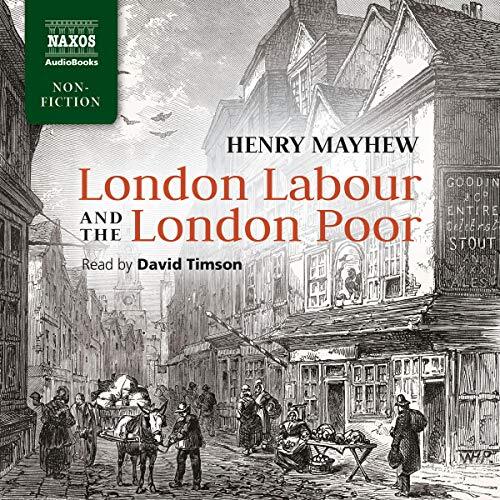
London Labour and the London Poor began life in a newspaper around 1850 and went through several editions, culminating in four volumes. Mayhew sought to survey at first-hand the lives of the impoverished, and analyse the causes of their poverty. Modern popular editions like this one are selections from the larger work. The editors in this case have sought not merely to provide a 'colourful' selection of Mayhew's interviews with the poor, but to represent the breadth of his writings and concerns. Thus, this edition is rearranged and chaptered thematically, whilst the knowledgeable introduction explores Mayhew's life and the context of and reactions to his work.
Nonetheless, the voices of the poor bubble to the surface incessantly throughout the book, their sober testimonials often shocking. There is a good deal on the subculture of costermongers, but we also hear from the Jews, the Irish, street entertainers, labourers, thieves, cabinet-makers, scavengers, "pure-finders", etc. The longest chapter here, and perhaps the most trenchantly polemical, presents Mayhew's exhaustive account of the methods by which unscrupulous employers exploit the workers, who, desperate to earn a crust, are forced to collude in cruelly inventive systems that can only depress their own wages. (One reads of the shamelessly profiteering system for hiring ballast-heavers with astonishment that such practices could be legal.) There are also chapters on criminality, domestic life, culture, etc.
Mayhew's determined efforts to support his case with statistics suffer from a paucity of good data and unsophisticated methodology at the time; but with both this and his copious direct experience he still succeeds in undermining the glib arguments of contemporary economists that the poor had essentially made their own beds, and that their capitalist employers should not be expected to help. Mayhew is against charity and for the working man (indeed, he divides the poor into "deserving" and "undeserving"...), but insists that wages must not be artificially depressed by exploitation. (In the closing section of this edition he draws economists' attention to the unmentioned 600 million "steam men" introduced into the labour market by industrialisation.)
Mayhew lets the poor speak for themselves - in itself a great service to social history - and earnestly draws his arguments out of his discoveries. His analytical writing is clear and cogent, while his reportage, as for instance in describing the street markets, is often vibrant and vivid, and would not disgrace the pages of Dickens.
This 600-page edition's appendices are a bibliography of Mayhew's works, the full table of contents of the larger work, and an expansive list of his sources and authorities - though oddly, no index. There are also 16 illustrations and 4 maps. Though I'm not able to compare other editions, this one seems to me a satisfying, informative, diverse and persuasive selection from one of the classics of social history.