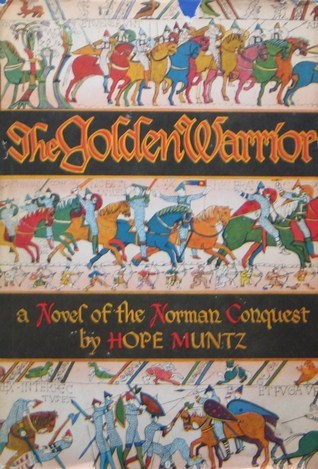
At Hastings, in the year 1066, Harold's great English army was defeated by the Normans under William the Conqueror, and Harold himself lost his life - but in that battle he won everlasting fame and a permanent place in English hearts.
It was a tragic culmination to a career that had seen many tribulations. Harold had sacrificed much for the sake of the he had given up his beloved common law wife, Edith Swanneck; he had banished his own brother, Tosti, from England; he had become a man almost without friends. And he had begun to wonder whether the price of kingship was not, after all, too high.
I have spread my reading of this book over a very long time. At first I was not sure I would finish it. The research is so comprehensive and the characterisation so factual and un-dramatic I felt I was reading a history book rather than an historical novel. And then it grabbed me and I finished the latter half of the book in two days. We all know the end of the Hastings story and the author uses this knowledge as the backdrop against which the characters move inexorably towards their fate. The primacy of fate in the downfall of Harold II is clearly described: the role of Hildebrand of Sovana with his Norman friends in influencing Pope Alexander II; the resentments over the spoils of Stamford Bridge slowing the progress of the Northumbrians and leading to the desertions of the western Fyrd. Each of these lesser known hammer blows racks up the sense of pre-ordained doom until in the end when all is lost there is a sadness and an overwhelming ‘if only’. The definitive novel for those interested in the currents driving down poor ill starred Harold II, potentially the best king England never really had.
It is interesting to see other's views on this book: everything from * & unreadable to ***** excellent. I first read this book some 50 years ago and 45 years ago bought my own copy. I have read it several times. Sure the style is unusual but overall I think it is very well written. it was this book that caused me to delve deeper into the Norman Conquest and its causes. For more background to the period you could do worse than visit my page: http://geoffboxell.tripod.com/1066.htm
The face-off between William the Conqueror and Harold the Wise. The writing style is that of the contemporary chronicles and ancient sagas. It holds the reader at a great distance from both characters and events. Finally, at about 70 pages from the ending, the reader is drawn closer to observe the final few days of Saxon England. I wouldn't have finished reading THE GOLDEN WARRIOR except that I can't walk out on Harold.
I read someone's comment about this book that author Muntz didn't make a choice between Harold or William, but I heartily disagree with that. She shows William as grimly determined to take England and all its riches. Her Harold is the image of idealism, sacrificing his happiness and then his life to defend his land and people. The Saxons, whose free culture includes the right to chose their own king, are to be burned out and slaughtered to force them to accept absolute rule by a foreigner. It is a clear tragedy.
An extraordinarily readable and believable re-imagining of the events leading up to the battle of Hastings and its immediate aftermath. It brings out particularly vividly the role that religion played in everyday life among the English and Norman aristocracy of the 11th century.
This stellar piece of historical fiction was mentioned in the wonderful book, _How the Heather Looks_.It's out of print, but well worth the search to find it.
It's the story of the Battle of Hastings, and all that led up to it, brilliantly told in spare, formal English. Somehow the language seemed to elevate the event and the historical characters, giving the "feel" of the times.
Harold was particularly well fleshed out, and his sterling character and honor grow in the eyes of the reader as we witness his humility, his bearing up under physical infirmity, and the way he treats his men.
His Norman counterpart, William, is also well portrayed, but he comes across more pompous and overbearing so that sympathies lie with Harold.
The men were nearly equally matched, and one feels the great sorrow of their being at odds with one another. To see one of them destroyed is such a waste of once-in-a-lifetime manhood.
The mindset of old England, the valor, the deep religiosity, the love of self rule--- all permeate this fabulous history. I wish I'd had this book when I was homeschooling, but I am glad I've filled in my own understanding of this milestone juncture of British history.
I’ve learned of the Battle of Hastings in the year 1066, heard of William the Conquerer and the Norman conquest, but I never really understood the significance. Reading this book not only gave me a great understanding of the years leading up to the battle, but of the relationships and rivalries between the main characters and their families, including the church, the Vikings, the Normans , and the English. It also gives an inside look at warfare in the 12th century, and the reasons why the battle went as it did. If you read any of the “Game of Thrones” you will love this book!
Written in the style of great epics like The Odyssey and The Illiad, this book about the Norman Conquest (written in 1949)was hard to read at times due to the archaic language and style. Overall though, a more balanced telling of the story which doesn't really seem to favor either Harold Godwineson or William of Normandy. The reader is assumed to know something about English history at this time as events are not always fully explained. 3.5 stars.
I found a very old used copy printed in 1950, cloth yellow cover. I read it in just 2 days and I fell in love with it. Hope Muntz writes divinely about human feelings, struggles and love. The feeling I've got with this book will live with me forever!
My dad says this might be his fav book and insisted I read it. I enjoyed it. If you read the Wolf Age, which I liked better, this takes place immediately afterwards and is somewhat connected, which was interesting. An account of the contest between King Harold and Duke William of Normandy for the English throne. Pretty quick read. Language is a little dated and thus tougher to follow in a couple places but not a significant issue.
I’m very impressed by such story of Harold King in old England I love this period epoch to explore and read other similar literature It’s amazing book I lost myself in time to finish it and will continue read stories of Harold King and epoch of Edward I in old England