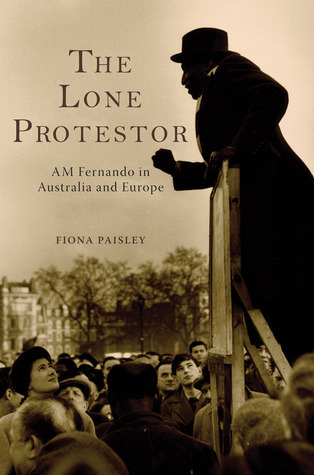
The late 1920s marked an extraordinary protest by an Australian Aboriginal man on the streets of London. Standing outside Australia House, cloaked in tiny skeletons, Anthony Martin Fernando condemned the failure of British rule in his country. Drawn from an extensive search in archives from Australia and Europe, this is the first full-length study of Fernando’s life and the self-professed mission that lasted half his adult life. A moving account, it chronicles the various forms of action taken by Fernando—from pamphlets on the streets of Rome to speeches in the famous Speakers’ Corner in Hyde Park—and brings to light previously unknown details about his extraordinary life in Australia and overseas.
Actually, I haven't read the entire book. I became interested in it because I read a review at Yvonne's Stumbling Through the Past blog http://wp.me/p12nEl-ZJ and I borrowed a copy of it through inter-library loan, but it's rather heavy-going for general reading and now I've run out of time to finish.
Still, I've read enough to complete the simplified bio I need for my students at school, supplemented by other online sources and Yvonne's review. (see http://lisahillschoolstuff.wikispaces...)
With 10-11 year olds, I won't be interrogating Fernando's history as an historian would, but Paisley's book shows the value of exploring the unwritten story of Aboriginal activism, using secondary resources. Fernando was an extraordinary man who devoted his life to activism on behalf of his people at a time when most of them were disempowered. Knowing his story counters the prevailing mythology of Aborigines as helpless victims, and it deserves to be widely known.
What I'd really like to see is a children's picture book about him ...
I was hoping for a more "reader-friendly" story. This was a heavy-going academic work which needed a lot of stamina to finish. I got about a third way through and gave up. It should have been a much more interesting book.