Edwards Albee's Pulitzer Prize-winning play A Delicate Balance reveals the emotional savagery of suburbia and the psychological terror of empty lives. First produced in 1966, this dark drawing room comedy may be Albee's masterpiece, as powerful in its 1996 revival as it was thirty years before.
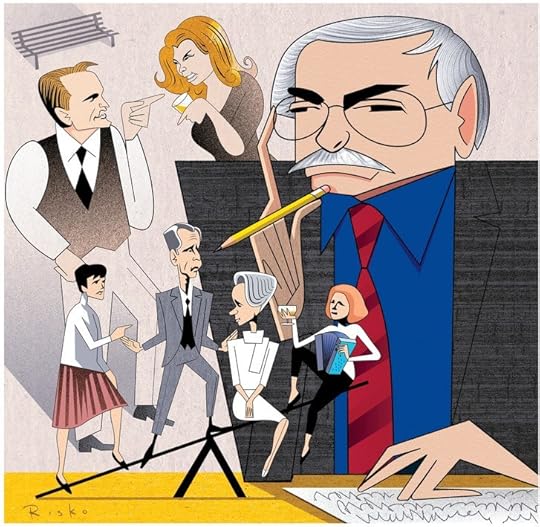
Its characters maintain a delicate balance between self-destruction and survival when a bitter 36-year-old daughter returns home to the family nest after the collapse of her fourth marriage. The much wed Julia shatters the uneasy peace of her long-married parents, Agnes and Tobias, and their permanent guest — acerbic, unpredictable, and witty alcoholic sister-in-law Claire. When two lifelong friends gate-crash this impromptu reunion, the masks of civility drop and raw feelings emerge. Filled with shades of meaning, subtleties, and whole paragraphs of brilliant dialogue, A Delicate Balance has become classic theater, a timeless mirror of the worst, and sometimes the best, aspects of modern life.
Noted American playwright Edward Franklin Albee explored the darker aspects of human relationships in plays like Who's Afraid of Virginia Woolf? (1962) and Three Tall Women (1991), which won his third Pulitzer Prize.
People know Edward Franklin Albee III for works, including The Zoo Story, The Sandbox and The American Dream. He well crafted his works, considered often unsympathetic examinations of the modern condition. His early works reflected a mastery and Americanization of the theater of the absurd, which found its peak in European playwrights, such as Jean Genet, Samuel Barclay Beckett, and Eugène Ionesco. Younger Pulitzer Prize-winner Paula Vogel credits daring mix of theatricalism and biting dialogue of Albee with helping to reinvent the postwar theater in the early 1960s. Dedication of Albee to continuing to evolve his voice — as evidenced in later productions such as The Goat or Who Is Sylvia? (2000) — also routinely marks him as distinct of his era.
Albee described his work as "an examination of the American Scene, an attack on the substitution of artificial for real values in our society, a condemnation of complacency, cruelty, and emasculation and vacuity, a stand against the fiction that everything in this slipping land of ours is peachy-keen."
Many of my friends who inhabit the theatrical world view Albee's A Delicate Balance, as his finest work. For me, it is a difficult to chose between this and Who's Afraid of Virginia Woolf. Both are towering achievements, both are brilliant, both are riveting pieces of theatre, and yes, both are flawed. There is something so intriguing about A Delicate Balance. It is a mix of Coward's comedies, Hellman's realism and Pinter's absurdism, which are ultimately reconciled in the dazzling word play Albee is best known for.
A Delicate Balance is probably the closest piece to Chekhovian drama Edward Albee has written. We begin with a large house that is slowly filled during the play with various family members and friends, and then, at the end, is slowly emptied of them again.
The characters in A Delicate Balance speak with the witty banter of a drawing-room comedy, but Albee takes these people to the very edge and forces them to look deep into the abyss. Edward Albee’s script is laden with insight, wit and touches of poetry. There is so much to dig into here for both actors and directors, and the audience is richly rewarded in turn. A Delicate Balance is an absorbing and illuminating experience in the theater from a master playwright.
This play reminded me of Who’s Afraid of Virginia Woolf for all the obvious reasons—the biting sarcasm, the viciousness lying just below the surface of the faux pleasantries. The scope of the discomfort is a bit broader in this Albee play, though. Instead of the focus being solely on the married couple, other bystanders get sucked into the fray. There’s even a slap across the face in one scene, which is something I always get a kick out of. Face-slapping scenes are the best, aren’t they? Sometimes I’ll tune into a soap opera when I’m home sick just to see if any faces are being slapped.
I’m not sure who Harry and Edna are meant to represent. Probably they aren’t meant to “represent” anyone and I’m just being overly analytical as usual, but their presence in the play and their bizarre interactions with Agnes and Tobias are just a trifle too…weird…not to possess some sort of subtextual meaning. Plus, with dialogue like “for fear of looking into a mirror” and “our lives are the same,” I had to wonder whether Harry and Edna aren’t mere extensions of Agnes and Tobias themselves.
Oh, you were expecting something deeper than that? Sorry, but that’s as far as I got. This ain’t AP English class, kids.
I’ll be seeing this play on Broadway next month with some fellow Goodreaders. Glenn Close and John Lithgow will be assuming the roles of Agnes and Tobias. I think Glenn Close will make a great Agnes, too—being subtly antagonistic toward her fellow characters on the one hand while on the other trying to maintain a sense of order in a life that seems to lend itself only to chaos. It’s as though a school of hungry piranhas were threatening to close in on her and it’s her job to prevent a feeding frenzy while simultaneously keeping at bay the anxiety that gnaws at her from within.
Inspired by Albee's memories of his grotesque parents and drunken aunt, living in suburban luxury, he becomes stylized with a hint of Pinter and introduces a neighbor couple who seek refuge because of an unknown "threat." In this play about Nothing, Albee punctuates his themes of loneliness & refined confinement with savage talk. A lot of brandy in a dribble glass.
Very good writing. I disliked all the characters. I didn't know what the play was about, which is OK, but a critic's blurb on the cover stated it was about the nothingness in our lives. It did have that 60's, nihilistic, hopelessness feel to it, which I often like (Heller, Vonnegut), but these characters annoyed the crap out of me and made me want to suggest they get hobbies or go for a bike ride. Something.
A truly clever play! M-a cucerit pe deplin. M-a atras nebunia lor. M-a fascinat pur și simplu.
Agnes și Tobias, un cuplu de vârstă mijlocie, trăiesc într-o casă unde calmul și ordinea par să fie regulile supreme. Alături de ei locuiește Claire, sora nonconformistă a lui Agnes, mereu gata să tulbure liniștea. Echilibrul precar al familiei este pus la încercare atunci când prietenii lor apropiați, Harry și Edna, vin să se refugieze acolo, cuprinși de o teamă inexplicabilă. Tensiunea crește și mai mult odată cu reîntoarcerea Juliei, fiica lor, proaspăt divorțată. Dincolo de politețuri și convenții sociale, ies la suprafață angoase, frustrări și spaime, iar spectatorul rămâne martor la fragilitatea relațiilor și la iluzia stabilității.
Nebunia personajelor lui Albee este, de fapt, nebunia noastră. A mea, a ta, a tuturor. În A Delicate Balance Albee demonstrează încă o dată cât de fragilă este existența și cât de ușor se clatină echilibrul pe care credem că îl avem.
TOBIAS: DO YOU HEAR ME?! YOU BRING YOUR TERROR AND YOU COME IN HERE AND YOU LIVE WITH US! YOU BRING YOUR PLAGUE! YOU STAY WITH US! I DON’T WANT YOU HERE! I DON’T LOVE YOU! BUT BY GOD … YOU STAY!!
my thoughts on "a delicate balance" or what's the problem with rich, white, and privileged americans 101 by edward albee...
this play started off as very confusing for me as it startled me as a reader through its unconventional dissection of the storytelling and narrative progression. that was something unique i found at first until i read the whole play. this is the first time i have read albee and it was breathtaking, heart-stopping reading experience. i didn't expect what was in the end. it also looked like darren aronofsky slightly copied this element for his film, "mother!". this play started out as a satire of rich, white american's lifestyle surviving through chaos and their careless indifference to their own family members. that was ruthlessly portrayed in this play. but if it's not that, then albee has ingeniously fooled me. also, i want to say something about the third act of the play which is all about late realisations about their mistakes. it also has a structures of tobias which has immortalised the play in my honest opinion. that scene is alone classic, unique, and bloody brilliant.
now, about the characters. overall, claire's character stands out as a mighty character who stands against the supposedly patriarchal oppressive structures. some might find her character as an obnoxious one but she is a very different character from the others and that's something extraordinary in this play. she singled out herself as a sane woman by pretending as an 'insane' one. she is like 'the joker' who just wants to watch the whole world burn. but, in the end, you feel simultaneously pity and sympathy for each and every characters. this play's triumph is to carve out the raw human behaviour through the inconsistencies of human nature. this is something that blew my mind away, completely.
two grand american plays back-to-back. awesome, awesome experience!!
CLAIRE: (Takes the glass.) It's only your daughter. Thank you. I should imagine--from all that I have...watched, that it is come-home time. (Offhand.) Why don't you kill Agnes?
TOBIAS: (Very offhand.) Oh, no, I couldn't do that.
CLAIRE: Better still, why don't you wait till Julia separates and comes back here, all sullen and confused, and take a gun and blow all our heads off? Agnes first--through respect, of course, then poor Julia, and finally--if you have the kindness for it--me?
TOBIAS: Do you really want me to shoot you?
CLAIRE: I want you to shoot Agnes first. Then I'll think about it.
I liked this more than I thought I would, you can really see a shift between the slightly more realistic 'virginia woolf' stuff and the weird later 'seascape' stuff. I really like that the plot is set in motion by the couple arriving simply because they are 'afraid'. That he doesn't feel the need to explain this. It's an important thing to realize, that you can just include a plot development like that and it doesn't require an explanation.
Edward Albee is one of my favorite playwrights, and this play does not disappoint. The story involves an upper middle class, dysfunctional family that begins to crumble as the weight of alcoholism, divorce, age, and fear becomes too much for their already shaky home to stand. Albee's use of humor is subtle, but brilliant, and the drama cuts deep to something very personal in the reader. It is very deserving of the Pulitzer Prize and the Tony Award.
If you like your plays full of self-obsessed, pitiful drunks, whining about the nothing was of existence and tearing each other apart with sarcasm, then you'll love this play.
This is an intriguing, dramatic and funny play. There is a word for that- tragicomedy.
On the surface, we have some fierce fighting, after all, there is even a pistol pulled out.
But underneath, together with the undertone of desperation, we could laugh at some of the things these people do.
First of all, we have a family, with Tobias and Agnes the father and mother of Julia. In the same household lives Claire, Agnes’ alcoholic sister.
At the beginning of the play, Agnes is already complaining about her sister’s permanent presence in the house.
And to add insult to injury, another couple arrives, two “friends”- Harry and Edna.
They arrive unannounced, in what seems like a piece of absurd drama. They feel some anxieties, fears and decide to come, lock, stock and barrel at their “friends’ house”.
Not only that, but Edna starts ordering Julia about:
- Make me a cocktail…oh, and why don’t you stop with your love life complications…
- How dare you…
This is not the exact dialogue, but the point is that Edna is driven into a fit and gets crazy.
And I mean she has all the right to be mad at the situation, the “friend” and others involved in this outrageous occupation of her room, private space and feelings.
One is tempted to say: incredible
But I say to you it is possible- I experienced an outlandish situation this summer, with a small guy landing on my couch- demanding “Ice-cream!!”Not with please or anything of the kind. He did not say hello up to the very end of his stay and got an iPhone in the process, from my wife (with whom I am no longer on speaking terms because of that, and more).
In other words, fucked up complications arrive in life, just as you say:
- I can’t believe this is happening to me.
Harry and Edna are no real friends. Not in my view, and I think of a short story by Thomas Mann, where a personage is calling into question the ease with which we say
- I love you, you are such a great friend- words cannot express it.
- This is nonsense, says that wise man:
- words like love, friend and more- mean such wonderful things that we do not see them in real life- we just say big words, without much to back them
The same goes for these guys: for how can you come at the door of friends, move in and take over the running of some things, just because you say you are “friends”.
Oh, I forgot- Edna uses another argument- that they are also godparents to Julia and therefore entitled to various privileges.
This edgy state of affairs brings out some other issues and characters are forced to choose between friends and family
- they brought with them the plague, says Agnes
- Tobias, you have to make a decision
- Why? They are our friends…
The version that I have listened to is an adaptation for Romanian National Radio, with the magnificent George Constantin, the best we ever had, and on a par with de Niro, Nicholson, only he did not come to Hollywood.
Needless to say, George Constantin brought this play to a higher, wonderful level.
"We do what we can...we keep it from falling apart"
Honestly, I could write essays and essays about this play and I've spent probably too much time trying to figure out how to write this review. I first saw a production of it about six months ago and I've been preoccupied with it since then - running so many of the lines through my mind so regularly. I've only recently purchased and read it, but having it in print has only made my attachment more intense. It's been a long time since I've come across a work I've felt so in tune with.
There's a good amount going on and what I've had difficulty doing is boiling it down into a concise couple of paragraphs (that's not to say that this play is particularly difficult - if there is any fault it may be that the lines are a little too on the nose from time to time - but it tackles a number of interrelated ideas/themes through a series of interrelated relationships), but what I will say is that it's definitely a worthwhile watch/read.
A wonderful play. It's long but gripping. We read it in our playreading group. Despite the length (the play is "talky", and despite our readers who are hardly real actors, attention was rapt throughout. This play deserved the Pulitzer that it won in 1967. (In my book, not every Pulitzer prize winning play merited that honor.) These points notwithstanding, I gave the play 4, not 5 stars, because its literary merits, which deserve 5 stars, appeal predominantly to the intellectual.
Interesting that Marian Seldes, who starred in the play's premiere, died this week.
The play is existential. Though it is existential in a neo-existential way, meaning this play is often funny and engaging in a visceral way, rather than a purely intellectual exercise, it brought to mind the final line of Sartre's play, "No Exit": "Hell is other people." Albee's play examines the ties that bind, stressing loyalties, not frailties. It is an intriguing look at human behavior in the modern world.
Albee’s first Pulitzer Prize. Some argued at the time that the play was “Who’s Afraid of Virginia Woolf” unsexed and with its mouth washed out with soap in order to win over the Pulitzer committee (which shockingly passed over “Virginia Woolf” a few years before) and there are certainly elements of the plays that call each to each, but this is a much more ambitious, philosophical, even metaphysical work. Absurdist drama of the highest order, a black comedy sparkling with stinging wit, gorgeous flights of language, and hot flashes of existential panic. One of Albee’s greatest, which means one of the greatest, period.
Alluding to it's timelessness Albee is said to have changed only 2 lines before the 1996 revival. Though well struck, the play, as a whole, is dead; a post War, WASPy, booze-soaked relic of the past. A cocktail period piece that barely has the legs of a good chapter or two of Updike or Cheever; though Parker Posie was born to be cast as Julia and Shirley Maclaine would be a pitch perfect Claire.
If it's an untimely guest you're after, stick to Godot. Otherwise, Journey remains the singular American "family" drama.
The first new Albee I have read since Three Tall Women, this Pulitzer Prize-winner is characteristic of that subtle, unsettling style of Albee's; the one that seems to surreptitiously, subconsciously strip you of all defenses. His mastery of use of complex language to elicit the rawest of emotion is retroactively indicative of all his proceeding work, and just goes to show how true talent never fades.
Albee is one of the best contemporary playwrights out there, if not THE best, and this is the best of the best. You should absolutely read or see Who's Afraid of Virginia Woolf, since that is known as his magnum opus, but I think this is actually a better play. It's beautiful and haunting and thought-provoking and touches on grand, universal themes yet holds Albee's originality.
Bunch of annoying and despicable characters arguing.
Along the lines of Who's afraid of Virginia Wolf, Albee dedicates an entire play about absolutely nothing. Only that this is repetitive and tad boring.
Rather tame. Some strong moments, Tobias is definitely the highlight here, and I enjoyed the feminist discourse, but a step-down from Who's Afraid of Virgina Woolf?
According to the cover quotes, many consider this Albee’s finest work, but I prefer Zoo Story and Who’s Afraid of Virginia Woolf far more than this one. This play focuses on a upper middle class couple (Agnes and Tobias), their alcoholic sister (Claire), their daughter Julia (a serial divorcee), and their best friends Harry and Edna. The play unfolds over a three-day period where they trade barbs with each other about their dysfunctional lives, and the stifled existences each of them have been living. The play hints at a shared dark past between Harry and Edna and Agnes and Tobias, but never goes beyond mere intimations. As a result, I didn’t find the play satisfying, nor engaging. The tension that bubbles up within their arguments lack any depth without more details emerging. I felt too removed witnessing this not-subtle critique of suburbia.
I came across this play in my Theater course in college this semester. The one thing that struck me throughout the play is the uneasiness between Tobias and Claire. A critical reading of the play and after much discussion with my professor, the scenario was clear- Claire is a rape victim and the "common" aspect between Tobias and Harry that Claire tried to point out is is practically this. The phrase "hot and wet July" made me think constantly about it and gradually the horrific aspect underlying the precariousness in the household was unveiled. Also the repeated sarcastic inquiries by Agnes from both Claire and her husband also redirects us to the haunting reality of the "hot and wet July".
A brilliant piece of work by Albee, the play creates a silent uneasiness in the spectators and brings them close to the dark phenomenon of going insane.
bleak. depressing. I ran lights for a production of this play and halfway through the run one of the actors mentioned how draining it was to play, night after night, such an unhappy character in a play that is so tense from beginning to end.
excerpt:
“Time.
Time happens, I suppose.
To people. Everything becomes…too late, finally. You know it’s going on…up on the hill; you can see the dust, and hear the cries, and the steel…but you wait; and time happens. When you do go, sword, shield…finally…there’s nothing there…save rust; bones; and the wind.”
I saw the play and became interested in reading the script directly. I read a couple of other plays by Albee while I was at it. I loved the play performed and would like to see other versions of it but perhaps I will not re-read it. It has been awhile since I read this but I recall finding it somewhat challenging reading desperate people who keep talking about themselves. But the experience of friends who fled from their house or the man and his cat all seem real to me when I saw the play performed and in a way more intimate when reading it.
This makes for a pretty horrible reading experience with so many stage & character directions, but it's a potent, and masterfully written, play. There's a lot to unpack. I like the underlying thread, which to me is: what are the invisible boundaries in all of our relationships? what happens when we push past them, past comfort? what does it mean to be comfortable? what is hospitality? and what is owed?
I can't say I found the play particularly moving, or that I'd recommend it, but I'm glad to have read an important part of the canon.
This play seems rather typical of the period for which it was written. A bit boring by today's standards and I think that even a remounting would have to be seen as a period piece rather than a current look at human behavior.
I wouldn't mind seeing a brilliant, current production, by I can see where I might easily be bored by a less than stellar performance. A good director will keep the humor out front and the drama, biting at the edges.