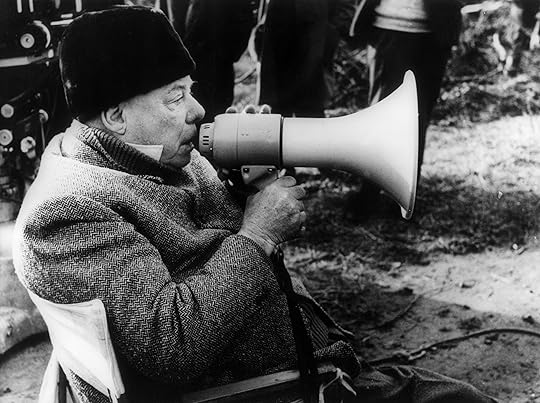
'Jean Renoir by Andre Bazin is the best book on the cinema, written by the best critic, about the best director. . . If this beautiful book is unfinished, consider it unfinished in the manner of A Day in the Country, which is to say this it is sufficient to itself and, even in its fragmentary state, the finest portrait of Jean Renoir ever written.' --- Francois Truffaut
Writings of French critic and film theorist André Bazin influenced the development of cinema of New Wave.
André Bazin founded the renowned and pioneering journal, Cahiers du cinéma.
Bazin saw and argued to depict "objective reality," such as documentaries of the Italian neo-realism school and "invisible" directors, such as Howard Winchester Hawks. He advocated the use of deep focus as George Orson Welles and wide shots as Jean Renoir "in depth," and he preferred "true continuity" through mise en scène over experiments in editing and visual effects. This preference placed him in opposition of the 1920s and 1930s to those who emphasized ability to manipulate reality. Theory of Bazin to leave the interpretation of a scene to the spectator linked the concentration on objective reality, deep focus, and lack of montage.
Bazin thought to represent a personal vision, rooted in the spiritual beliefs, known as personalism, of a director. A pivotal importance of these ideas on the auteur; François Truffaut in 1954 wrote the manifesto "A Certain Tendency of the French Cinema," article in Cahiers. People also know Bazin as a proponent of encouraging only "appreciative," constructive reviewers.
After World War II, Bazin, a major force, studied. He edited Cahiers until his death, and people then published a posthumous four-volume collection, titled Qu'est-ce que le cinéma? (What is Cinema?), to 1962. In the late 1960s and 1970s, people translated two of these volumes, mainstays of courses in the United States and England.
In response to widespread dissatisfaction with existing English translations, Caboos, the publisher of Montréal, in 2009 brought out a translation of selected essays from What is Cinema?
“For Renoir, what is important is not the dramatic value of a scene. Drama, action-in the theatrical or novelistic sense of the terms are for him only pretexts for the essential, and the essential is everywhere in what is visible, everywhere in the very substance of the cinema.” (32)
“The freedom of this construction, the contempt for dramatic and psychological verisimilitude, are the height of realism in the sense that Renoir, instead of taking the usual path from the idea to a simulated reality, imposes the idea by departing from reality. It is through Renoir's love, his sensibility, his intimacy with objects, animals, and people, that his moral vision confronts us so strikingly. With Renoir a swallow is enough to suggest spring.” (107)
“A Renoir film identifies itself instantly: the sensuality, the sense of happiness with its sharp counterpoint of skepticism and irony, but a smiling skepticism and an irony without bitterness. Cruel sometimes. but only out of tenderness. Its cruelty is objective; it is nothing more than the acknowledgment of destinies at odds with happiness, the measure of a love without constraint and without illusion. Its sympathy always goes out to the victim. Renoir has a sense of the tragic, but he does not dwell on it; not because he does not respect it, but because the only way to overcome destiny is to believe in happiness in spite of it.” (108)
“The entire work of Jean Renoir is an ethic of sensuality; not the affirmation of an anarchic rule of the senses or of an unrestrained hedonism, but the assurance that all beauty, all wisdom, and even all intelligence live only through the testimony of the senses. To understand the world is above all to know how to look at it and to make it abandon itself to your love under the caress of your eye.” (146)
This is a perceptive, frustrating book. It's a major work on Renoir, but it is daunting because Bazin's approach is so intellectual that you hunger for some examples of what he's talking about, just so you can get your hands around it. I recommend it to fans of Renoir, or at least people who have seen some of his films, but it is not a good place to start. The best place to start is with Renoir's films, and the Criterion DVDs and blu-rays are the best, especially because they give you a lot of supplemental material. If you want to see what all the fuss is about, I suggest sitting down and watching Grand Illusion. Then watch it again. If you go to the LA County Museum of Art, be sure to see the portraits of Jean painted by his father, Auguste. Here's a web page that offers you a slide show of Renoir's works; slides 3 and 9 show Jean. Now there's a talented family.
Pros franceses que escreveram esse livro, excetuados alguns filmes mudos de Renoir que são elegantemente camuflados, todo filme de Renoir é uma obra-prima, moderno e muito à frente do seu tempo. Jean-Luc Godard chega a dizer que Renoir é o mais inteligente dos cineastas, o que significa dizer que ele é francês até a ponta dos dedos dos pés. E que Elena et les Hommes é o mais inteligente dos filmes porque é o mais francês dos filmes.