Aftab, a young Kashmiri boy, leads a double life. By day, he is a normal, bubbly teenager whose prime concerns are cricket, family and friends. The night holds the secrets of the life of a child who sneaks away to confabulate with Akram and his fledgling group of tearaway terrorists. Akram—so handsome, so exciting. But what Aftab doesn’t realise—so dangerous. Aftab is in complete awe of Akram and is willing to follow him to the end of the earth. And Akram is more than willing to send him there...
Paro Anand is the author of 18 books for children and young adults, including plays, short stories, novellas and novels. She is also published in several anthologies and has written extensively on children’s literature in the country. She headed the National Centre for Children’s Literature, The National Book Trust, India, the apex body for children’s literature in India. As a part of her work here, she set up libraries and Readers’ Clubs in rural India and conducted training programs on the use of literature.
She is a World Record Holder, for helping over 3000 children make the World’s Longest Newspaper (850 meters long) in 11 Indian states in 13 languages. The concept behind the project was to give a voice to those children who do not have a platform and to empower young people to create their own literature.
Paro Anand has been awarded for her contribution to children’s literature by The Russian Centre for Science and Culture. Dr. Kalam, the President of India, honored her for her writings on Republic Day, 2007. She has represented the country at various forums internationally, including in the UK and France.
She is a performance storyteller and has performed her stories in many parts of India, UK, France and Switzerland. She runs a program, Literature in Action on the use of stories in the holistic development of young people. She was part of an Indo-Swedish workshop and has co-authored a book for teenagers with special needs, with a Swedish writer.
She has been a resource person with the Rajiv Gandhi Foundation, working with children impacted by terrorist, separatist violence in Kashmir. Coming out of her experiences, she has written No Guns At My Son’s Funeral, a book that has had extensive critical acclaim. The book was nominated onto the IBBY Honor List, 2006, as the best book for young people from India. It is currently being translated into Spanish and German and talks are on for basing a film on the book. The book is about a young boy, seduced into becoming a terrorist. A follow up novel, also based in Kashmir, entitled Weed is the story of the son of a terrorist and his struggle to find an alternate life to sustain himself and his family.
She was a writer-in-residence at the Woodstock School, Mussoorie, India where she worked on writing her first novel for adults.
On the face of it, the story is heart-wrenching, too cruel, but in the way the best of them are- breaking your heart, giving you hope and then breaking it again. But, the more you dwell on it, long after it's finished, the more you become aware of all those loose threads, that restraint on part of the author that shouldn't have been there. At best, it's a very brave and daring attempt. But it misses on a lot more.
What a remarkable book, with a dagger-sharp climax that will pierce your heart! No Guns at my Son’s Funeral, written by Paro Anand, is a heart-wrenching story of a young boy living in Baramullah, Kashmir, who fell into the trap of terrorism.
Hate, love, despair, and fear are constant companions during this novel. All the details are intricately and beautifully added into the storyline which provides this book completeness. The tense setting does not provide the calmness that one is used to despite there being a homely and warm plot in the story.
This is a very subtly plotted story. The story is properly structured; it has a well-established and explained beginning, a rising action leading to the climax, and finally the falling action followed by a resolution that justifies the book’s title. This book is suitable for teenagers as well as adults.
This book shows how innocence gets gunned down. Literally GUNNED DOWN. Kinda like The Boy In The Striped Pyjamas, which also, you know, stabs right at the heart of innocence. Although they are both heartcrushing in different ways.
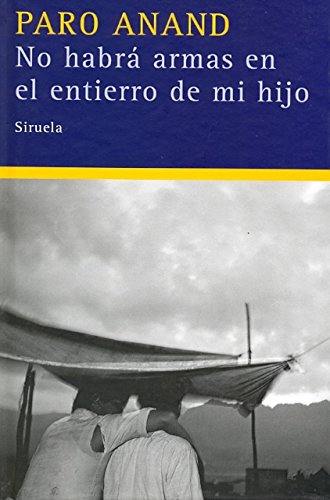
That title is such an eye-catcher. And that cover really appeals to me. So simplistic and kinda raw.
I like books that can have mature discussion of serious topics. I think that there should be more YA(ish) books about the situation in Kashmir. I think that terrorism is something that needs discussion. I liked that this book didn't *really* take sides, but showed the multi-faceted aspect of something terrible. I was in kashmir recently as a visitor, and I was glad that I could get a little piece of understanding of what has happened there in the past (because in the streets of Srinagar, it isn't very obvious, though there is army everywhere) Sadly though, the writing in the book was terrible. For one thing, there were three characters with very similar names (Angad, Akram, and Aftab) For another thing, there were no indications of time of space or place. The viewpoint kept switching without indicating who was telling the story. The plot was fairly predictable. Nothing really surprised me except Shazia. It could have been longer to show the characters develop, because that didn't happen. It had no depth and complexity, and the writing was confusing the entire time. I wanted to like this more than I did. The writing stole the value the story had on it's own.
What a sweet, tender and pure book. A short read, this was definitely an interesting insight into the lives of Kashmiris. Looking forward to reading more books of Paro Anand.
Payal Dhar reviews the book on Goodbooks: "Most children learn about war and conflict either from fiction, from their curriculum or from the media. All of these are highly subjective sources. In the first instance, since the plot itself is likely to revolve around defeating an enemy, the lines between good and evil are very clearly drawn. Textbooks and the media too provide a skewed version of events, depending on whose side they are on. Take Kashmir, for instance, where Paro Anand’s No Guns at My Son’s Funeral is set. Media coverage on the issue in India is one-sided and jingoistic. Propaganda disguised as news paints the militants as the evil ‘other’, even as the military has state sanction to do exactly what the militants are vilified for. Meanwhile, common people are caught up in the mess and swept along, forced to take sides whether or not they want to. And children, impressionable and keen to take their place in the order of things, are among the most innocent targets." Click here to read the full review: http://goodbooks.in/node/7255
Aftab is a young Kashmiri boy with stars in his eyes, only not the kind you'd expect from regular 12-year-olds. For the man he idolizes is a dangerous militant who goes by the name of Akram Raza. Aftab worships the ground Akram walks on and hangs on his every word. He will do anything to prove himself a worthy protégé. He scoffs at his parents’ yearning for peace and is steadfast in his conviction that freedom will have to be fought for, a conviction both lit and stoked by Akram’s influence and some Bollywood!
No guns at my son’s funeral, is a heart-wrenching story of Aftab a Kashmiri bubbly teenager. In mornings he is a normal kid playing with his friends, drinking chai his mother made for him, but, little did they know that he led a double life a dark life in night. Akram, handsome and genius, at the same time very dangerous militon and Aftab’s admiration and idol. Aftab was awe of his schemes and ready to follow him to the end of earth and Akram is more than willing to send him there. This story follows a child’s view towards terrorism tied between following his idol’s footpath and his lovely relationship between his family & friends. In the world of Akram’s Kashmiri Action Group- a militant group, there are no friends only foe. As a part of that group will Aftab chose the path his idol follows or would he remain a son/brother/ friend. This book was engaging from the beginning. Heart wrenching how the innocence of the children are used. Loved the way how that the children only wanted peace described in the book. However, I personally feel that this book could have been much longer, as it was a very small read. Also, I love the way how the book ended, though its heart wrenching, there could have been some explanations in the end. The author could have used less Hindi/Urdu dialogues, as many people wouldn’t understand what’s written. At the end of the day, this is a great read.
No guns at my son's funeral is a real time fiction about the happenings of kashmiri. This book belongs to a place where there is a violance. The book portrayed how the young boys are brainwashed to join the militon group and the impact on their family.
Aftab a 13 year old boy was bored of leading a normal , simple life in Kashmir. He meets Akram, a team leader of his own militan group called Kashmir Action Group. Akram makes him to be a part of his team. Aftab turns out to be a great fan of Akram. Akram's team member firoz got caught by the Indian army and taken into custody. From here on the story changes with a great twist. What happens to Aftab? Does he turned out to be a activist or caught by military?
In the world of the kashmiri militons death was another part of their life and there was no love great than the cause they lived. The young boys were brainwashed in that way to join their team. The terrorist groups pretend they have a cause, but they are only serving themselves ,using the civilians. The end will always be an unnatural death at early age for any terrorist.
Though the book is a slow start, it's a compelling story about kashmiri situation. Any book related to war or dispute, there will always be pain.
The story revolves around a young Kashmiri boy Aftab & his journey from an innocent little teenager to that of a wannabe militant. It portrays quite beautifully the contrast of the dual lives that many children & young adults in the valley live. Akram & Feroze are the two young inexperienced militants who decided to make a mark of their own & started recruiting young teenagers in order to train them. Aftab revered Akram as a mentor & would do anything for him without realizing that he might be just a pawn. What will happen when the Indian Army acknowledges the existence of this small group & makes it their mission to catch them? Read the full review on Just Another Bookaholic
A simple and powerful story about the tinderbox that is now Kashmir. A story about teenagers, probably intended for teenagers, it paints a graphic picture of the tough terrain and the tragedy of a lost generation.
Unfortunately, the Kindle edition is marred by poor editing and formatting. Hope an update with better readability is issued. But worth a read nevertheless.
I had the opportunity to listen to Paro Anand tell us how she wrote this story. I simply HAD to read it after that, but proceeded to avoid it for years.
Based in Kashmir, the story follows the journey of young Aftab. A sweet boy that walks grey roads. Heartbreaking, yet beautifully written.
Wanted to teach this to Grade 9 class - important messages and intriguing story. School decided it was too politically sensitive due to Kashmir/India conflict. Too bad.
"Tras este impactante título se esconde el estremecedor relato de Aftab, un adolescente del valle de Cachemira que se ha visto envuelto en un juego mucho más peligroso y complejo de los que hasta ahora estaba acostumbrado por su edad. Cuando el lector se incorpora al relato, hace un tiempo que Aftab ha conocido a Akram, un firangui, (un extranjero) como llama su madre a los que proceden de fuera del valle; aquellos a los que la misma achaca la situación de inestabilidad y violencia en la que está envuelta la región. Es Akram quien le enseña al joven cachemirí las diferencias existentes entre los habitantes de su ciudad, diferencias que él había pasado por alto hasta ahora, como que sus amigos de toda la vida sean de distintas religiones; es también quien le ha enseñado que hay que defender el valle de los Enemigos, el ejército, que están oprimiendo al pueblo y desangrando la nación. Es, en definitiva, quien le ha convertido en un terrorista sin que él se haya dado cuenta del todo. Esta historia plasma con crudeza pero mano firme una realidad que muchos conocemos por las noticias de televisión. Algo a lo que se tienen que enfrentar día a día chicos de nuestras edades que viven en condiciones mucho más desfavorecidas que la nuestra. => Sigue leyendo la reseña en http://www.eltemplodelasmilpuertas.com"
I love that a book for a younger audience tackles such a heavy topic. However, although all the characters were extremely interesting, the story did not build on any of them. They remained undeveloped. Additionally, the constant switching between the story's focus on the various characters didn't make sense in such a short book. I would have loved a longer book with a more developed characters.
A great piece of young adult from India. Paro Anand takes an engaging and important topic (recruitment of young people into terror cells) and makes it approachable for students. The character development and plot twists(!) make it fun to read.