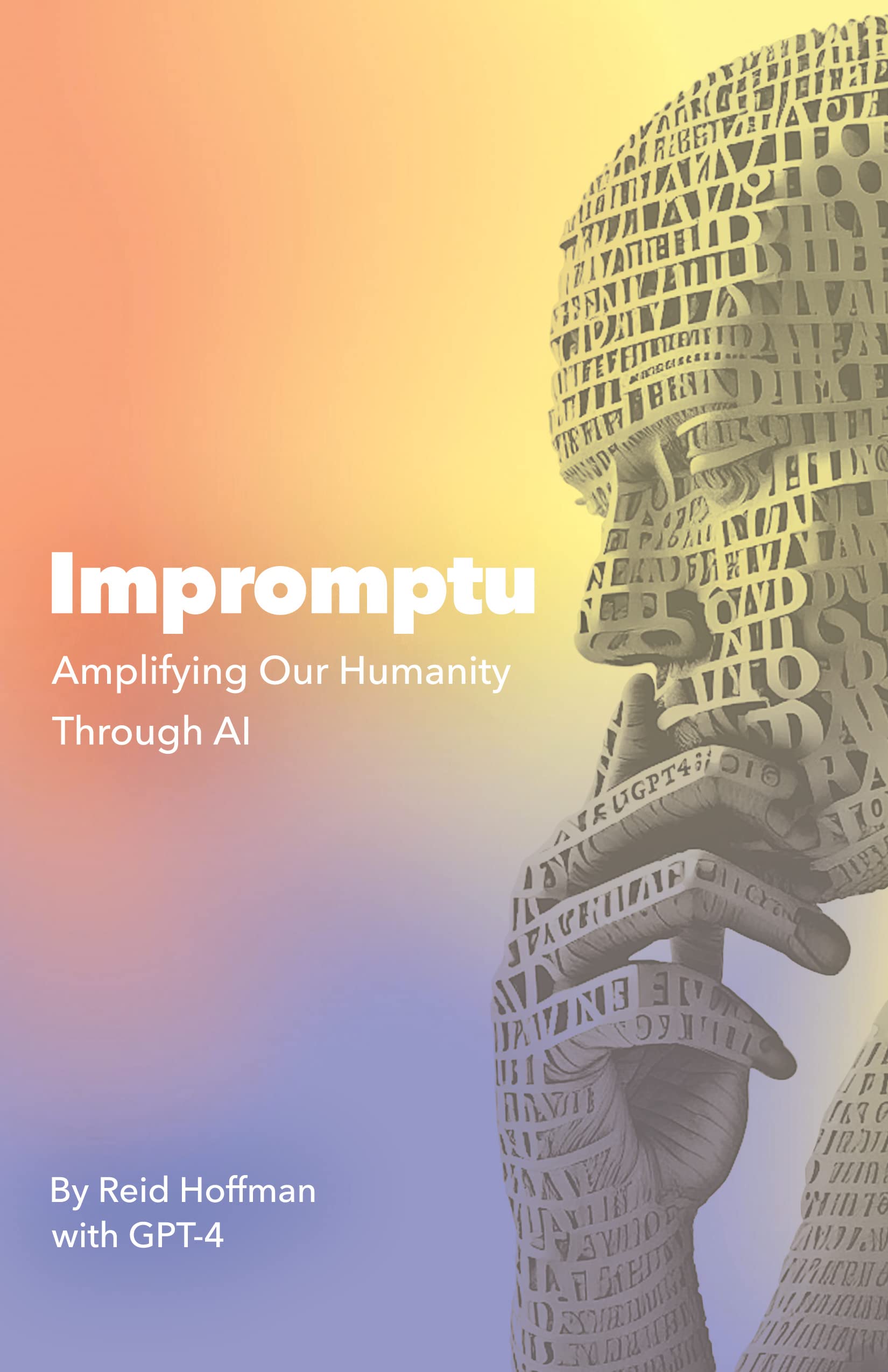
Impromptu: Amplifying Our Humanity Through AI
By Reid Hoffman
Book Review by Michael Attard
Reid Hoffman is an American internet entrepreneur, venture capitalist, podcaster, author and billionaire. He is the co-founder of LinkedIn, the business oriented social network. He is an unabashed believer in the potential of AI to not only create a better world but to spawn more enlightened humans. In his book, ‘Impromptu,’ he explains his reasoning and provides detailed statements created by Chat GPT4. In this review, I want to be as minimally technical as I can. But it is important to understand that GPT4 refers to Generative Pre-trained Transformer 4, which is a “large language model,’ created by OpenAI.
Hoffman points out that AI has been a part of our lives for a while, and this is readily seen in social media. “AI algorithms help tailor content and product recommendations to your own specific tastes.” Contrarily, algorithms can keep non-acceptable content at bay.
Throughout, he is careful to consistently present the possible cons along with the pros. The book as an exploration, or a conversation with GPT4, entertains various spheres of society and work. Areas of discussion include justice, journalism, social media, law, sales and management consulting. It did appear to me however, that many of the pros and cons offered by GPT4 were the same across the topics discussed.
Pertaining to justice, Hoffman wonders how AI could be used, “to give us more justice, not less.” For his inquiry, he chooses a relatively new tool which has been introduced into many law enforcement agencies. He asked GPT4: “How should we be thinking about the potential benefits and risks of body-worn cameras used in policing?” I found the response to be basic, certainly not profound. GPT4 responded that there would be, “improved transparency, accountability and trust between officers and the public,” etc. On the negative side there were “privacy concerns, data security issues,” etc. I do not really see anything new here.
A second point of discussion is AI and journalism, an industry whose business model has been brutalized by the internet and out-played by non-news players for advertising dollars. Hoffman asks GPT4 to “imagine that it is the year 2032, in the months leading up to the US presidential election.” Furthermore, GPT4 is to assume that fake news is everywhere: fake endorsements, false confessions, etc. The question then is, can GPT4 create a “travel advisory” for voters seeking news and information? The response included such statements as, “Do not trust any source of information without verifying its credibility … beware of holograms …. Use fact checking tools … and critical thinking.” My view is that as in the above discussion of justice, there is not anything new being presented.
Nevertheless, Hoffman believes that AI is here to stay and will progress from being useful to essential. He claims that AI will “leverage” some of our most significant technologies. He refers us to the introduction of the calculator in the 1970s. “Teachers and parents were alarmed.” And yet today, everyone recognizes that calculators, “are a critical part of math instruction.” A progression has gone from, “cheating to curriculum.” Time has been freed up to allow for a higher order of thinking.
With respect to regulation, Hoffman states: “I don’t think we have enough information and context yet, to determine what regulations we do need.” This is not to minimize risks but accepts that “technologies are never neutral.” Furthermore, he adds, “Zero risk is only possible in a world of zero progress.” His reasoning is similar surrounding the call to temporarily ban further AI development. “Holding AI algorithms … to error-free standards … will only prevent us from making real progress.” Instead, he offers that we should understand AI as a tool, “that requires human caution, curiosity and responsibility.” He believes that people need to choose to see AI as having human-amplifying abilities. Much easier said than done, I am sure.
One hot issue around AI for many people is the fear of losing their job to AI. Perhaps, somewhat dismissively, he says: “In the past it has always been breakthrough technologies that have created the jobs of the future – No different this time.” Following his line of thinking of AI as a tool, he does not see the replacement of search engines, but rather envisions new ways to gather relevant and useful information.
For Hoffman, AI will be a collaborative partner, not our replacement. He sincerely believes that AI is part of humanity’s progress. He even goes as far to say, “The people of 2060 will arguably be more human than us,” Let us hope so.
In conclusion, I do not see this book as a seminal work on AI. Rather it is a free-ranging discussion with demonstrations of AI as we can examine it today in its GPT4 form. Hoffman has started with a strong belief, and personally, I think that he is probably correct. But the easily readable book is more of an optimistic prediction rather than a deductive conclusion.