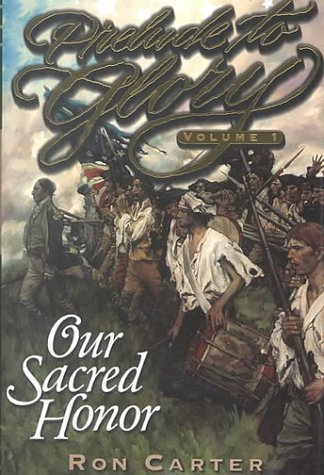
I liked reading about the American Revolution and being reminded of the amazing miracles of the events leading to our country's independence. I usually enjoy historical fiction and this book did help me think about what it would have been like to live in Boston at the time of Paul Revere and his midnight ride and put into context the sacrifices families and individuals made during a very uncertain time. These were incredible people with great courage and faith. I'm grateful for what they did and their examples for us today.
Although there were notes at the end of most of the chapters pointing out fact and fiction, I felt like there was too much fiction for me and some of the transitions and jumps in time were hard to follow. I think my next book on the Revolution will be non-fiction so I can get the real story better in the mind. I was glad that I read this book though. It did make me think about a very important time and wonderful selfless people who understood the importance of freedom and something bigger than themselves.
Here are a few of my favorite parts (most having to do with people in the book describing the miracles they saw through their sacrifice and hardships). These are fictitious characters, but I hope many of these sentiments were actually felt at the time.
"'I fear the cost we will pay--all of us--when we finally rise against them in the streets and in the fields. I see blood and tears in this land, and great sorrow lying like a dark cloud, and then a new land being born.' It was as thought his unexpected words struck into the very core of each of them. The strange, new spirit settled into the tiny, austere room, and it overwhelmed them, subdued them....It was coming, imminent, at the very door. There would be war. Blood would flow. Many would die. Their fair land would suffer much destruction. From the blood and pain and devastation would rise a new, shining land to take its place as a guiding star for the weary people of a tired and battered world. They knew it more than any other truth in their lives, from some unknown source they dared not challenge, nor could they explain....We have work to do (p. 139)."
"So far this thing with England has been mostly talk, but today it could have become more than that, and I realized something. Some of us could be killed. Is it worth it (p. 142)?"
"I don't know where it will end, but I don't need to know. It is enough that I know we must do this thing, by treaty if we can, by blood if we cannot. I don't want to die. But if I must, I will, and I know in my soul that if that happens, you will be all right, you and the children. Don't ask me how I know. Only that I do know (p. 190)."
"Women bear sons and sons leave them to go to war--what causes war? They start in someone's heart--change human hearts--that's the answer. Too hard to change hearts--we push it away--too hard--easier to kill each other than change our hearts--Christ tried to teach us--crucified him--easier to crucify him than change--how many times have we crucified him since? ten thousand? ten million (p. 230)?"
"John looked more deeply into his son than ever in his life and spoke with measured words. 'Yes. We're where we belong, doing what must be done. This is in the hands of the Almighty.' 'The killing--those dead men--are part of God's work?' In his mind he was seeing men who had fallen, arms and legs thrown at odd angles, mouths loose and open, eyes wide, flat, dead. Men who had had wives and children, who only moments earlier had been alive, with hopes and dreams, joys and sorrows. He saw no glory, nothing noble. 'Yes. So was the death of his Son (p. 283).'"
"'I did not find those shoals alone, sir.' None of them knew or cared how long they sat thus, awed, humbled by their frank confessions and the profound implications of what had been said. 'I don't think I'm religious. I've never talked about such things much--it's just that since the colonies broke with the British, things have happened that don't make sense....something's stirring. I can't explain it (p. 440).'"
And this is definitely fact and such a wonderful document:
"In Congress, July 4, 1776. The unanimous Declaration of the thirteen States of America.
"When in the course of human events, it becomes necessary for one people to dissolve the political bands which have connected them with another, and to assume among the powers of the earth, the separate and equal station to which the Laws of Nature and of Nature's God entitle them, a decent respect to the opinions of mankind requires that they should declare the causes which impel them to the separation.
"We hold these truths to be self-evident, that all men are created equal, that they are endowed by their Creator with certain unalienable Rights, that among these are Life, Liberty, and the pursuit of Happiness. That to secure these rights, Governments are instituted among Men, deriving their just powers from the consent of the governed.
"That whenever any form of Government becomes destructive to these ends, it is the Right of the People to alter or to abolish it, and to institute new Government, laying its foundation on such principles and organizing its powers in such form, as to them shall seem most likely to effect their Safety and Happiness.
"We therefore, the Representatives of the united States of America, in General Congress, Assembled, appealing to the Supreme Judge of the world for the rectitude of our intentions, do, in the Name, and by Authority of the good People of these Colonies, solemnly publish and declare, That these United Colonies are, and of Right ought to be Free and Independent States.
"And for the support of this Declaration, with a firm reliance on the protection of divine Providence, we mutually pledge to each other our Lives, our Fortunes and our sacred Honor (p. 541)."