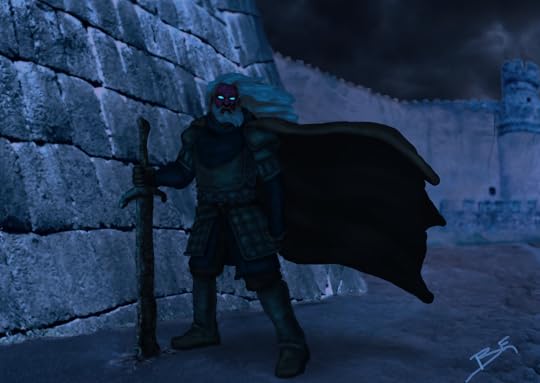
A Novel of the Malazan Empire, Ian C. Esslemont's Stonewielder is an enthralling new chapter in the epic story of a thrillingly imagined world that takes place in the timeline right after Steven Erikson's New York Times bestseller Dust of Dreams: A Malazan Book of the Fallen, left off.
Greymane believed he'd outrun his past. With his school for swordsmanship in Falar, he was looking forward to a quiet life, although his colleague Kyle wasn't as enamoured with life outside the mercenary company, the Crimson Guard. However, it seems it is not so easy for an ex-Fist of the Malazan Empire to disappear, especially one under sentence of death from that same Empire.
For there is a new Emperor on the throne of Malaz, and he is dwelling on the ignominy that is the Empire's failed invasion of the Korel subcontinent. In the vaults beneath Unta, the Imperial capital, lie the answers to that disaster. And out of this buried history surfaces the name Stonewielder.
In Korel, Lord Protector Hiam, commander of the Stormguard, faces the potential annihilation of all that he holds dear. With few remaining men and a crumbling stone wall that has seen better days, he confronts an ancient enemy: the sea-borne Stormriders have returned.
Religious war also threatens these lands. The cult of the Blessed Lady, which had stood firm against the Riders for millennia, now seeks to eradicate its rivals. And as chaos looms, a local magistrate investigating a series of murders suddenly finds himself at the heart of a far more ancient and terrifying crime--one that has tainted an entire land....
At the Publisher's request, this title is being sold without Digital Rights Management Software (DRM) applied.
IAN CAMERON ESSLEMONT was born in 1962 in Winnipeg, Canada. He has a degree in Creative Writing, studied and worked as an archaeologist, travelled extensively in South East Asia, and lived in Thailand and Japan for several years. He now lives in Fairbanks, Alaska, with his wife and children and is currently working on his PhD in English Literature.
Ian C. Esslemont and Steven Erikson co-created the Malazan world in 1982 as a backdrop for role-playing games. In 1991 they collaborated on a feature film script set in the same world, entitled Gardens of the Moon. When the script did not sell, Erikson greatly expanded the story and turned it into a novel.
Malazan Book of the Fallen by Steven Erikson is hands down my favorite series ever written, so I was pretty skeptical that more books written in the universe by someone would be anything better than "meh". But I have been pleasantly surprised by how well the first few Ian C. Esslemont Malazan books have been, including this wonderful entry.
If you were like me and didn't give the Esslemont books a try, you really need to give them a chance. They aren't the same level of depth as the Erikson ones, but they give a more compact story that has the exact same vibe and essential structure that makes Malazan books great.
Stonewielder does a wonderful job at putting you in an entirely new continent that simply nails worldbuilding. There are so many different aspects to this continent that are interesting, and every character arc that is presented is enjoyable. More than anything I enjoyed the depiction of the Stormguard, which for those of you not in the know, is a group who defends a huge wall against a race of beings who literally ride waves into combat.
I look forward to reading all of the Esslemont books, and remain thoroughly impressed by what he has done here.
“Burdens willingly taken on come to define the bearer.”
Stone me! This has proven to be rather unwieldy. Unwieldy, clumsy and cumbersome. In fact, reading the last two chapters was like hitting a stone wall. Repeatedly.
The previous novel of the Malazan Empire proved that Mr Esslemont has considerable skill in creating and controlling very intricate stories. Similarly to the Return of the Crimson Guard, Stonewielder sports a whole crowd of protagonists scattered across many seemingly unrelated threads. And while the author managed to keep everything in check, it was a near miss, not only because of the sheer number of individual stories, but also because some of them were hardly unique, as in: memorable, necessary and bringing something substantial to the tale.
⚔️ Bakune, Assessor of Bainith, a walking oxymoron (honest lawyer) and simultaneously a wrong man in a wrong place investigating weird murders against the interest of local coterie;
⚔️ Kyle and Greymane, though for the most part of the book we observe those through the eyes of other characters, most notably:
⚔️ Devaleth, a mage of Ruse (I wish I could write something more here, but a tattered sail has a more pronounced personality), and
⚔️ Suth who is just… um, Suth. Or whatever name you give to an archetypical trooper in the Malazan army;
⚔️ Rillish Jal Keth, an Untan noble and a friend of the Wiccans who thought himself retired, finds himself in the imperial service again;
⚔️ Lazar, Shell, Fingers, and Blues, a Crimson Guard commando on a desperate mission (tempted to say: suicidal? remember they can’t die so Mr Esslemont can exercise his cruel streak).
⚔️ Speaking of cruelty, there is also one Ussü, a mage without access to his warren forced to find alternative arteries of power;
⚔️ We also get to see the life on Stormwall in Korel (yay!) but if you hoped to see more of Iron Bars, abandon your hope. Instead, Corlo another member of the Crimson Guard will be our eyes there. Additionally, glimpses from the Lord Protector Hiam, and other of the Korelri Stormguard (Master Engineer Stimmis!) as we witness the struggle against the Stormriders;
⚔️ Ivanr, the famous champion of Toblakai heritage who decided to abandon war and become a pacifist gardener (you can imagine how well it went). By the way, if you think this theme is interesting you should read Pacifism by the charming professor Martin, who wrote this book and indeed become an academic because he had to prepare a defence for himself at the court when as a young man he refused to go to war for religious reasons.
⚔️ Woe is me, Kiska returns and is sent on a mission with a (not so) mysterious (for an attentive reader) henchman and (even less mysterious) mad priest of Shadow. (I beg you, the moment the word *giggled* was employed, his identity became painfully obvious.) We have whole passages of rumination on how the gal matured and outgrew the small island she’s been born on and then, as if these assurances (veiled apologies for the Night of Knives?) didn’t happen, she continues to be the very same idiotic and insecure creature hoping that by pretending a mysterious figure, her companions will take her more seriously.
These are the main ones; there are also other minor POVs and appearances, some curious some bizarre. Of those singled out above, the last two were particularly painful for me, and that was when the plot actually kicked in and started to roll.
And may, Mr Esslemont really needed the time to get these swinging. Three chapters in and these POVs felt like separate stories just conveniently cut into salami slices and randomly mixed with each other for no apparent reason whatsoever. Moreover, this slow coming together is further weakened by the fact that they run more parallel than towards a convergence. Indeed, for me there was no convergence per se; rather what happens in the finale is more akin to simultaneous micro bursts that to some extent coincide and overlap with each other. But this is far away from the orchestrated (to the smallest detail) perfection of Mr Erikson’s culmination points.
As if this was not enough, Mr Esselmont discovers that religion is a problem (how progressive of him) so you have the usual exposition of arguments against zealotry and some not very sophisticated observations on how what is true does not matter as much as what people believe to be the truth. Oh, and a case against special flakes (this I applauded) in favour of the ordinary who are asked to step in and to the extraordinary.
Put your gloves on, because the clawed hands are still present as are the tricks straight from an online course of creative writing (no, I have not taken one, I am making an uninformed guess). Like stating:
“After all, what could possibly be waiting for them here, in the middle of nowhere?”
Whenever you put something like that (granted, the ellipsis is missing so the ultimate kitsch has been avoided) you just know its the holy shit itself waiting.
In general, I had the feeling of being back in square one (that would be the first instalment in the series, ouch), which was a considerable setback after the previous book which was such an improvement, both conceptually and technically. The last two chapters were particularly painful to read, and then, even though I persevered, there was no ultimate prize. The whole Overlord gig left sour and curdled like milk after the expiry date, with only cursory explanations (why was the guy always so chilled?) and nothing beyond obvious revealed about the Lady.
There was even no meaningful death I could despair about!
I am definitely marking this book with a black stone.
"Run, little 'uns, run! The water comes to reclaim the land!"
Now this is the improvement and Ian’s work I really like reading. Work that reminds me of his Path to Ascendancy series. Pacing and structure, is still far from perfect, but for the most part Esslemont was able to handle the multiple plots pretty well, moving among them smoothly, with an ease, and balancing them quite good, actually.
The main story is on the island of Korel, famous for its Stormwall, with three factions fighting over dominance: Malazans, which are now divided among those that went rogue and those that were sent to deal with them; Stormriders, one more invasion army, consisting of sea-creatures that rise from the sea and The Lady, a Goddess who is trying to protect the island from all of them.
I really loved the story about the Lady and her possibly being a part of the Crippled God. As always, I enjoyed worldbuilding and getting to know more of the civilizations that lives on the shores of Korel, as well as those that assailed it. Great cast of characters. Having Malazan rogues, seeing their reasons for doing what they did – now that was interesting. Greymane is simply great. And some familiar faces resurface yet again, from both Malazan Book of the Fallen series, as well as Night of Knives, first book in the Malazan Empire series.
The other thing that I like with Ian’s work is that he takes parts of the Malazan world we haven’t had the opportunity to see while reading main series, and unlike with Erikson, Ian gets right to the point, which means there’s no five book introduction and exploration of the world. Now, if only prose could have been as good as Erikson’s, that would be delightful. Alas. But, readers who like big battles will not have to wait for too long. Battles are a plenty. Maybe too much. In my opinion, for sure.
All in all, now that I see Ian’s improvement with each book, I’m even more excited and looking forward reading next one in this series.
"Il vero male puro è lo spreco. È l'ottundimento del potenziale, l'interruzione della promessa o delle opzioni di sviluppo di una persona o di un popolo. È, emblematicamente, la morte di un bambino"
"E questo rende tutto ancora più difficile, no? Non essere speciale. Non avere quel segno buffo o quel presagio alla tua nascita. Solo una persona normale che ha chiesto di farsi avanti per fare qualcosa di straordinario".
"Allora com'era? Il tuo Warren. Oscurità. Rashan". "Non lo so", rispose Carfin, impassibile. "Era buio."
E' già trascorso un anno dalla battaglia tra la Lega Talian, la Guardia Cremisi e le forze Imperiali Malazan, eventi narrati nel romanzo precedente.
Per oltre cento anni l'Impero ha inviato le sue truppe e si è espanso su molti dei continenti conosciuti, ma da una di queste armate da oltre dieci anni nessun rapporto è più giunto. Una flotta Malazan viene quindi inviata a Fist, un luogo quasi inaccessibile e sconosciuto all'Impero, per riprenderne il controllo e scoprire cosa è accaduto loro.
A Korel le Stormguard, votate anima e corpo alla Beata Signora, da oltre 4.000 anni, inverno dopo inverno, proteggono con fede e coraggio lo Stormwall e le loro terre dagli attacchi dei Cavalieri delle Tempeste. Un gruppo di Guardie Cremisi guidate da Blues si avventura allo Stormwall in missione di salvataggio per liberare un gruppo di loro fratelli imprigionati. Ad ovest, nell'Impero di Jourilan, un "esercito" di ribelli e sfollati guidati da un sacerdote cieco è alla ricerca della libertà, la loro missione è spezzare il giogo imposto dalla religione della Beata Signora. Ad est l'assessore Bakune, nel regno di Rool, sta indagando su una serie di omicidi che sembrano avere uno schema preciso. Procedere nell'indagine cambierà la sua vita.
In questo terzo romanzo dell'Impero Malazan, Esslemont grazie ai suoi personaggi riesce a dare vita ad un intero continente con le loro storie e tradizioni, religione e fede, politica e lotte di potere, battaglie e onore, misteri e segreti, libertà e sacrificio. La natura umana con le sue virtù e debolezze è la protagonista assoluta. ll tono epico e drammatico.
Potete limitarvi a leggere le tante storie narrate separatamente, ma fermarvi a questo vuol dire aver intaccato solo la superficie della trama generale e vi precluderà di apprezzare appieno questo romanzo: queste storie sono collegate tra di loro da un sottile filo e i temi affrontati molteplici . Ogni storyline è un messaggio, un profondo inno alla natura umana e una volta chiarita la trama generale vi lascerà senza fiato nell'economia del ciclo intero Malazan.
Che altro aggiungere? un altro grandioso romanzo. Da leggere solo dopo i "Cacciatori di Ossa" e "Il ritorno della Guardia Cremisi".
----------------------------- "The true pure evil is waste. It is the dulling of potential, the interruption of the promise or development options of a person or a people. It is, emblematically, the death of a child"
"And that makes it even harder, doesn't it? Don't be special. Don't have that funny sign or omen when you were born. Just an ordinary person who asked to step up to do something extraordinary."
"So what was he like? Your Warren. Darkness. Rashan." “I don't know,” Carfin replied, impassive. "It was dark."
A year has already passed since the battle between the Talian League, the Crimson Guard and the Malazan Imperial forces, events narrated in the previous novel.
For over a hundred years the Empire has sent its troops and expanded on many of the known continents, but no reports have come from any of these armies for over ten years. A Malazan fleet is then sent to Fist, a place nearly inaccessible and unknown to the Empire, to regain control and discover what happened to them.
In Korel the Stormguard, devoted body and soul to the Blessed Lady, have been protecting the Stormwall and their lands from the attacks of the Storm Riders with faith and courage for over 4,000 years, winter after winter. A group of Crimson Guardsmen led by Blues venture to the Stormwall on a rescue mission to free a group of their imprisoned brothers. To the west, in the Empire of Jourilan, an "army" of rebels and displaced people led by a blind priest are seeking freedom, their mission is to break the yoke imposed by the religion of the Blessed Lady. To the east, Councilor Bakune, in the kingdom of Rool, is investigating a series of murders that seem to have a specific pattern. Proceeding with the investigation will change his life.
In this third novel of the Malazan Empire, Esslemont, thanks to her characters, manages to give life to an entire continent with their stories and traditions, religion and faith, politics and power struggles, battles and honor, mysteries and secrets, freedom and sacrifice. Human nature with its virtues and weaknesses is the absolute protagonist. The epic and dramatic tone.
You can limit yourself to reading the many stories told separately, but stopping at this means having only touched the surface of the general plot and will preclude you from fully appreciating this novel: these stories are connected to each other by a thin thread and the themes addressed are multiple. Each storyline is a message, a profound hymn to human nature and once clarified the general plot will leave you breathless in the economy of the entire Malazan cycle.
What else to add? another great novel. To be read only after "Bone Hunters" and "The Return of the Crimson Guard".
Reread: Pretty much the same thoughts as the first time. There's still some things about the story that bother me but overall well done.
----------------- Original: In book three of this epic ICE's prose has grown stronger. The story much less scattered than the first half of RotCG and the structure so much better than NOK. The convergence at the end was really good but not as good as the first two books or many of SE's. The tale did set the scene for the second half of the series quite well leaving lots of loose ends.
When you do not recognize the wrongs of the past, the future takes its revenge.
Stonewielder is a great addition to The Malazan world. It took me months to finish this but after finishing this book I have to admit that it's a good book. I have the same issues that I have with Ian's work which I'll explain in the next paragraph.
The writing style, it was boring and somewhat repetitive, Ian do this style that side characters have more narrative than the main characters, it's unsettling. This book is unnecessarily long, there are bunch of things here that added nothing to the plot.The pacing was terrible, it took forever for the plot to pick up.
Be not too rigid, For you will shatter; Be not too yielding, For you will be bowed.
The world as usual is awesome, I adore the depiction, that's one aspect Malazan never disappoints. The writing is easy to comprehend, it's written in third person multiple POV.
Sadly most of the characters are not memorable. I like just one of the new characters, the rest are reoccurring characters.
Suth is the aforementioned new character that I adore, he is a typical Malazan soldier, he's a Dal Hon who left home to join the army. Just like most reasonable people he realized that war has nothing to do with glory.
Rellish was also here, he left retirement for this campaign. He's now married with children. His POV was sporadic and he was barely in this.
Kyle is back, he is same old him. I'm loving his character growth.
Greymane is tired of running, he rejoined the Malazan army and is leading the campaign in Koreli.
The other memorable characters are Ivanr, Devalath, Bakune and Manask.
Manask lurched forward. ‘I will sneak ahead!’ Like a moving wall he pushed Bakune ahead of him. ‘Wait! There’s not enough room! Please …’ The priest threw open the door and the three burst through like peas from a pod to crash into shelves of pots and hanging pans. Bakune bumped a table and stacked bowls came crashing down. ‘Quiet as mice now!’ Manask yelled.
The plot is quite simple. Greymane is going back to Korel(a sub continent) for a second invasion. He also led the first one but it wasn't futile. The Koreli worship a goddess known as The Lady, she pretended to be their protector from the famed Stormriders who invade their waters. The Lady also does not allow any mage to use any magic or worship of any other apart from her, she blocks all their powers. She rules with an iron fist and revels in human sacrifice. To make things worse for the Koreli, there is a civil war happening on the continent. Another subplot is the Crimson Guard, Iron Bars is at an all time low because he missed long awaited battle of the Crimson Guard with Malazan. He also found out what actually happened to K'azz and he thought Skinner succeeded, unknowingly to him his friends were coming him and all wasn't over, not yet.
Night of Knives was poor but Return of the Crimson Guard was a vast improvement whilst still lacking in a few areas. Stonewielder, the third addition in Ian C Esslemont’s series of Malazan books, is a much more complete package than its two predecessors.
Set on the much referred to continent of Korel or Lands of the Fist as seems to be the proper title, the book continues storylines left unresolved in Return of the Crimson Guard whilst also setting up a new plot centred on the Stormwall and the imminent arrival of the demonesque Stormriders. From book two there is ex-Crimson Guard Kyle and disgraced ex-Malazan commander Greymane both trying to find a new purpose after the fallout of the Battle of the Plains. Fortunately the wait isn’t too long as they find themselves headed for Korel where destiny awaits. Kiska also returns and journeys into the Shadow Realm to find the disappeared mage Tayschrenn.
The main plot, where the inevitable convergence takes place, is in and around the legendary Stormwall; first and last proper line of defence against the Stormriders who season after season attack Korel in an attempt to reclaim the land from the Lady’s grasp. The Lady being the Goddess the people of Korel worship.
The Malazan world is my favourite fantasy creation. I just love how the whole thing is set up. From the deities to the magic system and the epic characters to the different continents it all just clicks together so well. I can forgive I.C.E for Night of Knives because it was the first release and even Gardens of the Moon was a little ragged round the edges. Thankfully he found his footing with Crimson Guard, which I consider a proper Malazan book, and now there is Stonewielder which announces its brilliance from Page 1 and doesn’t stop its literary masterclass until the last words of the epilogue. To explore the places and names only referred to in Erikson’s series is awesome and if you want to talk about shared ‘Cinematic Universes’ in books then the Malazan world is the answer.
“When you do not recognize the wrongs of the past, the future takes its revenge. -Author forgotten”
While I didn't like this one as much as Return of the Crimson Guard, I do think that ICE's writing style only continues to improve with each book. He's not at the level of Steven Erikson but he definitely demonstrates that he can write a good and entertaining story. And that's exactly what this book is: good and entertaining. My issue stems from the fact that I just could never get truly invested in the crop of characters, most of them new, that show up in this installment. And the two characters that I was most looking forward to reading about, one of them specifically referred to in the title, were hardly in it. Still, I'm glad I read it since it does present some significant events in the overall scheme of things.
[Second read]: I'm rereading the Malazan Empire books as a prelude to starting the Path to Ascendancy series. I'm hoping that by reading them successively, I'll get a better idea of what ties this series together, and I'm refamiliarizing myself with my beloved world of Malaz. I still stand by the review below but I enjoyed this read a bit more; I might not have been as harsh if reading this for the first time.
The writing remains clunky and there are too many uninvolving characters. Erikson has a knack for creating interesting actors in his books - like Whiskeyjack, Tattersail, Trull, Sorry and Tavore (Tavore above all!) - that Esslemont doesn't quite manage. ____________________________________________
A tepid 3 stars for this third installment in The Malazan Empire series, and that because I’m hopelessly enspelled by the Imperial Warren. It’s not that Esslemont is a bad writer – in the right context, he’s quite readable – it’s that the sprawling, multi-POV format that the series has taken doesn’t play up to his strengths.
The series has lost its focus. A problem that, in hindsight, was becoming apparent in Return of The Crimson Guard. There, however, the story could revolve around the civil war and the return of the Guard, and the characters were more interesting. In Stonewielder, we shift the story to Korel and the second Malazan invasion. The most interesting characters from RotCG get short shrift (e.g., Kyle, Rillish and Greymane), and we meet an entirely new cast, none of whom were unique or particularly interesting IMO (e.g., Suth, Ivanr and Bakune). The lack of focus also contributed to a lack of energy. The story dragged in too many places; I would shift restlessly (unconscionably disturbing the cats napping in my lap), hoping that this section didn’t go on for too many more pages. And I kept getting dragged out of the story by the inelegant prose.
Night of Knives is still the best novel in the series. There, Esslemont focused on two people – Kiska and Temper – and his talent was shown to better effect because he could take the time to develop his characters and their stories.
I feel bad that I can’t highlight anything particularly good about the book. I can only recommend it to Malazan geeks like myself; if you’re not a fan of the series, there’s better SF out there to spend your days with. (I feel like a Bridgeburner: Erikson is Kellanved, the first Emperor; Esslemont is Laseen, his successor and assassin who’s trying to destroy the legion without driving them to open rebellion. Like the Bridgeburners I’m trying to remain loyal to the Throne but it’s hard; so very, very hard.)
Where to start with this book? I actually began to read this way back in January and have only just finished it up now. I think, for me, this is an exceptionally long time to be reading one book, despite that it's long. Partially this is due to the fact that I have had a lot of uni work on the go recently and as this book was not a buddy read or a book I was really 'into' for ages, it wasn't my focus. The main issue I had with this is that it's kind of boring a lot of the time, and although there are some solidly exciting moments, they are SO few and far between.
This storyline feels a little disjointed at many points and I found myself getting quite bored by the battle-focus of the main plotline. As with most Esslemont books I just feel like his style of writing pales in comparison to the standard that Erikson has set, and in this book we see some crossover characters who I felt weren't up to their original standard in the Erikson books (sadly). The battle-focused storyline involves characters like Bars, Ussu, Greymane, Kyle, Suth, Develeth and more. I honestly didn't really care for most of the character except Greymane, Bars and Develeth becuase those three actually kept my attention when I read their sections. The others just didn't 'work' for me as fun, interesting or even thought-provoking stories, I just wanted their parts to be shortened to the raw essentials.
The other storyline, which definitely feels a lot less joined to the battle storyline was that of Kiska. Kiska is a returning character and she's travelling through some pretty grim and dark places for most of this story. Her plot doesn't really feel integrated into the rest of the book, but she was a character who I always found interesting and although her story felt tacked-on I felt that it was needed to relieve some of the boredom I felt at some of the other sections.
We also again get mention of the Lady and Crippled/Fallen God here. These are very powerful and influential figures who have unceasing hold on many citizens within this story. I definitely felt that we should have got a bit more insight into the lady and her origins and how she came to power, becuase some of the story didn't fully convince me... But maybe that was just me.
On the whole I think this is one of the better Esslemont's, but it's still far from being a book I can say I like. It's okay, it has some good moments, but it really is just so draggy at times and I just felt myself becoming less connected to the characters as we went on. I have to say I am so happy there's only one more Esslemont book to read before I can return to Erikson and finish up the Erikson series, unless the next book is mind-blowing then I won't be picking up any more Esslemont after that. Sadly, we just don't gel! 2.5*s
I felt like i read this book way faster than expected. As expected, the Malazan books always deliver, and this was no exception. Stonewielder takes place in the lands of Korel, a place that we know very few, only that it was partially destroyed thousands of years ago, when the Crippled God fell from the sky, and that it is a harsh land, constantly attacked by the Stormriders, and the only thing holding them back is the Stormguard, the guardians of the Stormwall. The book follows a Malazan fleet, commanded by Greymane and Nok himslef, to conquer and subdue the renegade Malazan army that went there several years ago. On the other hand, it also follows several Crimson Guardsmen, who go to Korel to save some of their brethren. A great entry on the saga, i really liked seeing some known faces coming back, and getting to know more of several legends from the Malazan Universe that, up to this point, had been a mystery. A book filled with action, interesting new characters, development of some old characters that made an appearance, an interesting and brutal enemy... all the necessary ingredients for a great Malazan book.
Simplemente genial. Regresar al universo de Malaz después de casi un año y medio fue algo maravilloso; temía no recordar muchas cosas después de tanto tiempo, pero fue como volver a encontrarme con viejos conocidos.
Stonewielder (Empuñapiedras, en la edición traducida) es el décimo tercer libro de Malaz que leo y lo disfruté tanto o más que los anteriores. El universo creado por Steven Erikson e Ian C. Esslemont es impresionante y tan enorme que 10 libros no fueron suficientes para abarcar todo. Los libros de Esslemont complementan la saga del Libro de los Caídos porque en ellos aparecen un montón de personajes y eventos que son mencionados a la pasada en los libros escritos por Erikson: concretamente, Stonewielder está ambientado en el continente de Korel y trata en profundidad todo el tema de los Stormriders (unos jinetes del fondo del mar que no se sabe bien del todo qué carajo son) y del legendario grupo de guardias que los combate. También retoma muchas tramas de libros anteriores como la de la Guardia Carmesí e incluso una trama que comenzó en el libro 6 de Erikson (si mal no recuerdo) y que Esslemont continúa en este arco argumental.
Esto último es otro gran plus que tienen estos libros: ver cómo los personajes "saltan" de una saga a otra y cómo ambos autores se "prestan" personajes entre sí, es como que le da una mayor sensación de cohesión a todo el universo de Malaz.
Por lo demás, es el típico libro de Malaz: al comienzo no tenemos más que diferentes tramas que parecen sumamente desconectadas una de la otra, pero a medida que avanza el libro convergen y dan lugar a momentos realmente espectaculares, en los que se enfrentan ejércitos, seres ancestrales, hechiceros y dioses.
Lo bueno es que Esslemont presenta todas las partes del conflicto y te da a entender que incluso quienes son considerados "malos" tienen fundamentos para actuar de la forma en la que lo hacen. Tanto Esslemnot como Erikson son arqueólogos y antropólogos, y esto se nota mucho en la riqueza de las diferentes culturas que aparecen en sus libros: todos tienen sus tradiciones, costumbres y diferentes formas de venerar a los dioses.
En pocas palabras, Stonewielder es una excelente continuación de esta enorme saga de 16 libros. Lamentablemente es imposible no comparar a Esslemont con Erikson; considero que si bien los libros de este arco argumental tienen todos los ingredientes que hacen de Malaz una saga única (batallas impresionantes, culturas complejas, seres ancestrales muy originales, etc.) es como que todavía a Esslemont le falta "soltarse" y encontrar su propia voz. De todas formas se nota mucho la evolución de este autor si lo comparamos con sus dos libros anteriores. A pesar de los diferentes ordenes de lectura que puedan encontrar en internet y acá en Goodreads, me parece mejor leer los 10 libros de Erikson primero y dejar estos 6 de Esslemont para el final, ya que requiere un conocimiento previo de diferentes eventos, del sistema de magia y razas que aparecen en ellos.
La saga de Malaz es de mis favoritas y la recomiendo totalmente, espero que se animen a leerla y, si precisan ayuda o no entienden algo, no duden en preguntarme (además ninguno de mis contactos de Goodreads la ha leído y quiero tener con quién comentarla xD). No se asusten por la cantidad de libros y por algunos comentarios que dicen que es extremadamente difícil e incomprensible. Es obvio que es una lectura compleja y requiere cierto "trabajo" por parte del lector, pero les puedo asegurar que una vez que le agarren el gusto a estos libros, van a querer averiguar todo sobre ellos. Yo voy 13 libros y no dejo de sorprenderme :)
Si les interesa saber más acerca de esta saga, pueden visitar el link de mi blog que les dejé más arriba en el que comento los aspectos generales de estos libros.
Why not 5 stars, you ask. There are three reasons: The first is Ivanr. What was the point? An unnecessary character whose story doesn't link in any way to the main story. As a background story it could have been done better. The second reason is what I started referring to as "Kiska in the mist" a la David Lynch. Again, I got the feeling that this character was added unnecessarily. All those she encounters along the way were also quite forced on the story. Perhaps this is relevant for the next book in the series, but in this one, her journey felt redundant. Lastly, I was disappointed with the ending. The book was developing so well up to the last 50 pages or so and then it all went downhill with a Scooby Doo ending. Now, the good part... everything else! The book itself was amazing, the stories of the main characters and the world described are superb. I couldn't put the book down. It is very fast paced and there are plenty twists and turns that are surprising and exciting and interesting. I strongly recommend this book and will continue reading the next installment in the series.
This book is really amazing where I think ICE has come on his own with his writing skills, he is not SE who likes to keep mystery from the start to the end of the book, but ICE gives you easily what SE makes you figure out every time.
The book has story lines of
1.GreyMane 2.Crimson Guard 3.Cult who has risen against lady 4.A malazan marine named suth 5.Kiska in search of tryaschrenn.
Greymane storyline is very interesting where in he is heading back to korel to conquer the island against renegade malazans who have declared themselves supreme authority over the islands I think mallick rel plays a really good game over here when he makes greymane high fist as he knows the man will do best possible to wipe clean the slate.We also have kyle from crimson guard who has abandoned the guard and is now adjunct to greymane.We also come to know why greymane is called stonewielder.
The second story line basically about iron bars who has became a champion on the storm wall and we have shell, lazar , blues and fingers who hear about him and come for his rescue.We also his squad mage cowl whom the koreli are using to make iron bars fight on the wall.
The third story is about uprising of peasants against the noble born on the island of fist which is leaded by martal who is known as black queen and a group of mages who have managed to stay alive on the island in spite of the lady.We also see lady who does not tolerate any kind of magic on the island.
In the fourth story line,like return of crimson guard here we have a raw malazan marine becoming a veteran and this is really where ice's writing shines through.We encounter suth who is a dal honese resident and has joined the malazan marines we encounter nuances what makes the malazan army a potential force because individual fight as a unit and not as single individuals.
In fifth story we have kiska whom we encountered both in Night of knives and Return of crimson guard and last we saw tryaschrenn was sucked into the abyss when he was fighting the mad mage fedding on choas.We also her travelling through kurald emruhaln with Jheval whom many will recognize and we also have them encountering a mad priest of shadow named warren, this part was absolutely awesome to read.
As a whole all the story lines converge except kiska and the writing in few final pages is really good especially the battle scenes, also the switching between pov is very seamless in this book.I definitely think this is one of the best book in the series although it is written by ICE.
Fantastic book. Esslemont has got better and better as he's gone through the series. For me, this stood up to the early Erikson books, both in scope and quality of writing. Excellent stuff, highly recommended.
Nie myślałem, że spotkam w tej serii postać, która tak łatwo kradnie sceny jak pewien pan z Przypływów Nocy. Ponownie, naciągane 4, ale ta właśnie postać była super. Nawet jeśli była tylko przez kilkanaście stron
Pues me sigue pasando, leer los libros de Esslemont me cuesta más que los de Erikson, por mucho que los segundos sean más voluminosos. Y eso que van en una amplia curva ascendente y este libro me ha parecido que tiene partes realmente interesantes. Otras me han parecido rellenazo, las cosas como son, o quizá se me ha quedado esa sensación porque han sido tramas incompletas, que entiendo que se resolverán en futuros libros.
Empuñapiedras continúa directamente la historia de El Retorno de la Guardia Carmesí, con Mallick Rel convertido en emperador de Malaz, y la Guardia Carmesí en desbandada después del cisma provocado por el enfrentamiento entre K'azz D'Avore y Despellejador, y nos traslada por primera vez a un continente al que Esslemont había hecho ya diversas alusiones pero nunca habíamos entrado de lleno: Korel, ese continente asediado por los exóticos Jinetes de la Tormenta y protegido por los que hasta este momento teníamos como muy épicos, la Guardia de la Tormenta. Y debido a la llegada de un nuevo cuerpo malazano dirigido por Melena Gris, el Almirante Nok y el Puño Rillish destinados a conquistar de una vez por todas el continente, de donde fueron rechazados en la primera expansión, vamos a conocer la verdad sobre la Guardia de la Tormenta, su Muro nutrido por esclavos y el tiránico dominio de la diosa a la que sirven, simplemente conocida como La Señora.
Y como es habitual, lo vamos a ver todos desde muchos puntos de vista y con muchos personajes, de uno y otro lado, lo que nos va a permitir conocer al mago Ussü, un rebelde malazano que ahora sirve a la Señora, a un toblakai pacifista llamado Ivanr que se va a encontrar dirigiendo una rebelión contra la tiranía de los nobles roolianos, a Melena Gris, Rillish, Kyle y otros malazanos dando la perspectiva desde el exterior, a algunos líderes y funcionarios del continente de Puño que nos van a permitir ver el mundo de La Señora desde el interior, y en un argumento un tanto de pegote, vamos a seguir el viaje de Kiska a través de Emurhlan, el fragmentado Reino de Sombra, buscando a Tayschrenn con ayuda de un misterioso acompañante... que no lo es tanto, las cosas como son, y es que en el momento en que te fijas un poco en qué armas lleva Jheval, vas a saber quién es en realidad.
En fin, una novela entretenida, y que me ha hecho disfrutar de nuevo de Malaz, como mundo y como cantera de situaciones en las que el asombro no tiene fin.
Was a very fun book. Fist / Korel was an awesome setting, if a bit confusing to picture in h geographically. The stormwall and riders are an awesome concept done well. Felt like their might be some mysteries and motivations I was missing in places? But overall very good
(Reposted from Drying Ink) While waiting for the release of the Crippled God - the last book in the main Malazan Book of the Fallen series - I picked up on Esslemont for my Malazan fix, and I'm very glad to say that Stonewielder has completely subverted my expectations. Esslemont's two previous novels in the Malazan world had a couple of problems, but in writing Stonewielder, it's obvious that he's become a much better writer, even rivaling Erikson.
Stonewielder takes on what's only been mentioned in the main Malazan series, although Esslemont has visited it briefly before: the subcontinent of Korel. Dominated by the worship of a goddess hostile to magic and the Warrens, the Blessed Lady, Korel has become the target for another Malazan invasion ordered by the new Emperor. It's an interesting setting, and Esslemont fleshes it out capably, bringing it into vivid life far better than he could the areas already explored. As well as the Malazan invasion, however, there are other concerns in Korel, and Esslemont follows these as well: a magistrate investigating a series of murders (seemingly linked to the Lady's worship), the Army of Reform attempting to end the goddess' religious monopoly, and the fight of the Stormguard against the relentless attacks of the Riders, which threaten to drown the subcontinent beneath the ocean. These all make for far more interesting and varied plotlines that the fairly cliched threads of Return of the Crimson Guard. Oddly enough, the only plotline where Esslemont falters is with the Army of Reform, which seems strangely pointless: there's very little fleshed out of the new religion motivating the uprising, or of its leaders.
Characters that previously seemed one dimensional also get development as well: chiefly Kyle. He's become less a stereotypically pious character than he was in previous books, and serving as the Adjunct to Greymane, he gets into fights that are far less easily won - the tension is high, and Kyle is not always successful. This, to me, is part of what makes this novel far more interesting fare than the ordinary. One of our other main protagonists, Greymane, also counteracts the typical fantasy stereotype: a commander forced to make lethal decisions and who suffers because of them, Greymane is an antithesis to the 'author's darling' which many fantasy protagonists seemingly represent.
Overall, I'd highly recommend Stonewielder: there are some flaws in the plot (particularly regarding the end of the novel), but it's unclear if these holes will simply be filled in through a later novel, as the Malazan universe has always been confusing. It's far better than Esslemont's previous novels, and manages some interesting dilemmas. The Lady in particular is an interesting goddess, and a change from Erikson's own deities. It's well worth reading just for the worldbuilding!
I’m happy to say that I feel like ICE has significantly improved his writing skills with the third installment of Novels of the Malazan series. Unlike the first two books of the series, in this one ICE manages to get the feeling and the structure of the Malazan universe right from the get go. It’s unfortunate that ICE has to always be compared against SE. But, in this book I think he can hold his head up high with the quality of his work.
In terms of the story itself, well what can I say other than it is a Malazan story. So, there are plenty of things that seem disparate in the beginning yet are revealed to be interconnected by the end. In this book, I feel that IcE manages to weave and tease the various threads more subtly and interestingly than the first two books. The convergences and the reveals are also markedly better, especially if compared to the first book, Night of Knives.
Very well written and a solid addition to the Malazan universe.
Ian Esslemont just gets better and better. This, his third Malazan book follows closely on Return of the Crimson Guard, but it feels like a much more complete book. I was sucked in immediately, and found myself unable to do anything else but read this book compulsively. It's amazing how closely Esslemont follows Erikson's style, building up numerous disparate stories, that culminate in a night of murder and mayhem. And as always, leaves you with SO many more questions than it answers. I keep wanting to reach for a history book to help me unravel these events. But alas, there's naught but the Malazan wiki.
I finished Ian Cameron Esslemont’s Stonwielder last night with mixed feelings. The novel marked Esslemont’s third endeavor for his own Malazan series set within the world which he co-created with his friend, Steven Erikson. Stonewielder was primarily enjoyable if only because it was set in the world that Steven had already made so rich; populated with interesting, unique and fascinating races, cultures, religions and civilizations. Don’t get me wrong, I enjoyed it for what it was – especially since it’s the last new Malazan book for awhile. And since Erikson has finished his ten volume Malazan Book of the Fallen epic, the only thing I still have to look forward to in the near future is Esslemont’s final two books in his five volume series. I guess that’s better than nothing. But I’ll admit to being a bit depressed over that.
Back to Stonewielder. The story picks up where Esslemont’s Return of The Crimson Guard left off. We follow some Malazans and a handful of Crimson Gaurdsmen across the sea to the lands of the Korelri learning intriguing little tidbits about some principle characters, events and history along the way. Chronologically, Stonewielder is set shortly after the events detailed in Erikson’s Bonehunters – only it takes place in the opposite hemisphere.
Kyle, Greymane and Rillish return in this tale to pursue their own hidden agendas across a new continent and a new political backdrop. There is plenty of action to sustain interest as the politics unfold and the reader is never really left with a sense of boredom. However, this was the first of Esslemont’s books where I began to notice distinct differences between his and Erikson’s writing styles. And whether for good or for bad, Steven and Ian definitely see their world through slightly differently hued lenses.
First, their differing approaches to their world. While Erikson and Esslemont are both very visceral writers capable of capturing the gut churning brutality of a frontier-esque medieval world where only the strong survive and only the ruthless succeed, they have their own opinions on the world’s rules as well. I get a completely different feel for the warrens and the capabilities and the properties of the magic system as I read Ian’s books as compared to Steven’s. Esslemont’s magical system seems slightly more mundane as opposed to Erikson’s esoteric system. Warrens become little more than a means of transportation, sorcerous batteries or handcuff keys in Ian’s story. Steven presented them as much, much more. I found his depth of description regarding their presence, their properties and their natures much more compelling than as described by Esslemont. To Erikson the warrens are entire realms or dimensions full of mystery, personality and even subtle awareness. To Esslemont they appear to be little more than ancient telephones or the means to throw sparkly but cheap stun gun energy bolts at unsuspecting enemies. There just wasn’t quite as much depth there, I guess.
Second, Erikson and Esslemont differ in their writing styles more than I had first realized. Where Erikson tends to come off as something of an over-achiever when it comes to lore, poetry and history, Esslemont seems to devote very little of his energy to that spectrum. Esslemont seems to focus more on telling a simple, contained story – from start to finish – than wowing audiences with his flair for dramatic prose and deep, world shattering philosophy. Who’s to say which approach is better? I guess I find myself slightly favoring Erikson simply because I like the way the man makes me think . . . but there’s much to be said about Esslemont’s lighter approach. Sometimes you just want to read a good story and forget about the “big questions” that Steven seems to be so fond of asking.
I’m beginning to think I might be painting myself in an anti Esslemont light. And that I’m being unfair in my comparing the two authors. But c’mon. If you’re going to agree to both write novels about similar characters within the same world, comparisons are bound to arise. To be fair to Ian, he got started late. Steven already had a good five book jump on him before he’d put his first out there. And seeing as how Erikson had made such an impression on me, it’s understandable that I might find a different Malazan style lacking.
So, I’ll now review Stonewielder for what it was rather than for how it compared. The story was satisfactory. There was nothing that really jumped off the page and stiffed-hooker-slapped me in the face. I enjoyed the tension that was built up toward the end of the novel but found the peak to be slightly underwhelming and the descent back down to be a little long winded and trite. The characters were fun to follow but were extremely stereotypical of the genre: a sanity challenged tyrant losing his grip on his kingdom, a simple minded giant who absorbs punishment like a sponge absorbs Diet Dr. Pepper, a gruff warrior who reluctantly accepts the mantle of martyrdom, a maniacally evil wizard who seeks only his own ends, a metaphorically blinded religious zealot who discovers he’s been misled, and on and on and on. The clichés just kept on coming in Stonewielder.
But it was fun. And many of the reveals were surprising and satisfying. There were a few nuggets of interwoven plot gold to be mined and examined in the light of Erikson’s cannon. All in all, a good fantasy read that will keep you entertained, if not mentally exhausted. Man, I kinda feel like this review was a little harsh . . . sorry Ian. I didn’t mean it to be. Stonewielder was fun. It just didn’t quite achieve my miles-high Malazan standard. But I’ll definitely be following your future work with great interest.
A very enjoyable book and the best of the novels by a good bit. There is quite a few POVs to follow in this one and there wasn’t one of them that I found overly difficult to spend time with (which is great !!)
The story is centred around one of the southern continents and specifically the story is focused around a storm wall that has been purpose build for a god called “the lady” and it stretches right along the coast and we have storm riders who are creatures that live in the water and attack the wall.
The story really is a massive step up from the last novel that I really didn’t care for and it has filled me with hope for future Esselmont novels.
Also we have some really nice new characters introduced in this novel with Ussu probably being the best and most layered of them, a Malazan mage who can’t use his warran due to the influence of the lady on the island but has found a way to bypass her which is interesting to say the least.
Ha habido unos pequeños tramos en los que se ha hecho un pelín pesado pero en general me ha gustado bastante, personajes carismáticos a los que les he cogido cariño a pesar de sus defectos y una trama que nos lleva a un lugar como es Korel del que tenía ganas de leer. Siguen fascinandome con cada libro que leo el mundo que Erickson y Esslemont han construido.
it had lots of cool moments, but also 300 pages of fluff, whole thing could have been done in 400 pages.
theres something that doesn't click with me about ICE's writting, battles and fight he does well, particularly closed quarters, but sometimea he describes awesome stuff in the most borig way.
I read this after Return of the Crimson Guard, between The Bonehunters and Reaper's Gale. It's my first time through the series, so I don't know how everything 'ends'.
I took some time off before writing this review (I've actually finished Reaper's Gale and am 25% of the way into Toll the Hounds), so I'm not going to go crazy with detail. My rating for this is a solid 3 stars. It was a perfectly serviceable book.
I'll say that many of my complaints from Return of the Crimson Guard (bit off more than he could chew, too many plot lines and characters) were improved significantly in this volume. It feels like Esslemont is coming into his own and growing more comfortable in the novel format.
Given that I'm a little sketchy on the details, I'll go ahead and give the 'spoilers ahead' warning now. Like right now.
I liked a lot of this book. The invasion, the reasons for the invasion, the REAL reasons for the wall, etc. It was great to see some returning characters, and some very cool things happened. My major gripes were focused on 2 areas of the story:
1) The wall was destroyed...so what? This whole thing was either rushed or glossed over because it didn't really stick with me (if it came up). I would have liked a better explanation of what this change means to everybody. What are the Stormriders going to do now? How will this change affect the Malazans plans? Could have used a little more denouement or earlier explanation of what the endgame would be.
2) Greymane (aka Stonewielder, remember Stonewielder? It's a book about Stonewielder). Love where his character starts from. My favorite book of all time is Dickens's Bleak House, and there's a character present that opens just this sort of training academy, with similar success. He's still a mysterious character in the book, and we know precious little about his background, and I for one was shocked that we made it through an entire novel without finding out that he had a magic sword he was reluctant to use. Admittedly, it's pretty much a carbon copy (pun intended...y'know, carbon...Earth magic) of Caladan Brood's hammer, but still, you'd think we would have heard about it before. Without the backstory it feels like deus ex machina...he needs to break the wall? Well he's got this magic sword he doesn't really talk about....
My real complaint with him is that there's just not that much story to his story. He starts at point A, gets roped into leading the invasion, does a pretty good job getting the soldiers into position, then leaps to the wall, breaks it, and changes everything while seemingly sacrificing himself. Honestly you could probably tell that story with a cleverly edited short story. For the titular character of the novel, I'd have expected more twists and turns.
And that goes to some of the complaints I have about the entire series. If you take a single character and chart their progress through any given novel, do you get a satisfying and balanced story? Oftentimes the answer is 'no'. They generally are unbalanced and focus far too long on (or on far too many) side characters and side stories. It's hard to balance 4 or 5 main characters within a novel and make sure each one gets a satisfying arc, while making sure they can all come together in a satisfying climax(es). When you start focusing on an additional say 10-20 side-stories/plots, then things get messy.
I said I wasn't going to talk about the overall series. Sigh.
Regardless, this book was a step forward for Esslemont and I'm pleased with the work he's doing. These last 2 books have showcased important changes in the world, and I'm anxious to see what the fallout will be. There's got to be fallout, right?