

What do you think?
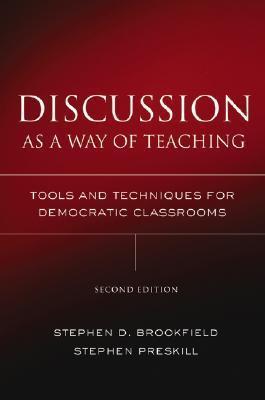
Discussion as a Way of Teaching: Tools and Techniques for Democratic Classrooms
Thoroughly revised and updated, the second edition of the landmark book Discussion as a Way of Teaching shows how to plan, conduct, and assess classroom discussions. Stephen D. Brookfield and Stephen Preskill suggest exercises for starting discussions, strategies for maintaining their momentum, and ways to elicit diverse views and voices. The book also includes new exercises and material on the intersections between discussion and the encouragement of democracy in the classroom. This revised edition expands on the original and contains information on adapting discussion methods in online teaching, on using discussion to enhance democratic participation, and on the theoretical foundations for the discussion exercises described in the book. Throughout the book, Brookfield and Preskill clearly show how discussion can enliven classrooms, and they outline practical methods for ensuring that students will come to class prepared to discuss a topic. They also explain how to balance the voices of students and teachers, while still preserving the moral, political, and pedagogic integrity of discussion.
336 pages, Hardcover
First published April 9, 1999
Ratings & Reviews
Friends & Following
Create a free account to discover what your friends think of this book!
Community Reviews
Displaying 1 - 24 of 24 reviews

August 25, 2013
An excellent book for anyone who would like to incorporate more discussion in their classrooms. I love all the practical ideas it offered in the chapters: preparing for discussion, getting discussion started, keeping discussion going, and keeping discussion going through creative grouping. I thought as a review, I'd share a few of their suggestions from these chapters which I hope to incorporate someday while teaching.
~ PREPARING FOR DISCUSSION~
End every lecture with a series of questions that the lecture raised or left unanswered.
Introduce periods of silence for reflection, every 20 minutes or so of lecturing
During this time they can write down the most important points, puzzling assertions and what question they would like to ask most
Include alternative perspectives during lectures
One way to do this is theatrical, present one perspective on one side of the room, then move to the other side of the room to present the other perspective
Have a period of “assumption hunting” to encourage critical thinking
Buzz Groups during lectures
Split students up in groups and have them answer these questions
What's the most contentious statement you've heard so far in the lecture today?
What's the most important point that's been made in the lecture so far?
What question would you most like to have answered regarding the topic of the lecture?
What's the most unsupported assertion you've heard in the lecture so far?
Of all the ideas and points you've heard so far, which is the most ambiguous to you?
Require critical reading as home-work
Epistemological questions
To what extent...
Does the writing seem culturally biased?
Are descriptions and prescriptions confused in an irresponsible and inaccurate way?
Are the central insights grounded in documented empirical data (personal experience counts)
Are the the ideas presented an uncritical extension of the paradigm within which the author
works?
Experiential questions
How do the metaphors use in the text compare to the metaphors you use to describe your own
similar experience?
What experiences are omitted from the text that strikes you as important?
If the text addresses experiences with which you are familiar, to what extent are these congruent
with or contradicted by your own experiences?
Communicative questions
To what extent does the text use a form of specialize language that is unjustifiably distant from
colloquial language?
To what extent is the text connected to practice?
Whose voices are heard in the text?
Political questions
Whose interest are served by the publication of this text?
What contribution does the text make to understanding and realization of democratic forms and
processes?
To what extent does this text challenge or confirm existing ideologies, values and structures
~GETTING DISCUSSION STARTED~
Frame the discussion around student questions
Either assign questions for home-work for which they must find answers, in which during class the answers are discussed. Or have them come up with questions from the reading and discuss the questions they had from the reading
Start wit ha sentence completion exercise
Write one the white board part of a sentence like “The thing I take issue with most in this reading is...” and have the students feel in the blank on a piece of paper, after this everyone can read their answers and discuss them.
Recalling a memorable experience
Have students share an experience that goes with the weakness or strength of a theory. For topics without personal dimensions, allow people to share their experience in trying to understand the topic at hand
Find illustrative quotes
Have students read a text and find quotes they like or dislike. Have students read and discuss selected quotes
State and respond to contentious opening statements
Start with a contentious or inflammatory quote. Discussion can then seek to understand why someone might hold such views, what lead them to such and what argument could be given in favor of it? Do this for “Cognitive warm up”
Discuss Experiences
Have people recall experiences that relate to the topic or if too abstract, for them to share their struggles in trying to understand the material. Start with freely giving narratives. Later incorporate more critical discussion.
Circle of voices
In a circle, everyone has three minutes to think of what they wanna say. Then it goes around the circle, each having 3 minutes to share. After this, people can only make comments on what others said, unless asked a question
Circular desponse discussion
To encourage listening skills, start a circle discussion, each has 3 minutes to speak. The next must summarize what the one said before him and add something related or connected.
Ensuring participation through the hatful of quotes
Have a hat full of quotes, people then share their reflection and response to the quote, this can be in whatever order, so the shy persons can go last
~KEEPING DISCUSSION GOING~
Ask questions for
Evidence
How do you know that?
What data is that claim based on?
What evidence would you give to someone you doubted your interpretation?
What does the author say that supports your argument?
Where did you find that expressed in the text?
Clarification
Can you put it another way?
What is a good example of what you are talking about?
What do you mean by that?
Can you explain the term you just used?
Could you give a different illustration of your point?
Ask Open question, especially WHY and HOW questions
Ask for definitions, the meaning of the words
Linking or Extension questions
Is there any connection between what you said and have was said by _____
How does your comment fit with so and sos comment
How does your observation relate with what was said last week
Does your observation challenge or support what we seem to be saying?
How does that contribution add to what has already been said?
Ask hypothetical questions
How would X have turned out if Y didn't happen?
What might have happened to X if Y didn't do P?
How might P be different if Y refrained from X?
If X did Y, how might he have changed P?
Ask Cause and Effect Questions
What is the likely effect of X on Y?
What does you think caused X?
Summery and Synthesis
What are one or two of the more important ideas that emerged from this discussion?
What remains unresolved or contentious about this topic?
What do you understand better as a result of this discussion?
Based on our discussion, what do we need to talk about next time to so to better understand?
What key word or concept best captures our discussion today?
LISTENING EXERCISES
PAIRED LISTENING
Pair people up, one has to share for no more than 5 minutes and the other has to intensely listen
The listener must strain to truly hear, using body language, head nodding, verbal interjctions like yes and uh-huh. He should paraphrase some of the speakers statements, even trying to repeat the actual words.
Instructions for the exercise
The immediate problem that comes to mind, is the whole asking them to share something personal. What will that mean to them? Well the speaker draw a blank? Do I elaborate on what is meant, tell some story from your life, adventure or struggle. Share about something you enjoy or know a lot about. Maybe I could give 3 minutes or so for the kids to think about what the speakers would like to say.
A variant of the exercise, could be assigning half the class to study and write on one topic, and the other half on a different one. Then I'll pair them together, and they will have to actively listen to the other share their research and then vise-versa
LISTENING TO THE SUBJECT
Watch an existentialist movie clip, look at a piece of abstract art or a brief surrealist film, something difficult to understand and easy to brush off, have them
Recount and paraphrase or discuss recount images, shapes colors and textures. Don't try and interpret, make meaning out of it. Have everyone discuss, afterwards, consider the meaning
HAVE A DESIGNATED LISTENER
Whose job is not to produce any ideas of his own, but to carefully listen without thinking of what to say next. Strive to understand the point without criticism or approving. Notice points of agreement and disagreement in the group. Raise questions that help clarify and explain key points.
RESPONDING with Questions
When a student ask you a question, instead of immediately responding, allow for some silence, giving the opening for someone else to answer, one can seek to paraphrase what was just spoken, possibly ask for more information or offer praise for the question, then instead of directly answering, pose a question to the one asking or to the group to help more deeply probe the topic, before offering an easy answer.
CONVERSATIONAL MOVES
One can make 3x5 cards and write and distribute notes with the follow conversational moves, each person is responsible for employing one. Mention these are all designed to strengthen connection among the group
Ask a question or make a comment that shows you are interested in what another said
Ask a question or make a comment that encourages someone else to elaborate on something that person has said.
Make a comment that underscores the link between two peoples contributions. Make this link clear in your comment
Use body language (even if slightly exaggerated) to show interest in what different speakers are saying
Make a comment indicating that you found another persons idea interesting or useful. Be specific as to why this was the case
Contribute something that builds on or springs from what someone else has said. Be explicit about the way you are building on the other person's thoughts.
Make a comment that at least partly paraphrases a point someone else has already made
Make a summary of observations that take into account several people's contributions and that touches on a recurring theme in the discussion.
Ask a cause and effect question—for example, “can you explain why you think it is true tht if these things are in place, such and such a thing will occur?”
At an appropriate moment, ask the group for a minute's silence to slow the pace of conversation and give you and others time to think.
Find a way to express appreciation for the enlightenment you have gained from the discussion. Try to be specific about what it was that helped you understand something better.
Disagree with someone in a respectful and constructive way
~KEEPING DISCUSSION GOING THROUGH CREATIVE GROUPING ~
Relaxed Buzz Group
Students get together simply to discuss the reading, they may discuss difficult or interesting passages, try to draw out the text main points or bring up flaws
Structured Buzz Group
Students spend 20 minutes to answer a few questions prepared by the instructor. They can finish by writing down their answers and submitting them to the teacher.
The Cocktail Party
Teach carries a tray with oeuvres and drinks, and students are to mingle and talk with other students like they were at a cocktail party, the one requirement of course is the topic of discussion is the one they are working on.
Student Expert
Students get to select one topic from a limited list of topic that they want to become an expert on. And they must study that topic, students who selected the same topic then meet together to raise question, explore understandings and misunderstandings and discuss what they learned.
Each student will take a turn leading the group in discussion or his or her expertise
TEAM DEBATE
On controversial topics, find topic in which students are divided, create debate TEAMS
Split the class in half, each half has to formulate arguments in favor of a certain view and in opposition to another view. Even if they personally don't agree.
Each team ask one person to conduct the argument, and the two go at it
After this the groups would join up again to draft a rebuttal argument
Have a different person present the arguments the following time
Afterwards, discuss with each-other, how did it feel to argue against a position you believe in?
Were any new ways of thinking opened up?
Did anyone come to a new understanding?
Did anyone change their position on the issue at all?
Ask participants to write a follow up reflection paper on the debate.
Students should address:
What assumptions about the issue were clarified or confirmed for you by the debate?
Which of these assumptions surprised you during the debate? Were you made aware of assumptions that you didn't know you held?
How could you check out these new assumptions?
What sources of evidence you consult?
What new perspective on the issue suggested themselves to you?
In what ways, if any, were your existing assumptions challenged or changed by the debate?
Conversational Role Playing
The Problem Dilemma, or theme poser
This person is suppose to think of topics of conversations, what is a problem or dilemma that fits with the theme
Reflective Analyst
This person keeps a record of the conversation's development, giving every twenty minutes or so a summary that focuses on shared concerns, issues the group is skirting, and emerging common themes.
Scrounger
The scrounger listens for helpful resources, suggestions and tips that participants have voiced as they discuss how to work through a problem or situation and keeps a record of these ideas that is read out before the session ends
Devil Advocate
This person listens carefully for any emerging consensus and then formulates and expresses a contrary view. This keeps Groupthink in check and helps participants explore a range of alternative interpretations.
Detective
The detective listens attentively for unacknowledged and unquestioned assumptions. And unchecked, and unchallenged biases related to culture, race, class, or gender that emerge in the conversations and brings them to the group's attention
Theme spotter
This participant identified themes that arise during the discussion that are left unexplored and that might form a focus for the next session
Umpire
This person listens for judgmental comments that may be offensive, insulting and demeaning and that contradict ground rules for respectful conversation generated by group members
Or he is one who monitors the conversation to make sure everyone talks to each other in a respectful and nonjudgmental manner.
~ PREPARING FOR DISCUSSION~
End every lecture with a series of questions that the lecture raised or left unanswered.
Introduce periods of silence for reflection, every 20 minutes or so of lecturing
During this time they can write down the most important points, puzzling assertions and what question they would like to ask most
Include alternative perspectives during lectures
One way to do this is theatrical, present one perspective on one side of the room, then move to the other side of the room to present the other perspective
Have a period of “assumption hunting” to encourage critical thinking
Buzz Groups during lectures
Split students up in groups and have them answer these questions
What's the most contentious statement you've heard so far in the lecture today?
What's the most important point that's been made in the lecture so far?
What question would you most like to have answered regarding the topic of the lecture?
What's the most unsupported assertion you've heard in the lecture so far?
Of all the ideas and points you've heard so far, which is the most ambiguous to you?
Require critical reading as home-work
“Critical reading happens when readers (1) make explicit the assumptions authors hold about what constitutes legitimate knowledge and how knowledge comes to be known, (2) take alternative perspectives on the knowledge being offered so that this knowledge comes to be seen as culturally constructed, (3) undertakes positive and negative appraisals of the grounds for and expression of this knowledge, and (4) analyze commonly held ideas for the extent to which they support or oppose varies political ideologies. It's often useful to structure a critical reading of text around four general categories of questions: epsitemological, experiential, communicative, and political. Asking questions like the examples shown here provides a template for the critical analysis of a text that makes this seem less daunting”
Epistemological questions
To what extent...
Does the writing seem culturally biased?
Are descriptions and prescriptions confused in an irresponsible and inaccurate way?
Are the central insights grounded in documented empirical data (personal experience counts)
Are the the ideas presented an uncritical extension of the paradigm within which the author
works?
Experiential questions
How do the metaphors use in the text compare to the metaphors you use to describe your own
similar experience?
What experiences are omitted from the text that strikes you as important?
If the text addresses experiences with which you are familiar, to what extent are these congruent
with or contradicted by your own experiences?
Communicative questions
To what extent does the text use a form of specialize language that is unjustifiably distant from
colloquial language?
To what extent is the text connected to practice?
Whose voices are heard in the text?
Political questions
Whose interest are served by the publication of this text?
What contribution does the text make to understanding and realization of democratic forms and
processes?
To what extent does this text challenge or confirm existing ideologies, values and structures
~GETTING DISCUSSION STARTED~
Frame the discussion around student questions
Either assign questions for home-work for which they must find answers, in which during class the answers are discussed. Or have them come up with questions from the reading and discuss the questions they had from the reading
Start wit ha sentence completion exercise
Write one the white board part of a sentence like “The thing I take issue with most in this reading is...” and have the students feel in the blank on a piece of paper, after this everyone can read their answers and discuss them.
Recalling a memorable experience
Have students share an experience that goes with the weakness or strength of a theory. For topics without personal dimensions, allow people to share their experience in trying to understand the topic at hand
Find illustrative quotes
Have students read a text and find quotes they like or dislike. Have students read and discuss selected quotes
State and respond to contentious opening statements
Start with a contentious or inflammatory quote. Discussion can then seek to understand why someone might hold such views, what lead them to such and what argument could be given in favor of it? Do this for “Cognitive warm up”
Discuss Experiences
Have people recall experiences that relate to the topic or if too abstract, for them to share their struggles in trying to understand the material. Start with freely giving narratives. Later incorporate more critical discussion.
Circle of voices
In a circle, everyone has three minutes to think of what they wanna say. Then it goes around the circle, each having 3 minutes to share. After this, people can only make comments on what others said, unless asked a question
Circular desponse discussion
To encourage listening skills, start a circle discussion, each has 3 minutes to speak. The next must summarize what the one said before him and add something related or connected.
Ensuring participation through the hatful of quotes
Have a hat full of quotes, people then share their reflection and response to the quote, this can be in whatever order, so the shy persons can go last
~KEEPING DISCUSSION GOING~
Ask questions for
Evidence
How do you know that?
What data is that claim based on?
What evidence would you give to someone you doubted your interpretation?
What does the author say that supports your argument?
Where did you find that expressed in the text?
Clarification
Can you put it another way?
What is a good example of what you are talking about?
What do you mean by that?
Can you explain the term you just used?
Could you give a different illustration of your point?
Ask Open question, especially WHY and HOW questions
Ask for definitions, the meaning of the words
Linking or Extension questions
Is there any connection between what you said and have was said by _____
How does your comment fit with so and sos comment
How does your observation relate with what was said last week
Does your observation challenge or support what we seem to be saying?
How does that contribution add to what has already been said?
Ask hypothetical questions
How would X have turned out if Y didn't happen?
What might have happened to X if Y didn't do P?
How might P be different if Y refrained from X?
If X did Y, how might he have changed P?
Ask Cause and Effect Questions
What is the likely effect of X on Y?
What does you think caused X?
Summery and Synthesis
What are one or two of the more important ideas that emerged from this discussion?
What remains unresolved or contentious about this topic?
What do you understand better as a result of this discussion?
Based on our discussion, what do we need to talk about next time to so to better understand?
What key word or concept best captures our discussion today?
LISTENING EXERCISES
PAIRED LISTENING
Pair people up, one has to share for no more than 5 minutes and the other has to intensely listen
The listener must strain to truly hear, using body language, head nodding, verbal interjctions like yes and uh-huh. He should paraphrase some of the speakers statements, even trying to repeat the actual words.
Instructions for the exercise
“Because listening is such an important part of successful discussion, you are going to engage in an active listening exercise to gain practice in attending closely to another person's message. You will be paired with another person for about 10 minutes. One of you will assume the rule of speaker, and the other will serve as the listener. The speak will have no more than five minutes no more than five minutes to talk about something personal; then we will reverse roles for another five minutes. Although the speaker's words are important, the burden is on the listener to make this exercise successful. The listener doesn't just passively receive the words of the speaker; she must attend carefully to their meaning. This means she uses every resource at her disposal to show that her first priority is witnessing and understanding the speaker's words. Body language, eye contact, head nodding, paraphrasing of the speaker's meaning, and echoing the actual words are all part of the active listening process.
If you are the listener, you may ask questions to get clarification on key points, but please ask them sparingly. This activity can feel a little awkward, especially when you're just parroting another person's words. Echoing is OK, but don't take it to an extreme; try to keep your responses varied. Take this activity seriously, but try to enjoy it as well. Most of all, when it's your turn to be the listener, devote every ounce of your attention to the speaker's message. To listen this closely can be exhilarating and illuminating.”
The immediate problem that comes to mind, is the whole asking them to share something personal. What will that mean to them? Well the speaker draw a blank? Do I elaborate on what is meant, tell some story from your life, adventure or struggle. Share about something you enjoy or know a lot about. Maybe I could give 3 minutes or so for the kids to think about what the speakers would like to say.
A variant of the exercise, could be assigning half the class to study and write on one topic, and the other half on a different one. Then I'll pair them together, and they will have to actively listen to the other share their research and then vise-versa
LISTENING TO THE SUBJECT
Watch an existentialist movie clip, look at a piece of abstract art or a brief surrealist film, something difficult to understand and easy to brush off, have them
Recount and paraphrase or discuss recount images, shapes colors and textures. Don't try and interpret, make meaning out of it. Have everyone discuss, afterwards, consider the meaning
HAVE A DESIGNATED LISTENER
Whose job is not to produce any ideas of his own, but to carefully listen without thinking of what to say next. Strive to understand the point without criticism or approving. Notice points of agreement and disagreement in the group. Raise questions that help clarify and explain key points.
RESPONDING with Questions
When a student ask you a question, instead of immediately responding, allow for some silence, giving the opening for someone else to answer, one can seek to paraphrase what was just spoken, possibly ask for more information or offer praise for the question, then instead of directly answering, pose a question to the one asking or to the group to help more deeply probe the topic, before offering an easy answer.
CONVERSATIONAL MOVES
One can make 3x5 cards and write and distribute notes with the follow conversational moves, each person is responsible for employing one. Mention these are all designed to strengthen connection among the group
Ask a question or make a comment that shows you are interested in what another said
Ask a question or make a comment that encourages someone else to elaborate on something that person has said.
Make a comment that underscores the link between two peoples contributions. Make this link clear in your comment
Use body language (even if slightly exaggerated) to show interest in what different speakers are saying
Make a comment indicating that you found another persons idea interesting or useful. Be specific as to why this was the case
Contribute something that builds on or springs from what someone else has said. Be explicit about the way you are building on the other person's thoughts.
Make a comment that at least partly paraphrases a point someone else has already made
Make a summary of observations that take into account several people's contributions and that touches on a recurring theme in the discussion.
Ask a cause and effect question—for example, “can you explain why you think it is true tht if these things are in place, such and such a thing will occur?”
At an appropriate moment, ask the group for a minute's silence to slow the pace of conversation and give you and others time to think.
Find a way to express appreciation for the enlightenment you have gained from the discussion. Try to be specific about what it was that helped you understand something better.
Disagree with someone in a respectful and constructive way
~KEEPING DISCUSSION GOING THROUGH CREATIVE GROUPING ~
Relaxed Buzz Group
Students get together simply to discuss the reading, they may discuss difficult or interesting passages, try to draw out the text main points or bring up flaws
Structured Buzz Group
Students spend 20 minutes to answer a few questions prepared by the instructor. They can finish by writing down their answers and submitting them to the teacher.
The Cocktail Party
Teach carries a tray with oeuvres and drinks, and students are to mingle and talk with other students like they were at a cocktail party, the one requirement of course is the topic of discussion is the one they are working on.
Student Expert
Students get to select one topic from a limited list of topic that they want to become an expert on. And they must study that topic, students who selected the same topic then meet together to raise question, explore understandings and misunderstandings and discuss what they learned.
Each student will take a turn leading the group in discussion or his or her expertise
TEAM DEBATE
On controversial topics, find topic in which students are divided, create debate TEAMS
Split the class in half, each half has to formulate arguments in favor of a certain view and in opposition to another view. Even if they personally don't agree.
Each team ask one person to conduct the argument, and the two go at it
After this the groups would join up again to draft a rebuttal argument
Have a different person present the arguments the following time
Afterwards, discuss with each-other, how did it feel to argue against a position you believe in?
Were any new ways of thinking opened up?
Did anyone come to a new understanding?
Did anyone change their position on the issue at all?
Ask participants to write a follow up reflection paper on the debate.
Students should address:
What assumptions about the issue were clarified or confirmed for you by the debate?
Which of these assumptions surprised you during the debate? Were you made aware of assumptions that you didn't know you held?
How could you check out these new assumptions?
What sources of evidence you consult?
What new perspective on the issue suggested themselves to you?
In what ways, if any, were your existing assumptions challenged or changed by the debate?
Conversational Role Playing
The Problem Dilemma, or theme poser
This person is suppose to think of topics of conversations, what is a problem or dilemma that fits with the theme
Reflective Analyst
This person keeps a record of the conversation's development, giving every twenty minutes or so a summary that focuses on shared concerns, issues the group is skirting, and emerging common themes.
Scrounger
The scrounger listens for helpful resources, suggestions and tips that participants have voiced as they discuss how to work through a problem or situation and keeps a record of these ideas that is read out before the session ends
Devil Advocate
This person listens carefully for any emerging consensus and then formulates and expresses a contrary view. This keeps Groupthink in check and helps participants explore a range of alternative interpretations.
Detective
The detective listens attentively for unacknowledged and unquestioned assumptions. And unchecked, and unchallenged biases related to culture, race, class, or gender that emerge in the conversations and brings them to the group's attention
Theme spotter
This participant identified themes that arise during the discussion that are left unexplored and that might form a focus for the next session
Umpire
This person listens for judgmental comments that may be offensive, insulting and demeaning and that contradict ground rules for respectful conversation generated by group members
Or he is one who monitors the conversation to make sure everyone talks to each other in a respectful and nonjudgmental manner.
June 1, 2026
interesting book on discussion
Interesting ideas on discussion classes, but much of it is outdated at this point. Discussion still needs to happen but we have to address the new AI world we live in.
Interesting ideas on discussion classes, but much of it is outdated at this point. Discussion still needs to happen but we have to address the new AI world we live in.

September 2, 2019
Despite its dry style and repetitiveness, I enjoyed this book. I appreciate the nuanced approach the authors take to discussion- the point is not for every student to prove they understood the text; instead, they’re focused on truly democratic, affirming, rigorous conversations that lead to collaborative creation of meaning and broader understanding of other people.

December 19, 2014
Brookfield, Stephen D., and Stephen Preskill. Discussion as a Way of Teaching: Tools and Techniques for Democratic Classrooms. 2nd ed. San Francisco: Jossey-Bass, 2005.
Teaching benefits from verbal interaction. The underlying conviction of Discussion as a Way of Teaching is that education includes content and conversation. Content can be delivered as a lecture, but learning requires engagement with the content. Multiply methods of class discussion deliver the highest quality of content engagement.
Professors Stephen Brookfield and Stephen Preskill share more an a first name. They share a friendship around a deep belief that group discussion leads to a richer educational experience. Their relationship and shared passion for teaching led to the writing of Discussion as a Way of Teaching. The book is a "how to" approach to college and university level class discussion. While a whimsical idea of class discussion includes little more than a provocative question and an open mic, Brookfield and Preskill carefully develop layers of approaches, techniques, and examples for meaningful discussions. Discussion deals with meaningful issues in a meaningful way, one in which group size, cultural and racial diversity, and gender distinctions are valued. Trust is a vital factor for healthy class discussion. Professors must trust in the students, students must grow to trust the professor, and students must value and trust one another, especially as different opinions surface.
The book's goal is to restore confidence in the power and usefulness of discussion. The first edition published in 1999 covered the classroom process of leading group discussions, along with useful techniques. In 2005 Brookfield and Preskill added four chapters to the end addressing the development of online education and recent contemporary theoretical positions affecting discussion.
There is much to commend in Discussion as a Way of Teaching. First, it expresses value to student contributions to the learning process. Personal stories are invited because experience is a proving ground for life's most significant lessons. Shared experiences offer opportunity for subgroups within a class to identify with each other. Forming trust is critical for meaningful dialogue.
Second, the use of detailed examples is a strength of Brookfield and Preskill's book. Not only do they offer creative suggestions for developing classroom discussion, but they also give details for making the suggestions work. For example, large group reports can be done as newsprints dialogue, rotating small group stations, snowballing, a cocktail party, or jigsaw. All five options are listed in chapter six, "Keeping Discussion Going Through Creative Grouping." Each examples is accompanied with a verbatim class introduction and explanation.
The encouragement that not all discussion will go well is sobering and true. The professor's dream of perfect dialogue is a true fairytale. Brookfield and Preskill share humbling testimonies of their own discussion failures. They present classroom discussion as an art, not a science, a skill teachers must develop.
In comparison to the overwhelming benefits of Discussion as a Way of Teaching, pointing out negatives seems like nitpicked. But there are a few potential criticisms. First, class discussion is built on political grounds. For example, Brookfield and Preskill write, "Discussion and democracy are inseparable because both have the same root purpose - to nurture and promote human growth" (Kindle location 544). Discussion is better attributed as a mark of all humanity.
Second, terminology referring to technology needs to be updated. Brookfield and Preskill write in chapter four, "Email allows you to do electronically what was previously accomplished by posting questions on newsprint in class" (Kindle location 1710). For millennial students who currently study in colleges and university, such a statement is obsolete. In two chapters dealing with online education little is mentioned about social media interaction and how it can play a positive role in online group discussions.
Having accounted for a few criticism, I recommend Discussion as a Way of Teaching to college and university professors to read and to practice. The book is applicable enough to be used in a workshop or presented at a faculty meeting.
Three distinctive themes extend throughout the book and are worthy of particular note. Brookfield and Preskill emphasis these themes as critical to healthy class discussion practice. First is the basic belief in the morality of all conversation. Discussing issues helps students process ideas. Trust is essential. Guidelines must be provide so that loquacious students speak less and timid students speak more. Opinions should be respected, and views valued as much as possible. This requires respecting ways of talking between students from an educated class and from a working class backgrounds. Communicative methods like language, volume, gestures, must be respected, especially present in different the racial groups.
Second is the necessity of silence. Brookfield and Preskill emphasize the virtue of one to two minutes of silent reflection before students answer, or moments of extended pause while discussion is stymied. They write, "We believe that even more time, up to a full minute, can occasionally be used to model unhurried deliberation and to emphasize the importance of reflection" (Kindle location 2299). The natural professor reacts to give the answer or pose a solution too quick. It may feel awkward, but silence is a key part of health class discussion.
A third theme is the value of a CIQ (Critical Incident Questionnaire). The CIQ is a series of five questions completed anonymously by students at the end of each class. It evaluates the classroom discussion and is used to enhance the discussion in the next class meeting. Questions cover what part of the discussion was most engaging, affirming, puzzling, or surprising. Because of anonymity, the professor receives critical, helpful information for adjusting future discussion. Brookfield and Preskill references the CIQ repeatedly throughout the book to show how it influences the students, professor, and class discussion. All three of these themes underscore the value of group discussion for college and university education.
Teaching benefits from verbal interaction. The underlying conviction of Discussion as a Way of Teaching is that education includes content and conversation. Content can be delivered as a lecture, but learning requires engagement with the content. Multiply methods of class discussion deliver the highest quality of content engagement.
Professors Stephen Brookfield and Stephen Preskill share more an a first name. They share a friendship around a deep belief that group discussion leads to a richer educational experience. Their relationship and shared passion for teaching led to the writing of Discussion as a Way of Teaching. The book is a "how to" approach to college and university level class discussion. While a whimsical idea of class discussion includes little more than a provocative question and an open mic, Brookfield and Preskill carefully develop layers of approaches, techniques, and examples for meaningful discussions. Discussion deals with meaningful issues in a meaningful way, one in which group size, cultural and racial diversity, and gender distinctions are valued. Trust is a vital factor for healthy class discussion. Professors must trust in the students, students must grow to trust the professor, and students must value and trust one another, especially as different opinions surface.
The book's goal is to restore confidence in the power and usefulness of discussion. The first edition published in 1999 covered the classroom process of leading group discussions, along with useful techniques. In 2005 Brookfield and Preskill added four chapters to the end addressing the development of online education and recent contemporary theoretical positions affecting discussion.
There is much to commend in Discussion as a Way of Teaching. First, it expresses value to student contributions to the learning process. Personal stories are invited because experience is a proving ground for life's most significant lessons. Shared experiences offer opportunity for subgroups within a class to identify with each other. Forming trust is critical for meaningful dialogue.
Second, the use of detailed examples is a strength of Brookfield and Preskill's book. Not only do they offer creative suggestions for developing classroom discussion, but they also give details for making the suggestions work. For example, large group reports can be done as newsprints dialogue, rotating small group stations, snowballing, a cocktail party, or jigsaw. All five options are listed in chapter six, "Keeping Discussion Going Through Creative Grouping." Each examples is accompanied with a verbatim class introduction and explanation.
The encouragement that not all discussion will go well is sobering and true. The professor's dream of perfect dialogue is a true fairytale. Brookfield and Preskill share humbling testimonies of their own discussion failures. They present classroom discussion as an art, not a science, a skill teachers must develop.
In comparison to the overwhelming benefits of Discussion as a Way of Teaching, pointing out negatives seems like nitpicked. But there are a few potential criticisms. First, class discussion is built on political grounds. For example, Brookfield and Preskill write, "Discussion and democracy are inseparable because both have the same root purpose - to nurture and promote human growth" (Kindle location 544). Discussion is better attributed as a mark of all humanity.
Second, terminology referring to technology needs to be updated. Brookfield and Preskill write in chapter four, "Email allows you to do electronically what was previously accomplished by posting questions on newsprint in class" (Kindle location 1710). For millennial students who currently study in colleges and university, such a statement is obsolete. In two chapters dealing with online education little is mentioned about social media interaction and how it can play a positive role in online group discussions.
Having accounted for a few criticism, I recommend Discussion as a Way of Teaching to college and university professors to read and to practice. The book is applicable enough to be used in a workshop or presented at a faculty meeting.
Three distinctive themes extend throughout the book and are worthy of particular note. Brookfield and Preskill emphasis these themes as critical to healthy class discussion practice. First is the basic belief in the morality of all conversation. Discussing issues helps students process ideas. Trust is essential. Guidelines must be provide so that loquacious students speak less and timid students speak more. Opinions should be respected, and views valued as much as possible. This requires respecting ways of talking between students from an educated class and from a working class backgrounds. Communicative methods like language, volume, gestures, must be respected, especially present in different the racial groups.
Second is the necessity of silence. Brookfield and Preskill emphasize the virtue of one to two minutes of silent reflection before students answer, or moments of extended pause while discussion is stymied. They write, "We believe that even more time, up to a full minute, can occasionally be used to model unhurried deliberation and to emphasize the importance of reflection" (Kindle location 2299). The natural professor reacts to give the answer or pose a solution too quick. It may feel awkward, but silence is a key part of health class discussion.
A third theme is the value of a CIQ (Critical Incident Questionnaire). The CIQ is a series of five questions completed anonymously by students at the end of each class. It evaluates the classroom discussion and is used to enhance the discussion in the next class meeting. Questions cover what part of the discussion was most engaging, affirming, puzzling, or surprising. Because of anonymity, the professor receives critical, helpful information for adjusting future discussion. Brookfield and Preskill references the CIQ repeatedly throughout the book to show how it influences the students, professor, and class discussion. All three of these themes underscore the value of group discussion for college and university education.

July 7, 2025
I’ve been teaching college since 1997. How did it take me this long to find this book??? Im excited to try many of these ideas.
Caveat: Because the book is dated, it makes a lot of assumptions about students that simply aren’t true anymore post-social media, post-Covid learning, and post-AI. The book is still worth reading, and most of its suggestions are even more relevant now. But it’s a sad reality that much of teaching now is managing students with dopamine addiction and/or severe attention deficits, while also trying to show them that AI isn’t doing them any favors—in spite of what all the tech fatcats are trying to sell them. It’s harder than ever to get buy-in on anything that requires sustained focus and slooowwwer, deeper thinking.
Caveat: Because the book is dated, it makes a lot of assumptions about students that simply aren’t true anymore post-social media, post-Covid learning, and post-AI. The book is still worth reading, and most of its suggestions are even more relevant now. But it’s a sad reality that much of teaching now is managing students with dopamine addiction and/or severe attention deficits, while also trying to show them that AI isn’t doing them any favors—in spite of what all the tech fatcats are trying to sell them. It’s harder than ever to get buy-in on anything that requires sustained focus and slooowwwer, deeper thinking.

September 29, 2017
Much to like in this practically-oriented guide: many activities that could be helpful to facilitating discussions of various types; many rationales for why discussion is helpful to learning; many smart caveats about how more discussion/participation doesn't always mean best/better discussion. I would have liked more examples from the authors' own experiences. Narratives to say more about how their proposed activities played out in their specific classes would help me to see how they could be best applied and what I might expect as results.

November 17, 2020
This is one of those books that has plenty of good information, many good ideas, and lots of good references but isn't a very good book to actually read. It's structure is extremely list-like, so it often feels more like reading an outline of a book than a book. It's often repetitive, so it feels very over-long. It's a useful reference, but a chore to actually read.

August 23, 2018
The book was a great eye opener for someone who wants to better structure discussion in the classroom. It gives good tips and advice on what to look out for and how to start.

October 11, 2018
An excellent combination of philosophy and strategy for discussion as a teaching method.

November 4, 2018
It gave good activities to do for discussion.
December 27, 2018
Practical manual on how to run a socratic seminar. Great questions categorization, debrief techniques, and overall tools to improve discussion.

December 1, 2023
Nice and wide range of discussion activities - much seem feasible in heating up the classroom!
April 14, 2025
Great insights in the early chapters. I advise reading through chapter 12 and then stopping.

October 9, 2012
Stephen D. Brookfield's and Stephen Preskill's book Discussion As a Way of Teaching defines discussion as “an alternately serious and playful effort by a group of two or more to share views and engage in mutual and reciprocal critique.” They don't believe in “guided” discussions with pre-ordained outcomes; instead, they focus on open-ended discussions that seek to question assumptions and challenge established beliefs. This is more intimidating to teachers but has more potential benefits as well. The authors give four main purposes for open-ended discussions: to achieve more critically formed views of a topic, to enhance self-awareness and self-critique, to appreciate a diversity of opinions, and to act as a catalyst for informing and allowing actions. And, of course, as the subtitle suggests, these discussions are utilized in the interest of striving towards the ideal of democracy. They seek to give each student an equal opportunity to speak, listen, and hold his or her views up to thorough scrutiny. They also allow for multiple views and intricate positions to arise amongst a group that could never have happened with just one person.
The book moves through the different stages of an in-depth discussion. Students should first be made to read background material on the topic beforehand so they feel that they have some knowledge from which to base their arguments. When opening a discussion, teachers should avoid vague questions and not be afraid to let silence linger; sometimes it just takes students a few moments to gather their thoughts. If the conversation is dying, teachers should make sure they dig deeper into the comments being made. Asking students what evidence they have, how they can elaborate, or what the best arguments against their own views might be can reignite discussions. Finally, students don't have to end the discussion in agreement. In fact, if this is the case, the agreed upon position is most likely contrived or hasn't been properly analyzed.
Aside from the general structure of discussions, the authors cover gender and socioeconomic differences. They discuss the different ways men and women treat discussions—or at least are perceived to. Men typically view the discussion as a way to reaffirm their status while women treat discussions more conversationally. Students who come from different economic or ethnic backgrounds can have wildly different views or at least ways of conveying those views. The authors stress how much empathy—in these situations and many others—often advances conversations and changes people's minds.
The authors are not so naïve to think there will be no problems with classroom discussions. Therefore, they address some of the most common issues. The first set of problems deals with students who either talk too much or too little. Getting students to let others into the conversation is mostly a matter of pulling them aside after class and addressing how they limit other possible speakers. Getting students to talk can be a bit trickier, but common solutions include providing plenty of pre-reading material, frequently modeling good questioning and critical thinking skills, and finding a way to break through the “culture of cool.” The second problem area concerns the role of the teacher: just how involved in the discussion should the teacher be? These two authors suggest teachers having less of a presence; instead, they should just add enough to entice students into doing their own critical thinking.
Throughout the main portion of the book, the authors do a good job alternating between specific techniques and activities that facilitate discussions and explanations of how and why these are important. They discuss a wide enough variety of activities that even though the book is aimed at college students, many of the plans could be tailored to high school students as well.
While it may fall outside of the scope of this book, the authors often assume student motivation is present when this is clearly not always the case. Some of the activities seem quite difficult to pull off without the most motivated of students. Also, the book contains a chapter on the theories that underlie many of the authors' beliefs about discussions. While this chapter is highly informative, it would have been much better closer to the beginning. That way, readers could have seen how these theories are present in the activities. These, however, are just minor gripes with an otherwise well-written and incredibly helpful book.
The book moves through the different stages of an in-depth discussion. Students should first be made to read background material on the topic beforehand so they feel that they have some knowledge from which to base their arguments. When opening a discussion, teachers should avoid vague questions and not be afraid to let silence linger; sometimes it just takes students a few moments to gather their thoughts. If the conversation is dying, teachers should make sure they dig deeper into the comments being made. Asking students what evidence they have, how they can elaborate, or what the best arguments against their own views might be can reignite discussions. Finally, students don't have to end the discussion in agreement. In fact, if this is the case, the agreed upon position is most likely contrived or hasn't been properly analyzed.
Aside from the general structure of discussions, the authors cover gender and socioeconomic differences. They discuss the different ways men and women treat discussions—or at least are perceived to. Men typically view the discussion as a way to reaffirm their status while women treat discussions more conversationally. Students who come from different economic or ethnic backgrounds can have wildly different views or at least ways of conveying those views. The authors stress how much empathy—in these situations and many others—often advances conversations and changes people's minds.
The authors are not so naïve to think there will be no problems with classroom discussions. Therefore, they address some of the most common issues. The first set of problems deals with students who either talk too much or too little. Getting students to let others into the conversation is mostly a matter of pulling them aside after class and addressing how they limit other possible speakers. Getting students to talk can be a bit trickier, but common solutions include providing plenty of pre-reading material, frequently modeling good questioning and critical thinking skills, and finding a way to break through the “culture of cool.” The second problem area concerns the role of the teacher: just how involved in the discussion should the teacher be? These two authors suggest teachers having less of a presence; instead, they should just add enough to entice students into doing their own critical thinking.
Throughout the main portion of the book, the authors do a good job alternating between specific techniques and activities that facilitate discussions and explanations of how and why these are important. They discuss a wide enough variety of activities that even though the book is aimed at college students, many of the plans could be tailored to high school students as well.
While it may fall outside of the scope of this book, the authors often assume student motivation is present when this is clearly not always the case. Some of the activities seem quite difficult to pull off without the most motivated of students. Also, the book contains a chapter on the theories that underlie many of the authors' beliefs about discussions. While this chapter is highly informative, it would have been much better closer to the beginning. That way, readers could have seen how these theories are present in the activities. These, however, are just minor gripes with an otherwise well-written and incredibly helpful book.

Read
September 12, 2008This is a very dense book which takes critical pedagogy theory into practice. Focus is on the benefits of discussion and on helping teachers implement in classrooms. The first two chapters are more philosophy of classroom discussion than help with teaching through discussion.
For practical purposes, Chapters 3 and 4 are the most useful. Chapter 3 focuses on the prep involved in good classroom discussion and has solid information on pre-discussion writing activities. Lots of good examples and discussion questions. The writing activities are helpful even if you don't plan to have a completely discussion oriented classroom.
Chapter 4 and half of Chapter five offer practical advice and techniques for getting class discussion started and keeping it going.
There are some strange tangents now and again, such as "how to keep discussion cool" and tips on dealing with "coolness."
Overall, the book is more a treatise on WHY you should create a discussion-centered classroom environment. Only the chapters mentioned above really get into the meat of HOW to lead a discussion-centered class.
For practical purposes, Chapters 3 and 4 are the most useful. Chapter 3 focuses on the prep involved in good classroom discussion and has solid information on pre-discussion writing activities. Lots of good examples and discussion questions. The writing activities are helpful even if you don't plan to have a completely discussion oriented classroom.
Chapter 4 and half of Chapter five offer practical advice and techniques for getting class discussion started and keeping it going.
There are some strange tangents now and again, such as "how to keep discussion cool" and tips on dealing with "coolness."
Overall, the book is more a treatise on WHY you should create a discussion-centered classroom environment. Only the chapters mentioned above really get into the meat of HOW to lead a discussion-centered class.

October 24, 2015
An excellent exploration of adult learning with the discussion-based methodology! Brookfield and Preskill wrote a brilliant book on effective methods of education that avoid pedagogical styles. They mentioned the essential four Rs of online teaching: responsiveness, research, respect, and relationships. In other words, there is a set of actions that effectively guide online learners through the curricula and assist the educators in achieving educational goals through online communitues.

July 11, 2009
I'm reading this slowly at work, during some lunches. Although the audience is primarily higher education, I'm fascinated by its messages and have found some ways to incorporate in my own training (and maybe future training). I have found Brookfield and Preskill to be excellent authors in this field! :) Their work fuels my ongoing passion...
January 20, 2012
The extensive and practical suggestions for discussion are phenomenal; the relativist philosophy not as much so. I recommend chapters 3-6 in particular for teachers looking for fresh ideas for classroom discussions.
January 5, 2012
I was feeling apprehensive about the discussion-based course I will be teaching in the fall, but after reading this book I feel prepared and excited to lead discussion!

Currently Reading
December 13, 2013OK, I've read a little more of it. Hopefully, it'll become less philosophical, and more practical, as I continue.

January 11, 2015
Assigned for my EDA 6302 course with Dr. Laine Scales at Baylor (Spring 2015).

November 1, 2016
Nothing revolutionary in this book, but I was reminded of some discussion techniques that I had forgotten about and learned a few new ones. It's worth the read.
Read
November 7, 2014378.12 B8726 2005
Read
September 29, 2017I need to download this book
Displaying 1 - 24 of 24 reviews