

What do you think?
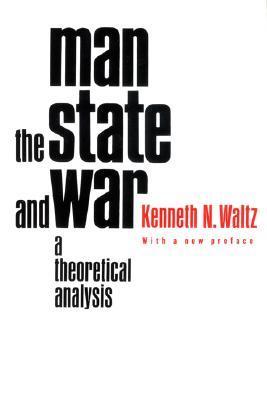
Man, the State, and War: A Theoretical Analysis
What are the causes of war? To answer this question, Professor Waltz examines the ideas of major thinkers throughout the history of Western civilization. He explores works both by classic political philosophers, such as St. Augustine, Hobbes, Kant, and Rousseau, and by modern psychologists and anthropologists to discover ideas intended to explain war among states and related prescriptions for peace.
263 pages, Paperback
First published January 1, 1954
Ratings & Reviews
Friends & Following
Create a free account to discover what your friends think of this book!
Community Reviews
Displaying 1 - 30 of 131 reviews

November 18, 2009
This book has legs! I read it first in graduate school in 1969. I was impressed with the argument then, and still appreciate its power now. He identifies a key problem as (page 12) "identifying and achieving the conditions of peace. . ." He notes that, over time, three separate views have dominated discourse on the causes of war (and how to achieve peace): (a) human nature is the root cause; (b) the structure of states is the key factor; (c) the international system itself is the major variable.
The book proceeds in a linear fashion. First, he examines the variety of arguments locating the cause of war in human nature. However, he also notes that to link human nature to war is not easily done (there is, of course, much debate over exactly what human nature is--or even if there is such a given nature), and that political matters must be taken into account. As he considers the contributions of the behavioral sciences, he notes that (page 79) "The more fully behavioral scientists take account of politics, the more sensible and the more modest their efforts to contribute to peace become."
The second level of analysis is the structure of states themselves. He notes that some have argued that if the state had a proper structure, then peace would result. He considers, for instance, liberal theorists of the 19th century who made that point. One problem: While trying to create more liberal states, what about those illiberal ones who may engage in conflict? What then? The structure of the state won't prevent self-defense. Indeed, some liberals, like Thomas Paine, wanted to use force to democratize the world.
The final level of analysis is the structure of the international system itself. The main point here is that that system can be termed "anarchy." There is no central force to prevent outbreaks of violence. So, violence will occur. Interestingly, he begins the chapter on international anarchy with a quotation from Cicero (page 159) "For what can be done against force without force." States need to protect themselves when there is no mechanism to maintain peace; they will act in their national interest when threatened. The end result is the possibility of war whenever a country might be threatened. In Waltz' words (page 227): "According to the third image, there is a constant possibility of war in a world in which there are two or more states each seeking to promote a set of interests and having no agency upon which they can rely for protection."
In short, all three levels (images) must be understood. None is irrelevant. But the key to understanding war is the state of international anarchy. The book holds up well over time. It still presents a useful message, albeit from the hard-nosed realist position. Neocons won't like the argument that changing the structure of states won't make a lot of difference as long as there is international anarchy. Anyhow, for those interested in a fairly hard-headed analysis, this book still serves a useful purpose.
The book proceeds in a linear fashion. First, he examines the variety of arguments locating the cause of war in human nature. However, he also notes that to link human nature to war is not easily done (there is, of course, much debate over exactly what human nature is--or even if there is such a given nature), and that political matters must be taken into account. As he considers the contributions of the behavioral sciences, he notes that (page 79) "The more fully behavioral scientists take account of politics, the more sensible and the more modest their efforts to contribute to peace become."
The second level of analysis is the structure of states themselves. He notes that some have argued that if the state had a proper structure, then peace would result. He considers, for instance, liberal theorists of the 19th century who made that point. One problem: While trying to create more liberal states, what about those illiberal ones who may engage in conflict? What then? The structure of the state won't prevent self-defense. Indeed, some liberals, like Thomas Paine, wanted to use force to democratize the world.
The final level of analysis is the structure of the international system itself. The main point here is that that system can be termed "anarchy." There is no central force to prevent outbreaks of violence. So, violence will occur. Interestingly, he begins the chapter on international anarchy with a quotation from Cicero (page 159) "For what can be done against force without force." States need to protect themselves when there is no mechanism to maintain peace; they will act in their national interest when threatened. The end result is the possibility of war whenever a country might be threatened. In Waltz' words (page 227): "According to the third image, there is a constant possibility of war in a world in which there are two or more states each seeking to promote a set of interests and having no agency upon which they can rely for protection."
In short, all three levels (images) must be understood. None is irrelevant. But the key to understanding war is the state of international anarchy. The book holds up well over time. It still presents a useful message, albeit from the hard-nosed realist position. Neocons won't like the argument that changing the structure of states won't make a lot of difference as long as there is international anarchy. Anyhow, for those interested in a fairly hard-headed analysis, this book still serves a useful purpose.

October 5, 2013
[This is a snapshot of my thoughts on this book after just finishing it. This is not meant to serve as a summary or a critique – only as some words on how I engaged with this book for the purposes of building a theoretical framework on strategy. I will likely have missed or misinterpreted some important points, so please forgive me in advance.]
In Man the State and War, Waltz provides three interrelated “images” through which the causes of war derive: “So fundamental are man, the state, and the state system in any attempt to understand international relations that seldom does an analyst, however wedded to one image, entirely overlook the other two” (160). He provides a fairly comprehensive literature review that incorporates philosophy, theology, and anthropology to help identify the prevailing views on human nature, the “badness” and “goodness” of men and the organization of men, and the interrelationship between organizations. He concludes that his realist frame provides the appropriate impetus to incorporate theory and politics toward the state’s ultimate moral responsibility, that being its accumulation of power via the use of force for the purpose of long-term viability: “A foreign policy based on this image of international relations is neither moral nor immoral, but embodies merely a reasoned response to the world about us” (238).
On human nature, Waltz argues “If human nature is but one of the causes of war, then, even on the assumption that human nature is fixed, we can properly carry on a search for the conditions of peace” (30). I disagree with this premise, as well as Waltz’s oversimplification of Augustine’s theories on the nature of man. If man is indeed tuned to seek out his own gain, and this cannot be corrected, then I argue that this provides an opportunity to anticipate behavior for the purposes of shaping it. I do not believe man’s human nature can be corrected, nor do I believe this is the sole solution to war; however, I do believe Waltz’s premise on his first image is incomplete. The “security dilemma” (37) is a constant existence for each individual, and then is projected upon the second image as men organize into governed states. If this first image is made more complete, I believe it would allow for the influence of non-state actors into Waltz’s theory – I recognize this is fundamentally not a part of the realist frame.
I see the second frame, the state, as similar to Kuhn’s paradigm or Allison & Zelikow’s Model I (Rational Actor Model) – states are predictable and are based on a unique perspective of itself. Waltz devotes the majority of his defense of the second image on countering liberalism instead of building a definition of the state. I see this as a metaphor for how states may be formed in the first place – not so much about what the shared values or objectives among men may be, but how they differ from other states’ values and/or objectives. The major issue I see with the second image is the prevalence of civil war and strife with non-state actors. The influence of international and social media now has a unique impact on international politics that I tend to believe is the external policing force that liberalism requires; however, that force is not strong enough to provide a balancing mechanism that prevents force-on-force conflict.
The third image is closely related to the second, in that the relationship between states is another source of war. As “the actions of states, or more accurately, of men acting for states, make up the substance of international relations” (122 – describes the second image), states can align, contest, or wait for opportunity in an effort to acquire power. This image projects the dangerous assumption that all states have this same perspective, and therefore can be the cause of war itself. Another potential source of conflict between the second and third images is that in order to solidify the image of the state, a state may require not only a unifying set of principles, and a need to vilify another state’s principles. This vilification was demonstrated between the US and USSR throughout the Cold War. Thucydides (fear, honor, interest) and Allison & Zelikow (Rational Actor, organizational outputs, and individual leaders) provide more perspective on the potential causes of war while still fitting neatly within Waltz’s realist perspective.
Waltz’s solution to war is force. This makes little sense to me; however, based on his argument, he believes it is the only option. Devote enough resources to be able to apply force as necessary to achieve the necessary amount of power to live in relative peace. When that peace is threatened, we need to have the capability to deliver force in such a way so as to eliminate the threat and preserve power. I believe that today, by projecting force to preserve power, we end up losing it. In a democracy, strategic power is dependent on public opinion, and public opinion is sensitive to what may be perceived as an immoral projection of force. The current administration has not necessarily paid the same political price as previous ones in this regard; perhaps because this administration understands how political capital is fungible. But that is another topic for another day.
In Man the State and War, Waltz provides three interrelated “images” through which the causes of war derive: “So fundamental are man, the state, and the state system in any attempt to understand international relations that seldom does an analyst, however wedded to one image, entirely overlook the other two” (160). He provides a fairly comprehensive literature review that incorporates philosophy, theology, and anthropology to help identify the prevailing views on human nature, the “badness” and “goodness” of men and the organization of men, and the interrelationship between organizations. He concludes that his realist frame provides the appropriate impetus to incorporate theory and politics toward the state’s ultimate moral responsibility, that being its accumulation of power via the use of force for the purpose of long-term viability: “A foreign policy based on this image of international relations is neither moral nor immoral, but embodies merely a reasoned response to the world about us” (238).
On human nature, Waltz argues “If human nature is but one of the causes of war, then, even on the assumption that human nature is fixed, we can properly carry on a search for the conditions of peace” (30). I disagree with this premise, as well as Waltz’s oversimplification of Augustine’s theories on the nature of man. If man is indeed tuned to seek out his own gain, and this cannot be corrected, then I argue that this provides an opportunity to anticipate behavior for the purposes of shaping it. I do not believe man’s human nature can be corrected, nor do I believe this is the sole solution to war; however, I do believe Waltz’s premise on his first image is incomplete. The “security dilemma” (37) is a constant existence for each individual, and then is projected upon the second image as men organize into governed states. If this first image is made more complete, I believe it would allow for the influence of non-state actors into Waltz’s theory – I recognize this is fundamentally not a part of the realist frame.
I see the second frame, the state, as similar to Kuhn’s paradigm or Allison & Zelikow’s Model I (Rational Actor Model) – states are predictable and are based on a unique perspective of itself. Waltz devotes the majority of his defense of the second image on countering liberalism instead of building a definition of the state. I see this as a metaphor for how states may be formed in the first place – not so much about what the shared values or objectives among men may be, but how they differ from other states’ values and/or objectives. The major issue I see with the second image is the prevalence of civil war and strife with non-state actors. The influence of international and social media now has a unique impact on international politics that I tend to believe is the external policing force that liberalism requires; however, that force is not strong enough to provide a balancing mechanism that prevents force-on-force conflict.
The third image is closely related to the second, in that the relationship between states is another source of war. As “the actions of states, or more accurately, of men acting for states, make up the substance of international relations” (122 – describes the second image), states can align, contest, or wait for opportunity in an effort to acquire power. This image projects the dangerous assumption that all states have this same perspective, and therefore can be the cause of war itself. Another potential source of conflict between the second and third images is that in order to solidify the image of the state, a state may require not only a unifying set of principles, and a need to vilify another state’s principles. This vilification was demonstrated between the US and USSR throughout the Cold War. Thucydides (fear, honor, interest) and Allison & Zelikow (Rational Actor, organizational outputs, and individual leaders) provide more perspective on the potential causes of war while still fitting neatly within Waltz’s realist perspective.
Waltz’s solution to war is force. This makes little sense to me; however, based on his argument, he believes it is the only option. Devote enough resources to be able to apply force as necessary to achieve the necessary amount of power to live in relative peace. When that peace is threatened, we need to have the capability to deliver force in such a way so as to eliminate the threat and preserve power. I believe that today, by projecting force to preserve power, we end up losing it. In a democracy, strategic power is dependent on public opinion, and public opinion is sensitive to what may be perceived as an immoral projection of force. The current administration has not necessarily paid the same political price as previous ones in this regard; perhaps because this administration understands how political capital is fungible. But that is another topic for another day.
December 31, 2007
If you are a student of International Relations, the reputation of this book should precede it. I personally picked it up and read it for pleasure after it kept being mentioned in my university courses. Let's just say that although I picked it up for pleasure, I got very little pleasureful reading from it. This is a very dry piece of academic work; some academics have a gift for making their writing engaging, but Waltz does not. He is fairly accessible and I think anybody interested in politics would have little trouble grasping the content, but odds are they'd be pretty bored.
I strongly disagree with Waltz's politics. I read the book to more closely familiarise myself with core realist thinkers, and Waltz does a good job of outlining the realist case. His argumentation is strong, as long as you accept certain assumptions and share certain perspectives. The main problem is that he completely fails to discredit other perspectives. This book will tell you what realism is, but it probably won't do much to persuade you of its superiority over any other theoretical approach to IR. I was just left with a bad taste in my mouth.
I strongly disagree with Waltz's politics. I read the book to more closely familiarise myself with core realist thinkers, and Waltz does a good job of outlining the realist case. His argumentation is strong, as long as you accept certain assumptions and share certain perspectives. The main problem is that he completely fails to discredit other perspectives. This book will tell you what realism is, but it probably won't do much to persuade you of its superiority over any other theoretical approach to IR. I was just left with a bad taste in my mouth.

October 7, 2018
3,5 stars
Waltz writes well and this is not a difficult read, but at the end of the day it is a glorified literature review that seeks to ground neorealist thought in classic philosophy. As such it is liable to the charge that to link Thucydides and Machiavelli to realism is just an exercise in narrative construction on the part of the realists, as well as to the usual criticisms of this approach to IR. Further, the works that Waltz chooses to review for each of his "images" seem to be chosen according to the fancy of the author rather than any thought-out system. Notably, the discussion of the second image is almost solely a discussion of Marxism.
On the plus side, chapter VI explains the essence of neorealism well, and I appreciated Waltz' admission that neither of the images alone can offer a satisfying analysis of world politics, as well as his nuanced reading of Machiavelli.
Waltz writes well and this is not a difficult read, but at the end of the day it is a glorified literature review that seeks to ground neorealist thought in classic philosophy. As such it is liable to the charge that to link Thucydides and Machiavelli to realism is just an exercise in narrative construction on the part of the realists, as well as to the usual criticisms of this approach to IR. Further, the works that Waltz chooses to review for each of his "images" seem to be chosen according to the fancy of the author rather than any thought-out system. Notably, the discussion of the second image is almost solely a discussion of Marxism.
On the plus side, chapter VI explains the essence of neorealism well, and I appreciated Waltz' admission that neither of the images alone can offer a satisfying analysis of world politics, as well as his nuanced reading of Machiavelli.

September 29, 2020
ما هي أسباب الحرب ولماذا يقتل البشر بعضهم على نطاق واسع؟ وهل يمكن منع ذلك؟
يحاول الكتاب الإجابة على هذا السؤال عن طريق فحص وتحليل آراء المفكرين والفلاسفة عبر التاريخ، وتصنيف وجهات نظرهم ضمن ثلاثة أنماط: 1- الطبيعة البشرية؛ 2- هيكلية الدول الداخلية؛ 3- فوضوية العلاقات الدولية. فيتناول كل نمط على حدى بالتمحيص والدراسة مبيناً مواقف المؤيدين والمعارضين من الفلاسفة. يصل أخيراً إلى خلاصة مفادها أنه وإن كان خروج العلاقات الدولية عن السيطرة وعدم إمكانية إخضاعها إلى قانون موحد يلعب الدور الأكبر في قيام الحروب، إلا أنه لا يمكننا إهمال دور الأنماط الأخرى، كالتوحش المتأصل في الطبيعة البشرية.
كتاب هام يستحق مراجعة أعمق. ربما لاحقاً
يحاول الكتاب الإجابة على هذا السؤال عن طريق فحص وتحليل آراء المفكرين والفلاسفة عبر التاريخ، وتصنيف وجهات نظرهم ضمن ثلاثة أنماط: 1- الطبيعة البشرية؛ 2- هيكلية الدول الداخلية؛ 3- فوضوية العلاقات الدولية. فيتناول كل نمط على حدى بالتمحيص والدراسة مبيناً مواقف المؤيدين والمعارضين من الفلاسفة. يصل أخيراً إلى خلاصة مفادها أنه وإن كان خروج العلاقات الدولية عن السيطرة وعدم إمكانية إخضاعها إلى قانون موحد يلعب الدور الأكبر في قيام الحروب، إلا أنه لا يمكننا إهمال دور الأنماط الأخرى، كالتوحش المتأصل في الطبيعة البشرية.
كتاب هام يستحق مراجعة أعمق. ربما لاحقاً

February 24, 2012
This is a paradigmatic book in the study of war. Kenneth Waltz was an important scholar of international relations and the founder of neorealism. His work set many of the standards for coherence, systematic thinking and good arguments that are common today in this discipline. This work is where all these benefits came from, it is still fresh, and I recommend it to any reader who wants to experience a nuanced and learned argumentation about the violent conflicts and how to stop them.
Kenneth Waltz was interested in the general causes of war and in the prescription of peace. Published in 1954, this work is an exploration of Western political thought, organized around three images (today called levels of analysis). There are the individual (human nature), the state (autonomous communities in general), and the society of states (international system, international society). These are the concepts presented in any beginner course of International Relations and they originate in this book, based on the author's PhD thesis.
The first two images are the best-known. In Kenneth Waltz’s depiction, if humans are evil, thus war happens: as Thucydides, Machiavelli, and Hobbes argued, they are greedy, fearful or vain. What is true of human nature applies even more for the leaders, yet we live in society, and war is a variable. Thus, we have to move one step above, where if some states are good (democracies, equalitarian communities), and others are bad, the latter’s behavior caused the war.
The critique also repeats: bad states live in a world of states, and the same is true for the moral ones. For Kenneth Waltz, the specificity of this society of states (called the international system now) matters and is defined by an absence. There is no executive, nor legislative, and the rules of behavior are weak, thus if a crime happens, there is no effective police to call. This is called the condition of anarchy and it forces each state to take care of itself by arming and making alliances, in other words by power.
This cause is called permissive, which means that is necessary, yet not sufficient for a particular war to happen, as detailed by Jack Levy. If we want to understand a specific case, we must combine all images (like leadership, regime, the distribution of power). But if we want to understand the most general cause, it’s anarchy. Today, this notion is muddier, and neorealism is out of fashion, though Kenneth Waltz’s argument is still impressive by its clarity and ability to navigate the muddy waters of Western political thought.
Kenneth Waltz was interested in the general causes of war and in the prescription of peace. Published in 1954, this work is an exploration of Western political thought, organized around three images (today called levels of analysis). There are the individual (human nature), the state (autonomous communities in general), and the society of states (international system, international society). These are the concepts presented in any beginner course of International Relations and they originate in this book, based on the author's PhD thesis.
The first two images are the best-known. In Kenneth Waltz’s depiction, if humans are evil, thus war happens: as Thucydides, Machiavelli, and Hobbes argued, they are greedy, fearful or vain. What is true of human nature applies even more for the leaders, yet we live in society, and war is a variable. Thus, we have to move one step above, where if some states are good (democracies, equalitarian communities), and others are bad, the latter’s behavior caused the war.
The critique also repeats: bad states live in a world of states, and the same is true for the moral ones. For Kenneth Waltz, the specificity of this society of states (called the international system now) matters and is defined by an absence. There is no executive, nor legislative, and the rules of behavior are weak, thus if a crime happens, there is no effective police to call. This is called the condition of anarchy and it forces each state to take care of itself by arming and making alliances, in other words by power.
This cause is called permissive, which means that is necessary, yet not sufficient for a particular war to happen, as detailed by Jack Levy. If we want to understand a specific case, we must combine all images (like leadership, regime, the distribution of power). But if we want to understand the most general cause, it’s anarchy. Today, this notion is muddier, and neorealism is out of fashion, though Kenneth Waltz’s argument is still impressive by its clarity and ability to navigate the muddy waters of Western political thought.

Read
May 11, 2015You'll notice that I've refrained from giving it a star rating.
This is a book I suffered through during my coursework. Since I read it at a time when I was heavily burdened by the constraints of time, I might think differently of it today.
Nevertheless, I'll have to be thoroughly convinced to give this book another try.
At first blush, it seems like the idea of looking at different levels of analysis is a very good idea. However, I got the sense throughout the book that Waltz wasn't giving each level its due. This suspicion turned to downright hostility once I discovered that one of the levels was eventually to "win" in the end, making me believe that I had been led down a pre-designed path rather than on a journey of theoretical discovery.
I think some of my suspicion would have been disarmed if Waltz had structured how he was going to interrogate each level.
There is one undeniable fact about this book -- it impacted the field of International Relations greatly. So even if you don't read the book (and I don't think you should), I still think you should know the book and how it impacted the field. Especially since other, better books, make reference to it.
This is a book I suffered through during my coursework. Since I read it at a time when I was heavily burdened by the constraints of time, I might think differently of it today.
Nevertheless, I'll have to be thoroughly convinced to give this book another try.
At first blush, it seems like the idea of looking at different levels of analysis is a very good idea. However, I got the sense throughout the book that Waltz wasn't giving each level its due. This suspicion turned to downright hostility once I discovered that one of the levels was eventually to "win" in the end, making me believe that I had been led down a pre-designed path rather than on a journey of theoretical discovery.
I think some of my suspicion would have been disarmed if Waltz had structured how he was going to interrogate each level.
There is one undeniable fact about this book -- it impacted the field of International Relations greatly. So even if you don't read the book (and I don't think you should), I still think you should know the book and how it impacted the field. Especially since other, better books, make reference to it.

August 3, 2007
A simple and crucial insight is at the heart of this book: states relating to each other create a structure -- a structure that then determines the actions of states. A must read for anyone with pretensions to studying International Relations.
This is how someone either untrained in dialectics, or someone who refuses to engage in such language, talks about dialectics. How can we know that he might not know his dialectics? Because at crucial stages of the argument he fails to apply dialectics. His explicit commitments, of course, are to positivism.
This is how someone either untrained in dialectics, or someone who refuses to engage in such language, talks about dialectics. How can we know that he might not know his dialectics? Because at crucial stages of the argument he fails to apply dialectics. His explicit commitments, of course, are to positivism.

September 8, 2026
In English next time please!

February 1, 2018
İnsanlık tarihinde savaşların neden yaşandığına ilişkin açıklamaları derleyip sınıflandıran bir giriş çalışması. 1959 yılında yazılmış bir doktora tezinden kitaplaştırılmış ve artık yaşlanmış. Yine de çok temel ayrımlardan söz ettiği için Batı üniversitelerinin siyaset bilimleri müfredatında hala okutuluyor.
Waltz'a göre, savaşın nedenine ilişkin açıklamalar üç başlık altında toplanabilir:
1. İnsan doğasına ilişkin açıklamalar: İnsan hırslı, yalancı, tatmin olmaz bir varlık olduğu için savaşlar hep olmuştur.
2. Devlet odaklı açıklamalar: Devletlerin başına adaletsiz, bencil yöneticiler geçerse kendi çıkarları için tüm halkı savaşa sürmekten çekinmezler. Tüm devletler demokrat olsa savaşlar olmazdı.
3. Güç dengesi açıklaması: Devletler bir uluslararası sistem oluştururlar. Bu yüzden bir devlet barışçıl, demokrat da olsa, güç dengeleri değiştiğinde ayakta kalabilmek için savaşmak zorunda kalabilir.
Kitabın bir başka ilginç yönü, Soğuk Savaş döneminde Sovyetler Birliği'ni baş düşman olarak bellemiş bir yazarın kaleminden çıkmış olmasına rağmen, sosyalistlerin 1. Paylaşım Savaşı sırasındaki iç tartışmalarına dair güzel bir özet sunması.
Kitap egemen sınıfların düşüncesinin evrimini güzel resmediyor: Çağımızda burjuvazi savaşı çözülebilecek bir siyasi sorun olmaktan çıkartarak, yönetilmesi gereken bir girişime dönüştürmüş artık. Egemen sınıfın düşünürleri, klasik siyaset felsefecilerinin yaptığı gibi büyük genellemeler, kapsamlı teoriler aracılığıyla savaşın temellerini ortadan kaldırmakla ilgilenmiyorlar. "Savaş hep olacak" diyorlar, "yapılması gereken şey savaşı müzakerelerle, güç gösterileriyle, doğru ittifaklar kurarak yönetip, buradan bizim için azami yararı sağlamak."
Waltz'a göre, savaşın nedenine ilişkin açıklamalar üç başlık altında toplanabilir:
1. İnsan doğasına ilişkin açıklamalar: İnsan hırslı, yalancı, tatmin olmaz bir varlık olduğu için savaşlar hep olmuştur.
2. Devlet odaklı açıklamalar: Devletlerin başına adaletsiz, bencil yöneticiler geçerse kendi çıkarları için tüm halkı savaşa sürmekten çekinmezler. Tüm devletler demokrat olsa savaşlar olmazdı.
3. Güç dengesi açıklaması: Devletler bir uluslararası sistem oluştururlar. Bu yüzden bir devlet barışçıl, demokrat da olsa, güç dengeleri değiştiğinde ayakta kalabilmek için savaşmak zorunda kalabilir.
Kitabın bir başka ilginç yönü, Soğuk Savaş döneminde Sovyetler Birliği'ni baş düşman olarak bellemiş bir yazarın kaleminden çıkmış olmasına rağmen, sosyalistlerin 1. Paylaşım Savaşı sırasındaki iç tartışmalarına dair güzel bir özet sunması.
Kitap egemen sınıfların düşüncesinin evrimini güzel resmediyor: Çağımızda burjuvazi savaşı çözülebilecek bir siyasi sorun olmaktan çıkartarak, yönetilmesi gereken bir girişime dönüştürmüş artık. Egemen sınıfın düşünürleri, klasik siyaset felsefecilerinin yaptığı gibi büyük genellemeler, kapsamlı teoriler aracılığıyla savaşın temellerini ortadan kaldırmakla ilgilenmiyorlar. "Savaş hep olacak" diyorlar, "yapılması gereken şey savaşı müzakerelerle, güç gösterileriyle, doğru ittifaklar kurarak yönetip, buradan bizim için azami yararı sağlamak."
May 29, 2020
The basic premise of anarchic structure of international politics has remained intact despite the passing of important events and the appearance of new trends since 1959, one of them being the increased legitimacy of multilateral institutions. The book remains therefore relevant, but so does the critique about largely ignoring cultural, historical, and economic factors when tackling the question of war.
June 23, 2014
Waltz's logical, step by step analysis of why war and peace are best understood at the systemic level of analysis and the basis for his later, starker, neorealism.

Read
November 19, 2017I read this quite some years ago, at university. Probably (no certainly) outdated by now.

January 22, 2022
read for a international relations class and skipped through some chapters, i mean it does provide a somewhat interesting theoretical analysis of war, supported by a bunch of classical political philosophy and real world examples, if u like neorrealism you cant go wrong with waltz rly, i just wasnt that captivated by most of the ideas presented tbf
June 19, 2025
Often cited, seldom read. This book is over hated and much of the criticism are folks who have not critically engaged with his assessments. This is one of his better works before he becomes more dogmatic later in life.
November 28, 2025
Read this for a class while on vacation. It is a very good analysis on hegemony and war.

April 16, 2023
Asking who won a particular war is like asking who won the San Francisco earthquake. Such senseless destruction and indiscriminate violence make the question absurd. But how far can we stretch this analogy? Are wars also like earthquakes in the sense that their occurrence is unpredictable? Or is warfare a human activity, subject to social-scientific explanation?
Kenneth Waltz begins Man, the State, and War (1959) with this incredibly illuminating analogy. Just as seismologists study earthquakes, a student of international relations studies the causes of war. Unlike earthquakes, however, we hope that studying war will help us prolong peace. To achieve peace, we must first ask: what causes war? Waltz is not interested in what caused any particular war, but what causes war in general.
Asking what caused World War One is, to an extent, an empirical question. Asking what causes war in general is a theoretical one. Waltz is unashamed about his reliance on political theory. “The empirical approach, though necessary, is not sufficient. The correlation of events means nothing”, Waltz argues. Empiricism does not tell us about the interrelation between data points, nor which factors are most salient. Establishing any kind of causality requires interpretation. Good interpretation requires theoretical clarity. It is precisely this kind of clarity that Waltz feels is missing from international relations. Most explanations of war tend to rely on unarticulated assumptions about which factors to study, and why. Some theorists, in seeking to explain war, blame individuals, or human nature writ large. Waltz calls this “the first image”. Other theorists, recognising that humans are shaped by their social environment, explain war in reference to the political make up of states. Basically, certain kinds of states are more warlike than others. Waltz calls this the “second image”. Finally, a handful of theorists recognise that states are just like individuals, they too are shaped by their external environment. At the level of international politics, anarchy prevails. There is no structured, regulated environment between states. Each must ensure its own survival. Power politics is the lingua franca of international relations.
In case you hadn’t already guessed, Waltz favours the third image. This does not mean neglecting the first two images. Instead, they should be interpreted through the prism of the third image. Waltz thus inaugurates what has come to be known as “structural” or “neo” realism. To understand the causes of war, look first to the structure (or lack thereof) of international politics. Waltz’s reasons for emphasising the third image are subtle and theoretically nuanced. Stop here if you are content with knowing Waltz’s conclusion. Read on if you want to know how he got there.
The First Image
Humans have an innate capacity and natural proclivity towards violence. We are selfish, greedy, and power-hungry. Humanity in the state of nature wages a “war of all against all.” Life is “nasty, brutish, and short.” Thomas Hobbes, just quoted, provides the pithiest description of the first image. War is caused by flaws buried deep within human nature itself. We are the problem, war is merely a symptom of our inherent sickness. Preventing war requires, if possible, a reformation of the human condition. Hobbes, though the most famous proponent of this view today, is the inheritor of a long tradition blaming war on humanity’s fallen nature. Hobbes’ innovation was to secularise a deeply religious argument. Saint Augustine, writing in the fourth century, expressed profound scepticism that heaven could ever be realised on Earth. To be human is to be sinful. Humans sin not just to survive, but to experience the joys of sinning. We are fallen creatures, as expressed by the Christian idea of original sin.
What are we to make of these arguments? They clearly speak to a deep truth about the human condition. Everyone has felt tempted to sin. It is thrilling. But can this impulse really explain war? Waltz reminds us that “the search for causes is an attempt to account for differences.” War broke out in 1914, but there was peace in 1913. And yet human nature (by definition) was the same across both years. Herein lies the basic problem with first-image analysis: “the importance of human nature…is reduced by the fact that the same nature, however defined, has to explain an infinite variety of social events (Waltz, p.29). In explaining everything, it explains nothing. In any case, the first image must logically give way to the second. If human nature is irredeemably violent, we need strong political structures to contain it. If human nature is redeemable, social structures can help reform individuals. Either way, our attention is drawn towards the importance of politics.
The Second Image
Only certain kinds of states – bad states – go to war. Ridding the world of war amounts to ridding the world of violent, warlike states. Ultimately, this amounts to a truism: bad states do bad things. But what kind of states are bad, and once identified, how do we get rid of them? Can we wage a war against war, as many liberals advocate? Paradoxically, this might have the effect of increasing, not decreasing, the incidence of war. This is the great dilemma faced by those who believe that war is a problem caused by problem states. Liberals and Marxists both agree on the second image frame but disagree on which states make war.
Liberals blame war on non-democratic, illiberal regimes. A tyrant who nervously hangs onto power is constantly looking for ways to unite and distract his people. By constructing a foreign enemy, blaming them for domestic problems, and waging an external war of aggression, the unelected leader shores up his political legitimacy. For a contemporary example of this kind of analysis, simply read mainstream accounts of Russia’s invasion of Ukraine. According to liberals, Russia invaded Ukraine because the existence of a burgeoning democracy next door makes Russian elites fearful that democracy will spread to Russia. Putin’s solution is to construct a foreign enemy in the United States and NATO, blame them for Russia’s economic woes, and wage a nationalistic war claiming to defend Russian interests. Russia’s authoritarian political system makes war a more likely tool of foreign policy.
For Marxists, capitalist states are the problem, be they nominally democratic or authoritarian. Capitalists only have one motive: profit. Cutting production costs is the surest way to maximise profit. Left unattended, capitalists will attempt to pay workers as little as possible. This runs into an immediate problem: if workers’ purchasing power is reduced, who is left to consume the finished product? Capitalists must also therefore constantly seek newer and bigger markets to dump their goods. Hijacking the state, the capitalist convinces his or her country to get involved in overseas ventures. The most obvious historical example is Britain’s opium war against China. In a desperate attempt to reverse Britain’s trade deficit with China, Britain began selling opium to the Chinese. However, China had banned opium and quickly seized British shipments. Using this as a pretext for war, Britain attacked China and forced it to open up its markets to British opium in return for peace. A similar Marxist reading can be made of the ongoing US-China trade war.
Waltz has two primary objections to second image analysis. First, those convinced that they are on the right side of history tend to wage wars as if they were crusades. Ironically, in waging a war against war, they themselves become the chief cause of human suffering. As A.J.P. Taylor said: Bismarck fought ‘necessary’ wars and killed thousands, idealists of the twentieth century fought ‘just’ wars and killed millions. Second, holding down or destroying “bad states” (however one construes them) requires a preponderance of force and an overarching authority that simply does not exist at the international level. Quite naturally, we move onto the third image.
The Third Image
Just as society conditions individuals, international society conditions states. Nation-states are born into and conditioned by anarchy. There is no international authority to enforce decisions. This environment gives rise to a certain kind of rationality, a rationality which does not easily incorporate domestic notions of morality. Machiavelli made this point well: “if a prince wants to maintain his rule, he must be prepared not to be virtuous.” But it is Rousseau, according to Waltz, who offers the best explanation of why Machiavelli is right. Imagine a group of hunters who band together to catch and eat a stag. Working alone, no one can catch the stag and each will die of starvation. Cooperation is a necessity for survival. Except that during the hunt, one of the hunters notices a hare. He can catch and eat the hare by himself, avoiding the hard work of catching a stag. Viewed from his perspective alone, it would be rational for him to do this. The same hunter, however, knows that he will be punished for breaking rank. Furthermore, he knows that all the other hunters are having the exact same thoughts as him. If he decides to cooperate, what if another hunter steals the hare and he is left starving? Rationally, he is better off by being the first to stop cooperating. Through the stag hunt analogy, Rousseau shows why conflict arises from the structure of social activity itself, regardless of the intentions of individual actors.
At the domestic level, this problem of trust can be overcome by developing institutions which facilitate cooperation and punish those who break the social contract. No such institution exists at the international level. One solution might be an international federation of states. Practically speaking, establishing such a federation would run into the same problems as waging a war against war: it would surely prompt fierce backlash. Furthermore, our liberties might be at risk under such a globally powerful institution. Short of establishing world government, the most prudent way of securing peace is to ensure a balance of power between states. If one state - or a coalition of states - grows too powerful, it will be tempted to exploit others; enforcing the rules when it suits them, disregarding them when it does not. As Thucydides said: the strong do what they can and the weak suffer what they must. States must avoid being too weak and prevent others from becoming too strong. It has always been so.
http://www.ideasmatterpod.com
Kenneth Waltz begins Man, the State, and War (1959) with this incredibly illuminating analogy. Just as seismologists study earthquakes, a student of international relations studies the causes of war. Unlike earthquakes, however, we hope that studying war will help us prolong peace. To achieve peace, we must first ask: what causes war? Waltz is not interested in what caused any particular war, but what causes war in general.
Asking what caused World War One is, to an extent, an empirical question. Asking what causes war in general is a theoretical one. Waltz is unashamed about his reliance on political theory. “The empirical approach, though necessary, is not sufficient. The correlation of events means nothing”, Waltz argues. Empiricism does not tell us about the interrelation between data points, nor which factors are most salient. Establishing any kind of causality requires interpretation. Good interpretation requires theoretical clarity. It is precisely this kind of clarity that Waltz feels is missing from international relations. Most explanations of war tend to rely on unarticulated assumptions about which factors to study, and why. Some theorists, in seeking to explain war, blame individuals, or human nature writ large. Waltz calls this “the first image”. Other theorists, recognising that humans are shaped by their social environment, explain war in reference to the political make up of states. Basically, certain kinds of states are more warlike than others. Waltz calls this the “second image”. Finally, a handful of theorists recognise that states are just like individuals, they too are shaped by their external environment. At the level of international politics, anarchy prevails. There is no structured, regulated environment between states. Each must ensure its own survival. Power politics is the lingua franca of international relations.
In case you hadn’t already guessed, Waltz favours the third image. This does not mean neglecting the first two images. Instead, they should be interpreted through the prism of the third image. Waltz thus inaugurates what has come to be known as “structural” or “neo” realism. To understand the causes of war, look first to the structure (or lack thereof) of international politics. Waltz’s reasons for emphasising the third image are subtle and theoretically nuanced. Stop here if you are content with knowing Waltz’s conclusion. Read on if you want to know how he got there.
The First Image
Humans have an innate capacity and natural proclivity towards violence. We are selfish, greedy, and power-hungry. Humanity in the state of nature wages a “war of all against all.” Life is “nasty, brutish, and short.” Thomas Hobbes, just quoted, provides the pithiest description of the first image. War is caused by flaws buried deep within human nature itself. We are the problem, war is merely a symptom of our inherent sickness. Preventing war requires, if possible, a reformation of the human condition. Hobbes, though the most famous proponent of this view today, is the inheritor of a long tradition blaming war on humanity’s fallen nature. Hobbes’ innovation was to secularise a deeply religious argument. Saint Augustine, writing in the fourth century, expressed profound scepticism that heaven could ever be realised on Earth. To be human is to be sinful. Humans sin not just to survive, but to experience the joys of sinning. We are fallen creatures, as expressed by the Christian idea of original sin.
What are we to make of these arguments? They clearly speak to a deep truth about the human condition. Everyone has felt tempted to sin. It is thrilling. But can this impulse really explain war? Waltz reminds us that “the search for causes is an attempt to account for differences.” War broke out in 1914, but there was peace in 1913. And yet human nature (by definition) was the same across both years. Herein lies the basic problem with first-image analysis: “the importance of human nature…is reduced by the fact that the same nature, however defined, has to explain an infinite variety of social events (Waltz, p.29). In explaining everything, it explains nothing. In any case, the first image must logically give way to the second. If human nature is irredeemably violent, we need strong political structures to contain it. If human nature is redeemable, social structures can help reform individuals. Either way, our attention is drawn towards the importance of politics.
The Second Image
Only certain kinds of states – bad states – go to war. Ridding the world of war amounts to ridding the world of violent, warlike states. Ultimately, this amounts to a truism: bad states do bad things. But what kind of states are bad, and once identified, how do we get rid of them? Can we wage a war against war, as many liberals advocate? Paradoxically, this might have the effect of increasing, not decreasing, the incidence of war. This is the great dilemma faced by those who believe that war is a problem caused by problem states. Liberals and Marxists both agree on the second image frame but disagree on which states make war.
Liberals blame war on non-democratic, illiberal regimes. A tyrant who nervously hangs onto power is constantly looking for ways to unite and distract his people. By constructing a foreign enemy, blaming them for domestic problems, and waging an external war of aggression, the unelected leader shores up his political legitimacy. For a contemporary example of this kind of analysis, simply read mainstream accounts of Russia’s invasion of Ukraine. According to liberals, Russia invaded Ukraine because the existence of a burgeoning democracy next door makes Russian elites fearful that democracy will spread to Russia. Putin’s solution is to construct a foreign enemy in the United States and NATO, blame them for Russia’s economic woes, and wage a nationalistic war claiming to defend Russian interests. Russia’s authoritarian political system makes war a more likely tool of foreign policy.
For Marxists, capitalist states are the problem, be they nominally democratic or authoritarian. Capitalists only have one motive: profit. Cutting production costs is the surest way to maximise profit. Left unattended, capitalists will attempt to pay workers as little as possible. This runs into an immediate problem: if workers’ purchasing power is reduced, who is left to consume the finished product? Capitalists must also therefore constantly seek newer and bigger markets to dump their goods. Hijacking the state, the capitalist convinces his or her country to get involved in overseas ventures. The most obvious historical example is Britain’s opium war against China. In a desperate attempt to reverse Britain’s trade deficit with China, Britain began selling opium to the Chinese. However, China had banned opium and quickly seized British shipments. Using this as a pretext for war, Britain attacked China and forced it to open up its markets to British opium in return for peace. A similar Marxist reading can be made of the ongoing US-China trade war.
Waltz has two primary objections to second image analysis. First, those convinced that they are on the right side of history tend to wage wars as if they were crusades. Ironically, in waging a war against war, they themselves become the chief cause of human suffering. As A.J.P. Taylor said: Bismarck fought ‘necessary’ wars and killed thousands, idealists of the twentieth century fought ‘just’ wars and killed millions. Second, holding down or destroying “bad states” (however one construes them) requires a preponderance of force and an overarching authority that simply does not exist at the international level. Quite naturally, we move onto the third image.
The Third Image
Just as society conditions individuals, international society conditions states. Nation-states are born into and conditioned by anarchy. There is no international authority to enforce decisions. This environment gives rise to a certain kind of rationality, a rationality which does not easily incorporate domestic notions of morality. Machiavelli made this point well: “if a prince wants to maintain his rule, he must be prepared not to be virtuous.” But it is Rousseau, according to Waltz, who offers the best explanation of why Machiavelli is right. Imagine a group of hunters who band together to catch and eat a stag. Working alone, no one can catch the stag and each will die of starvation. Cooperation is a necessity for survival. Except that during the hunt, one of the hunters notices a hare. He can catch and eat the hare by himself, avoiding the hard work of catching a stag. Viewed from his perspective alone, it would be rational for him to do this. The same hunter, however, knows that he will be punished for breaking rank. Furthermore, he knows that all the other hunters are having the exact same thoughts as him. If he decides to cooperate, what if another hunter steals the hare and he is left starving? Rationally, he is better off by being the first to stop cooperating. Through the stag hunt analogy, Rousseau shows why conflict arises from the structure of social activity itself, regardless of the intentions of individual actors.
At the domestic level, this problem of trust can be overcome by developing institutions which facilitate cooperation and punish those who break the social contract. No such institution exists at the international level. One solution might be an international federation of states. Practically speaking, establishing such a federation would run into the same problems as waging a war against war: it would surely prompt fierce backlash. Furthermore, our liberties might be at risk under such a globally powerful institution. Short of establishing world government, the most prudent way of securing peace is to ensure a balance of power between states. If one state - or a coalition of states - grows too powerful, it will be tempted to exploit others; enforcing the rules when it suits them, disregarding them when it does not. As Thucydides said: the strong do what they can and the weak suffer what they must. States must avoid being too weak and prevent others from becoming too strong. It has always been so.
http://www.ideasmatterpod.com

June 1, 2016
This is a work that seeks to answer one of humanity’s most important questions: why is there war? Rather than offering empirical analysis – an approach dismissed due to lack of clear data – Waltz takes a theoretical approach, surveying and critically analysing the different ways that various philosophers, politicians, academics and others have addressed the question. He identifies three main schools of thought (or, as he terms them, “images of international relations”): the first sees the ultimate cause of war within man; the second explains war as caused by certain types of states; and the third sees the problem in the inter-state system.
Waltz is highly critical of the first image, which he attributes primarily to behavioural scientists (i.e. psychologists, sociologists and anthropologists) and which can manifest itself either as the belief that the moral improvement of individuals would prevent war, or that war is unavoidable as humans are inevitably imperfect. Waltz’s objection to this image is summed up nicely in the following quotation: “Since everything is related to human nature, to explain anything one must consider more than human nature”. He analyses the ideas of various individual proponents of this image, pointing out a tendency among them to be either vague or unrealistic (especially in terms of their prescriptions).
Waltz is equally critical of the second image, which he attributes to socialists (both true Marxists and “revisionists”) and classical liberals as well as to Kant, and which can be summed up as the belief that if all states were perfect there would be no war. Firstly, he points out that different definitions of perfection create conflict (a belief in one country that all states should be liberal democracies is not compatible with a belief in another country that all states should be proletarian dictatorships). Secondly, he borrows Rousseau’s argument that even if a state were internally perfect, its interests could still clash significantly with those of another state (e.g. two liberal democracies could still fight over resources).
It is the third image that Waltz sees as the most compelling. He looks chiefly at the writings of Rousseau, who he argues supported this position. He looks at the case of trade tariffs, which he describes as beneficial to no-one, and claims that they exist because “in a condition of anarchy […] relative gain is more important than absolute gain”. He then goes on to give an excellent explanation of game theory and “balance of power” politics, arguing that a “balance of power” policy is likely to be pursued so long as there’s no supra-state authority to ensure peace and stability. He points out astutely that a state acting too peacefully may lead to war by strengthening and emboldening an aggressor, whereas a state acting too assertively may lead to war by intimidating neighbours.
Unsurprisingly, in the end Waltz concludes that to fully understand the causes of war, one must consider all three images. However, he argues that the third image is fundamentally different to the first and second, saying that the first and second images describe “accidental” causes, whereas the third describes the “underlying” cause (i.e. why the “accidents” can or do lead to war). He explains that while the interstate system obviously doesn’t directly cause one state to attack another (the immediate causes are contained in the first and second images), it makes it unfeasible for states (or individuals) to unilaterally become more peaceful. Finally, he concludes that although particular issues that cause wars (many of which are quite trivial) could often easily be solved rationally, they alone are not adequate to explain war, and as such their rational settlement is not enough to prevent wars from occurring.
The work is well written, clear and very thorough, though as it is written from a purely theoretical perspective, some readers may find it a bit dry (concrete historical examples are few and far between). Waltz’s arguments seem sound, though as I haven’t personally read the works of any of the theorists he critiques, I can’t judge how fairly or accurately he represents them. His conclusions are certainly still relevant today, despite the fact that nearly half a century has passed since its original publication, though in the age of ethnic conflict and international terrorism it’s worth adding the proviso that this work deals only with interstate wars. The only major shortcoming worth mentioning is the fact that, although he identifies anarchy between states as the chief cause of interstate war, Waltz dismisses supranational government without really explaining why. This seems particularly strange to the twenty-first century reader, living in the age of globalization, where regional blocs are often as important as states.
Waltz is highly critical of the first image, which he attributes primarily to behavioural scientists (i.e. psychologists, sociologists and anthropologists) and which can manifest itself either as the belief that the moral improvement of individuals would prevent war, or that war is unavoidable as humans are inevitably imperfect. Waltz’s objection to this image is summed up nicely in the following quotation: “Since everything is related to human nature, to explain anything one must consider more than human nature”. He analyses the ideas of various individual proponents of this image, pointing out a tendency among them to be either vague or unrealistic (especially in terms of their prescriptions).
Waltz is equally critical of the second image, which he attributes to socialists (both true Marxists and “revisionists”) and classical liberals as well as to Kant, and which can be summed up as the belief that if all states were perfect there would be no war. Firstly, he points out that different definitions of perfection create conflict (a belief in one country that all states should be liberal democracies is not compatible with a belief in another country that all states should be proletarian dictatorships). Secondly, he borrows Rousseau’s argument that even if a state were internally perfect, its interests could still clash significantly with those of another state (e.g. two liberal democracies could still fight over resources).
It is the third image that Waltz sees as the most compelling. He looks chiefly at the writings of Rousseau, who he argues supported this position. He looks at the case of trade tariffs, which he describes as beneficial to no-one, and claims that they exist because “in a condition of anarchy […] relative gain is more important than absolute gain”. He then goes on to give an excellent explanation of game theory and “balance of power” politics, arguing that a “balance of power” policy is likely to be pursued so long as there’s no supra-state authority to ensure peace and stability. He points out astutely that a state acting too peacefully may lead to war by strengthening and emboldening an aggressor, whereas a state acting too assertively may lead to war by intimidating neighbours.
Unsurprisingly, in the end Waltz concludes that to fully understand the causes of war, one must consider all three images. However, he argues that the third image is fundamentally different to the first and second, saying that the first and second images describe “accidental” causes, whereas the third describes the “underlying” cause (i.e. why the “accidents” can or do lead to war). He explains that while the interstate system obviously doesn’t directly cause one state to attack another (the immediate causes are contained in the first and second images), it makes it unfeasible for states (or individuals) to unilaterally become more peaceful. Finally, he concludes that although particular issues that cause wars (many of which are quite trivial) could often easily be solved rationally, they alone are not adequate to explain war, and as such their rational settlement is not enough to prevent wars from occurring.
The work is well written, clear and very thorough, though as it is written from a purely theoretical perspective, some readers may find it a bit dry (concrete historical examples are few and far between). Waltz’s arguments seem sound, though as I haven’t personally read the works of any of the theorists he critiques, I can’t judge how fairly or accurately he represents them. His conclusions are certainly still relevant today, despite the fact that nearly half a century has passed since its original publication, though in the age of ethnic conflict and international terrorism it’s worth adding the proviso that this work deals only with interstate wars. The only major shortcoming worth mentioning is the fact that, although he identifies anarchy between states as the chief cause of interstate war, Waltz dismisses supranational government without really explaining why. This seems particularly strange to the twenty-first century reader, living in the age of globalization, where regional blocs are often as important as states.

May 1, 2024
lenses
The author looks at war through two lenses; man (philosophy) and state (political and international order). Very interesting and a book that I am sure I will return to for reference if not reflection.
The author looks at war through two lenses; man (philosophy) and state (political and international order). Very interesting and a book that I am sure I will return to for reference if not reflection.

September 12, 2025
foundational book in international relations and realism as a perspective. good points regarding defensive realism and i enjoyed how the use of varying political philosophers
January 5, 2026
Waltz’s core point is duly taken: that any single image is insufficient to analyze the causes (or ways in which we can prevent) war, that the dominance of any one image usually results in a distortion of the other two. I think some of the high points are the discussion of Rousseau and the relative takedowns of human-nature focused explanations. But, simultaneously, there are a bevy of claims that need substantiation and are instead left to the reader to adjudicate. And not a fan of the writing.

October 1, 2019
Kenneth N. Waltz’s Man, the State, and War (1959) is a foundational work in the field of international relations and a seminal statement of realist theory. Written at a time when the discipline was still consolidating its theoretical identity, the book offers a systematic framework for analyzing the causes of war by organizing existing explanations into three “images”: human nature, the internal organization of states, and the structure of the international system. Although later overshadowed in some respects by Waltz’s Theory of International Politics (1979), this earlier work remains indispensable for understanding both the evolution of realist thought and the enduring debates over war and peace.
The central contribution of Man, the State, and War lies in its analytical typology. Waltz classifies theories of war according to the level of analysis at which they locate causation. The first image attributes war to human nature, emphasizing innate aggression, psychological defects, or moral failings. The second image focuses on the domestic characteristics of states, such as regime type, economic system, or ideological orientation. The third image locates the primary cause of war in the anarchic structure of the international system, which lacks a central authority capable of enforcing rules and guaranteeing security. Waltz’s purpose is not merely classificatory but evaluative: he seeks to demonstrate the relative strengths and limitations of each image.
While Waltz treats the first and second images with seriousness, his analysis ultimately privileges the third. He argues that even if individuals were morally improved or states internally reformed, the absence of an overarching authority in international politics would continue to generate insecurity, competition, and the possibility of war. Under conditions of anarchy, states must rely on self-help to ensure survival, leading to arms races, alliance formation, and recurrent conflict. In this sense, war is not primarily the product of evil leaders or flawed political systems but a structural feature of international life.
A notable strength of the book is its engagement with a wide range of intellectual traditions. Waltz draws on classical political philosophy, liberal internationalism, Marxism, and early realist thought, offering concise and often incisive critiques of each. His discussion of liberal and utopian approaches—particularly those emphasizing international law, collective security, or democratic reform—highlights their tendency to underestimate structural constraints. At the same time, Waltz avoids crude determinism, acknowledging that while the international system makes war possible and recurrent, it does not render it inevitable in every instance.
Methodologically, Man, the State, and War is exemplary for its clarity and rigor. Waltz’s insistence on analytical separation between levels of explanation helped discipline a field prone to conceptual confusion. His framework has since become standard in international relations pedagogy, shaping how generations of scholars approach questions of causation and theory-building. The book’s theoretical restraint—its refusal to collapse explanation into moral condemnation or policy prescription—marks a significant advance over earlier, more impressionistic accounts of war.
Nevertheless, the work has been subject to substantial criticism. By emphasizing systemic constraints, Waltz arguably downplays the role of agency, ideology, and domestic politics in shaping state behavior. Subsequent empirical research has demonstrated that regime type, economic interdependence, and leadership perceptions can significantly affect the likelihood and character of conflict. Moreover, critics from constructivist and critical traditions have challenged Waltz’s assumption that anarchy has a fixed meaning, arguing that international structures are socially constructed rather than purely material.
Despite these limitations, Man, the State, and War remains a classic of international relations theory. Its analytical framework continues to structure debate, even among those who reject its realist conclusions. As a work of theoretical clarification and intellectual synthesis, it stands as a model of disciplined scholarship and an enduring reference point for understanding the causes of war in international politics.
GPT
The central contribution of Man, the State, and War lies in its analytical typology. Waltz classifies theories of war according to the level of analysis at which they locate causation. The first image attributes war to human nature, emphasizing innate aggression, psychological defects, or moral failings. The second image focuses on the domestic characteristics of states, such as regime type, economic system, or ideological orientation. The third image locates the primary cause of war in the anarchic structure of the international system, which lacks a central authority capable of enforcing rules and guaranteeing security. Waltz’s purpose is not merely classificatory but evaluative: he seeks to demonstrate the relative strengths and limitations of each image.
While Waltz treats the first and second images with seriousness, his analysis ultimately privileges the third. He argues that even if individuals were morally improved or states internally reformed, the absence of an overarching authority in international politics would continue to generate insecurity, competition, and the possibility of war. Under conditions of anarchy, states must rely on self-help to ensure survival, leading to arms races, alliance formation, and recurrent conflict. In this sense, war is not primarily the product of evil leaders or flawed political systems but a structural feature of international life.
A notable strength of the book is its engagement with a wide range of intellectual traditions. Waltz draws on classical political philosophy, liberal internationalism, Marxism, and early realist thought, offering concise and often incisive critiques of each. His discussion of liberal and utopian approaches—particularly those emphasizing international law, collective security, or democratic reform—highlights their tendency to underestimate structural constraints. At the same time, Waltz avoids crude determinism, acknowledging that while the international system makes war possible and recurrent, it does not render it inevitable in every instance.
Methodologically, Man, the State, and War is exemplary for its clarity and rigor. Waltz’s insistence on analytical separation between levels of explanation helped discipline a field prone to conceptual confusion. His framework has since become standard in international relations pedagogy, shaping how generations of scholars approach questions of causation and theory-building. The book’s theoretical restraint—its refusal to collapse explanation into moral condemnation or policy prescription—marks a significant advance over earlier, more impressionistic accounts of war.
Nevertheless, the work has been subject to substantial criticism. By emphasizing systemic constraints, Waltz arguably downplays the role of agency, ideology, and domestic politics in shaping state behavior. Subsequent empirical research has demonstrated that regime type, economic interdependence, and leadership perceptions can significantly affect the likelihood and character of conflict. Moreover, critics from constructivist and critical traditions have challenged Waltz’s assumption that anarchy has a fixed meaning, arguing that international structures are socially constructed rather than purely material.
Despite these limitations, Man, the State, and War remains a classic of international relations theory. Its analytical framework continues to structure debate, even among those who reject its realist conclusions. As a work of theoretical clarification and intellectual synthesis, it stands as a model of disciplined scholarship and an enduring reference point for understanding the causes of war in international politics.
GPT
September 14, 2017
For one of my first reads about political science, this book has given me a keen desire to dig deeper into the topic. It is sometimes very dense, and some paragraphs will need to be read multiples times to grasp the their full meaning, it is worth making the effort nonetheless, as the ideas expressed are very thought-provoking.
The book looks at three reasons for war that were expressed by great thinkers of past times - Spinoza, Kant, and Rousseau, in particular. The three reasons are: man, the structure of states, and the interaction between states in the international system.
Waltz doesn't object to the existence of a link between human nature and war, but points out that our understanding of our nature is too limited to be able to give accurate answers. Additionally, if man could be improved, what goals are to be achieved ? Ultimately, men have different goals and opinions of what is right. These disparities are a path to conflict. One very compelling argument: "If men were always at war, or always at peace, the question why there is war, or why there is peace, would never arise. What does account for alternation of periods of war and peace ?" Man cannot be the cause of war and peace at the same time.
Human nature is certainly a cause of war, but it is not the only one, and no one has a clear answer as to how it should be improved. Thus, Waltz turns to politics.
The structure of states could certainly lower the occurrence of war, if they were all perfect. If one state is imperfect, its imperfection will lead it to attack others. In this situation, how should the other perfect states act ? Should they attack the imperfect state preemptively before it has the upper hand and has the ability to destroy them ? In a situation where one imperfect state is enough to topple the balance of peace, the solution of perfect state structure for all states seems feeble.
The conclusion of this book is that war can be explained mostly by the state of anarchy in which states find themselves. Indeed, the states are in the same situation man was in before government, with its monopoly on the use of force, came into place. In a context where no entity has the power to decide who is right or wrong (and actually has the power to enforce its decision) in a quarrel between states, war is bound to happen in some occasions. As Waltz says: "Then what explains war among states? Rousseau's answer is really that war occurs because there is nothing to prevent it."
Although man and the structure of state can explain wars on a case to case basis, it is the lack of a strong international arbiter that enables them to be.
The book looks at three reasons for war that were expressed by great thinkers of past times - Spinoza, Kant, and Rousseau, in particular. The three reasons are: man, the structure of states, and the interaction between states in the international system.
Waltz doesn't object to the existence of a link between human nature and war, but points out that our understanding of our nature is too limited to be able to give accurate answers. Additionally, if man could be improved, what goals are to be achieved ? Ultimately, men have different goals and opinions of what is right. These disparities are a path to conflict. One very compelling argument: "If men were always at war, or always at peace, the question why there is war, or why there is peace, would never arise. What does account for alternation of periods of war and peace ?" Man cannot be the cause of war and peace at the same time.
Human nature is certainly a cause of war, but it is not the only one, and no one has a clear answer as to how it should be improved. Thus, Waltz turns to politics.
The structure of states could certainly lower the occurrence of war, if they were all perfect. If one state is imperfect, its imperfection will lead it to attack others. In this situation, how should the other perfect states act ? Should they attack the imperfect state preemptively before it has the upper hand and has the ability to destroy them ? In a situation where one imperfect state is enough to topple the balance of peace, the solution of perfect state structure for all states seems feeble.
The conclusion of this book is that war can be explained mostly by the state of anarchy in which states find themselves. Indeed, the states are in the same situation man was in before government, with its monopoly on the use of force, came into place. In a context where no entity has the power to decide who is right or wrong (and actually has the power to enforce its decision) in a quarrel between states, war is bound to happen in some occasions. As Waltz says: "Then what explains war among states? Rousseau's answer is really that war occurs because there is nothing to prevent it."
Although man and the structure of state can explain wars on a case to case basis, it is the lack of a strong international arbiter that enables them to be.

February 1, 2018
I have no hesitation in admitting that, I felt devoid of intellectual capacity while reading this book. If someone is undergoing research in the field of political science and International Relations, this book should be the guiding light to your research, as it provides crude abstractions from the political philosophers from across the era like Spinoza, Kant, Rousseau et al. The sayings of political philosophers lays down the fundamental basis for the theoretical formulations of the causes of war. It further provides enormous clue to the understanding of the causes of two World Wars.
The book formulates three images of International systems. There are three underlying causes of war, according to Waltz viz human behavior, internal structure of states, and International Anarchy; subsequently validating it with examples, which was discussed at length in the following chapter. To me the interesting part of the book was, when Waltz was establishing relation between International Socialism and International conflict. How wave of socialism in 19th century shaped the politics European country, in particular hawkish state like Germany. The socialist party in Germany was strongest among all socialist parties of the time. Socialism as an ideology emerged in reaction to capitalism, providing an alternative model of economic system, overtly condemning imperialism and state aggression against other, eventually chose to support in the war.
The contradictory behavior of socialist party seems baffling but rational, says Waltz. States survival and self preservation is contingent upon guarding it's self interest from getting affected from it's potential rival state. And as far as State will exist, war is inevitable. Socialism unveils a stateless society, if this proposition is extended further, we will find that Socialism does have the near perfect ideological coherence between absence of state and extinguishing of war. But here the contradiction slips into when socialist parties of European countries supporting their individual state to defend itself from the aggressor state.
The book, thus having interesting concepts and framework with reference to how the World political system operates, however, we have to admit that author is trying to construct theoretical analysis of the causes of war. So someone interested in broadening it's concept in the field of International Relations can pick up this book.
The book formulates three images of International systems. There are three underlying causes of war, according to Waltz viz human behavior, internal structure of states, and International Anarchy; subsequently validating it with examples, which was discussed at length in the following chapter. To me the interesting part of the book was, when Waltz was establishing relation between International Socialism and International conflict. How wave of socialism in 19th century shaped the politics European country, in particular hawkish state like Germany. The socialist party in Germany was strongest among all socialist parties of the time. Socialism as an ideology emerged in reaction to capitalism, providing an alternative model of economic system, overtly condemning imperialism and state aggression against other, eventually chose to support in the war.
The contradictory behavior of socialist party seems baffling but rational, says Waltz. States survival and self preservation is contingent upon guarding it's self interest from getting affected from it's potential rival state. And as far as State will exist, war is inevitable. Socialism unveils a stateless society, if this proposition is extended further, we will find that Socialism does have the near perfect ideological coherence between absence of state and extinguishing of war. But here the contradiction slips into when socialist parties of European countries supporting their individual state to defend itself from the aggressor state.
The book, thus having interesting concepts and framework with reference to how the World political system operates, however, we have to admit that author is trying to construct theoretical analysis of the causes of war. So someone interested in broadening it's concept in the field of International Relations can pick up this book.

August 2, 2020
This is a really engaging book and a fun read. It’s got a great explanation of realist logic in IR, and flows succinctly through an explanation and analysis of the three “images” that can be used to explain causes of war: 1) within man, 2) within individual state structures, and 3) within the international system itself.
While I don’t ultimately agree with all of Waltz’s assumptions, his logic certainly tracks for the most part if you buy into his assumptions and go along for the ride. My main criticism is that this is a largely white, Western, male perspective on IR (but that’s all of realism, really). Overall, I think it’s worth the read to understand realism in IR (and since so many powerful people subscribe to that philosophy and act accordingly, it’s worth understanding), but it should certainly be paired with critical thought about underlying assumptions and the generalizability of an argument that does not include many time periods or parts of the world.
While I don’t ultimately agree with all of Waltz’s assumptions, his logic certainly tracks for the most part if you buy into his assumptions and go along for the ride. My main criticism is that this is a largely white, Western, male perspective on IR (but that’s all of realism, really). Overall, I think it’s worth the read to understand realism in IR (and since so many powerful people subscribe to that philosophy and act accordingly, it’s worth understanding), but it should certainly be paired with critical thought about underlying assumptions and the generalizability of an argument that does not include many time periods or parts of the world.

Read
January 28, 2017Waltz authored the original work in 1954. During that time, his work was seminal in the field of international relations and war and peace studies. At first, his dissertation committee did not understand his objective, but they saw the value in the comprehensive nature of “Man, the State, and War” that they allowed Waltz to continue. Overall, following Waltz’s writing style is very hard to follow. Waltz seems so overwhelmed with the information that he is trying to put as much into his work as possible. The reader is then left scrambling to remember key points as a result of Waltz’s method of presenting evidence. He manages to answer his three questions and ensure he articulates his Waltz hoped identify a trend as to why war starts and determine if prescriptions are available to inoculate states from external conflict. Waltz states the propensity to peace in international conflict may increase the likelihood of war. He then assesses that autocratic regimes will take advantage of peaceful states to pressure these states into suing for peace. Waltz’s final assessment that states act in their own interest and this method embodies a reasons response to the world is the bedrock of 20th Century Diplomacy.

November 23, 2017
I heard that Waltz's 'Man, the State, and War' was dense yet I foolishly did not heed such warnings. Waltz uses three lenses to understand why war occurs: the individual, the state, and the international arena. To analyse each lens he uses a number of scholars whose works are considered seminal in each field, framing them as inhabiting one of two (or 2.5 sometimes) perspectives. For instance, the individual is understood as inhabiting either optimistic or cynical world views which are then teased out to better understand the origins of conflict. The larger framing of the book is to show that these three lens interlink, but Waltz is hesitant to decisively conclude the details of the how.
I think that 'Man, the State, and War' is going to be one of those books that I will have to return to again, and soon, to best understand Waltz's argument. Until then, it certainly has provided a wider perspective on the beliefs underpinning one of the colossus' in the field of International Relations.
I think that 'Man, the State, and War' is going to be one of those books that I will have to return to again, and soon, to best understand Waltz's argument. Until then, it certainly has provided a wider perspective on the beliefs underpinning one of the colossus' in the field of International Relations.

July 23, 2011
As with many such classics, this book requires a substantial background in the social contract tradition to properly engage with its core arguments. (I could write a similar review of various other works - reviews of Leviathan that take no account of the destabilizing effects of the English civil wars, or reviews of Paradise Lost or Faust that completely ignore how pretty much the entire Western canon is wrapped up in the narrative, for example) A 'four star' review doesn't mean that I agree with Waltz's structural realism - I'm a constructivist through and through - just that it's a powerful argument, powerfully stated.
April 28, 2008
Buckle up kiddies this is a deep one. I'd imagine this is a book that one would read when forced to by some angry poli-sci teacher. Well I read it without prompting so fuck you i'm awesome. Great ideas based on where conflict comes from, while i haven't read it recently (and most of it was too dense for my waek mind) i can summize it like this: War comes from either, man's nature, the nature of states, or the lack of supervisory control over states. In the end we get a cop out answer stating it is all three, well bah humbug, so much for solving anything.
Read
January 13, 2016K. Waltz tries to argue the statement that "Realpolitik" in world policy is shifted by the new (mostly liberal) theories. He provides the facts of misanderstanding in the postbipolar world, and sometimes this approach is seemed to be constructivistic. It could be explained with the words of R. Aronm who claimed the death of the "clear approaches" and reagarded the realism as the most cummulative ideology, which absorbed other methods. I really recommend this book as a good one guide on the neorealistic theory.
Displaying 1 - 30 of 131 reviews