In this, the only up-to-date critical work on still life painting in any language, Norman Bryson analyzes the origins, history and logic of still life, one of the most enduring forms of Western painting. The first essay is devoted to Roman wall-painting while in the second the author surveys a major segment in the history of still life, from seventeenth-century Spanish painting to Cubism. The third essay tackles the controversial field of seventeenth-century Dutch still life. Bryson concludes in the final essay that the persisting tendency to downgrade the genre of still life is profoundly rooted in the historical oppression of women.
In Looking at the Overlooked, Norman Bryson is at his most brilliant. These superbly written essays will stimulate us to look at the entire tradition of still life with new and critical eyes.
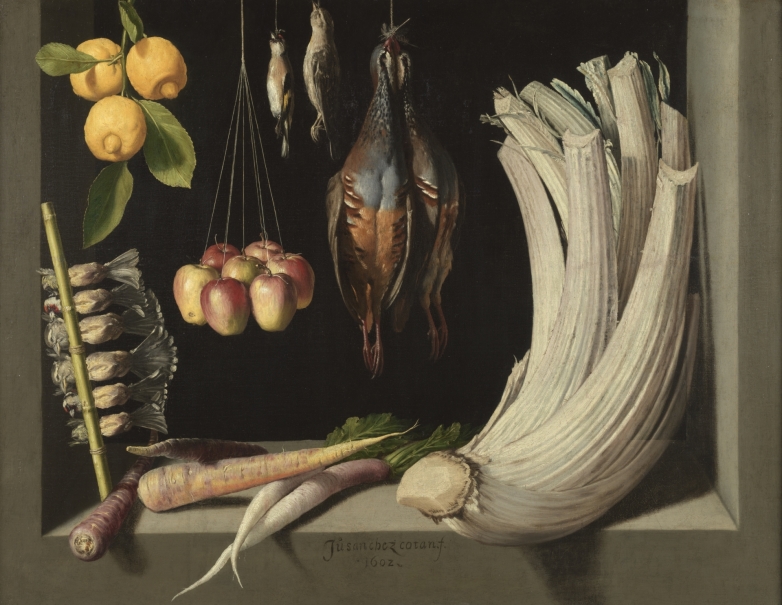
Bryson has good thoughts on Still Life - he goes through Juan Sanchez Cotan's hyperrealistic rhopography for the purpose of renouncing normal human priorities; Caravaggio for structuring monumental in scale similarly to a heroic history painting, Cezanne's megalography in theatrical effects of tone on shapes, the Dutch for their abundance even in vanitas form, Zurbaran's chiaroscuro for the purpose of humility, Juan Gris and the Cubist penchant for fragmented planes and spatial torsions.
Chapter 1 - on Roman xenia depictions:
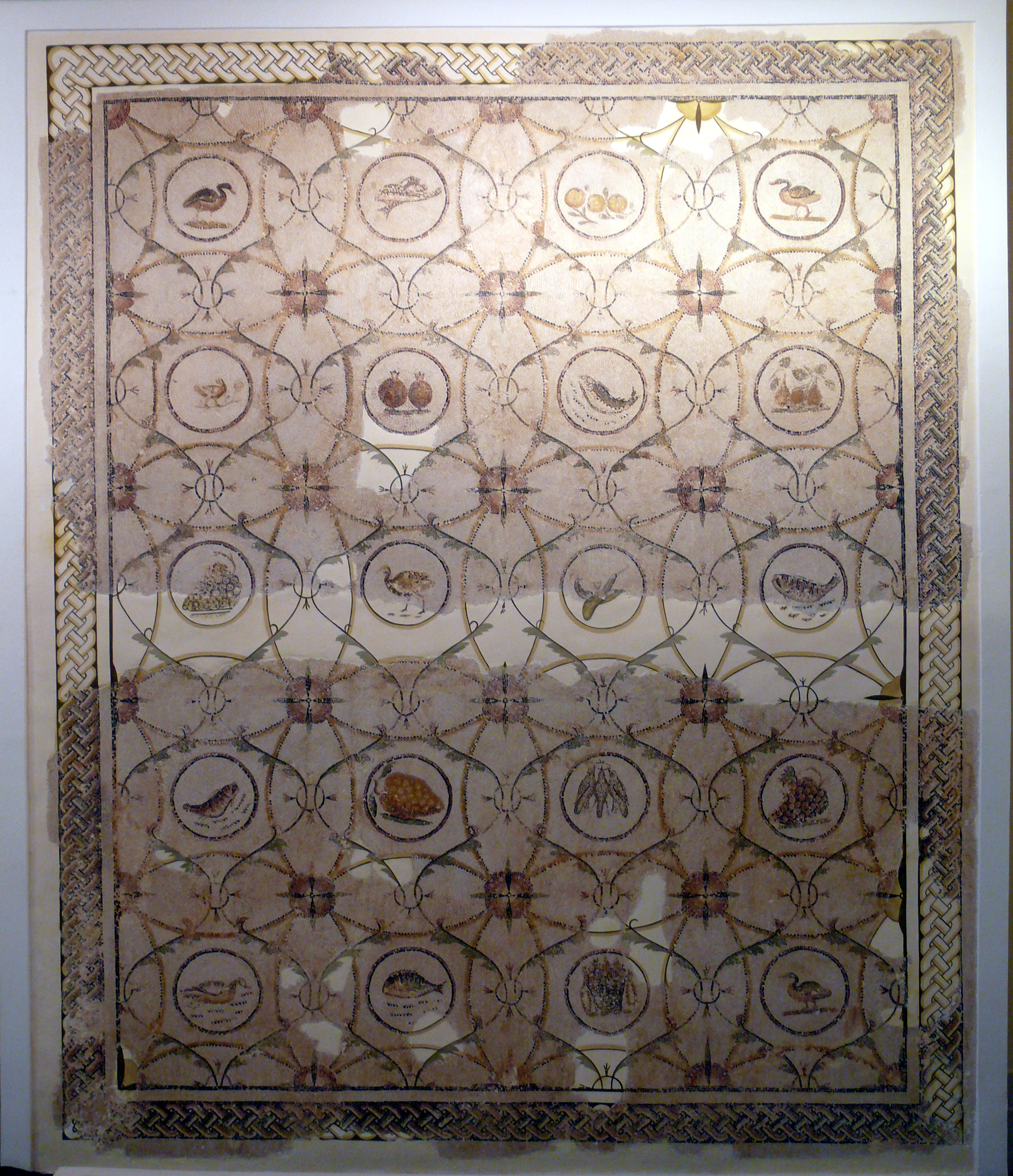
Not necessarily an origin of Still Life, this is an art form that is to be approached on its own terms. According to Vitruvius, xenias can only contain depictions of countryside produce: figs, honey, eggs, cheese, wine, pears and other produce that do not require human labour or culinary fire, fermentation seen as a work of Nature - every produce locally harvested, even the fig's branch produces the frame.
Vitruvius mentions a tradition taken from the Greeks of inviting guests to dinner and on the next day, send a gift of figs, honey, fruit, vegetables and other raw country produce. This particular form of hospitality was to disperse social distance: the guest is initially absorbed into the household, but allows for them to also eat the food separately, in their own space, respecting autonomy and independence.
The Greek word xenos refers equally to Guest and Host, so the relationship of dependence between them is replaced by one of equality; the aim is a suspension of social relations of rank and patronage. To that end, the dishes are raw and simple, instead of an abundant display of wealth, so the relationship of Host and Guest is transformed into a relationship of Human and Nature, where Nature shows no trace of human work or social difference: figs open by their own, honey oozes from the comb by itself - there is a sense of fantasy of a wealth of Nature shared equally by all, regardless of social hierarchy - the equality of a world so abundant that there is no need to fight for a plate.
Chapter 4, on still life and feminine space:
Here, I cannot quite put my finger on what exactly was Bryson smoking whilst writing: he argues that Still Life is looked down upon because it deals in objects that are mostly handled by Women: food, interiors, tables, vases, pitchers, jugs, luxury nautilus cups etc; he involves Freud's mother-figure-madness into it and I'm wondering whether this way of thinking isn't... sexist in itself?
Neither sexism nor art hierarchy started because of a couple of Dutch paintings of women sitting at tables or because Rembrandt painted men in guildhalls and women inside houses - on the contrary - this just proves that Dutch culture already had preordained gender roles, no different than any other European society of the time, I think of France's Chardin depicting most of his women busy with some form of house labour.
I have no desire to put the Reader off this book, it's a really good observational study on human's historical perception of Objects, Still Life, and Art history - just that last chapter to be taken with a pinch of salt.
"The year is regulated by a cycle of indulgence and rationing which ensures that the earth's fruits are evenly spread, whether troweling piles of food onto the groaning boards or eking out a meal of herring and bread" Bryson on Pieter Brueghel the Elder
Still life's history is a lot richer than one would imagine. Bryson goes all the way back to the proto-still life paintings of the Roman trompe l'oeil frescos, breaking down the layers of cultural meaning buttressing the imagery. It only gets richer and headier from there.
If you're looking for something beyond a simple descriptive history of still life painting, this is your book.
following bryson's arguments are very enjoyable and supremely enlightening. the chapter on rhopography can be very impactful for all artists, all are valuable.
I just love the way this is written. Look at this:
...the forms of still life have enourmous force (jug, jar, bowl, pitcher). As humnan time flows around the forms, smoothing them and tending them through countless acts of attention across countless centuries, time secrets a priceless product: familiarity.