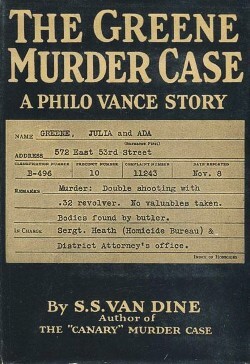
Willard Huntington Wright, under the pseudonym S. S. Van Dine, wrote the Greene Murder Case in 1928. It's the third in a series of detective novels centered on Philo Vance. The protagonist of "Greene" is Philo Vance, a wealthy, thirty-something New York art lover and expert. Vance is a erudite who seems to know something about everything, and a lot about art, history, and classic literature in particular.
I'd seen several old Philo Vance movies in the past, several of which starred William Powell, one of my favorite actors, and I think he was perfect in the role. In truth, the Philo Vance character is more Willard Huntington Wright than anyone else.
Vance's personal attorney, assistant, general secretary, friend, and almost constant companion in the Philo Vance novels is . . . wait for it . . . S. S. Van Dine. That's right. It's Van Dine who is our chronicler/story-teller, much as Doctor Watson told the stories of his friend and sleuth, Sherlock Holmes. Unlike Watson, the Van Dine of these stories does not participate in the action. He's an observer to the investigations and solutions, who recounts them to us. It works.
In "Greene," as in all of the Philo Vance stories, our hero/protagonist is invited by the NY District Attorney to observe/participate/assist in an murder investigation. The NYDA is Vance's longtime, close friend who takes a far more active role in police investigations than any DA you've ever encountered, going to far as actual crime scene investigation and witness interrogations. Taking this process as logical and factual, and getting to the stories themselves, our cast of characters work well together.
"The Greene Murder Case" starts when two young-adult daughters of an extremely wealthy family are mysteriously shot in the families NY City Mansion late one night. One of the sisters, who has been shot point-blank in the chest, dies. The other, younger adopted sister, has been shot point-blank in the back, but she lives to recover relatively quickly. The NYPD, NYDA, and Philo Vance, accompanied by his ever-present sidekick, Van Dine, show up to unravel the mystery.
What follows is a classic Who-Done-It, with lots of characters, suspects, and clues. Some of those clues seem more obvious to us as readers than they appear to the authorities. We're never quite sure what Vance thinks, as he always keeps his cards close to his vest until the great unveiling near the end where he discloses all.
As the story starts, there is the aged, invalid mother and widow of the family's patriarch and source of vast wealth, two sons, and three daughters, one now dead. Before your read is finished there will be more violence, and more bodies drop.
Can Philo Vance stop the carnage before the family is obliterated? THAT is the story, but I'm not going to disclose any more of the plot, as that would destroy the fun of uncovering it for yourself.
Wright/Van Dine has created a great story that keeps the reader involved and anxious to see what happens next. He writes intelligently--at times almost too much so. There's a lot of references to The Classics, Latin, Shakespeare, and others, that certainly fit the Philo Vance character, but could be off-putting to some readers. I'm a pretty well-educated reader, but I had to stop a few times to check for the meanings of some words or references.
Do any of those style elements detract from the overall enjoyment of the story? Not for me, as I've already started reading the next story in the Philo Vance series. I loved "The Greene Murder Case," and think you will, too.