
What do you think?
Rate this book

256 pages, Paperback
First published October 1, 2011


There are many types of people who choose to live off-grid: some are committed environmentalists who approach the issue as an exercise in planning and ecological science; some are technology dropouts who just have to get away, no matter what it takes; many are natural inheritors of rural traditions who choose to embrace their environment as fully as possible, for ideological, practical, or financial reasons. Ted Carns grew up on a financially marginal family property in rural Pennsylvania and eventually settled there, finding that the deep well of practical know-how he and his family possessed, and his general distaste for the rat race, led him to greater and greater self-sufficiency as a means of extracting himself from the pressures of the money economy. He (with, later, his wife Kathy) gradually developed his property, installing sustainable technologies, amateur architecture projects, and an integrated and bounteous ecosystem that supports them in abundance in return for their considerable, and ongoing, personal inputs of labor and planning.
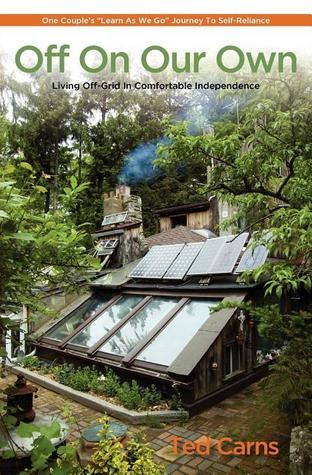
Off On Our Own: Living Off-Grid in Comfortable Independence: One Couple's "Learn as We Go" Journey to Self-Reliance in many ways reads like the well-known sustainability memoirs of Helen and Scott Nearing, providing a history of the Carns's efforts and the various projects they took on over the years, detailing techniques of farming and DIY technology that did or did not succeed, and illustrating their home, gardens, and various other projects as examples for others to take advantage of. Like the Nearings, the Carnses have become local environmentalist gurus, and their homestead - "Stone Camp" - has become an educational destination for those interested in sustainable lifestyles or contemplating starting their own off-grid property.
The Carnses are not technology-phobic: they have a variety of power tools and electrical technology (including TV and radio) and discuss the pros and cons of solar, wind, and micro-turbine power sources and their own history with them. They willingly recycle plastic and metal from rubbish dumps for farm-related purposes, and see this as a form of environmental cleanup. But they also extoll hand labor, and have set up many ingenious (and not so) contraptions to assist with chores. Their attitude toward environmentalism is to seek net zero impact and to take personal responsibility - through personal labor - in doing so, but not to needlessly fetishize the "natural" to the point of excluding the actual benefits of technology. This is a valuable illustration of one point of view along the contentious spectrum of environmentalist purity, and one of the book's main strengths is the opportunity it provides to hear an experienced voice report on that topic.
The book contains a wealth of useful information, and many photographs, for those interested in pursuing a back-to-the-land off-grid lifestyle for themselves. Reading between the lines, it is also a revealing illustration of how far off any recognizable grid it is possible to go (living in a home partly constructed around a tree growing through the roof, drinking fermented glop from old canning jars, and dragging home every bit of scrap metal and broken machinery possible in order to retrofit them to some Rube Goldberg farm tool). It turns out that "comfortable independence" depends to a very great degree on what you regard as comfort.
Readers interested in environmentally-conscious living will find the book entertaining and thought-provoking. Those seriously contemplating pursuing a similar lifestyle will find it offers a useful exercise in repeatedly challenging themselves: "is that really necessary?"; "am I willing to go that far?"; "what are my commitments and what will I do to live up to them?" As a contribution to the literature of committed and experienced sustainable-lifestyle advocates, Off On Our Own occupies a particular and fascinating niche, simultaneously more extreme in practice but less so in politics than the works of the Nearings, more slapdash in execution than the Whole Earth ethos but more inventive and creative than Mother Earth News. The Carnses come off as a cross between an old farmer-hippie couple and Tom Bombadil and Lady Goldberry of Tolkien's fantasy paradise - a charming and welcoming pair of guides along an unique but rewarding path.


