

What do you think?
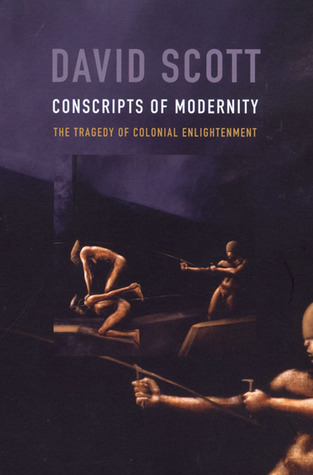
Conscripts of Modernity: The Tragedy of Colonial Enlightenment
At this stalled and disillusioned juncture in postcolonial history—when many anticolonial utopias have withered into a morass of exhaustion, corruption, and authoritarianism—David Scott argues the need to reconceptualize the past in order to reimagine a more usable future. He describes how, prior to independence, anticolonialists narrated the transition from colonialism to postcolonialism as romance—as a story of overcoming and vindication, of salvation and redemption. Scott contends that postcolonial scholarship assumes the same trajectory, and that this imposes conceptual limitations. He suggests that tragedy may be a more useful narrative frame than romance. In tragedy, the future does not appear as an uninterrupted movement forward, but instead as a slow and sometimes reversible series of ups and downs. Scott explores the political and epistemological implications of how the past is conceived in relation to the present and future through a reconsideration of C. L. R. James’s masterpiece of anticolonial history, The Black Jacobins , first published in 1938. In that book, James told the story of Toussaint L’Ouverture and the making of the Haitian Revolution as one of romantic vindication. In the second edition, published in the United States in 1963, James inserted new material suggesting that that story might usefully be told as tragedy. Scott uses James’s recasting of The Black Jacobins to compare the relative yields of romance and tragedy. In an epilogue, he juxtaposes James’s thinking about tragedy, history, and revolution with Hannah Arendt’s in On Revolution . He contrasts their uses of tragedy as a means of situating the past in relation to the present in order to derive a politics for a possible future.
296 pages, Paperback
First published November 1, 2004
About the author
David Scott
8 books11 followersDavid Scott is Professor of Anthropology at Columbia University. He is the author of a number of books, including Omens of Adversity: Tragedy, Time, Memory, Justice and Conscripts of Modernity: The Tragedy of Colonial Enlightenment, and is the editor of Small Axe: A Caribbean Journal of Criticism, all also published by Duke University Press.
Ratings & Reviews
Friends & Following
Create a free account to discover what your friends think of this book!
Community Reviews
Displaying 1 - 20 of 20 reviews
December 3, 2007
Amazing book, bursting with ideas. Drawing on R.G. Collingwood and Quentin Skinner, among others, Scott engages with C.L.R. James' "The Black Jacobins" to rethink the postcolonial present through the colonial past. The only thing missing from this book, I feel, is a closer engagement with the text of the "Black Jacobins" itself. While this might not be the task that Scott sets for himself - why tread, after all, where the mighty Robert Hill has already tread - but when Scott does engage the text, his close readings are so compelling that you wish he had dedicated the whole book to an exegesis of "Jacobins."
March 11, 2026
Theoretically rich, but only acceptable if one shares Scott's extremely pessimistic view of the postcolonial that precludes any sort of revolutionary change. Scott never explains *why* the "longing for total revolution" must be displaced by a rethinking of colonial power in a Foucauldian vein, except for a bit in his epilogue where his liberal Arendtian intentions to twist James into disavowing revolution as a manipulative destruction of freedom are revealed.
It seems to me that the dialectics of colonial "conscription" into modernity can coexist, indeed *have* to coexist, with that of the agency of anticolonial revolt. The idea that the anticolonial is no longer relevant in the postcolonial moment has become a laughable, if not dangerous assertion, in the aftermath of the Gazan genocide (not to mention that Palestine was still occupied while Scott was writing twenty five years ago!).
Scott's thoughts are interesting, and they bring important critiques of postcolonialism, but in the wrong direction. The postcolonial rejection of the nationalist postrevolution as it developed was correct, but they erred in rejecting Fanon and the anticolonial. Scott intensifies this mistake rather than resolving, certainly in a manner James would have resolutely dismissed (and I'm disappointed to see few Jamesians wield this critique against Scott, who is cited widely!).
I imagine many of the Goodreads reviews came from grad students who had seminars, lectures, and instructors guiding them through this work and extrapolating the Foucauldian historiography while discarding the political conclusions. I could not imagine receiving it positively otherwise.
It seems to me that the dialectics of colonial "conscription" into modernity can coexist, indeed *have* to coexist, with that of the agency of anticolonial revolt. The idea that the anticolonial is no longer relevant in the postcolonial moment has become a laughable, if not dangerous assertion, in the aftermath of the Gazan genocide (not to mention that Palestine was still occupied while Scott was writing twenty five years ago!).
Scott's thoughts are interesting, and they bring important critiques of postcolonialism, but in the wrong direction. The postcolonial rejection of the nationalist postrevolution as it developed was correct, but they erred in rejecting Fanon and the anticolonial. Scott intensifies this mistake rather than resolving, certainly in a manner James would have resolutely dismissed (and I'm disappointed to see few Jamesians wield this critique against Scott, who is cited widely!).
I imagine many of the Goodreads reviews came from grad students who had seminars, lectures, and instructors guiding them through this work and extrapolating the Foucauldian historiography while discarding the political conclusions. I could not imagine receiving it positively otherwise.
November 14, 2025
Honestly I wanted this to be so much better. David Scott is super smart and super well read, and as a result, his book is very insightful. However, I came into the project with a very specific interest in the writing of history, and specifically how it was done in C. L. R. James’ The Black Jacobins, and while Scott obviously takes it up throughout, James’ work felt more like a means to a theoretical end than the protagonist y the study. Theory surrounding romantic and tragic emplotment of history was the goal, and this was valuable, I have to say. My final gripe was a lot of repetition and introductory language, personal thing I guess. Maybe this book deserves 4/5, will def keep thinking abt it cause there’s lots to chew on for sure
January 11, 2021
The author's project is to assign the "failure" of anticolonial movements to purely idealist reasons (that the colonized cannot possibly liberate themselves from enlightenment ideas or western ideas), a defeatist and ahistorical take which ignores the material conditions each of these struggles took place in, pressures within and without, the global system of slavery, capitalism. Taking these things into account would mean actually studying their impacts on people's actual lives not only on ideas. Very reductive analysis and it doesn't even stem from the masses of these countries, they are actually absent from the book. If you hate hope read this.

July 23, 2014
Great commentary on C.L.R. James that made me appreciate The Black Jacobins even more as a central document of modernity. I felt there was a bit too much "what I intend to show" and not enough showing, although I feel the book is well worth the time of any fan of The Black Jacobins.

September 5, 2018
3.9 stars. I enjoyed it and found it stimulating, and I recommend it overall. It seems to offer a novel reading of CLR James's The Black Jacobins. However, something about Scott's broader historiographical intervention felt lacking.
A few of the critical scholarly reviews I've read take other issues with the book--the centering of Toussaint Louverture in tragedy as a "great man" arising from history (rather than taking into account collective history of the Haitian people/revolutionaries), the sidelining of other important figures in the revolution and of the Cuban Revolution, and the focus on present and historical moments as homogenous ("we" are in the postcolonial contemporary problem-space)--but none seem to take direct hits at the central thesis, which is the part that feels underwhelming to me. My reading of Scott's argument is: "After Bandung," we moderns (setting aside the aforementioned definitional problems there) face not the Romantic vindicationism of anticolonial revolution but tragic postcolonial conditions, in which our choice for possible futures is not between colonialism and some alternative future or a return to "before colonialism," but between choices *within modernity.* - i.e., rendering us "conscripts of modernity." Scott calls on postmodern intellectuals not to exercise anticolonial attitudes but, rather, the tragic sensibility inherent in recognizing the "ambiguity and complexity" of the postcolonial conditions that shape our choices in the first place. Our rational faculties, he argues, should employ compassion and humility, recognizing that enlightened principles are always subject to "chance and contingency" -- that which is beyond human control.
This doesn't seem very interesting to me, not because I disagree, but because it's all been said before, right? The book itself implicitly admits this; the discussion of tragedy and moral/political theory largely draws on prior scholarship and merely drops it into the postcolonial setting (the seamlessness of that "drop in" is also worth interrogating). I'm also unclear what exactly it means to recognize the limits of one's rationality; how does that help postmodern intellectuals negotiate their so-called "tragic" choices, other than a vague exercise of compassion and open-mindedness to contingency/chance/ideas not one's own? As a reading of The Black Jacobins, the book is great. But as a broader intervention, I fail to see the novelty. Or am I misreading something?
Also, three other things: (1) Isn't it more interesting, perhaps, to think about how we can reshape these conditions in the first place, to combat modernity's positive power structures with our own restructuring? In that sense, Scott's call to the tragic seems awfully passive. (2) Doesn't Foucault's discussion of heterotopias in The Order of Things and "Of Other Spaces" grapple with the ambiguity/complexity of modern structures, thereby undermining the Foucault/Habermas dynamic which forms a central impasse that Scott attempts to answer or move past? (3) Scott says quite a lot about decentering Eurocentric scholarship, but almost all of his references are Euroamerican, so... ? Like, the focus on tragedy alone seems pretty Eurocentric; surely, there are many other narrative forms that might allow us to rethink ambiguity/complexity/contingency (see, e.g., Dipesh Chakrabarty's The Calling of History).
Side-gripe: Why is the DR not mentioned once?!
A few of the critical scholarly reviews I've read take other issues with the book--the centering of Toussaint Louverture in tragedy as a "great man" arising from history (rather than taking into account collective history of the Haitian people/revolutionaries), the sidelining of other important figures in the revolution and of the Cuban Revolution, and the focus on present and historical moments as homogenous ("we" are in the postcolonial contemporary problem-space)--but none seem to take direct hits at the central thesis, which is the part that feels underwhelming to me. My reading of Scott's argument is: "After Bandung," we moderns (setting aside the aforementioned definitional problems there) face not the Romantic vindicationism of anticolonial revolution but tragic postcolonial conditions, in which our choice for possible futures is not between colonialism and some alternative future or a return to "before colonialism," but between choices *within modernity.* - i.e., rendering us "conscripts of modernity." Scott calls on postmodern intellectuals not to exercise anticolonial attitudes but, rather, the tragic sensibility inherent in recognizing the "ambiguity and complexity" of the postcolonial conditions that shape our choices in the first place. Our rational faculties, he argues, should employ compassion and humility, recognizing that enlightened principles are always subject to "chance and contingency" -- that which is beyond human control.
This doesn't seem very interesting to me, not because I disagree, but because it's all been said before, right? The book itself implicitly admits this; the discussion of tragedy and moral/political theory largely draws on prior scholarship and merely drops it into the postcolonial setting (the seamlessness of that "drop in" is also worth interrogating). I'm also unclear what exactly it means to recognize the limits of one's rationality; how does that help postmodern intellectuals negotiate their so-called "tragic" choices, other than a vague exercise of compassion and open-mindedness to contingency/chance/ideas not one's own? As a reading of The Black Jacobins, the book is great. But as a broader intervention, I fail to see the novelty. Or am I misreading something?
Also, three other things: (1) Isn't it more interesting, perhaps, to think about how we can reshape these conditions in the first place, to combat modernity's positive power structures with our own restructuring? In that sense, Scott's call to the tragic seems awfully passive. (2) Doesn't Foucault's discussion of heterotopias in The Order of Things and "Of Other Spaces" grapple with the ambiguity/complexity of modern structures, thereby undermining the Foucault/Habermas dynamic which forms a central impasse that Scott attempts to answer or move past? (3) Scott says quite a lot about decentering Eurocentric scholarship, but almost all of his references are Euroamerican, so... ? Like, the focus on tragedy alone seems pretty Eurocentric; surely, there are many other narrative forms that might allow us to rethink ambiguity/complexity/contingency (see, e.g., Dipesh Chakrabarty's The Calling of History).
Side-gripe: Why is the DR not mentioned once?!

November 22, 2025
A mix of Michel Foucault, Hayden White, and Talal Asad to ask questions about how our desires for certain emancipatory futures give shape to our questions about the past and our actions in the present. Hall is less concerned with actual material history but with narrative, how a kind of romantic longing for overcoming and redemption shapes these desires. But he posits that such a mode of emplotment may be less efficacious than it once was, especially in light of a series of failed nationalist projects in the 20th century. He argues that tragedy may speak better to our (postcolonial) present, and he uses James’s text The Black Jacobins as a catalyst for his speculations, especially honing in on James’s revisions of the text for its second edition. I was just a little unclear where such a project leads those of us who wish to overcome capitalism, contemporary forms of imperialism, and coloniality. We just sit with contingency and the suspicion that we’re far more limited than we understood previously, that at any moment long-held assurances could suddenly become undone? Still, he asks some good questions. I’m impressed by the range of thinkers he was able to synthesize to frame his project.

June 26, 2020
A Benjaminian style awareness of the re-production of history built atop the tragedy of anticolonial utopias becoming postcolonial nightmares.
He reexamines James' The Black Jacobins and redeems the narrativistic construction of this history which characterized Toussaint on a scale comparable to the greek icons in Homer.
Most beautifully, Scott finds in the genre of tragedy a philosophical logic that mythopoetically challenges the dialectic of enlightenment (seemingly building on Adorno's critique)
He reexamines James' The Black Jacobins and redeems the narrativistic construction of this history which characterized Toussaint on a scale comparable to the greek icons in Homer.
Most beautifully, Scott finds in the genre of tragedy a philosophical logic that mythopoetically challenges the dialectic of enlightenment (seemingly building on Adorno's critique)

March 20, 2025
Good blend of literary criticism and philosophy of history. A lot of the concepts seem common sense now - to contextualize anticolonial writings in the colonial worlds they were in (and beware of how their worlds were linked to ours) - but this certainly reinforces the message that our imaginations are conditioned by prior reality, and past solutions condition (though not determine) present questions.

May 19, 2026
a well argued book with many valid points on how we should see ourselves as postcolonial subjects, and how we conceptualize history based on the conditions of our present. david scott makes many points in this dense text concerning the narrativization of history and what we stand to gain by writing history in one narrative form over another.

November 3, 2019
Scott rereads CLR James The Black Jacobins and articulates some fascinating ideas about the tragedy of the postcolonial condition.

August 1, 2022
never before has a piece of academic writing made me weepy the way this one did
March 23, 2023
This is unbelievably elegant and lucid, more like an extended essay than anything. It's wonderful!

October 13, 2024
Interesting book! In the face of political hope, it is quite grim to see how our enlightenment ideals might not fruit because of the necessities of the practical world 🌹.

November 12, 2025
started to all make sense like 140 pages in

January 21, 2013
In Conscripts of Modernity: The tragedy of Colonial Enlightenment, David Scott utilizes his anthropological acumen to excavate his hypothesis by asking the appropriate questions as it relates to politics; and where the concept of anticolonial revolution stands in this present age. Scott states that antiquated questions are no longer adequate for the present age. He states, “ the way one defines the alternative depends on the way one has conceived the problem; consequently, reconceiving alternatives depends in significant part on reconceiving the object of discontent and thus the longing that stimulates the desire for an alternative.” Scott applauds the view that it is not the anticolonial nationalist’s answers that have needed changing so much as the postcolonial theorist’s questions that needed dissolving. In other words, Scott says, it is the old object of anticolonial discontent that needs reformulation.

February 5, 2008
Ok, so I am almost done with this one... while i like the fact that he is trying to engage with the politics (and discursive nature) of history, I am sort of enthused by the overindulgence in continental philosophy and what seems to be an uncritical distinguishing between the anticolonialism of the moment that CLR James wrote the black jacobins and now. I guess I am pedestrian in my thinking about that difference but really its not clear to me. Overall: interesting ideas about historical narrative, worth reading, but also not earth-shattering.
Currently Reading
June 26, 2008I learned at SCAs that dude is snarky as fuck and has a smooth ass Caribbean accent. Don't know if I like his book yet

May 22, 2009
read for 240a. interesting points, valuable reminder of the politics of writing. serious questions about the linearity of time in the piece, as well as his appraisals of our present-in-ruins
Displaying 1 - 20 of 20 reviews