In December 1903 a British army marched over the Himalayas to counter a non-existent Russian threat and was confronted by a medieval Tibetan army ordered to stop it by non-violent means. It was a clash between the mightiest political power in the world and the weakest: a land of mystery locked behind the most formidable natural barriers on earth and governed by a reincarnate lama.
Leading what was supposed to be a peaceful political mission was the charismatic Francis Younghusband. At his side, a group of young officers who were as eager as he to be the first Europeans in almost a century to reach Lhasa: to gaze, as one of their number put it, 'with awe upon the temples and palaces of the long-sealed Forbidden City'. But commanding the army escort was an officer determined to do things by the book: General James Macdonald, known to his troops as 'Retiring Mac'. The result was conflict at every level, with a tragic outcome that both enthralled and shocked the outside world.
Drawing on diaries, letters and unpublished first-hand accounts, Charles Allen overturns this accepted view, presenting the real story of what became known to history as the Younghusband Mission. In doing so, he reveals not only the true character of one of Britain's great imperial heroes but also the calamitous outcome for the Tibetan people of Britain's last attempt at empire-building.
Charles Allen is a British writer and historian. He was born in India, where several generations of his family served under the British Raj. His work focuses on India and South Asia in general. Allen's most notable work is Kipling Sahib, a biography of Rudyard Kipling. His most recent work, Ashoka: the Search for India's Lost Emperor, was published in February 2012.
Selected works:
Plain Tales from the Raj: Images of British India in the Twentieth Century (1975) Raj: A Scrapbook of British India 1877–1947 (1977) Tales from the Dark Continent: Images of British Colonial Africa in the Twentieth Century (1979) A Mountain in Tibet: The Search for Mount Kailas and the Sources of the Great Rivers of India (1982) Tales from the South China Seas: Images of the British in South-East Asia in the Twentieth Century (1983) Lives of the Indian Princes, with co-author Sharada Dwivedi (1984) Kipling's Kingdom: His Best Indian Stories (1987) A Glimpse of the Burning Plain: Leaves from the Journals of Charlotte Canning (1986) A Soldier of the Company: Life of an Indian Ensign 1833–43 (1988) Architecture of the British Empire, Ed. R. Fermor-Hesketh (1989) The Savage Wars of Peace: Soldiers' Voices 1945–1989 (1990) Thunder and Lightning: The RAF in the Gulf War (1991) The Search for Shangri-La: A Journey into Tibetan History (1999) India Through the Lens: Photography 1840–1911, Ed. Vidya Dehejia (2000) Soldier Sahibs: The Men who Made the North-west Frontier (2000) The Buddha and the Sahibs: The Men who Discovered India's Lost Religion (2002) Duel in the Snows: The True Story of the Younghusband Mission to Lhasa (2004) Maharajas: Resonance from the Past (2005) God's Terrorists: The Wahhabi Cult and the Hidden Roots of Modern Jihad (2006) Kipling Sahib: India and the Making of Rudyard Kipling (2007) The Buddha and Dr Führer: An Archaeological Scandal (2008) The Taj at Apollo Bunder: The History of the Taj Mahal Palace, Mumbai, with co-author Sharada Dwivedi (2011) Ashoka: The Search for India's Lost Emperor (2012)
I could probably write a REALLY long review of this one; but since only 30+ folks have rated it in the past 20 years, it's not like a lot of people are waiting for my thoughts here before reading it for themselves. That said, however, a coupla things…
First off, Allen is undeniably a strong writer and researcher, and both the British Raj and Tibet are obviously close to his heart (see his earlier — and better — A Mountain in Tibet). However, the subtitle here — "The True Story of the Younghusband Mission to Tibet" — is both accurate AND misleading, since while it is correct that this is "the true story," the fact is that all previous books on this topic have been "true stories" as well, since Allen really presents no new information here. Yes, he's included material from previously unsourced diaries and reports, but there are really no new facts to report.
What IS new here are some of his conclusions, or at least his bias. Overall, he comes across a little more favorably disposed to military leader Gen. James Macdonald (although frequently noting that he was largely disliked by most everyone else on the mission), and more negative towards political commissioner Younghusband himself — often inexplicably so. For example, early on he states that Younghusband "contrived to get himself involved" in the relief of Chitral as a correspondent for The Times, although Younghusband was in fact an obvious choice; he was at the time on extended leave from the Indian Army, and had previously served as the political agent to Chitral — so who indeed would have been better? And I found it surprising that Allen — himself British — consistently chooses to interpret (i.e., misinterpret) the sort of self-deprecating tone common in many English military and travel writers (see any of Peter Fleming's travel writings) as moments of unguarded self-revelation; and he unfailingly (and intentionally?) views Younghusband's attempts at humor in describing both the Tibetans and his own troops as "mocking" or "humiliating." Overall, IMHO and based on extensive related reading, I have to conclude that Allen goes out of his way to ascribe motivations and emotions to several major characters that just aren't borne out by the source material itself.
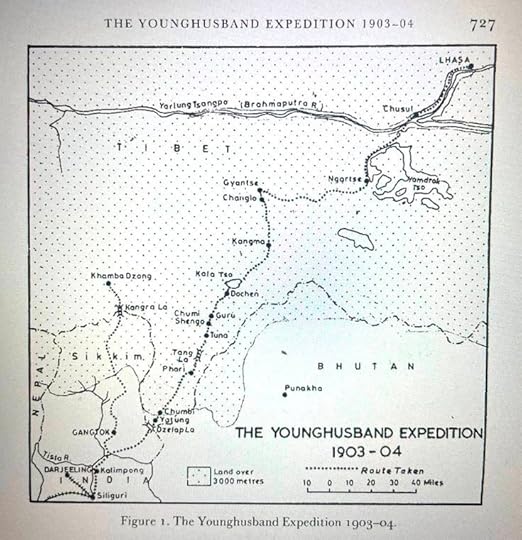
But my BIGGEST complaint with the overall book is the lack of any map showing the convoluted route of the Mission — how hard would it have been to include something like this anywhere in the book?
Instead, we are confronted with endless"Las" (passes), “Tsos” (lakes) and "Jongs" (forts) that are visited and revisited, and barraged with passages like "...it is impossible to visit the killing field at Chumik Shenko beside the Bam Tso or to cross the Tang La to Phari Jong and Chumbi. But it is possible to drive through the Red Idol Gorge as far south as Kangmar and to follow the invading army's route from Gyantse up and over the Karo La..." with zero attempt at putting any of this into geographical perspective.
Anyway — glad I finally read this; it's been sitting on my GR "to read" shelf for over a decade, and on my physical bookshelf for twice that long. But for anyone else interesting in reading about this final episode of the Great Game, you'd be better served reading any of the classics by Peters Hopkirk and Fleming, Patrick French, or Younghusband himself.
This was utterly fascinating, especially when read in conjunction with the account written by Edmund Candler, the Daily Mail journalist who accompanied the invasion. (I was amused to read that Younghusband described Candler as “a fearful bounder…I feel sorry for the readers of the Daily Mail.”).
I knew almost nothing about the British invasion of Tibet before reading these two books but I am now left in no doubt that it was one of the most infamous, illegal, and unprovoked attacks ever perpetrated by a strong power on a weak one. Colonel Younghusband emerges as a most noxious villain. He deliberately provoked resistance from the inadequately armed Tibetans and deliberately massacred thousands of them with the use of Maxim guns when they tried to flee. He was childish and petulant to colleagues, disobeyed orders from superiors, and engaged in looting and destruction of Tibetan property with little or no military justification. His treatment of Tibetan religion was a disgrace – he described tormenting the monks as “great sport.”
Younghusband was also a coward who fled in terror in his pyjamas when his base was attacked (having stupidly detached many men and weakened the defences) and when his servants took part in the defence, instead of commending them, he mocked them. It is remarkable that such a vile human being could have had supporters even long after the event – including Peter Fleming, who was apparently a Younghusband fanboy. I find nothing can be said in Younghusband’s favour. Either the Dalai Llama should have caught him and hanged him, or the British Government should have done (no chance of that, even though many Tory MP’s were angry and concerned, especially about the massacres of Tibetans).
Doctor Waddell, the invasion’s chief medic and Tibetan “expert”, looted on an epic scale and hypocritically court martialled an unfortunate couple of Sikh soldiers for trying to replicate on a smaller scale what he was doing himself. His denials that he engaged in looting are shown by the author to be contradicted by the evidence of contemporary letters. He was a liar as well as a thief.
Can anything positive be said about all this? Many young British officers, and their mostly Sikh and Gurkha soldiers, performed acts of quite astonishing heroism worthy of a better cause. So did some Tibetans, though hamstrung by ineffective leadership, and especially the Dalai Llama’s insistence that they avoid confrontation as much as possible. On the one hand, thousands of Tibetans were cruelly slaughtered while trapped or trying to flee, but on the other hand, those who were captured were treated with humanity. Even the evil Doctor Waddell partially redeemed himself by giving free medical treatment to hundreds of Tibetan civilians – the first time they had encountered modern medicine.
But overall this is a melancholy tale. The destruction by the invaders of the 14th century Tsechen monastery was an appalling act of cultural vandalism. To add yet further humiliation, the Tibetans were forced to pay the invaders’ costs – at an inflated rate which would have bankrupted the country had the terms not later been softened (once Younghusband was out of the picture).
This is an excellent narrative – clear, lucid, and exciting – of a tragic and unnecessary episode. It tells you far more about what really happened than Candler’s colourful but biased journalism.
The Younghusband Tibetan Mission was another episode in the Great Game between Great Britain and Russia although Younghusband in his megalomaniac and self-aggrandising way took it much further than the British government had actually allowed. Britain had given a pledge to Russia that Tibet would not become a protectorate with a permanent Resident in Lhasa unless another power interfered. But that is exactly what the Commissioner planned to achieve as well as a permanent trade post in Gyantse and possession of the fertile Chumbi Valley, a plan that was on Viceroy Lord Curzon’s agenda, too.
Only held in check at times by his military escort and nemesis, cautious and punctilious General Mcdonald, Younghusband was prepared to take any risk to carry out his audacious plan and he pulled it through at great cost to the lives of his coolies, porters and innumerable poor yaks, mules, camels and horses while relatively few of the invading officers and Sikh and Gurkha sepoys died. The loss of Tibetan lives was in the thousands.
The Tibetans refused to negotiate with the British unless they went back to their own side of the border so Younghusband did everything he could to provoke the Tibetans into a violent reaction which had been forbidden by the Dalai Lama. Eventually the Tibetans realised with horror that all their mantras, charms and amulets were of no use against the ruthless invaders’ modern weapons so they tried to defend themselves as best they could with what they had. By now Younghusband had declared to the British government that there were any number of Russian rifles to be found and that it was actually a war against Russia, which was a blatant lie.
Amazingly, there were also three newspaper men - from the Daily Mail, the Times and Reuters - taking part in this incredibly tough and dangerous endeavour of crossing the mountains in winter and surviving on the icy, windswept Tibetan plateau.
Anyway, ignoring orders by his government, Younghusband and Macdonald finally made it to Lhasa, having killed or wounded about 3.000 Tibetans, destroyed monasteries, depleted their food stores, stolen their animals, looted their sacred objects, committed the massacre of Chumik Shenko and caused the Dalai Lama to flee. In the end a treaty was negotiated with Younghusband adding three clauses of his own and having the nerve to demand from the Tibetan government a vast sum of money as indemnity for the expenses incurred during the invasion. This treaty was later renegotiated, deleting Younghusbands three clauses. All in all, the result of the mission seems to have been hardly worth the effort and it did not bring the Commissioner the eternal glory he had expected.
Apart from the military side of the story, Charles Allen gives the reader a look at Tibetan society at the beginning of the 20th century, at the time “the most priest-ridden country in the world”. It was a centralised theocratic state run entirely by the lamas with the Dalai Lama at the head, all of whom had very little knowledge of the outside world. There were thousands of monasteries and nunneries with the largest, Drepung Gompa, estimated to house 10.000 monks, all practising Vajrayana, a form of tantric Buddhism involving mantras and idol worship, quite far removed from the Buddha’s original teachings. The people were basically serfs as all of the land and animals belonged to the monasteries. Men and women’s lives were short, harsh, ignorant and plagued by superstitious fears of malignant spirits, demons, hungry ghosts etc. Infant mortality was high and many young children had to be given to the monasteries as their families were not able to provide for them.
I'm not really into military history but I found this book by one of my favourite authors entirely engrossing.
An excellent account of one of the last great adventures of the British Empire. Charles Allen picks his way through the controversies and the often bitter divisions as the mission persistently exceeded its brief. There is a wealth of previously unpublished material and the story of the year long trek across the Himalayas to Lhasa is vividly told.
A very objective but easy-to read account of this little known incident in British and Tibetan history, the effects of which are still being felt today. Well worth a read.