

What do you think?

Five Days in London, May 1940
5/24 to 5/28/40 altered the course of the history, as the British War Cabinet debated whether to negotiate with Hitler or continue the war. The importance of these five days is the focus of Lukacs' new book. He takes us hour by hour into the unfolding of events at 10 Downing St, where Churchill & his cabinet were considering their war responsibilities. We see how the military disasters on the Continent--especially the plight of the nearly 400,000 British soldiers bottled up in Dunkirk--affected Churchill's fragile political situation, for he'd been prime minister only a fortnight & was regarded as impetuously hotheaded even by many of his own party. He also investigates the mood of the British, drawing on newspaper & Mass-Observation reports showing how they, tho only partly informed of the dangers, began to support Churchill's determination.
Preface
Acknowledgments
The Hinge of Fate
The turning point. Two accounts
The awesomeness of the German tide
Black Fortnight
Problems of British morale
Distrust of Churchill
Opinions & sentiments
"Outwardly calm, inwardly anxious"
Friday, 24 May
Hitler's halt order
The Germans before Dunkirk
Calais
Hitler & the Conservatives
The two Rights
Chamberlain
Appeasers
Halifax
The War Cabinet
Churchill & Roosevelt
The British press
"A slight increase in anxiety & a slight decrease in optimism"
Saturday, 25 May
An English weekend
The French: Weygand & Petain
Halifax & the Italian ambassador
Churchill & the Defence Committee
"Depression is quite definitely up"
Sunday, 26 May
An agitated day
Three meetings of the War Cabinet
Chamberlain, Halifax, Churchill
Disagreements between Halifax & Churchill
Scarcity of news: "A mandate to delay judgment & not to worry"
"In Westminster Abbey"
Monday, 27 May
What was happening at Dunkirk
The Belgians surrender
American considerations
Three War Cabinets & a walk in the garden
"You'd have been better off playing cricket"
Tuesday, 28 May
Morale, opinion & the press
"We cannot possibly starve the public in this way"
Foreigners & refugees
Churchill's instructions & the first War Cabinet
His statement in the Commons
The second War Cabinet
Churchill's coup
He comes through
Survival
A long-range view of the war
The meaning of Dunkirk
"It is time to face up to facts"
Halifax redux
An antiquated Britain
Churchill & Europe
Fortissimo
Bibliography
Illustration Credits
Index
Preface
Acknowledgments
The Hinge of Fate
The turning point. Two accounts
The awesomeness of the German tide
Black Fortnight
Problems of British morale
Distrust of Churchill
Opinions & sentiments
"Outwardly calm, inwardly anxious"
Friday, 24 May
Hitler's halt order
The Germans before Dunkirk
Calais
Hitler & the Conservatives
The two Rights
Chamberlain
Appeasers
Halifax
The War Cabinet
Churchill & Roosevelt
The British press
"A slight increase in anxiety & a slight decrease in optimism"
Saturday, 25 May
An English weekend
The French: Weygand & Petain
Halifax & the Italian ambassador
Churchill & the Defence Committee
"Depression is quite definitely up"
Sunday, 26 May
An agitated day
Three meetings of the War Cabinet
Chamberlain, Halifax, Churchill
Disagreements between Halifax & Churchill
Scarcity of news: "A mandate to delay judgment & not to worry"
"In Westminster Abbey"
Monday, 27 May
What was happening at Dunkirk
The Belgians surrender
American considerations
Three War Cabinets & a walk in the garden
"You'd have been better off playing cricket"
Tuesday, 28 May
Morale, opinion & the press
"We cannot possibly starve the public in this way"
Foreigners & refugees
Churchill's instructions & the first War Cabinet
His statement in the Commons
The second War Cabinet
Churchill's coup
He comes through
Survival
A long-range view of the war
The meaning of Dunkirk
"It is time to face up to facts"
Halifax redux
An antiquated Britain
Churchill & Europe
Fortissimo
Bibliography
Illustration Credits
Index
254 pages, Hardcover
First published January 1, 1999
About the author
John Lukacs
65 books119 followersLukacs was born in Budapest to a Roman Catholic father and Jewish mother. His parents divorced before the Second World War. During the Second World War he was forced to serve in a Hungarian labour battalion for Jews. During the German occupation of Hungary in 1944-45 he evaded deportation to the death camps, and survived the siege of Budapest. In 1946, as it became clear that Hungary was going to be a repressive Communist regime, he fled to the United States. In the early 1950s however, Lukacs wrote several articles in Commonweal criticizing the approach taken by Senator Joseph McCarthy, whom he described as a vulgar demagogue.[1]
Lukacs sees populism as the greatest threat to civilization. By his own description, he considers himself to be a reactionary. He claims that populism is the essence of both National Socialism and Communism. He denies that there is such a thing as generic fascism, noting for example that the differences between the political regimes of Nazi Germany and Fascist Italy are greater than their similarities.[2]
A major theme in Lukacs's writing is his agreement with the assertion by the French historian Alexis de Tocqueville that aristocratic elites have been replaced by democratic elites, which obtain power via an appeal to the masses. In his 2002 book, At the End of an Age, Lukacs argued that the modern/bourgeois age, which began around the time of the Renaissance, is coming to an end.[3] The rise of populism and the decline of elitism is the theme of his experimental work, A Thread of Years (1998), a series of vignettes set in each year of the 20th century from 1900 to 1998, tracing the abandonment of gentlemanly conduct and the rise of vulgarity in American culture. Lukacs defends traditional Western civilization against what he sees as the leveling and debasing effects of mass culture.
By his own admission a dedicated Anglophile, Lukacs’s favorite historical figure is Winston Churchill, whom he considers to be the greatest statesman of the 20th century, and the savior of not only Great Britain, but also of Western civilization. A recurring theme in his writing is the duel between Winston Churchill and Adolf Hitler for mastery of the world. The struggle between them, whom Lukacs sees as the archetypical reactionary and the archetypical revolutionary, is the major theme of The Last European War (1976), The Duel (1991), Five Days in London (1999) and 2008's Blood, Toil, Tears and Sweat, a book about Churchill’s first major speech as Prime Minister. Lukacs argues that Great Britain (and by extension the British Empire) could not defeat Germany by itself, winning required the entry of the United States and the Soviet Union, but he contends that Churchill, by ensuring that Germany failed to win the war in 1940, laid the groundwork for an Allied victory.
Lukacs holds strong isolationist beliefs, and unusually for an anti-Communist émigré, "airs surprisingly critical views of the Cold War from a unique conservative perspective."[4] Lukacs claims that the Soviet Union was a feeble power on the verge of collapse, and contended that the Cold War was an unnecessary waste of American treasure and life. Likewise, Lukacs has also condemned the 2003 invasion of Iraq.
In his 1997 book, George F. Kennan and the Origins of Containment, 1944-1946, a collection of letters between Lukacs and his close friend George F. Kennan exchanged in 1994-1995, Lukacs and Kennan criticized the New Left claim that the Cold War was caused by the United States. Lukacs argued however that although it was Joseph Stalin who was largely responsible for the beginning of the Cold War, the administration of Dwight Eisenhower missed a chance for ending the Cold War in 1953 after Stalin's death, and as a consequence the Cold War went on for many more decades.
Lukacs sees populism as the greatest threat to civilization. By his own description, he considers himself to be a reactionary. He claims that populism is the essence of both National Socialism and Communism. He denies that there is such a thing as generic fascism, noting for example that the differences between the political regimes of Nazi Germany and Fascist Italy are greater than their similarities.[2]
A major theme in Lukacs's writing is his agreement with the assertion by the French historian Alexis de Tocqueville that aristocratic elites have been replaced by democratic elites, which obtain power via an appeal to the masses. In his 2002 book, At the End of an Age, Lukacs argued that the modern/bourgeois age, which began around the time of the Renaissance, is coming to an end.[3] The rise of populism and the decline of elitism is the theme of his experimental work, A Thread of Years (1998), a series of vignettes set in each year of the 20th century from 1900 to 1998, tracing the abandonment of gentlemanly conduct and the rise of vulgarity in American culture. Lukacs defends traditional Western civilization against what he sees as the leveling and debasing effects of mass culture.
By his own admission a dedicated Anglophile, Lukacs’s favorite historical figure is Winston Churchill, whom he considers to be the greatest statesman of the 20th century, and the savior of not only Great Britain, but also of Western civilization. A recurring theme in his writing is the duel between Winston Churchill and Adolf Hitler for mastery of the world. The struggle between them, whom Lukacs sees as the archetypical reactionary and the archetypical revolutionary, is the major theme of The Last European War (1976), The Duel (1991), Five Days in London (1999) and 2008's Blood, Toil, Tears and Sweat, a book about Churchill’s first major speech as Prime Minister. Lukacs argues that Great Britain (and by extension the British Empire) could not defeat Germany by itself, winning required the entry of the United States and the Soviet Union, but he contends that Churchill, by ensuring that Germany failed to win the war in 1940, laid the groundwork for an Allied victory.
Lukacs holds strong isolationist beliefs, and unusually for an anti-Communist émigré, "airs surprisingly critical views of the Cold War from a unique conservative perspective."[4] Lukacs claims that the Soviet Union was a feeble power on the verge of collapse, and contended that the Cold War was an unnecessary waste of American treasure and life. Likewise, Lukacs has also condemned the 2003 invasion of Iraq.
In his 1997 book, George F. Kennan and the Origins of Containment, 1944-1946, a collection of letters between Lukacs and his close friend George F. Kennan exchanged in 1994-1995, Lukacs and Kennan criticized the New Left claim that the Cold War was caused by the United States. Lukacs argued however that although it was Joseph Stalin who was largely responsible for the beginning of the Cold War, the administration of Dwight Eisenhower missed a chance for ending the Cold War in 1953 after Stalin's death, and as a consequence the Cold War went on for many more decades.
Ratings & Reviews
Friends & Following
Create a free account to discover what your friends think of this book!
Community Reviews
Displaying 1 - 30 of 257 reviews

August 4, 2021
Wow! What a remarkable book that takes a true "inside" look at Churchill and his War Cabinet during the most crucial days of WW2. This is part of a group of books the author has written which examine WW2 and Churchill and despite its short length it provides so much insight as to how Churchill was able to turn the political tides in the UK and his War Cabinet at the time of the disastrous defeat and retreat from Dunkirk of the British Expeditionary Force (BEF). Taken from official British documents that had only been released prior to writing this book, as well as secret public opinion polls that were conducted daily, and a multitude of public and private diaries, Lukacs is able to give us a glimpse of both the politics and the general publics impressions on the course of the war. After he replaced Neville Chamberlain, Churchill kept him in the War Cabinet and he became an ally of Winston, he also appreciated Churchill allowing him to remain living at 10 Downing Street even though he was no longer the Prime Minister. Also you discover how Lord Halifax and Churchill butted heads over policy and how Halifax was ready to accept peace offers from Hitler while the fighting still raged in France. Eventually Churchill prevailed and the naval retreat from Dunkirk was a success. During this entire time the British public was kept in the dark about the BEF, how poorly the French were fighting on their home soil and the state of the evacuation/retreat. Truly a remarkable work of research and a great addition to any library on WW2. The author ends the book with some very good observations on the state of democracy and a prediction of a new dark age that would be coming to darken the lives of our children and grandchildren. Just a superb read!

September 19, 2021
Lukacs A párviadal c. könyvére azt találtam írni, hogy "elképesztő mélységű elemzés" Churchill és Hitler 1940-es összefeszüléséről. De akkor most erre a kötetre mit mondjak? Hogy egy tudományos Mariana-árok? Hm. Ez mondjuk így elég félreérthető lenne.
Akárhogy is, Lukacs prof az esemény 50 éves jubileumát közelegni érezvén úgy vélte, túl felületesen kapargatta csak azt a szerinte sorsdöntő időszakot, amikor Hitler győzelmének útjában egyedül a Brit Birodalom állt. Talán nem tettem elég világossá mindenkinek - tépelődött -, hogy Churchill mekkora istenkirály csávó, a komplett európai civilizáció megmentője, a konzervatív hazafiság csillámló fárosza, visszafogott értelmezésben, persze. Ha én akkor ott lettem volna, nyilván azt mondom, hogy "De, János, mindezt félreérthetetlenül világosan közölted", de szerencsére nem voltam ott, aminek eredménye ez az elemzés.
Szerzőnk ezúttal csak öt napra koncentrál: az 1940. május 24-től 28-ig terjedő intervallumra, amikor az egymást követő haditanácsokon Churchill megsemmisítette a defetistákat, és felszámolva a békepártiak utolsó barikádjait is, létrehozta azt a nemzeti egységfrontot, amibe aztán bele is tört a Luftwaffe foga. Ebben a kontextusban az igazi antagonista nem Hitler, de nem is Chamberlain*, hanem Lord Halifax, aki Churchillt valami meggondolatlan bugrisnak tekintette, aki vesztébe viszi a birodalmat - ő maga viszont a józan elme, aki tudja, mi a megoldás: észszerű béke a nácikkal, akár területi engedmények árán is, mert Anglia így megőrzi függetlenségét, és amúgy is, mi dolgunk nekünk a kontinenssel? Persze mi tudjuk (ahogy Winston is tudta), hogy Halifax tévedésben leledzett, ami Hitler alapvető félreértéséből fakadt. A Führer ugyanis csak egy olyan békét tudott volna elképzelni, ami a szigetország fegyverkezési potenciálját végleg taccsra vágja. De már maga a béketapogatózás is azzal járt volna, hogy a britek elveszítik maradék reputációjukat is nem csak a németek, hanem az egész világ (benne saját alattvalóik) szemében. Churchill tudta ezt, mert jobban ismerte Hitlert, mint bárki (és tegyük hozzá: jobban ismerte Hitlert, mint Hitler őt), mint ahogy azt is megértette, hogy most szívósnak kell mutatkozni, és akkor eljön az idő, amikor jobb lesz a leosztás. Bevetette hát szuperszonikus szónoki képességeit, megszilárdította a közhangulatot, kemény volt és hajlíthatatlan, Halifax puhány pacifizmusa pedig lepattant végül akaratáról, akár a kőfalról.
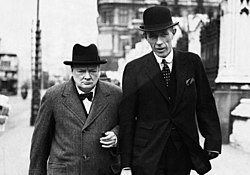
(Churchill és Halifax. Tisztára mint Stan és Pan, nem? Amúgy itt ragadnám meg az alkalmat, hogy elmondjam: Halifax bal kéz nélkül született. Valószínűleg kevesen viseltek olyan elegánsan implantátumot, mint ő.)
Remekbe szabott szöveg a demokrácia boszorkánykonyhájáról, amely boszorkánykonyha végtére is sokkal izgalmasabb belső folyamatokat rejt, mint az uncsi, monomániás diktatúrák döntéshozói mechanizmusai. Lukacs kiválóan festi meg a közhangulat finom változásait, valamit a háttérben zajló eseményeket: a Dunkerque-i evakuációt, illetve Hitler lehetséges motivációit. Nyilván áthatja a bizonyosság, hogy ha ez az öt nap máshogy alakul (és alakulhatott volna másképp is), akkor most egy sötét és vigasztalan világban élnénk. Ilyen értelemben pedig ő is "csak" egy újabb "fordulópont-elméletet" írt, ami a tárgyalt eseményeket úgy interpretálja, mint a komplett második világháború dobogó szívét. De nem is számítottam másra. Meg aztán: még jól is csinálja.
* Bár Chamberlain miniszerelnöksége a müncheni kudarcról, és a nácikkal szembeni álhatatos gyávaságról lett hírhedt, de ekkorra már ő is megértette, hogy Hitlerben nem lehet bízni. Ez pedig elég volt ahhoz, hogy Churchillel kielégítő munkakapcsolatot alakítson ki.
Akárhogy is, Lukacs prof az esemény 50 éves jubileumát közelegni érezvén úgy vélte, túl felületesen kapargatta csak azt a szerinte sorsdöntő időszakot, amikor Hitler győzelmének útjában egyedül a Brit Birodalom állt. Talán nem tettem elég világossá mindenkinek - tépelődött -, hogy Churchill mekkora istenkirály csávó, a komplett európai civilizáció megmentője, a konzervatív hazafiság csillámló fárosza, visszafogott értelmezésben, persze. Ha én akkor ott lettem volna, nyilván azt mondom, hogy "De, János, mindezt félreérthetetlenül világosan közölted", de szerencsére nem voltam ott, aminek eredménye ez az elemzés.
Szerzőnk ezúttal csak öt napra koncentrál: az 1940. május 24-től 28-ig terjedő intervallumra, amikor az egymást követő haditanácsokon Churchill megsemmisítette a defetistákat, és felszámolva a békepártiak utolsó barikádjait is, létrehozta azt a nemzeti egységfrontot, amibe aztán bele is tört a Luftwaffe foga. Ebben a kontextusban az igazi antagonista nem Hitler, de nem is Chamberlain*, hanem Lord Halifax, aki Churchillt valami meggondolatlan bugrisnak tekintette, aki vesztébe viszi a birodalmat - ő maga viszont a józan elme, aki tudja, mi a megoldás: észszerű béke a nácikkal, akár területi engedmények árán is, mert Anglia így megőrzi függetlenségét, és amúgy is, mi dolgunk nekünk a kontinenssel? Persze mi tudjuk (ahogy Winston is tudta), hogy Halifax tévedésben leledzett, ami Hitler alapvető félreértéséből fakadt. A Führer ugyanis csak egy olyan békét tudott volna elképzelni, ami a szigetország fegyverkezési potenciálját végleg taccsra vágja. De már maga a béketapogatózás is azzal járt volna, hogy a britek elveszítik maradék reputációjukat is nem csak a németek, hanem az egész világ (benne saját alattvalóik) szemében. Churchill tudta ezt, mert jobban ismerte Hitlert, mint bárki (és tegyük hozzá: jobban ismerte Hitlert, mint Hitler őt), mint ahogy azt is megértette, hogy most szívósnak kell mutatkozni, és akkor eljön az idő, amikor jobb lesz a leosztás. Bevetette hát szuperszonikus szónoki képességeit, megszilárdította a közhangulatot, kemény volt és hajlíthatatlan, Halifax puhány pacifizmusa pedig lepattant végül akaratáról, akár a kőfalról.
(Churchill és Halifax. Tisztára mint Stan és Pan, nem? Amúgy itt ragadnám meg az alkalmat, hogy elmondjam: Halifax bal kéz nélkül született. Valószínűleg kevesen viseltek olyan elegánsan implantátumot, mint ő.)
Remekbe szabott szöveg a demokrácia boszorkánykonyhájáról, amely boszorkánykonyha végtére is sokkal izgalmasabb belső folyamatokat rejt, mint az uncsi, monomániás diktatúrák döntéshozói mechanizmusai. Lukacs kiválóan festi meg a közhangulat finom változásait, valamit a háttérben zajló eseményeket: a Dunkerque-i evakuációt, illetve Hitler lehetséges motivációit. Nyilván áthatja a bizonyosság, hogy ha ez az öt nap máshogy alakul (és alakulhatott volna másképp is), akkor most egy sötét és vigasztalan világban élnénk. Ilyen értelemben pedig ő is "csak" egy újabb "fordulópont-elméletet" írt, ami a tárgyalt eseményeket úgy interpretálja, mint a komplett második világháború dobogó szívét. De nem is számítottam másra. Meg aztán: még jól is csinálja.
* Bár Chamberlain miniszerelnöksége a müncheni kudarcról, és a nácikkal szembeni álhatatos gyávaságról lett hírhedt, de ekkorra már ő is megértette, hogy Hitlerben nem lehet bízni. Ez pedig elég volt ahhoz, hogy Churchillel kielégítő munkakapcsolatot alakítson ki.

January 26, 2014
A poorly organised and written history, that only retains two stars because the story - the five days during which Churchill's war cabinet debated whether to negotiate with Hitler - is inherently fascinating.
This made my frustration with Lukacs' rendering of his material all the greater. There are many examples of bad habits and stylistic foibles that both slow down and mangle the narrative.
Writing style is a matter of personal taste, but surely 'it would not develop' is a simpler and less pompous way of writing than 'and develop it would not.'
The author switches between referring to himself as 'I' and the royal 'we'.
He / they tell us that 'this is not the place to explore x', then proceed to explore x over several pages.
Page after page of diaries, government minutes and Mass Observation are pasted wholesale, further bogging down the narrative.
The number of typos, including one on the first page, add to the frustration. 'British' becomes 'Bntish'; 'morale' is rendered as 'morak'; 'relendless could be 'endless' or 'relentless'.
The reader has to get to the meaning despite the archaic writing style and misspellings, instead of being carried along by a bold and clear narrative thrust.
It ends on a randomly evangelical note.
After all the political, personal, historical factors, we are told that Churchill succeeded:
"because of God's will, of which, like every human being, he was but an instrument."
What was the point of all the previous analysis if Churchill's victory was part of a divinely-ordained pattern?
I'm fine with people offering this kind of religious interpretation, but make that clear up front, instead of dropping it in at the end.
An incredibly frustrating read.
This made my frustration with Lukacs' rendering of his material all the greater. There are many examples of bad habits and stylistic foibles that both slow down and mangle the narrative.
Writing style is a matter of personal taste, but surely 'it would not develop' is a simpler and less pompous way of writing than 'and develop it would not.'
The author switches between referring to himself as 'I' and the royal 'we'.
He / they tell us that 'this is not the place to explore x', then proceed to explore x over several pages.
Page after page of diaries, government minutes and Mass Observation are pasted wholesale, further bogging down the narrative.
The number of typos, including one on the first page, add to the frustration. 'British' becomes 'Bntish'; 'morale' is rendered as 'morak'; 'relendless could be 'endless' or 'relentless'.
The reader has to get to the meaning despite the archaic writing style and misspellings, instead of being carried along by a bold and clear narrative thrust.
It ends on a randomly evangelical note.
After all the political, personal, historical factors, we are told that Churchill succeeded:
"because of God's will, of which, like every human being, he was but an instrument."
What was the point of all the previous analysis if Churchill's victory was part of a divinely-ordained pattern?
I'm fine with people offering this kind of religious interpretation, but make that clear up front, instead of dropping it in at the end.
An incredibly frustrating read.

February 7, 2018
I took this book off my shelves to re-read, having just seen the film “Darkest Hour” which was fantastic - Churchillian!
In his Memoirs of the Second World War (Their Finest Hour) Churchill, when he assumed the helm of Prime Minister-ship in May of 1940, makes it seem as if all in the British War Cabinet were unanimous in their determination to fight on against Nazi Germany. Not so! Halifax, who Churchill had appointed as Foreign Secretary, made inquiries to approach Italy as an intermediary for peace negotiations with Nazi Germany. Initially Churchill reluctantly agreed to this, but by the fourth day of the five days under scrutiny in this book, he overcame his reluctance to confront Halifax and proclaimed that “England must fight on regardless of the cost”. To enter negotiations would be embarking onto a slippery slope.
This book examines these critical five days of confrontation between Churchill and Halifax, with Chamberlain somewhat in the middle between the two. As the author points out this is a key period of history. If Halifax had had his way, England, in some form could have capitulated and ceased fighting. History would have been entirely different. Interestingly, Halifax vetted his diary to try to remove all evidence of his disagreement with Churchill.
The author, John Lukacs, gives us wonderful portraits of the men involved. I only wished he would have emphasized Churchill as a renegade, rather than constantly referring to his conservative outlook. Churchill was a rule-breaker, not one to follow procedures.
John Lukacs also explains well Churchill’s tenuous hold on the Prime Minister-ship at that time in May. He had only just assumed it on May 10. Europe was crashing down, with French and British armies collapsing in front of German armor. There were some in the Conservative Party who loathed Churchill. Churchill’s charismatic hold on leadership had yet to be attained.
Mr. Lukacs is very opinionated and his writing style can be long-winded (he is in love with his words); but at just over 200 pages it’s a thrilling read.
In his Memoirs of the Second World War (Their Finest Hour) Churchill, when he assumed the helm of Prime Minister-ship in May of 1940, makes it seem as if all in the British War Cabinet were unanimous in their determination to fight on against Nazi Germany. Not so! Halifax, who Churchill had appointed as Foreign Secretary, made inquiries to approach Italy as an intermediary for peace negotiations with Nazi Germany. Initially Churchill reluctantly agreed to this, but by the fourth day of the five days under scrutiny in this book, he overcame his reluctance to confront Halifax and proclaimed that “England must fight on regardless of the cost”. To enter negotiations would be embarking onto a slippery slope.
This book examines these critical five days of confrontation between Churchill and Halifax, with Chamberlain somewhat in the middle between the two. As the author points out this is a key period of history. If Halifax had had his way, England, in some form could have capitulated and ceased fighting. History would have been entirely different. Interestingly, Halifax vetted his diary to try to remove all evidence of his disagreement with Churchill.
The author, John Lukacs, gives us wonderful portraits of the men involved. I only wished he would have emphasized Churchill as a renegade, rather than constantly referring to his conservative outlook. Churchill was a rule-breaker, not one to follow procedures.
John Lukacs also explains well Churchill’s tenuous hold on the Prime Minister-ship at that time in May. He had only just assumed it on May 10. Europe was crashing down, with French and British armies collapsing in front of German armor. There were some in the Conservative Party who loathed Churchill. Churchill’s charismatic hold on leadership had yet to be attained.
Mr. Lukacs is very opinionated and his writing style can be long-winded (he is in love with his words); but at just over 200 pages it’s a thrilling read.

September 21, 2012
Very competent historical analysis of a five day period in May 1940 (24th to 28th). This was early in Churchill's premiership, the BEF was in retreat and had reached Dunkirk, France was about to fall and Churchill had opposition within the cabinet from those who wanted to explore whether peace terms were possible.
This is history in detail and Lukacs does it rather well. The relationships between Churchill, Chamberlain and Halifax are examined in detail. Churchill was by no means secure at this time; most of the conservatives were supporters of Chamberlain and hated Churchill. Many pundits expected him to be a temporary PM. There was also stong feeling in the war cabinet that if peace negotiations were possible they should be pursued. This was a pivotal time, which Churchill survived, strengthening his position. Lukacs, whilst a Churchill fan, is not blind to his faults and Halifax, always painted as an arch-appeaser, is also given a fair hearing. The point is again made thet whilst Russia and the US won the war, Churchill ensured Britain did not lose it.
Lukacs is a historian I often disagree with, but here he does a good job marshalling all the detail and presenting his case. He also does a good line in sideswipes at other historians and commentators when he demolishes their arguments.
This is history in detail and Lukacs does it rather well. The relationships between Churchill, Chamberlain and Halifax are examined in detail. Churchill was by no means secure at this time; most of the conservatives were supporters of Chamberlain and hated Churchill. Many pundits expected him to be a temporary PM. There was also stong feeling in the war cabinet that if peace negotiations were possible they should be pursued. This was a pivotal time, which Churchill survived, strengthening his position. Lukacs, whilst a Churchill fan, is not blind to his faults and Halifax, always painted as an arch-appeaser, is also given a fair hearing. The point is again made thet whilst Russia and the US won the war, Churchill ensured Britain did not lose it.
Lukacs is a historian I often disagree with, but here he does a good job marshalling all the detail and presenting his case. He also does a good line in sideswipes at other historians and commentators when he demolishes their arguments.

July 23, 2017
Picked this up after seeing "Dunkirk." Lukacs' case is that Churchill understood intuitively at the fall of France that Hitler could not be negotiated with, and that capitulation would have ultimately meant the end of Western Civilization. Though I've read that elsewhere, Lukacs gives a picture of meetings inside the British War Cabinet over those five days, when Churchill, newly installed as PM, had to seriously confront the idea of a negotiated peace with the threat of invasion and the disaster at Dunkirk brewing. He sketches out the personalities of Chamberlain and Halifax, and puts in stark terms what Hitler was considering at that moment. A very good, intense read.

Read
November 23, 2019Spotted this secondhand and grabbed it in the expectation that it'd be a bit juicier than Kershaw's treatment of the Five Days in Fateful Choices. Not so much, though Lukacs has some interesting skerricks on the depth of sympathies for appeasement inside Westminster and Whitehall, and the extents senior politicians and civil servants *coughHalifaxRABButlerHoraceWilsoncough* went to clean up their papers after the fact.
Apart from some archival work, Lukacs leans heavily on Andrew Roberts' Halifax bio and Mass Observation, and while his analyses of the latter's surveys on each of the days in question were adroit, his tendency to treat them as the sole vox populi played off against the diaries and memoirs of the great figures of the day serve to underline his background in high politics.
The book is written in a conversational (rambling) style, peppered with magisterial judgements, including editorial asides in primary source quotations [Yeah, really]. This is in keeping with Lukacs' overall tone of sweeping retrospective [old man yells at century], which sometimes strays into national stereotyping and end-of-history grandstanding. For all this, his characterisation of the Halifax-Churchill showdown is compelling [though the material is just really interesting] and his argument that nationalism, and fascism were the defining forces of the 20th century probably sounds more convincing now than it did at the end of the century.
Apart from some archival work, Lukacs leans heavily on Andrew Roberts' Halifax bio and Mass Observation, and while his analyses of the latter's surveys on each of the days in question were adroit, his tendency to treat them as the sole vox populi played off against the diaries and memoirs of the great figures of the day serve to underline his background in high politics.
The book is written in a conversational (rambling) style, peppered with magisterial judgements, including editorial asides in primary source quotations [Yeah, really]. This is in keeping with Lukacs' overall tone of sweeping retrospective [old man yells at century], which sometimes strays into national stereotyping and end-of-history grandstanding. For all this, his characterisation of the Halifax-Churchill showdown is compelling [though the material is just really interesting] and his argument that nationalism, and fascism were the defining forces of the 20th century probably sounds more convincing now than it did at the end of the century.

August 26, 2013
A serious disappointment. But I also had fairly high expectations.
The structure of the book was incoherent.
The author sometimes travelled a bit too far in time and space. Certainly his remarks about the peace of Amiens should have been kept out of this book. And when the author expects that his readers understand what he means by Foxite and Hollandite Whigs then he certainly overestimates me. But I'm of course a simpleton who only graduated from Oxbridge.
In a few places the author states a fact in order to support his views, where to the best of my judgment it does the opposite. I noted 2 such sentences, but I won't browse the whole book again to find them again.
It is also quite clear that the author has ploughed this field before and that he tends to forget that readers may not have read his previous works.
But what really annoyed me was statements about a person being 'a disater' in a certain position (e.g. Stafford Cripps as ambassador to Moscow). It may be true, but I read books to be told why.
The structure of the book was incoherent.
The author sometimes travelled a bit too far in time and space. Certainly his remarks about the peace of Amiens should have been kept out of this book. And when the author expects that his readers understand what he means by Foxite and Hollandite Whigs then he certainly overestimates me. But I'm of course a simpleton who only graduated from Oxbridge.
In a few places the author states a fact in order to support his views, where to the best of my judgment it does the opposite. I noted 2 such sentences, but I won't browse the whole book again to find them again.
It is also quite clear that the author has ploughed this field before and that he tends to forget that readers may not have read his previous works.
But what really annoyed me was statements about a person being 'a disater' in a certain position (e.g. Stafford Cripps as ambassador to Moscow). It may be true, but I read books to be told why.

February 21, 2022
3.5***
Historian John Lukacs has written over twenty books, several dealing with World War II. In this book he focuses specifically on Winston Churchill and the five days from May 24 to May 28, 1940. Churchill did not win the war in those five days, but his actions and leadership ensured that England would NOT lose the war.
Lukacs did extensive research, pouring over diaries, letters, journals, official memoranda and newspaper reports of the time, to illuminate and reconstruct the thought-processes and leadership that ultimately ensured the Allies’ success. We obviously know the outcome already, but Lukacs manages to convey the sense of urgency and tension and uncertainty of this moment in history.
This is a slim volume, but very dense and I had to remind myself a few times that the timespan was a mere five days.
Historian John Lukacs has written over twenty books, several dealing with World War II. In this book he focuses specifically on Winston Churchill and the five days from May 24 to May 28, 1940. Churchill did not win the war in those five days, but his actions and leadership ensured that England would NOT lose the war.
Lukacs did extensive research, pouring over diaries, letters, journals, official memoranda and newspaper reports of the time, to illuminate and reconstruct the thought-processes and leadership that ultimately ensured the Allies’ success. We obviously know the outcome already, but Lukacs manages to convey the sense of urgency and tension and uncertainty of this moment in history.
This is a slim volume, but very dense and I had to remind myself a few times that the timespan was a mere five days.

January 30, 2018
Letto, dopo aver visto l'ora più buia, che ne è la versione romanzata (con alcuni errori storico/Politici.
Storia dei 5 giorni più lunghi della 2 Guerra Mondiale, un Lunghissimo giorno che durò dal 24 al 28 Maggio e in cui gli inglesi pensarono, anche se solo come retropensiero , di svincolarsi dalla Guerra.
Anche gli eroi hanno dei dubbi, ma alla fine la rettitudine è ricompensata.
Questa " non svolta "della guerra geberò a cascata tutta la storia come noi la conosciamo, Vedasi
https://www.amazon.it/Scelte-fatali-d...
Storia dei 5 giorni più lunghi della 2 Guerra Mondiale, un Lunghissimo giorno che durò dal 24 al 28 Maggio e in cui gli inglesi pensarono, anche se solo come retropensiero , di svincolarsi dalla Guerra.
Anche gli eroi hanno dei dubbi, ma alla fine la rettitudine è ricompensata.
Questa " non svolta "della guerra geberò a cascata tutta la storia come noi la conosciamo, Vedasi
https://www.amazon.it/Scelte-fatali-d...

January 24, 2020
“Five Days in London May 1940” is a well-written, historical analysis of five very important days in May 1940 as Churchill and the British War Cabinet debated steps to be undertaken concerning Hitler, Nazi Germany and the approaching invasion of England.
How close we were to a completely different ending! The details will amaze you on how things hung by the most slender of threads.
“At the end of May 1940 and for some time thereafter, not only the end of a European war but the end of Western civilization was near. Churchill knew that...”
It was amazing to read the details.
I am not a history major so this was intense reading for me but I would think this writing is valuable for history professionals and lay members alike. I do forewarn: this does not read like a novel. It is non-fiction in the truest sense.
I AM REREADING MY NOTES. I learned so much from this book!
How close we were to a completely different ending! The details will amaze you on how things hung by the most slender of threads.
“At the end of May 1940 and for some time thereafter, not only the end of a European war but the end of Western civilization was near. Churchill knew that...”
It was amazing to read the details.
I am not a history major so this was intense reading for me but I would think this writing is valuable for history professionals and lay members alike. I do forewarn: this does not read like a novel. It is non-fiction in the truest sense.
I AM REREADING MY NOTES. I learned so much from this book!

June 19, 2009
The well-known Phony War (Lukacs calls it the Reluctant War) followed Germany's invasion of Poland in September 1939 and the subsequent declarations of war by Britain and France. The following May Germany ended the Phony War by invading Belgium. French, British and Belgian forces were quickly overwhelmed by the new German tank-forward, airplane-supported tactics. Belgium capitulated. The beleaguered French and British retreated to the coat where 300,000+ troops were eventually evacuated from Dunkirk. In the five May days Lukacs is concerned with, the British debated whether to continue fighting or seek the most favorable terms they could wring from Hitler. The crux of this history concerns the debate between Churchill, who'd become prime minister the day the Germans bolted through the Ardennes, Lord Halifax, the foreign secretary, and the rest of the War Cabinet. Halifax, with the British Expeditionary Force backed against the Channel and facing defeat, with Britain possibly facing a subsequent invasion by the Germans, and with France almost certainly to be overrun, encouraged seeking terms with Germany to prevent total defeat. Churchill argued against negotiations with Hitler because the British would essentially get the same terms by going ahead and fighting it out. Plus they would avoid becoming a puppet government for Hitler and would be able to save the fleet, almost certainly part of the terms. Churchill's views prevailed. The British continued the war, Hitler was unable to gain a favorable enough military position--air superiority--for a move across the Channel, and he eventually turned his attentions to the Soviet Union, whose vast European landscape was his primary goal in the war. Lukacs' main point is that this period in May 1940 was the most decisive of the war. Hitler came very close to winning the war at that time but eventually lost because Churchill refused to give in when the overall picture looked the bleakest. Hitler failed to win because Churchill refused to lose. Much of the book is simply recounting what the record is, those War Cabinet meetings where Churchill finally persuaded the government he was right. Lukacs also refers to diaries, letters, and personal memoirs of those days. What makes the book such a valuable read is his interpretations of those events in the brighter light of the war and the 50-year ripples affecting Europe and the world. And in his cogent thoughts on history as a whole. He says 2 of the most important elements in history are understanding and knowing. He gives weight to the distinction that understanding of a historical event or process may precede our knowing all the facts and how we can see how this works by our following the news of our day. He explains how this is important in the decisions made by the British during May 1940 and how we're today still awash in the reverberations from those decisions made when understanding preceded knowledge. Lukacs' ideas are convincing, especially because we can see, as he states, how Churchill's vision encompassed and sought a future for all of Europe rather than being concerned only with Britain. Becuse Churchill refused to allow defeatism Hitler couldn't neutralize them as an enemy and left a base for the Allies buildup and from which the counterattack would come.

July 9, 2008
This is a very detailed account of a pivotal moment in Britain's engagement in WWII and of Churchill's crucial role in keeping his country in the war in that most pivotal phase prior to America's entry starting December 1941. The writing style is easily accessible to non-specialists, although Lukacs does presume basic familiarity with the events of the second World War.

July 20, 2020
Review title: Saving civilization
While Lukacs doesn't use the term "civilization" to describe what Churchill saved during those five crucial, eventful, and exhausting days in May 1940, it is the closest one word to describe the object of his efforts. For it was then, says Lukacs, that Hitler came closest to winning the war he wanted (p. 188), which would have meant, quoting Churchill, 'we should be reduced to the status of vassals forever.' (p. 217). This little book is a historical essay on the events and outcomes of those days.
I just reviewed the new and much longer and more widely read narrative history by Erik Larson of the full year beginning May 1940, including the five days Lukacs documents here in a different style and with a different purpose. The Splendid and the Vile tells the story of how Churchill survived the first year of his Prime Ministership with his personal and political extended families. Lukacs focuses on his political, military, and leadership actions in the crucial five days May 24 to 28 when, just two weeks into his role and still doubted by both friends and does alike, Churchill had to navigate and negotiate the potential capitulation of France to the on-rushing German attack, the entrapment and improbable evacuation of the British army from Dunkirk, the call for negotiations with Hitler either directly or through the offices of Mussolini, and the splintering of his own infant government along the fault lines attendant with all those crises.
Lukacs writes this short treatise not only with a different purpose (in earlier books he had already covered the war years 1939-1941, and then the 80 days from May 10 to the end of July) but with a different style. While the bibliography documents the published and primary sources Lukacs referenced, he writes in essay style on the broad topics of those days with footnotes in which he often disagrees with the source's conclusions or cites multiple sources to synthesize what he believes is the most historically accurate view within the context of those multivariate and rapidly evolving crises.
While it is easy (and thus often done) to identify the period as Churchill versus Hitler, in fact Lukacs documents the many variables and combinations facing England and Churchill: how to best use the British forces in France (fight to the last man or evacuate to fight another day); how to honor treaties and support France without sacrificing British chances to fight on if France fell; whether or how to keep Mussolini out of the war on the German side or let him negotiate French or British terms; how to preserve the national government utilizing the best of conservatives, liberals, Tories, Whigs, and Labor; how and how much to communicate to the British public.
These decisions and communications were complicated by how rapidly the crises evolved and how often the communications even to the key participants were hours behind the actual events. This was especially true about Dunkirk, where Churchill's War Cabinet was often debating actions based on data that was eight hours old and already overcome by events not yet known in London. While information clearly didn't travel at the speed of the Internet in 1940, it seems shocking that well into the telegraph, telephone, and radio eras communications could be as chaotic as they were. One of Lukac's most interesting and insightful threats of discussion is the trend of British public opinion (and public sentiment, as Lukacs points out two separate things) during those days and how it responded to the available news and trended or lagged actual events; like Larson, Lukacs relied on the invaluable information gathered by the national Mass Observation organization for collecting and analyzing commercial data. It is a fascinating source of information and the story of the Mass Observation is worth further reading.
In the end, we now know as no one in government or out, in England, Germany, the United States, or the rest of the world did then, that Churchill did what needed to be done to save civilization in those five days. Lukacs concludes with a short chapter entitled "Survival" (p. 187ff) in which he summarizes the hinge points then and later (the air Battle for Britain, the German invasion of Russia, the siege of Stalingrad, the D Day landing) when Hitler might have succeeded--but didn't. His arguments are plausible if sometimes densely worded, his conclusions are valid if sometimes couched too indirectly. More readers will read and enjoy Larson's Churchill over the full year; but Lukacs takes readers further inside the corridors of power and Churchill's mind those fateful five days in May.
While Lukacs doesn't use the term "civilization" to describe what Churchill saved during those five crucial, eventful, and exhausting days in May 1940, it is the closest one word to describe the object of his efforts. For it was then, says Lukacs, that Hitler came closest to winning the war he wanted (p. 188), which would have meant, quoting Churchill, 'we should be reduced to the status of vassals forever.' (p. 217). This little book is a historical essay on the events and outcomes of those days.
I just reviewed the new and much longer and more widely read narrative history by Erik Larson of the full year beginning May 1940, including the five days Lukacs documents here in a different style and with a different purpose. The Splendid and the Vile tells the story of how Churchill survived the first year of his Prime Ministership with his personal and political extended families. Lukacs focuses on his political, military, and leadership actions in the crucial five days May 24 to 28 when, just two weeks into his role and still doubted by both friends and does alike, Churchill had to navigate and negotiate the potential capitulation of France to the on-rushing German attack, the entrapment and improbable evacuation of the British army from Dunkirk, the call for negotiations with Hitler either directly or through the offices of Mussolini, and the splintering of his own infant government along the fault lines attendant with all those crises.
Lukacs writes this short treatise not only with a different purpose (in earlier books he had already covered the war years 1939-1941, and then the 80 days from May 10 to the end of July) but with a different style. While the bibliography documents the published and primary sources Lukacs referenced, he writes in essay style on the broad topics of those days with footnotes in which he often disagrees with the source's conclusions or cites multiple sources to synthesize what he believes is the most historically accurate view within the context of those multivariate and rapidly evolving crises.
While it is easy (and thus often done) to identify the period as Churchill versus Hitler, in fact Lukacs documents the many variables and combinations facing England and Churchill: how to best use the British forces in France (fight to the last man or evacuate to fight another day); how to honor treaties and support France without sacrificing British chances to fight on if France fell; whether or how to keep Mussolini out of the war on the German side or let him negotiate French or British terms; how to preserve the national government utilizing the best of conservatives, liberals, Tories, Whigs, and Labor; how and how much to communicate to the British public.
These decisions and communications were complicated by how rapidly the crises evolved and how often the communications even to the key participants were hours behind the actual events. This was especially true about Dunkirk, where Churchill's War Cabinet was often debating actions based on data that was eight hours old and already overcome by events not yet known in London. While information clearly didn't travel at the speed of the Internet in 1940, it seems shocking that well into the telegraph, telephone, and radio eras communications could be as chaotic as they were. One of Lukac's most interesting and insightful threats of discussion is the trend of British public opinion (and public sentiment, as Lukacs points out two separate things) during those days and how it responded to the available news and trended or lagged actual events; like Larson, Lukacs relied on the invaluable information gathered by the national Mass Observation organization for collecting and analyzing commercial data. It is a fascinating source of information and the story of the Mass Observation is worth further reading.
In the end, we now know as no one in government or out, in England, Germany, the United States, or the rest of the world did then, that Churchill did what needed to be done to save civilization in those five days. Lukacs concludes with a short chapter entitled "Survival" (p. 187ff) in which he summarizes the hinge points then and later (the air Battle for Britain, the German invasion of Russia, the siege of Stalingrad, the D Day landing) when Hitler might have succeeded--but didn't. His arguments are plausible if sometimes densely worded, his conclusions are valid if sometimes couched too indirectly. More readers will read and enjoy Larson's Churchill over the full year; but Lukacs takes readers further inside the corridors of power and Churchill's mind those fateful five days in May.

September 25, 2020
Lukacs apresenta aqui mais do que simples relato de fatos desses cinco dias - 24 a 28 de maio de 1940; ele trabalha com uma tese e busca prová-la: a de que esses dias foram decisivos para decidir a guerra - ao menos a "guerra" como Hitler queria vencer, aquela que fizesse a Inglaterra descer do seu pedestal e aceitar condições apaziguadoras para uma "paz" (?) em separado com a Alemanha enquanto Hitler iria anexando partes e partes da Europa. Para Churchill, o primeiro ministro inglês, "paz" nessas condições não seria paz. Churchill, apesar de todas as pressões, inclusive de ministros ingleses do conselho de guerra, nunca cedeu. A "Guerra" como Hitler queria vencer nunca se realizou por causa da determinação de Churchill, indomável. Esta é a tese do historiador John Likacs, muito bem apresentada. Excelente livro!

November 27, 2017
When you buy a book from a garage sale, you're especially dependent on the reviews at the front. "Artfully constructed and elegantly narrated" raves the Philadelphia Inquirer. I’ll never trust the Philadelphia Inquirer again.
As a relative newbie to WW2 history, I thought this sounded like an exciting narrative about a key moment in the war. Instead it felt like a rambling love letter to its own "compact" "(if that is the correct adjective)" (hint: it isn't) prose.
Lukacs refers to his own writing constantly throughout the book. For example: "Churchill admitted (if that was the proper verb)...". And: “That accounts for much, perhaps everything -- including the saving grace (if that is what it was) of Dunkirk…". This distracting construction occurs every couple of chapters. You *wrote* the book. Why not just use the “proper verb” in the first place?
Even when the writing doesn’t explicitly mention the writing, it definitely draws attention to itself: “There was, too, an almost universal expectation that Churchill's ministry was going to be short-lived. ‘Almost universal’ may be too much, but, again, it was not without serious substance.” Wait. What were we talking about?
Or: "I began this last chapter, entitled ‘Survival,’ with this sentence: ‘Had Hitler won the Second World War we would be living in a different world.’ And now, at the end of this chapter, indeed of this small book, I must change its tone and end with a fortissimo." First of all, maybe I just don't know enough history, but that hardly seems like a compelling enough statement to quote oneself on. Second, the second sentence doesn't refer to the first here, except that both are just unnecessary references to the writing itself. (I assume the antecedent of “its” is “book”? Or is it the “world”?) Third, “a fortissimo” is just a *little* grand for what happens over the next few pages. Fourth, why are you making me reread this? You’d better have a good reason for making me reread a sentence I just read a few pages ago.
Speaking of rereading, I noticed a couple of passages that were repeated almost verbatim a few pages apart, sans quotes. Just one example: Page 50: "... the willingness of many Conservatives and at least a portion of the upper classes to give some credit to the then-new types of authoritarian governments in Europe, largely owing to their seemingly *determined anti-Communism*." Page 54: "He, as indeed did many others (including Churchill), saw the new kind of order established by Mussolini (and, in Chamberlain's case, even the one by Hitler) as having certain positive features, especially their *determined anti-Communism*." It's hard to dig through all the clauses to find the points of the arguments on these two pages, but even those are essentially the same.
Aside from these obvious mistakes (another reviewer points out that the writer switches from "I" to the royal "we" throughout), the narrative is incoherent, action is dully written, and characters are not developed. I know it’s a history book, but I was promised “...the power and sweep of Shakespeare’s chronicle plays” by the Boston Globe.
I may not be the intended audience, as a simple non-WW2 buff, but the book seems to put forward very little historical argument. It seems to finally ramp up to the point that the five days in question were a more crucial turning point than other historians have generally acknowledged. A little navel gazing, but fair enough. But on the final page, it ends bizarrely with a reference to God's will as the ultimate motive of all history, which is mentioned nowhere else in the book. Maybe this is an understood part of Lukacs’ philosophy, known to those who’ve read the rest of his oeuvre, but he did not convince me.
I kept reading in the hopes that the reviewers would be proven right. On its surface, the book seems so erudite that I kept thinking I must just not get this Important History. Maybe the self-referentiality is a critique of the writing of history itself? But good writing should bring readers along at least somewhat. When a book makes you feel nothing so much as defensive, that’s mainly the book's fault.
The only saving grace is the very long footnotes, which mean you sometimes only have to read half or three quarters of a page before you can move on.
Once I confirmed that it wouldn't get any better, I flipped back to the reviews inside the front cover, looking for any confirmation of my own understanding. I noticed the New York times quote was suspiciously poker-faced. Could it be a hidden signal from a real human buried in this academic morass?: "Historian John Lukacs, who has written widely on World War II and on Hitler and Churchill, comprehensively traces the events of that long weekend, which culminated in Churchill's decision on May 8th to fight on, no matter what happened to France." Yep, “comprehensive” is the best adjective for it. The clearest passage in the book.
As a relative newbie to WW2 history, I thought this sounded like an exciting narrative about a key moment in the war. Instead it felt like a rambling love letter to its own "compact" "(if that is the correct adjective)" (hint: it isn't) prose.
Lukacs refers to his own writing constantly throughout the book. For example: "Churchill admitted (if that was the proper verb)...". And: “That accounts for much, perhaps everything -- including the saving grace (if that is what it was) of Dunkirk…". This distracting construction occurs every couple of chapters. You *wrote* the book. Why not just use the “proper verb” in the first place?
Even when the writing doesn’t explicitly mention the writing, it definitely draws attention to itself: “There was, too, an almost universal expectation that Churchill's ministry was going to be short-lived. ‘Almost universal’ may be too much, but, again, it was not without serious substance.” Wait. What were we talking about?
Or: "I began this last chapter, entitled ‘Survival,’ with this sentence: ‘Had Hitler won the Second World War we would be living in a different world.’ And now, at the end of this chapter, indeed of this small book, I must change its tone and end with a fortissimo." First of all, maybe I just don't know enough history, but that hardly seems like a compelling enough statement to quote oneself on. Second, the second sentence doesn't refer to the first here, except that both are just unnecessary references to the writing itself. (I assume the antecedent of “its” is “book”? Or is it the “world”?) Third, “a fortissimo” is just a *little* grand for what happens over the next few pages. Fourth, why are you making me reread this? You’d better have a good reason for making me reread a sentence I just read a few pages ago.
Speaking of rereading, I noticed a couple of passages that were repeated almost verbatim a few pages apart, sans quotes. Just one example: Page 50: "... the willingness of many Conservatives and at least a portion of the upper classes to give some credit to the then-new types of authoritarian governments in Europe, largely owing to their seemingly *determined anti-Communism*." Page 54: "He, as indeed did many others (including Churchill), saw the new kind of order established by Mussolini (and, in Chamberlain's case, even the one by Hitler) as having certain positive features, especially their *determined anti-Communism*." It's hard to dig through all the clauses to find the points of the arguments on these two pages, but even those are essentially the same.
Aside from these obvious mistakes (another reviewer points out that the writer switches from "I" to the royal "we" throughout), the narrative is incoherent, action is dully written, and characters are not developed. I know it’s a history book, but I was promised “...the power and sweep of Shakespeare’s chronicle plays” by the Boston Globe.
I may not be the intended audience, as a simple non-WW2 buff, but the book seems to put forward very little historical argument. It seems to finally ramp up to the point that the five days in question were a more crucial turning point than other historians have generally acknowledged. A little navel gazing, but fair enough. But on the final page, it ends bizarrely with a reference to God's will as the ultimate motive of all history, which is mentioned nowhere else in the book. Maybe this is an understood part of Lukacs’ philosophy, known to those who’ve read the rest of his oeuvre, but he did not convince me.
I kept reading in the hopes that the reviewers would be proven right. On its surface, the book seems so erudite that I kept thinking I must just not get this Important History. Maybe the self-referentiality is a critique of the writing of history itself? But good writing should bring readers along at least somewhat. When a book makes you feel nothing so much as defensive, that’s mainly the book's fault.
The only saving grace is the very long footnotes, which mean you sometimes only have to read half or three quarters of a page before you can move on.
Once I confirmed that it wouldn't get any better, I flipped back to the reviews inside the front cover, looking for any confirmation of my own understanding. I noticed the New York times quote was suspiciously poker-faced. Could it be a hidden signal from a real human buried in this academic morass?: "Historian John Lukacs, who has written widely on World War II and on Hitler and Churchill, comprehensively traces the events of that long weekend, which culminated in Churchill's decision on May 8th to fight on, no matter what happened to France." Yep, “comprehensive” is the best adjective for it. The clearest passage in the book.

February 18, 2018
There was a good deal of info in this pre-war narrative. I’ve read and listened to many of the “during the war” books, but never pre-war.
The discussions and comments about Churchill before he became Prime Minister was interesting. He wasn’t too popular….and yet he was just what the country needed. I had recently viewed the movie Churchill… it portrayed him as very human, his positive and negative qualities. He’ll always be my idol…adore his sense of humor.
I also found the early opinion polls curious. They were so simplistic; the common people really didn’t know what was coming. What a nerve wracking time for some and a shock it must have been for others when war came.
Since I’m clearly a neophyte on war strategy and all the “what if” type scenarios… the discussions overwhelmed my feeble thinking.
The diary comments are my favorites. Personal and candid thoughts.
The discussions and comments about Churchill before he became Prime Minister was interesting. He wasn’t too popular….and yet he was just what the country needed. I had recently viewed the movie Churchill… it portrayed him as very human, his positive and negative qualities. He’ll always be my idol…adore his sense of humor.
I also found the early opinion polls curious. They were so simplistic; the common people really didn’t know what was coming. What a nerve wracking time for some and a shock it must have been for others when war came.
Since I’m clearly a neophyte on war strategy and all the “what if” type scenarios… the discussions overwhelmed my feeble thinking.
The diary comments are my favorites. Personal and candid thoughts.

August 10, 2015
I’m always a bit skittish with books that claim that a specific small time period became a hinge on which all of human history swung thereafter. I always get a bit suspicious that this is someone’s thesis desperately seeking importance in an information-saturated world. So I approached this with some care; indeed, it has been on a to-read pile for years. My skittishness was replace by fascination once I got into the book.
Winston Churchill is just hours into his prime ministership as the book begins. All of Europe is at the very crossroads of oppression. Hitler’s forces are poised to push farther into territory Britain had hoped to defend. Its expeditionary force was literally on the run, and the stark existential question Churchill and others had to face was whether to fight Hitler or scramble to negotiate and get the best terms possible.
Churchill argued that by staying in the fight, Britain may well lose, but it would at least get the opportunity to save much or all of its fleet by sending it to Canada. Lord Halifax argued that rather than face total humiliation, Britain needed to negotiate some kind of peace.
This book, then, is essentially the record of those five days in late May when Britain had to decide whether it wanted peace or victory. The country’s leaders were bright enough to know that they wouldn’t likely achieve full-on victory, but they could fight and perhaps garner better terms from Hitler than they would have gotten from rapid capitulation.
As one excellent reviewer on Goodreats explained, Hitler failed to win because Churchill refused to lose. Hitler ultimately didn’t have the air superiority necessary to cross the channel decisively, and he was in some ways more interested in capturing the resource-rich land that would become the Soviet Union.
You not only get a look at the debates here within the war cabinet, you get letters and diary entries that support the author’s contentions. He asserts that those five days created echoes that reverberated through much of the remainder of the twentieth century. A worthy thoughtful read for anyone interested in World War II history.
Winston Churchill is just hours into his prime ministership as the book begins. All of Europe is at the very crossroads of oppression. Hitler’s forces are poised to push farther into territory Britain had hoped to defend. Its expeditionary force was literally on the run, and the stark existential question Churchill and others had to face was whether to fight Hitler or scramble to negotiate and get the best terms possible.
Churchill argued that by staying in the fight, Britain may well lose, but it would at least get the opportunity to save much or all of its fleet by sending it to Canada. Lord Halifax argued that rather than face total humiliation, Britain needed to negotiate some kind of peace.
This book, then, is essentially the record of those five days in late May when Britain had to decide whether it wanted peace or victory. The country’s leaders were bright enough to know that they wouldn’t likely achieve full-on victory, but they could fight and perhaps garner better terms from Hitler than they would have gotten from rapid capitulation.
As one excellent reviewer on Goodreats explained, Hitler failed to win because Churchill refused to lose. Hitler ultimately didn’t have the air superiority necessary to cross the channel decisively, and he was in some ways more interested in capturing the resource-rich land that would become the Soviet Union.
You not only get a look at the debates here within the war cabinet, you get letters and diary entries that support the author’s contentions. He asserts that those five days created echoes that reverberated through much of the remainder of the twentieth century. A worthy thoughtful read for anyone interested in World War II history.

August 10, 2019
A surprisingly slow, disorganized, meandering mess. The footnotes offer some interesting historical tidbits, but imagine your least interesting history professor holding court in a pub after far too many drinks, and you have an idea of what it is like as Lukacs rambles his sentences together in this shockingly short, yet interminably long read.

May 20, 2020
Questions of when the Second World War became an inevitable Allied victory usually center around titanic battles like Midway, El Alamein, Stalingrad, Kursk, D-Day, or the Bulge, to name a few. All of these are viable candidates, but framing them as the solution begs the question of was it actually a battle that turned the tide?
Lukacs predicates this book around the idea that the most crucial phase of the war was before December 7, 1941, that the summer of 1940 was the central period of that phase, and that the days of May 24-28 were the defining pin on which the war’s ultimate conclusion turned. That’s a bold statement, but not, as Lukacs shows, one without reason. When one considers the months following Winston Churchill’s assumption of the Premiership, one is drawn towards his speeches, or towards the miracle at Dunkirk, or the bravery and skill of the RAF during the Battle of Britain, or the fortitude of the British people during the Blitz. What is extraordinary about the five days of Friday the 24th to Tuesday the 28th is that they possess virtually none of those. Except for the early stages of the Dunkirk evacuation, none of the highlights of that summer are present during this crucial passage of time. So what makes those days so important?
In short, it was by fighting through opposition within in his own War Cabinet that Churchill came to the conclusion that Britain, no matter what befell it or its allies, would not and could not surrender, that to do so would mean the end of Western Civilization, and that it would be dooming Europe and perhaps much more to wanton tyranny of a kind hardly imaginable. From this resolve, which was not solidified on Friday but as night fell on Tuesday was the official position of His Majesty’s Government, flowed a refusal to hear peace terms brokered by Italy and a decision to not doom the BEF to disaster in France, among others. Much of Lukacs’s narrative takes place in War Cabinet meetings, where Churchill battled it out with his peace-above-all-else Foreign Secretary, Lord Halifax. As the 5-day period began, Churchill was optimistic about the French Army’s changes against the Wehrmacht and full of confidence in France’s government to continue the fight. He was also not entirely opposed to a brokered peace initiated by Mussolini.
One enormous factor changed this calculation: the complete inability of the French Army and the British Expeditionary Force to withstand blitzkrieg. With the French government falling apart under the shocks of the German army making it farther in 1 week than it had in four years just 25 years prior, Halifax forcefully made the case that only by pursuing peace could Britain save any part of itself. The central contention of these five days was Churchill steadily hardening his position, grounded in the now indisputable fact that a British Empire that made Hitler tear her piece by piece would at worst buy time for the Commonwealth, and at best withstand the brunt and provide a fortress for a free and liberal world to win back Europe. But on the other hand an Empire that capitulated and allowed a German overlordship of Europe would never stand, and any allies would be hard pressed to aid her and when they did her society, her government, and her economy would be incapable of sustaining a war effort.
While his speech to the Commons on June 4 occurred after the dates of this history, his promise, not even to the British people but to the free world, laid bare this resolution. His confidence in the British people to provide space for the "Empire beyond the seas, armed and guarded by the British Fleet, [to] carry on the struggle, until, in God's good time, the New World, with all its power and might, steps forth to the rescue and the liberation of the old,” was the same confidence that propelled him to refuse Halifax’s urging and commit to outliving Hitler, if necessary for years, if necessary alone.
This was the central resolve of Churchill, and his victory over Halifax, not won by overpowering him with oratory in private, but my slowly internalizing the support of his larger coalition government and the British people, is one of the remarkable achievements of his long life and career. It was, purely put, his stubborn bravery and love for that ‘royal seat of kings and precious stone in the silver sea’ as Shakespeare described England that compelled him to withstand the temptation of striking a devil’s bargain. There are parts of the Churchill legacy that are hyperbolic, that do not withstand scrutiny. But his actions in May 1940, and his tenacious refusal to squander the legacy of his home to a inherently unquenchable evil was a moment of divinely-inspired leadership perhaps unmatched in modern history. Indeed, Churchill could not win the war, but he was perhaps the only one who could lose it. As he made clear in his speech to the House of Commons after assuming the Prime Ministership, his only aim was victory. In the end, after a long, hard road, it was achieved.
Lukacs predicates this book around the idea that the most crucial phase of the war was before December 7, 1941, that the summer of 1940 was the central period of that phase, and that the days of May 24-28 were the defining pin on which the war’s ultimate conclusion turned. That’s a bold statement, but not, as Lukacs shows, one without reason. When one considers the months following Winston Churchill’s assumption of the Premiership, one is drawn towards his speeches, or towards the miracle at Dunkirk, or the bravery and skill of the RAF during the Battle of Britain, or the fortitude of the British people during the Blitz. What is extraordinary about the five days of Friday the 24th to Tuesday the 28th is that they possess virtually none of those. Except for the early stages of the Dunkirk evacuation, none of the highlights of that summer are present during this crucial passage of time. So what makes those days so important?
In short, it was by fighting through opposition within in his own War Cabinet that Churchill came to the conclusion that Britain, no matter what befell it or its allies, would not and could not surrender, that to do so would mean the end of Western Civilization, and that it would be dooming Europe and perhaps much more to wanton tyranny of a kind hardly imaginable. From this resolve, which was not solidified on Friday but as night fell on Tuesday was the official position of His Majesty’s Government, flowed a refusal to hear peace terms brokered by Italy and a decision to not doom the BEF to disaster in France, among others. Much of Lukacs’s narrative takes place in War Cabinet meetings, where Churchill battled it out with his peace-above-all-else Foreign Secretary, Lord Halifax. As the 5-day period began, Churchill was optimistic about the French Army’s changes against the Wehrmacht and full of confidence in France’s government to continue the fight. He was also not entirely opposed to a brokered peace initiated by Mussolini.
One enormous factor changed this calculation: the complete inability of the French Army and the British Expeditionary Force to withstand blitzkrieg. With the French government falling apart under the shocks of the German army making it farther in 1 week than it had in four years just 25 years prior, Halifax forcefully made the case that only by pursuing peace could Britain save any part of itself. The central contention of these five days was Churchill steadily hardening his position, grounded in the now indisputable fact that a British Empire that made Hitler tear her piece by piece would at worst buy time for the Commonwealth, and at best withstand the brunt and provide a fortress for a free and liberal world to win back Europe. But on the other hand an Empire that capitulated and allowed a German overlordship of Europe would never stand, and any allies would be hard pressed to aid her and when they did her society, her government, and her economy would be incapable of sustaining a war effort.
While his speech to the Commons on June 4 occurred after the dates of this history, his promise, not even to the British people but to the free world, laid bare this resolution. His confidence in the British people to provide space for the "Empire beyond the seas, armed and guarded by the British Fleet, [to] carry on the struggle, until, in God's good time, the New World, with all its power and might, steps forth to the rescue and the liberation of the old,” was the same confidence that propelled him to refuse Halifax’s urging and commit to outliving Hitler, if necessary for years, if necessary alone.
This was the central resolve of Churchill, and his victory over Halifax, not won by overpowering him with oratory in private, but my slowly internalizing the support of his larger coalition government and the British people, is one of the remarkable achievements of his long life and career. It was, purely put, his stubborn bravery and love for that ‘royal seat of kings and precious stone in the silver sea’ as Shakespeare described England that compelled him to withstand the temptation of striking a devil’s bargain. There are parts of the Churchill legacy that are hyperbolic, that do not withstand scrutiny. But his actions in May 1940, and his tenacious refusal to squander the legacy of his home to a inherently unquenchable evil was a moment of divinely-inspired leadership perhaps unmatched in modern history. Indeed, Churchill could not win the war, but he was perhaps the only one who could lose it. As he made clear in his speech to the House of Commons after assuming the Prime Ministership, his only aim was victory. In the end, after a long, hard road, it was achieved.

March 27, 2011
(From my Blog) A few posts back, I compared the present upheavals in the Middle East to the dramatic events of October-November 1956 -- both being critical moments in history with future consequences that weren't, or won't be, fully realized until much later. Even better, I now realize, I might have called to mind the brief but critical period between May 24 to 28, 1940.
I've just finished reading Five Days in London, May 1940, by the American historian John Lukacs. Lukacs has views that seem somewhat eccentric -- he is a self-described "reactionary," who describes Hitler as a "populist." A basic premise of most of his books is that the fact that "populist" regimes have replaced governments guided by aristocrats ("elitists") over the past half century is the greatest threat facing civilization today. Nevertheless -- keeping in mind his biases, which help explain his strong attachment to Churchill -- his book is a fascinating read. He relies heavily not only on governmental and diplomatic archives, personal memoirs by officials and other persons living at the time, and newspaper accounts, but also on contemporary assessments from day to day of British public opinion and morale.
Lukacs makes a strong case that those five days in May 1940 were a turning point, more important in certain respects than the dramatic military events that transpired later. Critical decisions were made by the British government, decisions that did not themselves ensure Germany's defeat but that did ensure that Hitler could not achieve his fundamental war aim -- i.e., total domination of continental Europe.
The essential struggle within Britain's five-man War Cabinet was between Churchill, who had just been appointed prime minister, and Lord Halifax, the foreign secretary. Both were Conservatives. But Lukacs describes Churchill as a fellow reactionary, and Halifax as a rational and balanced conservative, an apparently desirable characteristic which, in the context of the world of 1940, resulted in his being an appeaser. Churchill won the argument, helped in great part, surprisingly, by the critical support of the still highly influential Neville Chamberlain, whom he had just replaced and who now served as Lord President of the Council and a member of the War Cabinet.
When the critical five days began, few of the British people outside the government realized the peril that the nation faced. France was on the verge of surrender. Just under a half million British and French troops were rapidly pulling back toward Dunkirk, with no hope of holding back the German forces that were pushing them toward the sea. No one in the British government believed that more than a small fraction could be evacuated before they were captured, along with all their equipment, or killed. Italy was clearly on the verge of declaring war against France, although many in the British government, including Lord Halifax, held to the misguided belief that Mussolini was afraid of German domination in Europe and would assist Britain in negotiating a settlement upholding a balance of power.
Then, during the five ensuing days, King Leopold surrendered Belgium to the Nazis, despite the opposition of his government, making the position of the troops at Dunkirk even more untenable.
Moreover, for years, there had been a general feeling throughout Europe, including within Britain itself, that parliamentary democracy was an old, stale form of government. Hitler seemed to offer the world a new sort of leadership, one that seemed vigorous, dynamic, highly competent. (And absolutely no one questioned the superiority of Germany's military forces and equipment.) Moreover, Naziism was based on a form of populism -- a Führer who embodied and enacted the will of the people (der Volk) -- rather than one based on fusty old aristocratic institutions and interminable parliamentary squabbling.
Lord Halifax weighed all these facts rationally. He came to the conclusion that Britain would be invaded within weeks, and utterly defeated. To him, it appeared clear that Hitler's essential war aim was the domination of continental Europe -- not the securing of colonies overseas or the occupation of England. Britain, by having declared war the prior September and by remaining in the war, was an obstacle to that domination. By temperament and interests, Halifax was not particularly concerned with the European continent; he urged that Britain should come to terms with Hitler, offer him no opposition in Europe, and thus preserve the British Empire.
Churchill was hardly more optimistic about the future. But he was convinced that Hitler would agree to such a settlement only if he secured Britain's surrender of its fleet, obtained possession of certain critical British island possessions, and forced the Kingdom into general disarmament -- in other words, Britain would have to accept a new status as an "independent" state in name only, one that was, in effect, a German vassal. Churchill was a romantic. He was also a student of history. Nations that are utterly defeated often rise again, he noted; nations that surrender without a struggle are doomed forever. Better to go down swinging, even in the face of impossible odds.
Churchill won his argument within the cabinet, and the rest is history -- victory for Britain and the Allies, a victory secured much more easily by the odd failure of Germany in the next couple of weeks to prevent the British evacuation from Dunkirk, and by the subsequent decision of Hitler -- finding himself confronted by Churchill's irritating obstinacy -- to attack the Soviet Union rather than to invade Britain.
Lukacs agrees that there were to be many critical turning points in the years ahead -- but failure at none of those points would necessarily have been fatal to Britain -- and to Western civilization. If Lord Halifax had prevailed during those five days of cabinet meetings, however, we would be living in a far different world. But the triumph was temporary: Lukacs is morosely convinced that Churchill simply won the West another fifty years; he idiosyncratically believes that "populism" finally triumphed about twenty years ago, and that the values for which Britain fought are more or less doomed.
I've just finished reading Five Days in London, May 1940, by the American historian John Lukacs. Lukacs has views that seem somewhat eccentric -- he is a self-described "reactionary," who describes Hitler as a "populist." A basic premise of most of his books is that the fact that "populist" regimes have replaced governments guided by aristocrats ("elitists") over the past half century is the greatest threat facing civilization today. Nevertheless -- keeping in mind his biases, which help explain his strong attachment to Churchill -- his book is a fascinating read. He relies heavily not only on governmental and diplomatic archives, personal memoirs by officials and other persons living at the time, and newspaper accounts, but also on contemporary assessments from day to day of British public opinion and morale.
Lukacs makes a strong case that those five days in May 1940 were a turning point, more important in certain respects than the dramatic military events that transpired later. Critical decisions were made by the British government, decisions that did not themselves ensure Germany's defeat but that did ensure that Hitler could not achieve his fundamental war aim -- i.e., total domination of continental Europe.
The essential struggle within Britain's five-man War Cabinet was between Churchill, who had just been appointed prime minister, and Lord Halifax, the foreign secretary. Both were Conservatives. But Lukacs describes Churchill as a fellow reactionary, and Halifax as a rational and balanced conservative, an apparently desirable characteristic which, in the context of the world of 1940, resulted in his being an appeaser. Churchill won the argument, helped in great part, surprisingly, by the critical support of the still highly influential Neville Chamberlain, whom he had just replaced and who now served as Lord President of the Council and a member of the War Cabinet.
When the critical five days began, few of the British people outside the government realized the peril that the nation faced. France was on the verge of surrender. Just under a half million British and French troops were rapidly pulling back toward Dunkirk, with no hope of holding back the German forces that were pushing them toward the sea. No one in the British government believed that more than a small fraction could be evacuated before they were captured, along with all their equipment, or killed. Italy was clearly on the verge of declaring war against France, although many in the British government, including Lord Halifax, held to the misguided belief that Mussolini was afraid of German domination in Europe and would assist Britain in negotiating a settlement upholding a balance of power.
Then, during the five ensuing days, King Leopold surrendered Belgium to the Nazis, despite the opposition of his government, making the position of the troops at Dunkirk even more untenable.
Moreover, for years, there had been a general feeling throughout Europe, including within Britain itself, that parliamentary democracy was an old, stale form of government. Hitler seemed to offer the world a new sort of leadership, one that seemed vigorous, dynamic, highly competent. (And absolutely no one questioned the superiority of Germany's military forces and equipment.) Moreover, Naziism was based on a form of populism -- a Führer who embodied and enacted the will of the people (der Volk) -- rather than one based on fusty old aristocratic institutions and interminable parliamentary squabbling.
Lord Halifax weighed all these facts rationally. He came to the conclusion that Britain would be invaded within weeks, and utterly defeated. To him, it appeared clear that Hitler's essential war aim was the domination of continental Europe -- not the securing of colonies overseas or the occupation of England. Britain, by having declared war the prior September and by remaining in the war, was an obstacle to that domination. By temperament and interests, Halifax was not particularly concerned with the European continent; he urged that Britain should come to terms with Hitler, offer him no opposition in Europe, and thus preserve the British Empire.
Churchill was hardly more optimistic about the future. But he was convinced that Hitler would agree to such a settlement only if he secured Britain's surrender of its fleet, obtained possession of certain critical British island possessions, and forced the Kingdom into general disarmament -- in other words, Britain would have to accept a new status as an "independent" state in name only, one that was, in effect, a German vassal. Churchill was a romantic. He was also a student of history. Nations that are utterly defeated often rise again, he noted; nations that surrender without a struggle are doomed forever. Better to go down swinging, even in the face of impossible odds.
Churchill won his argument within the cabinet, and the rest is history -- victory for Britain and the Allies, a victory secured much more easily by the odd failure of Germany in the next couple of weeks to prevent the British evacuation from Dunkirk, and by the subsequent decision of Hitler -- finding himself confronted by Churchill's irritating obstinacy -- to attack the Soviet Union rather than to invade Britain.
Lukacs agrees that there were to be many critical turning points in the years ahead -- but failure at none of those points would necessarily have been fatal to Britain -- and to Western civilization. If Lord Halifax had prevailed during those five days of cabinet meetings, however, we would be living in a far different world. But the triumph was temporary: Lukacs is morosely convinced that Churchill simply won the West another fifty years; he idiosyncratically believes that "populism" finally triumphed about twenty years ago, and that the values for which Britain fought are more or less doomed.
[Churchill] helped to give us -- especially those of us who are no longer young but who were young then -- fifty years. Fifty years before the rise of new kinds of barbarism not incarnated by the armed might of Germans or Russians, before the clouds of a new Dark Age may darken the lives of our children and grandchildren. Fifty years! Perhaps that was enough.I was chagrined, as I read the book, to realize that essentially I'm a Halifaxian, a damnably rational Halifaxian -- and that had I been a member of the War Cabinet in 1940, I would have made the same arguments as did Lord Halifax. I suspect I would have shared Halifax's opinion that Churchill was mad -- not literally, of course, but with the lunacy of an irrational romantic.

February 26, 2023
Hang on, this is going to be pretty scathing. As my partner says "Sean has Opinions."
This book is full of interesting facts, but there is zero coherent narrative arc. The author may be a good historian, but this book needs an Eric Larson or a Candice Millard to prove his premise — The war in Europe during WW2 was decided politically during five days at the end of May 1940.
The author takes time to tell us how Evelyn Waugh spent the weekend, and later, how George Orwell went to a pub, asked that they put the radio news on, and nobody else paid attention. He tells us about a US Embassy employee that steals documents from the embassy and then distributes them to other fascists (mostly ladies). The documents don’t result in anything except his arrest.
The point is, so what? I came here for a vivid description of Churchill, Chamberlin, and Halifax and their machinations during those five days. And there’s some of that, but I also learned that Halifax only had one hand, and he was personal friends with the King, and sometimes they sent overtures to Hitler and Mussolini about a way out of the war before and during Dunkirk. This last bit is actually what the book should be about, but it's buried in "oh, by the way, this other thing happened in 1938, which reminds me of the French military leadership during WW1."
There’s probably a good story in here, but I can’t find it among what was playing in the theater that week (“Destry Rides Again” starring Marlene Dietrich.)
Just a mess, and it’s too bad.
This book is full of interesting facts, but there is zero coherent narrative arc. The author may be a good historian, but this book needs an Eric Larson or a Candice Millard to prove his premise — The war in Europe during WW2 was decided politically during five days at the end of May 1940.
The author takes time to tell us how Evelyn Waugh spent the weekend, and later, how George Orwell went to a pub, asked that they put the radio news on, and nobody else paid attention. He tells us about a US Embassy employee that steals documents from the embassy and then distributes them to other fascists (mostly ladies). The documents don’t result in anything except his arrest.
The point is, so what? I came here for a vivid description of Churchill, Chamberlin, and Halifax and their machinations during those five days. And there’s some of that, but I also learned that Halifax only had one hand, and he was personal friends with the King, and sometimes they sent overtures to Hitler and Mussolini about a way out of the war before and during Dunkirk. This last bit is actually what the book should be about, but it's buried in "oh, by the way, this other thing happened in 1938, which reminds me of the French military leadership during WW1."
There’s probably a good story in here, but I can’t find it among what was playing in the theater that week (“Destry Rides Again” starring Marlene Dietrich.)
Just a mess, and it’s too bad.

April 2, 2018
This is an analysis of what Lukacs refers to as a "hinge" of history, where certain events have very significant results on the unfolding of history. He contends, with significant academic and historical support, that the days in may during the Dunkirk evacuation and Belgium's surrender in WW2 the Churchill government was on a knife's edge and could easily have collapsed, leaving Hallifax in charge. Earl Hallifax had the King's support but was an appeaser who wanted peace and saw no outcome of war that would defeat the Germans.
He supported an immediate peace deal with the Germans to end their brief war, which would have been not only a sign of weakness to Hitler, but would have put the UK in a very weak position for negotiations, putting them under the German thumb.
The book has a rather impressive amount of detail and documentation about the events of those days, background maneuvering, various factions within the British government and culture, and the mood and morale of the nation. It also has more interestingly quite a bit of information on the French government's reactions and thoughts during those days.
If only things had gone slightly different, what could have been?
He supported an immediate peace deal with the Germans to end their brief war, which would have been not only a sign of weakness to Hitler, but would have put the UK in a very weak position for negotiations, putting them under the German thumb.
The book has a rather impressive amount of detail and documentation about the events of those days, background maneuvering, various factions within the British government and culture, and the mood and morale of the nation. It also has more interestingly quite a bit of information on the French government's reactions and thoughts during those days.
If only things had gone slightly different, what could have been?

November 27, 2024
Complicated yet enriching. I can safely presume that I am very well versed in the narrative of ww2, however what struck me in this book was something different. The complexity of the political phrases used in both discussions and corresponding together with the art of memoir writing. The phrases seemed structured in layers, as if there is an undeclared vow to conceal the real intention of every belligerent.
The entire book seems to me like an exercise in political maneuvers and the art of compromise. Winston through both his visionary and a resilient character had succeeded in navigating through these unbeatable hurdles. His main enemy at theses five days was fear and despair.
He succeeded in maneuvering these two hurdles and repelled the German onslaught till the new world had come to the help of the old (quoting his words).
The entire book seems to me like an exercise in political maneuvers and the art of compromise. Winston through both his visionary and a resilient character had succeeded in navigating through these unbeatable hurdles. His main enemy at theses five days was fear and despair.
He succeeded in maneuvering these two hurdles and repelled the German onslaught till the new world had come to the help of the old (quoting his words).

April 22, 2019
Somewhat interesting, but the author’s reactionary tendencies and worship of Winston Churchill were distasteful. How someone can actually be proud of being a reactionary is beyond me. I also disagree with the significance he places on those 5 days, and how he uses the term “Western Civilization” and harks Churchill as its savior.

April 10, 2019
Apesar de algumas passagens maçantes e até de certo ponto repetitivas, muitas delas ajudam a recriar com maior fidelidade a pressão vivida pelo primeiro ministro e sua habilidade política para fazer sua vontade. Senti falta de um olhar mais crítico do próprio escritor ao longo do livro, com mais observações e análises, o que só se deu de fato no trecho final. Boa leitura

March 10, 2023
This book is longer on analysis than narrative but provides an interesting study of the relationship between leadership and events. Lukacs argues that Churchill's greatest triumph was not just marshalling the country through the blitz and the war but by garnering support from his government and preventing Halifax his foreign minister from reaching out for some sort of peace settlement. The book is riddled with interesting anecdotes and cogent analysis of events. During the last chapter the argument is woven together. Rich lessons about politics and leadership can be drawn from Churchill's attention to relationships behind the scenes which backed up his soaring rhetoric before Parliament and the people. The way Churchill and Neville Chamberlain trusted and worked with one another came as a complete surprise to me as their policies are shown as contrasting. This is an interesting "micro-history" and Lukacs is always worth reading.
September 8, 2020
Thought I'd re-read this after finishing The Splendid and the Vile. Like that book, "Five Days" focuses on the days surrounding the British retreat in France in May 1940 and their subsequent evacuation at Dunkirk, and more importantly the intense pressure on Churchill to consider negotiating terms with Hitler.
I found "Five Days" much less interesting this time around, with a lot of speculative stuff about Churchill and Halifax. "The Splendid and the Vile" has much more interesting period information about food, nightclubs, the blitz, attitudes toward sex (very lax).
I found "Five Days" much less interesting this time around, with a lot of speculative stuff about Churchill and Halifax. "The Splendid and the Vile" has much more interesting period information about food, nightclubs, the blitz, attitudes toward sex (very lax).

July 31, 2010
This book, according to Lukacs, traces the most decisive events of the war. Between May 24-28th, five crucial days, the British Cabinet debates what to do about a French proposal to sue for a peace mediated by Italy. Churchill, as we all know, is determined that Britain will never surrender, but Halifax – like many others – thinks that defeat is imminent and that there could be terms negotiated that are acceptable: that however unpalatable, it may be better to let Europe fall, i.e. Europe under the Nazis, America and Britain with its Empire intact. Unable to resolve the impasse within the inner cabinet, Churchill has a meeting with the whole cabinet and sways them with his oratory. They endorse the decision to fight on because Churchill convinces them that any Nazi terms would involve giving up the fleet and being a vassal state under someone like the British fascist, Oswald Mosley. (p183)
The decision to fight on meant that by the end of 1940 ‘London was the capital of freedom, the fountain of hope for millions of Europeans who listened night after night to the broadcasts of the British Broadcasting Corporation That inspiring condition would last throughout the war.’ (p207). Although Australia had to fight Churchill to have our Aussie troops return home to fight the Pacific War and defend our homeland, it remains the fact that it is Churchill we have to thank for the defeat of the Nazis and the survival of Western civilisation. Lukacs says that
The greatest threat to that Western civilisation was not Communism. It was National Socialism. The greatest and most dynamic power in the world was not Soviet Russia. It was the Third Reich of Germany. The greatest revolutionary of the twentieth century was not Lenin or Stalin. It was Hitler. Hitler not only succeeded in merging nationalism and socialism into one tremendous force; he was a new kind of ruler, representing a new kind of populist nationalism. What was more, the remnants of the older order (or disorder) were not capable of withstanding him; indeed, some of their conservative representatives, in Germany and elsewhere, were inclined – for many reasons, including their fear of Communism – to accommodate themselves to him. It was thus that in 1940 he represented a wave of the future. His greatest reactionary opponent, Churchill, was like King Canute, attempting to withstand and sweep back that wave. And – yes, mirabile dictu – this King Canute succeeded. (p218)
To see the rest of this review (which includes a timeline of events leading up to these crucial events, please visit http://anzlitlovers.wordpress.com/200...
The decision to fight on meant that by the end of 1940 ‘London was the capital of freedom, the fountain of hope for millions of Europeans who listened night after night to the broadcasts of the British Broadcasting Corporation That inspiring condition would last throughout the war.’ (p207). Although Australia had to fight Churchill to have our Aussie troops return home to fight the Pacific War and defend our homeland, it remains the fact that it is Churchill we have to thank for the defeat of the Nazis and the survival of Western civilisation. Lukacs says that
The greatest threat to that Western civilisation was not Communism. It was National Socialism. The greatest and most dynamic power in the world was not Soviet Russia. It was the Third Reich of Germany. The greatest revolutionary of the twentieth century was not Lenin or Stalin. It was Hitler. Hitler not only succeeded in merging nationalism and socialism into one tremendous force; he was a new kind of ruler, representing a new kind of populist nationalism. What was more, the remnants of the older order (or disorder) were not capable of withstanding him; indeed, some of their conservative representatives, in Germany and elsewhere, were inclined – for many reasons, including their fear of Communism – to accommodate themselves to him. It was thus that in 1940 he represented a wave of the future. His greatest reactionary opponent, Churchill, was like King Canute, attempting to withstand and sweep back that wave. And – yes, mirabile dictu – this King Canute succeeded. (p218)
To see the rest of this review (which includes a timeline of events leading up to these crucial events, please visit http://anzlitlovers.wordpress.com/200...

December 31, 2012
I do not think in the history of the West, has it been as easy to point to such dramatic turning points, of the rising and falling of many, as the five days in London from May 24 through May 28th, 1940. From the perspective of over 70 years now, I think it is easy to just assume that the events that have happened since then - the winning over fascism, the ascendancy of the West over the communist bloc (led by America and Britain), even the lives that have lived in many cities and towns and their countless opportunities and choices. But what Lukacs has done in this work is to show how decisions made by so few, in such a small space changed the world largely for the better.
Five Days reads like a drama. Lukacs has an introduction, setting the scene in late May of 1940, the dire situation of so many continental European nations falling to NAZI Germany, leading to the march on Paris itself. He then spends a chapter on each day. He closes with a conclusion, showing the immediate effects of the decisions, particularly on morale and military achievement.
What should strike the reader here is the very small geography of this book - essentially the City of Westminster, the high government offices in London, and the relatively small cast of characters. I think the author makes the case well that so few people were involved here, that the reader can grasp the personalities involved, and see the consequences of why people acted like they did.
The reader will come away with the lingering wariness of conflict from the British Conservative party, particularly from the King's favorite, Lord Halifax. The real conflict of this drama is between Churchill, who had just surprisingly become Prime Minister and who was regarded with real wariness by the Conservative leadership, and Halifax. Also, the reader will understand a bit of the native, grassroots British character, and why it did not collapse in the face of real pressure from Germany.
The reader should come away with a great lesson in how leadership, consensus and turning opinion are done, particularly at the high government level, through a fog of seemingly contradictory information.
Understanding the real hinge of fate here, the reader should come away with why World War II was fought the way it was, from this point forward, and why an Empire stood against a new pagan tyranny, largely based on its character.
Five Days reads like a drama. Lukacs has an introduction, setting the scene in late May of 1940, the dire situation of so many continental European nations falling to NAZI Germany, leading to the march on Paris itself. He then spends a chapter on each day. He closes with a conclusion, showing the immediate effects of the decisions, particularly on morale and military achievement.
What should strike the reader here is the very small geography of this book - essentially the City of Westminster, the high government offices in London, and the relatively small cast of characters. I think the author makes the case well that so few people were involved here, that the reader can grasp the personalities involved, and see the consequences of why people acted like they did.
The reader will come away with the lingering wariness of conflict from the British Conservative party, particularly from the King's favorite, Lord Halifax. The real conflict of this drama is between Churchill, who had just surprisingly become Prime Minister and who was regarded with real wariness by the Conservative leadership, and Halifax. Also, the reader will understand a bit of the native, grassroots British character, and why it did not collapse in the face of real pressure from Germany.
The reader should come away with a great lesson in how leadership, consensus and turning opinion are done, particularly at the high government level, through a fog of seemingly contradictory information.
Understanding the real hinge of fate here, the reader should come away with why World War II was fought the way it was, from this point forward, and why an Empire stood against a new pagan tyranny, largely based on its character.
Displaying 1 - 30 of 257 reviews