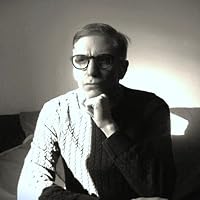
Italian poet, novelist, critic, essayst, journalist, translator, dramatist, film director, screenwriter and philosopher, often regarded as one of the greatest minds of XX century, was murdered violently in Rome in 1975 in circumstances not yet been clarified. Pasolini is best known outside Italy for his films, many of which were based on literary sources - The Gospel According to Saint Matthew, The Decameron, The Canterbury Tales...
Pasolini referred himself as a 'Catholic Marxist' and often used shocking juxtapositions of imagery to expose the vapidity of values in modern society. His essays and newspaper articles often critized the capitalistic omologation and also often contributed to public controversies which had made him many enemies. In the weeks leading up to his murder he had condemned Italy's political class for its corruption, for neo-fascist terrorist conspiracy and for collusion with the Mafia and the infamous "Propaganda 2" masonic lodge of Licio Gelli and Eugenio Cefis.
His friend, the writer Alberto Moravia, considered him "the major Italian poet" of the second half of the 20th century.
Unorthodox sketches of post-war Roman life, taken from a much larger collection of miscellaneous writings.
These are tales of whores and beggers, hustlers and brawlers, thieves and peasants; of grimy alleyways and courtyards baked in a Neapolitan poverty; of the allure of young males, and the homoeroticism of tight trousers and smoothe bodies; of streets laden with filthy garbage and rotting veg. Not a whiff of La Dolce Vita here: Just the stench of stale piss.
Clear to see that this is very much the work of a poet. A poet who, just like in his early films and novels depicting The Eternal City, is only interested in the lower classes; in characters dwelling in squalor, and who barely scrape a living.
No doubt though, throughout most of this selection, it is Rome itself that becomes the main protagonist.
Pasolini, you weren't only an awesome director, you had some writing chops too. regarding a couple of your films...
Teorema! amazing. perfect.
however I hated Salo. ugh. but you directed the fuck out of that, I was really impressed by all those elegant tracking shots and the elegant mise-en-scène, all that elegance amidst the humiliation and torture, nice contrast, I really did appreciate it, at least for the first 45 minutes I saw before I fled the theater in total disgust, repelled and angry and swearing to never watch another film by you, goddamn you. well, I broke that promise.
anyway, the book. fascinating and challenging and beautiful prose and all of that. longing and melancholy and the unbearable lightness of being and all of that too. here's a nice review of it, in fact one of the very few reviews of it on Goodreads, and can't someone fix that:
Pasolini's Roman Nights is the perfect example against those who believe that fiction is written according to some "rules" they have been taught is a class or a workshop. The stories are written in a way that defies any kind of rule or even structure. “Night on the Tram,” whose style could be compared to the notes jotted down by a hurried journalist, seems entirely shapeless: it starts with a narration about a young boy’s life, but after the first paragraph the narrator begins to describe his neighborhood, and from that point on the landscape becomes the story’s main character. The narrator is so focused on the various landscapes and the incidental characters he happens to see in passing—most of them described in parentheses that pepper the story, some of them three quarters of a page long, and others including other small parentheses—that he seems to have forgotten about the “main character.” When he does remember, he follows him through a particular scene in which everything the reader is shown is paralleled by the narrator’s comments in which he tells us what his character feels. He "shows" and "tells" at the same time. Then, the main character is abandoned again, we are showed various disparate scenes, and the story ends shortly after introducing a new character. The story ends with no “resolution” whatsoever, and we are abandoned in the middle of what could be a new “story.” Yet for anyone who reads without looking for the application of certain rules, “A Night on the Tram” is a very poignant story. And if one reads carefully, even its shapelessness is the result of a particular esthetic vision: rather than being written according to the cause-effect linear logic that underlies the vision of “plot,” this story has an intentionally disorderly structure whose effect is cinematic: the reader can see all those scenes as if being there, and in the end the story does develop a great character: Rome.
Pasolini's Rome is a hidden one of grimy plazas and neon nightlives -- hustlers, urchins, backstreet deals taking place along suspect industrial canals. The streets are his world, to the point where interior scenes seem almost out of place amongst the other settings. These stories, extracted from a massive compendium of prose works, were probably never intended for individual consumption as stories -- they're notes, sketches, portraits of the people and places that permeate Pasolini's rich universe. Some could be designed to gather up and hold onto an atmosphere, others could be notes for a shooting script that never was. In each, the skeletal plotting may become unexpectedly submerged by sensory or rhetorical detail. Unfinished, perhaps, but rich.
"From Pasolini's 'Ali dagli occhi azzurri', a five hundred page collection of miscellaneous writings, the five pieces selected and published in the volume stand out as characteristic of Pasolini's thought and method, displaying variety and natural progression over fifteen richly creative years of his life. They also reflect the significant cultural changes taking place in post-war Italian society and the new realism prevalent in artistic life. As stories, they are wholly unconventional and brilliantly improvisatory in style; Pasolini's restless attraction towards handsome young boys gives us Remo, Rafele, Romanino and the rest but his passion for Rome itself seems almost as deep as his homoerotic desires. The earliest of the pieces dates from 1950, when Pasolini left his native Friuli and settled in Rome; the last, 'Rital and Raton', is from 1965, the year of the publication of 'Ali dagli occhi azzurri'." From the synopsis on the 1994 paperback Quartet edition.
Some of the praise these stories received when first published, in English, in 1986:
'First and foremost Pasolini was a poet and an intellectual...(He was) the official thorn in the side of post-war Italy.' European
'Pasolini, of course, was always much more than another vogue director from the 1960s...As a poet, novelist, essayist and polemicist, he was arguably the central, seminal figure in post-war Italian literary culture, comparable in influence, to Sartre in France.' Glasgow Herald
'Several of the stories are so strong, so raw in their homo-eroticism, that one is dumbfounded to discover that the earliest was written over thirty five years ago...John Shepley's translation of these stories is a triumph. Rendered into dense, visceral English, it is startlingly true to the lushness of the Italian original.' New York Times Book Review
I have quoted these reviews because they say important things about these stories and Pasolini (please see my footnote *1 below for further comments). I have no idea if Pasolini has the name recognition in English language culture that he had when I was a teenager in the 1970s, but I rather doubt it. Certainly appreciation of him as a literary figure is even less then the appreciation of him as a film director (he did more films then Salo and even that is a more complex and moving piece then the titillating sniggers it usually receives suggest). I came to know Pasolini first via his films and only later learnt that he also wrote. It took me a long time to understand that he wasn't a film maker who wrote but a writer who also made some films. There is not a great disjunktion between the writer and the filmmaker. It has been many years since I saw any of Pasolini's films in a cinema, but I remember so clearly the overwhelming physicality of those films. The visual language conveyed the reality of flesh in bodies and food, of smells, textures and every other sense. Pasolini's writing in these stories is as powerful an assault on the senses via language as his films were an assault via images. He was a tactile writer and filmmaker.
This is a short collection of stories but it should wet any reader's appetite for both Pasolini's other literary works and his films.
As final note I want to make clear that these are not 'gay' stories even though I have shelved them as queer interest, I couldn't do otherwise, this is some of the most beautiful, but homoerotic, paeans to the raw sensuality and desirability of the male body you will ever read. Most of them were written in the early 1950s, the latest in 1965, and when you compare their rich erotic honesty to the pallid writing in English at that time that barely dared to hint at such things is to be reminded how deeply homophobia trammelled English language writing compared to Italy or France in those years.
*1 For me it is also a reminder of different times when newspapers from provincial cities not only carried reviews of literary works but would be quoted on paperback editions of those works. 'O tempora, o mores'!
The Marlboro Press edition was the one I had the luck to read. Themes from the first story resonate right thru to the last. It's Pasolini, so you guessed it: Sex=death=judgement. The great path of his life, dying on a lover's sword before being murdered for it. "Modernity in flames", the hot landscape as much a character as the virile ghetto boys tearing thru it hollering vaffanculo. Strange and sometimes alienating structure, but absolutely young, punk, socialist and worth it.
I kept resisting the idea that Pasolini is like some latter-day Italian variation of Jean Genet but then when the final story ("Rital e raton") shifted the action from Rome to Paris, I thought, well, what if he is. Like Genet, Pasolini has a romantic POV re: the underclass, a distaste for the bourgeoisie, and plenty of homoeroticism laced with violence. Unlike Genet, Pasolini doesn't have a first-rate translator for his entire oeuvre. English-language readers of Genet get the excellent Bernard Frechtman; those same readers of this short story collection will be stuck with John Shepley whose prose never gives evidence of the remarkable poet Pasolini was. As for the stories themselves, the opener "Squarci di notte romane" is a city sketch unconcerned with narrative; "Studi sulla vita del Testaccio" is likewise loose yet with more prominent characters; "Storia burina" concerns two young frenemies named Romano embarked on a life of crime; while "Rital e raton" similarly forgoes a single protagonist as it bounces from person to person. If you're into Pasolini, this book's worth a look. If you're not a Pasolini fan already, maybe start elsewhere.