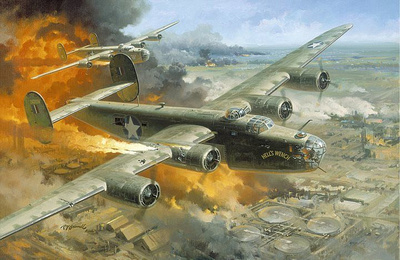
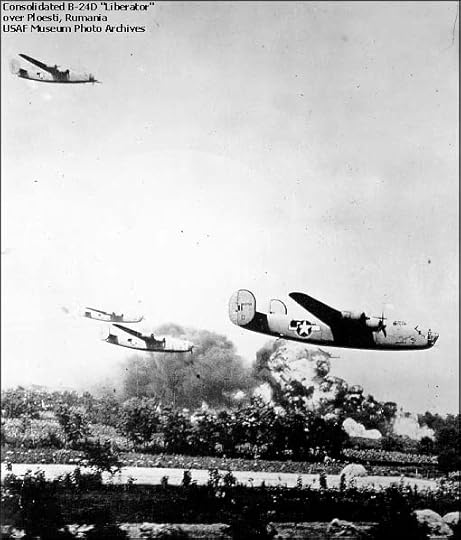
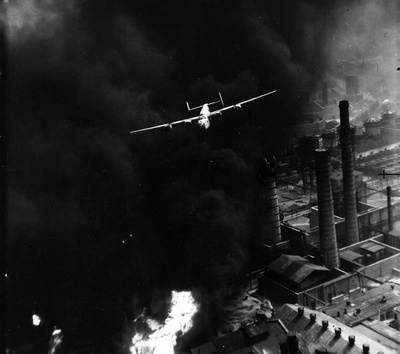
On August 1, 1943, an enormous armada of America B-24 Liberator bombers roared at nearly treetop level over the peaceful farms and villages of Romania. This mission was Operation Tidal Wave. Its target―“the taproot of German might,” Hitler’s giant oil refineries at Ploesti. Hundreds of U.S. airmen had volunteered for the mission despite warnings that half might not return. In thirty minutes, more firepower was exchanged than in two Gettysburgs, and five men earned the Medal of Honor. Ploesti presents a vivid reconstruction of a dramatic and controversial mission.
James Dugan was a historian, editor and magazine article writer. He is best known for his collaborations with Jacques Cousteau.
Dugan had a long-lasting connection with Jacques Cousteau. Dugan first met Cousteau in 1944 during the liberation of France. At this time he was a Yank magazine correspondent. Much of his writing in the 50's and 60's concerns underwater exploration with Captain Jacques Cousteau. Dugan received the Grand Prix, Cannes International Film Festival award for the documentary The Silent World in 1956. He was also part of the team that produced the Academy Award-winning documentaries The Silent World (1956) and World Without Sun (1964). Dugan wrote the narration for both films. Dugan edited Cousteau's books The Silent World (1953) and World Without Sun (1965) and co-authored The Living Sea (1963) with Cousteau.
James Dugan died June 3, 1967 in Panama City, FL from a heart attack at the age of 55. He was buried at sea.
One would wish that his hometown's claim to fame would be something else than being dubbed Public Enemy No. 1 during World War II, but when you sit at the center of one of the first and biggest oil fields in Europe, such wishful thinking doesn't stand a chance when confronted with real politiks.
The name was being used frequently in the secure rooms in Washington, London, Berlin, Moscow and Cairo. Ploesti's refineries produced one-third of Adolf Hitler's high-octane aviation gasoline, panzer fuel, benzine and lubricants. From Ploesti came half of the oil that kept Rommel's armor running on the sand seas of the Mediterranean Africa. [...] The Statistical Survey had studied enemy economics and all known industrial targets whose destruction would hurt Hitler most. Ploesti was number one.
I thought it would be interesting to compare notes between the stories my parents and grandparents told about the extensive bombing of my town, and the enemy's point of view, and I was not disappointed. James Dugan and his coauthor have treated the subject not only professionally, doing extensive research and interviews with key players from American, German and Romanian sides, giving historical, strategic and economic context to the action, but they have also written one of the most gripping tales of personal heroism and sacrifice, of dogfights and evasive actions described in almost blow-by-blow sequence. Dugan seems at times over-fond of superlatives and world breaking records when the talks about the Black Sunday raid, but a quick wikipedia search will confirm most of his claims as true to life.
The Arcadian city was incongruously fenced by the source of its prosperity - the smoking stacks, cracking towers, pumping stations, tank farms and noisy rail yards of eleven huge modern refineries, Romania's main economic asset, providing 40 percent of her exports.
also, Ploiesti was the first place in the world to refine commercially the black blood of contemporary industrialism. That was in 1857, two years before the petroleum strike at Titusville, Pennsilvania.
I have personally worked as a machinist in five of these wartime refineries (the ones that are still operating), and have been taken as a kid more than once on a tour of the local Museum of Oil History. I have heard long before reading the book about the rain of tinsel dropped by American planes ("a blizzard of metalized paper strips designed to craze the German radar targetting systems." in the book) , and about the fog machine deployed by the Germans in order to hide the targets. I was shown old signs of the damagee on the walls of my primary school, and have played hide-and-seek in the forests outside of town in abandoned trenches and bomb crater holes. So you can say, that I have a personal interest in this book, but even if it were another town, in another country, I would still say that James Dugan has written a war book that is as good as the more famous "Longest Day" or "A Bridge Too Far".
I'm not sure we can talk about spoilers when describing a historical event, and with a label like "Black Sunday" it should be clear to most readers that the mission was not an unqualified succes, but for the sake of readers unfamiliar with the story let there be a warning that the rest of my review contains SPOILERS.
V V V V V V V V V V
The actual engagement took a little over 30 minutes , but the preparations and the aftermath of the raid covers more than two years. The problem (or the luck, if you ask the local population) of Ploiesti is the geographical position, far outside the normal range of the Allied bombers. The first attempt to destroy the refineries surrounding the city was a Hail Mary pass of the sort made famous by the Doolitle Raid on Tokyo : a small group of B 24 bombers were launched from the Middle East more as a gesture of defiance than a real tactical strike. The Halpro raid of June 24, 1942 reached the destination area eventually, but most of the bombs failed to strike the targets and most of the planes failed to make the return trip, being stranded on the way back in Turkey. One unfortunate consequence of the premature raid was to alert the Germans of the vulnerability of their main source of fuel, and to put in charge of Ploiesti's protection Luftwaffe General Alfred Gerstenberg [who] built one of the heaviest and best-integrated air defense networks in Europe
More than a year later, the city was still at the outer range limit for the B-24 Liberators, stationed at the time around Benghazi in the Lybian desert, but the Chiefs of Staff were determined to destroy it. The key decision that was taken by one of the planners was to abandon the usual tactic of carpet bombing from high altitude and go in at ground level, both on the approach in order to avoid radar detection, and on the bomb run in order to accurately strike the main targets. No efforts were spared in the preparation, including some more 'firsts' and 'records'
This was the first use of movies to prepare men for a single battle. They also turned out 8 mm silent films showing how each refinery would look from the air on a low-level approach and crossing.
Pilots and crew were prepared also for the eventuality of crashing into enemy territory:
Men who found themselves in Romanian forests were advised to avoid wolves and bears, but not peasants. "The people of Romania, especially the peasants, are honest, friendly, kindly and hospitable to strangers"
Bears and sometime wolves are still present in the more isolated areas of mountains and forests in Romania, and the people are still proud of their hospitality, so the advice from 1943 still stands. I left out the part of the message that told soldiers to be wary of the urban population who is more opportunistic and more suspicious of strangers. The later sections of the book will bear witness to this difference in welcome by describing the internment of the downed airmen, passed from venal bureaucrats to kind peasants.
Talking of downed airmen, there were quite a lot of them, and Dugan spends as much effort in research and interviews for the aftermath as he spent on the preparation and the actual engagement. What he cannot help is to maintain an Allied bias of the account, by stressing the role of the monarchist factions and diminishing the efforts of the communists. The authors are also reticent to describe in detail the extended collateral damage to both Ploiesti and the capital Bucharest, when the Americans abandoned the idea of precise low level bombing and returned to the safer (for them) tactic of high altitude carpet bombing. Talking again to older persons in town, the thing these people recall most vividly is that the families were forced to evacuate from Ploiesti to the countryside, since the German fog machines made it impossible to distinguish between military and civilian targets. I would go even further, and say that industrial installations are NOT a legitimate military target, if they do not manufacture directly weapons or explosives.
The mission was the last act of chivalry in aerial bombing. There was probably no other urban air raid of the war in which more airmen died than civilians.
I believe this last statement from the book is the most important lesson learned on Black Sunday. Some other historians will probably focus on the losses of more than half of the original B-24 Liberators, or on the fact that in a couple of weeks oil production from Ploiesti was actually at a higher level than before the raid. What I got out from the analysis of results is this fact that remains true today : American soldiers have no taste for going head to head against a determined and well prepared adversary. They will always stand back and call in air support, bombing indiscriminately from as far away from the enemy as possible, regardless of 'collateral' damage. The fact that Black Sunday is the only individual battle that resulted in five Congressional Medals of Honor for valor is indicative of the later focus put on saving their own skin as opposed to jumping down in the middle of the fray. The Medals are undoubtledly well deserved and fine examples of courage and sacrifice to a higher purpose, but such heroes will be harder and harder to find in the future.
This mission was one of the costliest for the USAAF in the European Theater, with 53 aircraft and 660 aircrewmen lost. It was the worst loss ever suffered by the USAAF on a single mission, and its date was later referred to as "Black Sunday". Five Medals of Honor and numerous Distinguished Service Crosses were awarded to Operation Tidal Wave crew members.
the rest of my notes are mostly trivia, and will probably only serve to dilute the message I was trying to stress above, but I will include them here as a personal reference:
- "At the Versailles peace conference and during the amputation of Romanoff territory in the Russian civil war she got Bessarabia and part of Bukovina from Russia, Transylvania from Hungary, and Dobruja from Bulgaria, doubling the size of her country." Dugan makes a lot of noise about the role of Queen Marie of Romania in establishing the national borders after World War I, making it sound as if we were robbing our neighbours of vital territory. Two aspects of this thesis strike me as misguided : monarchy was never a major player in Romanian modern politics, their role being strictly ceremonial and not executive; and secondly, these territories that Dugan mentions were all populated my an ethnic Romanian majority. Historically, the national borders in the Balkans have always been fluid, with three major empires battling over the land and passing the 'peasants' from one side to another - Russian, Ottoman and Austro-Hungarian. Saying that Romania profited from backdoor deals and economic bribery is an over-simplification of the issue. It's also true that this reference is only a paragraph long in the book, since the focus is on the Operation Tidal Wave and not on the long-term history of the Balkans.
- "Princess Caterina Caradja at the estate of Nedelea, ten miles northwest of Ploesti. The first engineered petroleum well had gushed forth on this domain of her grandfather, Prince George Cantacuzene." another world record and another praise for Romanian aristocracy. I should do more research of local sources regarding princess Caragea before I let my mouth run off in criticism, but I can say she is virtually forgotten today.
- Dugan calls the inhabitants of Ploiesti "the best-fed people in Europe" at the time of the raid. Again the statement might be true for 1943, knowing the city is even today surrounded by extensive vegetable gardens to the south, orchards to the north and prosperous farming all around. But parents and neighbors don't remember this affluence. They remember the devastating famine of 1945-1947, when they used ot eat grass and leaves from the trees.
>>> <<<>>> <<<
I said in the introduction I wish my hometown was famous for something else than heavy industry and war. I hope I haven't scared potential tourists, and would like to remark that we are also famous for the 'Tzuica' (plum brandy) produced close by in Valenii de Munte, for the dry red wine of Valea Calugaresca, and for several luminaries of the cultural scene: - Geo Bogza and Radu Tudoran - one a reporter, the other a popular novelist and one of my all-time favorite authors - Ion Luca Caragiale - our best playwright - Toma Caragiu - an A-list actor of the sixties and seventies, tragically killed in the 1977 earthquake - Nichita Stanescu - our best modern poet
Ploesti is a superb, 5 Star riveting account of both Ploesti missions, the first one on 12 June 43 and the big one on 1 August 43, OP TIDAL WAVE. The authors, both members of the 8th Air Force but not participants in the raids, interviewed many participants in the battles. The book contains US, UK, German, Romanian, Bulgarian, Turkish accounts of the attacks. The book finishes with the aftermath of captured fliers and their time in various POW situations, heart-breaking losses and serendipitous escapes. The big raid on the oil complex lasts only 27 minutes (longer than planned) but the book is chock full of details. I especially like how the bomber streams are diagrammed attacking the targets and how they exited the area.
I appreciated the authors provided the correct pronunciation of Ploesti—which is not what I have always imagined.
Ploesti (plé-yésht’) was the first place in the world to refine commercially the black blood of contemporary industrialism. That was in 1857, two years before the petroleum strike at Titusville, Pennsylvania. Within a half century the automobile arrived with its croaking petrophilia, and British, French, Italian and Dutch capital and technology came to Ploesti. By 1914 Ploesti was coveted as an essential of machine warfare. In 1916 the Germans invaded Romania, and British engineers dynamited the refineries.
The book covers the preparations for the raid. The units picked for the mission are stationed in England and, since the mission will attack at low level, the crews are cleared to practice: …the crewmen …reveled in the sudden legalization of buzzing, heretofore a highly illicit pleasure. English farmers were not as happy about it. They complained of horses in shock, cows gone dry, and bees on strike against May flowers.
Reconnaissance of Ploesti was not allowed to maintain surprise. Also, the raid is going in low to fool the Luftwaffe, expecting the bombers to come in high just as they do every day. How to prep the aircrews for the target run??
The book covers all the extensive preparations to defend the oil complex. Lt Gen Gerstenberg is resourceful and thorough. Allied intelligence is woefully lacking on the defense and the bombers will pay a heavy price. The “Tidal Wave” takes off for Ploesti:
The plan was to hit the oil complex together. The groups were separated by clouds over the Balkan mountains and attacked at different times. The lead group turns at the 2nd instead of the 3rd checkpoint and misses their attack heading. They realize their error and turn back to the target but are now heading on a reciprocal heading. They are also going nose-to-nose with following bombers. The bombers are flying down to 20 feet at times and it gets crazy:
The leader of one group from the first group of bombers is taking their wingmen to the target. The pilot and copilot of “Hell’s Wench” will both be awarded the MoH.
Multiple waves of attacking Liberators have missed their planned attack headings and are heading into the oil complex to bomb targets of opportunity, if they can’t find their original targets. The German commander has one impression that was not intended:
The book follows the bombers through recovery to Benghazi and other divert bases. Many crash along the way, ditch in the Med, land in Turkey. The book tells the stories of the airmen who became POWs. And the book also covers in less detail the follow-on campaign against Ploesti.
Jams Dugan's book deals with Operation Tidal Wave which was the US operation to bomb the oil city of Ploiesti in Romania. This mission was one of the costliest US air force missions in Europe and as proportion of losses it was actually the most costly Allied air raid of the entire war. This was a battle of epic proportions with US air force being pitted against one of the most fortified cities in Europe.
Having visited Ploiesti many times and having driven past the refineries which are still working to this very day, I could only imagine the inferno that was unleashed upon this industrial city in World War II. After reading this book I have a better picture of what actually happened and I must say in a way it was even worse than what I had imagined. The tragedy of the death and destruction is captured very well in the book. I found myself feeling sorry for the bombing crews on many occasions although my own country was the one being bombed. This is especially sensitive since my grandmother was a war veteran and was a nurse during the 1944 bombing of Bucharest by the US air force.
Ploiesti (correct Romanian spelling) was one of the biggest hubs of petrol for the Nazi war machine. One third of all of the petrol that Nazi Germany used came from Ploiesti and this was the number one industrial target for the Allies. The problem was that it was extremely far away from any Allied bases. The closest Allied airfields from where a large bombing raid could be launched was Benghazi in Lybia. The US bombers had to fly from a very long distance, try to avoid detection, penetrate the largest concentration of flak cannons in Europe, bomb the refineries of Ploiesti and then somehow make it back to Libya or to neutral countries such as Turkey.
The author does a fantastic job of recreating the events and the atmosphere of the battle. The story of the initial raid of Ploiesti is covered, then the build up, preparation and planning at Benghazi, the bombing mission and the battle during Tidal Wave and the return of the planes to various bases. The descriptions of the bombing runs are breathtaking, the author vividly describes the high speed chase, the explosions and destruction on the ground as well as the impact of the enemy fighters and flak on the bombers.
There is also quite a long story about the lives of the US servicemen who crashed and were captured and interned in Romania. These pilots were probably the most privileged prisoners in the whole war. They lived comfortable lives in semi-captivity in a country where the regular people generally treated them as exotic guests or even saw them as saviours. Most of the airmen were interned in a scenic resort in the Carpathian mountains where they enjoyed an almost idyllic life eating, drinking, playing games and even spending time with the local female peasants. Romania was the only wartime country in Europe which did not suffer from deprivation or major shortages. Due to this, the airmen were well fed and even received a salary from the Romanian government which was the salary of their equivalent rank in the Romanian airforce.
There are also a lot of anecdotes about the personal lives of the US pilots, who they were and what their fate was. There is a lot of information about most of the planes involved, what their names were, where they came from, what their mission was, who made up their crew and what happened to them.
The author also tries to present the German perspective and has done some research for this. We get information about General Gerstenberg who was the Luftwaffe general in charge of the defense of the Ploiesti fields. There is also a lot of information about the various German pilots and flak gunners involved in the battle including their ultimate fate in the war.
The biggest problem with the book is the large number of factual inaccuracies and historical confusions on the Romanian side. Lots of places names are mixed and confused, events are mixed up and historical figures are presented inaccurately. There is a clear lack of research on this side which is probably connected to the fact that the book was written during the Cold War so there was likely a lot less access to native Romanian sources back then. Still, some of the mistakes are pretty glaring and makes the reader wonder how thorough was the research for the book.
Some of the issues that I have picked up include:
- many Romanian place names are written incorrect: Pepira instead of Pipera, Znagov instead of Snagov, Astro Romana instead of Astra Romana, Taxeroul is a place name that does not exist and is almost impossible to figure out what the actual correct name is - Queen Marie is mentioned as the true ruler of inter-war Romania. She had a lot of influence at the Paris peace conference indeed and she was involved in some political decision making, but she was far from ruling the country - the author mentions that Ion Antonescu first came to notice in 1919 when he was the captain of a band that looted, shops, homes and hospitals in Bucharest. This is extremely doubtful as by that time Antonescu was already a war hero after having been Chief of Staff of Marshall Constantin Prezan and having contributed decisively to the plans for the battle of Marasesti. In 1919 he was a Lieutenant and was already participating in high level government meetings with ministers such as IC Bratianu. It is likely that the author is actually confusing and mixing up Antonescu with Corneliu Zelea Codreanu - the above confusion is further deepend when Antonescu is named as the leader of the Iron Guard. Again, he was not the leader of the Guard and he is probably confused with Codreanu or Horia Sima, the actual leaders - the author mentions that in 1940 Antonescu as leader of Romania told the USSR that Romania was too weak to fight against it and as such they served an ultimatum for the occupation of Bessarabia. This is completely incorrect. The Soviet ultimatum was delivered in June 1940 and the regions were occupied in early July. Antonescu only became prime-minister in September 1940 as a direct result of the territorial losses. In fact, he protested against the territorial losses and was arrested as a result of this. He was an advocate for war against the USSR which is exactly what happened later on. - the author mentions that the fascist Iron Guard rose in rebellion against Antonescu for 'selling out to the German'. This is absolutely incorrect, the Iron Guard was subsidised and supported by Nazi Germany, the whole point of the rebellion was to establish a fascist dictatorship just like in Germany. The - the Romanian sculptor Constantin Brancusi is mentioned as being a native of Ploiesti with the city having one of his abstract sculptures. Brancusi is not a native of Ploiesti, the author is probably confusing Ploiesti with Targu Jiu where there are indeed sculptures - the author is confusing the name of the Carpathians with the Alps. He does mention the Transilvanian Alps at one point but then he refers to the mountains as just the Alps which is not correct
If I am to be objective this book probably deserves less than 4 stars (maybe 3.5) due to the large number of inaccuracies and the general dated character of the book. The book was first published in 1973 which is actually a lot closer to the date of the events (30 years after the bombing) than it is to today's date. However, I can not help but be subjective for a topic which is so close to my heart and also for the really vivid descriptions of the battle.
There is really no way to describe acurately what this book means to me.
It changed my life.
This is the story of American Army Air Force bomber crews who attempted to cut six months off WWII with a low-level attack on the oil refineries of Ploesti, Romania.
It is about heroism, sacrifice, tragedy and bravery beyond words.
I read it for the first time in 1964. I read parts of it every year.
I have committed passages to memory, some of which I cannot repeat without crying.
I personally have individually interviewed several of the combatants, and communicated with numerous others.
Every year I put flowers on the grave of one of the fallen.
What a great book. The authors had access to many of the participants from both the American and German/Romanian side. Although the prose can get a little flowery at times, once the B-24s approach the target, my heart rate quickened and breathing tightened as one plane after another is shredded by flak or fighters, struggles on, drops it's bombs and then crashes, or limps home, or limps to internment in Turkey.
So, an exciting read. Do I have quibbles? Yes
1. My copy was an old paperback edition. No maps, no photos. 2. There are no notes or bibliography leaving me the persistent feeling that this was not written by professional historians. 3. Mentioned in passing were the fates of some of the crews that made it back to base yet had further missions. An enumeration of all the crew and their fates by plane would have made for a powerful appendix. 4. It was known at the time that many US bombs were duds yet no mention was made as to why or whether the problem was ever fixed. And ... 5. There was virtually no analysis of whether the raid's tremendous cost had any affect on the German war effort. This would require digging into German logistics records which may not have been available
Finally, one can reflect on the raid and how an equivalent target would be attacked today. Most likely by cruise missiles, fired at no risk by the launch crew.
I picked up this book earlier this year at a scale modeling swap meet. A terrific read on one of the most celebrated and controversial air raids of World War II. I knew some of the particulars of Operation TITAL WAVE, but this gave me pretty much the whole story. I could not put this down. Highly recommended.
This is an interesting book from the perspective of just how difficult it was to bomb a target accurately, how dangerous it was to fly the B-24 Liberator and the detail of this operation.
Even though its been thirty years since I read this, it is a great reference for the first full scale air raid to knock out the petroleum pipeline for Hitler’s war machine. The main impressions were how intricate the planning was to hit the refinery, flying at tree top level to evade radar detection. The planners severely underestimated the defenses surrounding the site. Between fighter and ack-ack, the boys were flying straight into a maelstrom from hell. Add to that a mistake in navigation and the results would be no better than the first raids on Regensburg and Schweinfurt. Operation “Tidal Wave” was going to live up its name, but not in the way the 9th Air Force would have liked.
An error in navigation caused one flight to hit the refinery before the main body was scheduled. Their early arrival alerted the Germans and what ensued was nothing more than a blood bath for the crews to follow. The picture on the cover sums up the mission more than any words could. Heavy ack-ack, ground fire and burning buildings filled the air and tested the mettle of every pilot who had to fly into the maelstrom.
An excellent story depicting on the darkest days for our Air Force, yet filled with unflinching valor and courage.
Unbelievable dedication to the mission. For those interested, co-author Carroll Stewart built a complete scale model of the refinery and the low level mission. It is on display at the Mid America Air Museum at Bud Day Field in Sioux City, Iowa. Also the site of the crash of United 232.