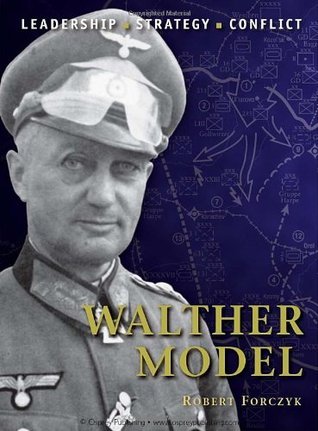
This volume details the military career and accomplishments of Walther Model, the youngest Generalfeldmarschall in the Wehrmacht in World War II and Hitler's favorite commander. His role on the Eastern Front saw him involved in most of the key battles of the second half of the warm, including the battles of Kursk Leningrad and the desperate attempt to halt the Soviet Bagration offensive. He also played a key role in the west, where his drive and defensive prowess saw his forces inflict heavy casualties on British forces at Arnhem and US forces in the Hürtgen Forest.
Model was a tough and tenacious commander, particularly when on the defense, and his career rise was virtually unprecedented in German military history. Model truly made his mark late in the war, when time was already running out for the Third Reich, but time and again he was rushed from one crumbling front to the next and succeeded in temporarily restoring the situation. Above all, Model deserves recognition as one of the great defensive commanders of modern military history.
Robert Forczyk has a PhD in International Relations and National Security from the University of Maryland and a strong background in European and Asian military history.
Walter Model: an interesting man, with an interesting background. There has been a mixture of feelings towards him by various historians, but honestly, he was a soldier, a general, and in all honesty, from the standpoint of a historian, he fought and defeated his enemies with skill. Model was one of the few who defeated Zhukov, Bradley, and Montgomery in the field of battle, and it was because of his skill that Germany was not crushed much earlier in the war. There were no written memoirs left by Model, so any books written on him are worth reading, however one must always think critically about these figures From history .
In this book, the author talks about models life, his achievements, why he is such a skilled general in terms of the German Wehrmacht, and how he used defensive tactics, that wore down and defeated allied armies. The author wants the reader to think critically about Models relationship with Hitler and his henchmen, presenting shifting views on the general by his peers and historians. Despite this, it is a great book, and I learned more about Model and his achievements than I had before.
Walther Model a primit botezul focului în timpul Primului Război Mondial. Pe Frontul de Vest a fost impresionat de defensiva rigidă, cu puncte fixe. Învățăminte care îi vor fi de folos în timpul următorului conflict mondial.
Generalul s-a făcut remarcat în timpul bătăliei pentru apărarea intrândului Rjev de lângă Moscova. Sovieticii au lansat în această porțiune de front Operațiunea Marte: un atac masiv din patru direcții pentru a cuceri Rjevul. Dar forțele germane bine pregătite și motivate le-au încurcat planurile. Ca să vă faceți o idee despre ferocitatea luptelor, sovieticii au numit bătălia "tocătorul de carne din Rjev".
În timpul bătăliei de la Kursk, lui Model i-a fost repartizat flancul de nord. Neîncrezător în operațiunea ofensivă, acesta și-a pregătit o linie defensivă în caz de retragere. O alegere inspirată deoarece a făcut fața mult mai bine viitoarelor ofensive sovietice.
De la Kursk, Model s-a transformat în "pompierul" armatei germane, fiind chemat în ultimă instanță pentru a salva situația. În Ucraina a reușit să elibereze o pungă 200 000 de soldați încercuiți. A salvat Grupul de Armate Nord purtând o bătălie de aproape 6 luni lângă orașul estonian Narva. N-a avut ce să mai facă când sovieticii au lansat Operațiunea Bagration prin care au distrus Grupul de Armate Centru.
Pe Frontul de Vest i-a oprit temporar pe anglo-americani în Olanda și lângă orașul Aachen
Fapt remarcabil printre generalii lui Hitler, sfaturile îi erau ascultate de către dictatorul german. Ceea ce i-a făcut pe unii comentatori să-l considere favoritul lui Hitler.
It could be a page-turner for historians but really enjoyable read for me. It illustrates how much hardships Model would struggle in both fronts, and his constant defensive welfare delaying third Reich from imminent defeat. I personally find him as one of the most underrated commanders in Wehrmacht. Contrary to German commanders who are succubus to Blitzkrieg doctrine, he spends most of his time from hardening the lines, keeping zone defense and saving his troops from pockets. To quote it from the book,
"Model is remembered as a fine tactician and stubborn defensive commander, but his detractors - of whom there were many - tend to define him as sycophantic if not servile to Hitler, lacking the operational brilliance of Manstein or charisma of Rommel."
Fascinating read. Model truly is one of the greatest military minds of history, though I'd much rather have him on defense than offense. My only complaint is that this book isn't longer!
I usually like Forczyk's work, although his heavy German bias is evident here. Model is depicted as a tough defensive fighter with a lot of varied experience, leading to an attention to detail that few commanders possessed. All of this is true enough. Where Forczyk fails is in ignoring Model's severe moral failings and in disparaging Allied commanders, particularly Bradley. Not a bad book as an introduction, but be aware this is written by a fan, and that Model was notorious for his acquiescence to Nazism even if he was not a true believer like Walther von Reichenau, Ernst Busch, and to a lesser degree Heinz Guderian.