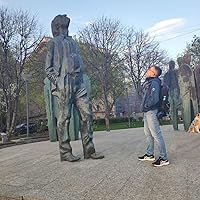
Aleksandr Radishhev - russkij literator- revolyucioner, po vyrazheniyu Ekateriny II, buntovshhik xuzhe Pugacheva ,?- pisatel glubokij i smelyj. Za knigu Puteshestvie iz Peterburga v Moskvu Radishheva posadili v Petropavlovskuyu krepost. Sud prigovoril ego k smertnoj kazni, kotoruyu imperatrica zamenila lisheniem chinov i dvoryanstva i ssylkoj v sibirskij ostrog. Eta kniga - redchajshij po sile prosvetitelskij traktat, napisannyj v vide putevyx ocherkov, gde i tochnye nablyudeniya puteshestvennika, i vdoxnovennye liricheskie otstupleniya uvlekayut chitatelya k soperezhivaniyu i sorazmyshleniyu#58; chto est Rossiya, chto dlya nee blago i chto zlo.
Aleksandr Nikolayevich Radishchev, was a Russian author and social critic who was arrested and exiled under Catherine the Great. He brought the tradition of radicalism in Russian literature to prominence with the publication in 1790 of his A Journey from Saint Petersburg to Moscow. His depiction of socio-economic conditions in Russia earned him exile to Siberia until 1797.
This is a really interesting book. I didn't love all of it, and it took me forever to read, but since finishing it I keep thinking about different parts of it. This isn't so much of a novel as it is an Enlightenment jeremiad disguised as a travelogue. Published in 1790, the plot basically consists of the narrator stopping at a postal or carriage house on his journey and meeting someone who tells a long story, or finding a letter and reading it, or seeing something that sparks a long reverie. It's basically an excuse for speech-making, and reform-minded speechmaking at that.
Radishchev was a noble, but an enlightened enlightenment noble, and you can tell why he was exiled to Siberia for this book, because almost nothing in then-current Russian society escapes comment. Especially coming in for scorn is the hypocrisy and self-interest of the noble class and the plight of the serfs, who were at the mercy of the aforementioned hypocritical, rapacious, and cruel nobles. I knew life as a Russian serf probably wasn't that great but it is awful to see his depictions of the hereditary servitude system and think about how much of humanity lived like this over the centuries.
It's also very interesting to see Radishchev make analogies between the serf system and slavery in the USA, making the argument that serfs are treated "just as badly" as American slaves and that the serf system is an evil just like slavery. Fascinating that only about a decade or so after independence (and just after the US Constitution was ratified with the disgusting 3/5ths compromise) that the system of slavery is seen as such an evil and a reference to something awful that would immediately be recognized by his audience.
Like I said, this was a slow going book, but while I am glad I am no longer reading it, I am also very glad that I have read it.
**Thanks to the translator, publisher, and NetGalley for a free copy in exchange for an honest review.
Journey from St. Petersburg to Moscow is a wild fever dream of a trip through late 18th century Russia in the company of a traveller who sees everything and reacts with febrile and intense emotion to what he sees. This translation is weepy-marvelous. I kept stopping to write down passages I wanted to remember, just for the beauty of the language and the oddness of the scene. The introduction to the work in this edition is outstanding--both fascinating to read and deeply informative. I'm not an expert in the author or the era, but reading the book was a marvelous and intense experience. I kept trying to keep in mind that this work was banned and nearly all copies destroyed of it by Catherine the Great and the author exiled to Siberia--it's important to read the work in this context--but at the same time the writing is so harshly satirical and so exaggerated that I'm reminded more than anything of Voltaire's Candide, written a few decades earlier, and I guess that leads me to ponder how differently wend the fates of scholars and writers, depending on where they happen to live and write. And it amazes me anew to ponder how dangerous it is, after all these centuries, for Russians to speak out or criticize those in power in their country. An exuberant, harsh, confusing, demanding, and ever-enlightening read.
Now, this will most likely be long and rambling, of no interest to people who do not deal with Slavic linguistics, and simplistic and silly to those who actually do. So let's get to it.
Radishchev's book is one of the great classics of early Russian literature. It's *always* mentioned in any book on Russian lit, and I would say that it's one of those stepping stones before Russian became... Russian. Russia was notoriously slow in its literary development, and while other countries were writing seedy dramas on love, murder and deception, Russians were going to church or dying in slavery. That's my take on it, anyway. This is 1790, Pushkin is in the 1820's, Lermontov 1830's Dostoevsky and Turgenev didn't publish anything until 1846, Tolstoy in 1852, Chekhov (decent-looking man by the way) is all the way up somewhere in the 1880's, and I guess those are the authors Western folks know about. So - 1790, that's early! That's in the days of Catherine the Great, the supposedly enlightened monarch. Radishchev's book shocked her deeply and he almost lost his life because of it, but ended up only being exiled. I do see her point, if I were tsarina and read "Скажи мне, в чьей голове может быть больше несообразностей, если не в царской?" ("Tell me, in whose head can there possibly be more incongruities, than in that of a tsar?") I would also be a bit annoyed. Perhaps Radishchev thought she'd be cool about it because the form, strictly speaking, is masculine? Or that she'd think it only applied to those who came before her? Hmm. Nah.
There's probably lots and lots of good stuff in here for historians. Radishchev criticizes the societal order rather harshly (there's a reason why there finally was a revolution, after all) by staging meetings with various individuals during his trip from St Petersburg to Moscow. The people he meets tell him of their troubles, of how daughters and wives of farmers are raped and mistreated, their husbands executed for defending their honor, how petty masters and mistresses do as they please with their property (their "souls"), how a just judge has no business in the judicial system, on the uselessness of censorship, and so on. Pretty depressing reading. This is furthermore interspersed with long sermon-like passages on how to build a better future, on the falseness of society, etc, with some musings on how prostitution should be banned NOT on moral grounds, but because prostitutes spread diseases. And also a part on how erotic literature can ruin the minds of young men. He doesn't mention young women. ^^
To be honest, the never ending moral preaching kind of made me zone out from time to time. You blink in the middle of line 3 of a 10 line sentence, and all of a sudden you have no idea who that damned participle is in agreement with, what on earth the plural dative is referring to, and... well... all of a sudden, you're counting occurrences of the root "blag". (It's everywhere.) It's not an easy read. Because this is not actually Russian. This novel could be translated into Russian. This is funny, because at the end of the book, Radishchev says the exact same thing about all that has been published up until Lomonosov (1711-1765, all-around genius, author of the first Russian grammar), during which time people (= those who could write, i.e. almost no-one) wrote in the same language as that prior to the Mongols, i.e. "na slovenskom" (Old Church Slavonic). Radishchev emulates a learned Church Slavonic idiom, using all he can find of OCS connectors, conjugations, vocabulary, and participles, probably because that *was* what being educated was about. Never ending participles! Not a single sentence without them. This makes for very cumbersome reading, and for endless amounts of fun for Old Church Slavonic geeks.
I had the most wonderful example of "we've got cases, so screw word order", but can't remember where I wrote it down. :(
First and foremost, and most incredible of all, there are absolute datives! Several of them! I really think it's a shame the absolute dative has not permeated colloquial Russian. As far as I can remember, it's a calque from Classical Greek's double genitive (but my Classical Greek grammar is shady at best, so I'm not sure now that they fill the exact same functions), but I do think I've read some article stating that it also reached East Slavic. And then, obviously, went away again. Such a shame, it's so elegant. And my edition has a note explaining what the absolute dative means, so it's not all that familiar to modern day Russians. (It's a temporal/causal adverbial clause.)
Look what I found!
"Я пью и ем не для того только, чтоб быть живу" <-- ! is that a dative? Infinitive with dative! "Подъезжал я к Новугороду" and "монастырей, вокруг оного лежащих" <-- double declination, lots and lots of онъ in the form of оного as 3rd.p.sg. pronoun (probably for non-animate referents, as его is also frequent). "власы главы его" <-- South Slavic metathesis! (lots and lots of these, also град, брад, сребро, слат... but also a fair amount of East Slavic polnoglasie forms!) зрети instead of видеть, яко, дондеже, еже, да-imperatives, которые without antecedent, ити and итти instead of идти, many short form всяк, единожды (однажды), токмо, at least one active present participle in the sg.m. without the щ-suffix!
And those are just a couple of examples. This was very interesting, but tiring. I have only read 10th-15th century texts, and then 19th century, so I'm lacking this middle period, which is very fascinating! I need to find some Lomonosov now.
Don’t be misled; apart from its chapter names, the book has (almost) nothing to do with travel. Radishchev gave such a title to his novel so that it could pass for a travel guide and get through the state censorship system. It didn’t prevent him from being exiled though.
When I read this book in Russian, I had an overwhelming feeling of hopelessness. As a speaker of Russian, who had read most of the classic works of fiction written in the language, I was experiencing excruciating pain while reading word after word, page after page — Radishchev’s language is archaic and much closer to the Russian of the preceding centuries than to the poetic writing of Pushkin’s, even though a tiny period of 20-30 years separated Pushkin’s greatest poems and prose from Radishchev’s “Journey.” What’s more, Pushkin was a fierce critic of Radishchev’s literary oeuvre, considering most of his legacy old-fashioned and badly-written. It is true that reading a 230-year-old book is a challenge. That said, once you get used to the peculiar presentation, you’re in for a treat. It’s not a book about an actual journey in time and space; it is a journey through the mind of a peculiarly intelligent and gifted person — the mind that is clear, progressive-thinking, full of connections and references, characterised by high morale. Each railway station of this ‘metaphysical journey’ is a vignette, not longer than 20 pages, where the author raises the most essential questions of the country’s then-present. Some of these loosely connected vignettes are inspired by true events and historical figures, others are philosophical musings about existence in its broadest meaning. The book spans lots of styles and genres, there is one section of poetry and several parts written as drama, the dialogues are presented in a linear way with no breaks separating the speakers, which adds up to the difficulty of following the narrative. However, when you manage to get hold of the writer’s logics and start to follow his ideas, you will find it surprising how daring and liberal his ideas might seem even to a 21st century person. Radishchev touches upon many societal sore spots — absolute power, religion, systems of legal punishment, education, military service, slavery, prostitution, marriage, class, father-child relationship, and many others. It’s been 230 years since the book was semi-legally published for the first time, but the global world is still looking for possible solutions to many of these fundamentals.
Get prepared for the challenge, ready yourself, and embark on the journey. It will be difficult, but by the moment you finish the trip, you will have understood that the world hasn’t changed much and we still have a long way to go before it becomes a better place — if it is capable of ever becoming a better place.
Un récit passionnant qui nous confronte à la réalité de la Russie impériale! J’admire l’auteur pour avoir eu ce courage d’affronter la souveraineté et d’avoir imposer son idéologie. Sans cette œuvre des mouvements révolutionnaires et intellectuels comme les Decembristes ou la célèbre Intelligentsia n’auraient sûrement pas eu lieu. Malgré que certains moments étaient difficiles à lire j’ai tout de même énormément apprécié cette lecture.
Не знаю, зачем это вообще проходят в школе - особенно на литературе. Я бы оставила выдержки для уроков истории. Радищев впихивает в книжку решительно все, от стиховедческой критики до чистки зубов, и да, борьбу с несправедливостью тоже.
Мой любимый эпизод - длинная-длинная история, как некто нанял лодку и вышел в Финский залив полюбоваться природой (тут длинные красивые описания природы), тут случился шторм и они сели на мель (длинные драматические описания, как один гребец отправился за помощью, а все остальные храбро держались), и как сержант на каком-то местном посту не дал лодку, потому что офицер спит, а будить не велено, и лодку давать кому попало не велено. Лодку все же нашли в другом месте, рассказчик потом пожаловался офицеру на сержанта, а офицер сказал - мол, тот все правильно сделал, не положено. И все знакомые потом рассказывали в ответ на эту историю - ну да, ужасно, бесчеловечно... но ничего не поделаешь, не положено. И поэтому рассказчик этой истории покидает жестокий бесчеловечный Петербург!
... в общем, так и вижу Радищева занудным современным блоггером или фейсбукером, перепощивающим отовсюду философские статьи.
София - байка из жизни на почтовом стане Тосна - встреча с архивным регистратором - родословная Любани - встреча с пахарем в воскресенье Чудово - история крушения морской двендцативесельной шлюпки - цена человеческой жизни Спасская полесть - знаменитый сон про Екатерину II - невозможно читать Подберезье - проблема недоступности образования Новгород - любительские рассуждения об экономике Бронницы - Холмоград - рассуждения о тленности бытия Зайцово - о судопроизводстве из жизни - частная история помещика Крестьцы - отцы и дети на службе с младенчества Яжелбицы - согласен с Екатериной Алексеевной - при чем здесь государство Валдаи - валдайские бани с мздоимными девушками Едрово - вот это бомба глава про деревенскую девку Хотилов - Радищев пишет проект СССР Вышний Волочок - о рабстве Выдропуск - упадок дворянства Торжок - о цензуре, чтобы не посадили Медное - о банкротстве помещика Тверь - ода Вольность Городня - о рекрутах Завидово - о преувеличении полномочий военными чинами Клин - о ветеране войны Пешки - о грязном быте крестьян Черная Грязь - о Ломоносове
Ну и стоило за этот блог приговаривать к смертной казни
Если очистить книгу от старомодного словоблудия, из которого она состоит чуть более, чем полностью, найдется несколько характерных и неприятных сцен российской жизни, а оценка книги властями (Радищева хотели казнить, но потом сослали) добавляет ей веса. Радищев был эмоционален и хотел моментального перехода к конституционной республике, освобождения крестьян, прав для всех граждан страны. Эти вполне нормальные желания современникам казались опасным бредом романтика, как и наличие честного человека на каком-то посту в принципе. При этом экзальтация Радищева все-таки вызывает раздражение.
Aj napriek prekladu z 20. storočia vidno, že knižka je z 18. storočia. Filozofický cestopis pretkaný kritikou vtedajšej (a vlastne z časti aj súčasnej) ruskej spoločnosti. Myšlienky boli výstižné, napriek tomu mi naozaj trvalo veľmi dlho, kým som sa cez ňu dostala, a niektoré pasáže boli ozaj ťažké na prečítanie.
В жарком августе 2024 года, возвращаясь из живописной Карелии, мне удалось совершить довольно долгое (около 8ми часов) путешествие из Петербурга в Москву (а если быть точнее - в Московскую губернию) на почтовых, перекладных, точнее на машине. Разумеется, я ожидала от этой повести большего: описание собственно дороги, пейзажей, приключений, в которые попадает автор 18 века. Что я получила взамен: философские изъяснения автора по поводу устройства бытия, небытия и прочее и прочее. Здесь вы не найдёте описание собственно дороги , а найдёте небольшие истории незнакомцев и знакомцев, которые рассказывают автору о своей жизни, когда он останавливается в одном из городов. Очень часто путешественник в лице автора критикует царскую власть, между строчек можно безошибочно прочесть склонность автора к социализму. Неудивительно, что какое-то время спустя, после публикации (а это, на минуточку, 1790 год), книга оказалась под запретом, автор приговорён к смертной казни, но , к счастью, Радищев отделался только ссылкой на 10 лет. Некоторые главы совершенно не связаны между собой. Например, есть глава, которая посвящена мнению автора о Ломоносове. Стиль Радищева - невероятно сложный, тяжеловесный, словно яблоня, которая согнулась от веса своих плодов. В итоге, ожидание - реальность у меня не сошлись, не доросла я ещё до такого высокопарного стиля, увы.
Радикально во многом даже на сегодняшний день, чего я не ждал от предтечи классиков, которые все-таки вуалировали сови социально-политические воззрения. Радищев же спустя несколько глав благополучно забывает о путешествии, и просто начинает рубить правду-матку, о том п, что творится вокруг. Отвечая ему хаотичным добром. Сама же книга очень душная, надоедающая стремлениями к крестьянской простоте и природе, интересная скорее как артефакт.
Aleksandr Radishchev (1749-1802) is sometimes called the father of the Russian intelligentsia, the “first Russian humanist” or “the first Russian radical”. The Soviets took him on board and called him “the first Russian revolutionary”. I’m not qualified to judge these assessments, but certainly it appears that he was probably the first person to raise his voice on behalf of the serfs, and this is his most acclaimed and well-known book, suppressed until 1905 but later becoming a Soviet classic. It’s sometimes compared to Uncle Tom’s Cabin as it brought to the wider reading public the plight of the serfs in Russia just as Harriet Beecher Stowe highlighted the plight of the slaves. Written between 1780-1790, the timing wasn’t good as although the French Revolution was still in its early stages by 1790 it had already made Catherine the Great wary and she accused Radishchev of trying to stir up the people against the government. He was imprisoned in the Peter and Paul Fortress and condemned to death although this was later commuted to exile in Siberia. After Catherine’s death he was allowed to live on his estate, although he eventually committed suicide. The book recounts his experiences on his journey of the title where he was witness to the degradation, misery and inequities of serfdom, which he describes graphically and with empathy. There are some harrowing and moving episodes, particularly one describing a serf auction. Unfortunately there are also some definite longueurs, such as a long passage on censorship. The human parts are very affecting but essentially it’s a book of ideas and I found myself skipping whole chunks. I feel that this is a book for the lover or student of Russian history and culture rather than the general reader, and even though I am both I still found it palled on occasion. However I am extremely glad to have discovered it thanks to NetGalley and very much enjoyed meeting Aleksandr Radishchev.
Да-да, роль Радищева в истории понятна, но смысл читать это "произведение"? Это трактат с критикой нравов, власти, иерархии общества, семейной жизни, отношения детей и родителей и тд. Была ли книга важна в свое время? Разумеется. Сейчас? Нет. Просто скучный "псевдороман", где автор высказывает свои измышления в лоб, выдавая их за слова второстепенных персонажей.
Надеюсь, в школьной программе этой книги больше нет, ей там не место. Давать ее на чтение фактически детям - бессмысленно. Считаю, что важно знать о ее существовании, о ее роли в истории, о самом Радищеве. Но читать - нет. Разве что историкам, заинтересованном в становлении революции.
Довольно отвратительно написано, и дело не в архаичности языка, а в склонности автора к графомании; но очень много тонких наблюдений, гуманизма, и влияние эта книга оказала мощнейшее, конечно, Радищев не графоман, а большой писатель, один из первых в России.
(Сейчас бы сказали «редактора бы ему хорошего», но где в его годы были редакторы. Но вот книге 250 лет, а читают, значит справился как-то и сам).
Вот бы каждому чиновнику обязательно прочитать "Путшествие..." перед вступлением в должность. Глава Крестьцы - кладезь житейских советов молодым родителям.
As a Russian major, this work was never my favorite. It's *important* in the genealogy of later Russian and Soviet writers, from Pushkin to Solzhenitsyn, but not the most enjoyable to read. This, though, is meant to be the definitive translation, and it delivers. The introduction features a useful biography of Radishchev and background on the reception of the book.
Thank you to the publishers and NetGalley for the opportunity to review a temporary digital ARC in exchange for an unbiased review.
Не думал, что вместо романа буду читать филосовский трактат, размышления на темы воспитания детей, справедливости, цензуры, рабства и крепостного права.
I received a digital copy via NetGalley in exchange for an honest review.
This is a really nice translation of an important book, and one that makes Radishchev accessible and even enjoyable to an English-speaking audience. While I'm able to read in Russian, Radishchev is not an author I feel very confident tackling in the original--and this translation worked really well for me. I enjoyed it and found myself digitally highlighting passages in nearly every chapter--it's not exactly light reading, but certainly worthwhile for those with an interest in Russian intellectual and political history. Many of Radishchev's observations and ideas are striking and relevant even today, even beyond their true significance to Russian history and literature. This is a book that is meant to make the reader think, and it does.
The introduction to this translation is interesting and informative, and provides a good amount of historical context on Radishchev and his work. It's probably most helpful and of more interest to someone with some background in Russian history, and I can't speak to how accessible it would be for someone without that background--but personally, having the necessary background, I really liked it.
Держи глаза и уши закрытыми, а рот на замке, если хочешь спокойно дожить до старости. Тем ты не наживёшь себе бед и по смерти твоей о тебе никто не вспомнит. А ежели надумаешь правде в лицо смотреть, покажешь ту правду другим, кто глаз не открывает, зато уши держит для внимания речам пустозвонным, то примешь за то наказание в полной мере. И не сказал ты ничего нового, объективно отразив увиденное, чем и заслужил порицание от общества, предпочитающего под смыслом бытия понимать им привычное. В чём же причина способности видеть другими не замечаемое? Виной тому образование заграничное и имеющийся опыт, отличный от для прочих обыденного. Достаточно ознакомиться с нравами другой страны, как в нравах своей обнаружишь изъяны. Но нет в том ничего греховного, ибо привычно то стало твоим соотечественникам, не поймут они тебя при всём твоём желание. Но обидеться могут. И обидятся!
In a sort of anti-Canterbury Tales, our author travels across his country as the title suggests, but rather than gaining stories from the people with him, finds tales, opinions and discussion with the people he encounters. But this being a book deliberately designed to ask whether or not some socialist-tinged reform might not happen in 1780s and '90s Russia, all the beats are looking at human compassion, liberty, equality, and so on. There's no hiding the fact this is not a book people turn to in between Oprah recommendations.
Early on we get the narrator enraged with a worker asleep on the job, but finding the fact he tipped his first coachman a great boon in getting a second. He discusses with a landworker at the plough how he ever finds time and energy to work for himself. He meets with a chap who, almost like the seller of indulgences in the Chaucer, has designed genealogical charts to flog to people who might want a minor title – our narrator is disgusted at the idea of the nouveaux riches getting all hoity-toity and lording it over things as a result. And he meets with an old friend, who dismisses St Petersburg as a city, due to a slovenly official's response to a potentially fatal situation.
The episodes don't always come from the people he meets, as in a fiercely powerful look at a dream, where he is a ruler seeing everything through rose tinted glasses before a sort of Ghost of Tzar-dom Past removes them for him. On the whole, however, the people bestow the contents on the narrative and not the places – this is rarely ever a travelogue as we know it, with only a couple of instances, such as Novgorod, making any impact on the page. But there's no mistaking the power this text would have had at the time for the real people in these places, and there's little surprise this civil servant-turned-author was charged with heresy against the state (of course, a death sentence, and then a change of that to ten years in Siberian exile, were a bit harsh as a response).
It's not as unreadable as the (excellent) introduction made me fear, and this is a fairly accessible read as a result of the translators' labours. But you do feel the urge to twitch a page or two ahead when faced with an interior monologue discussing the legitimacy of promissory notes. As such, and as is the norm from this publishing house, this is geared to a tiny niche market, and even more so with these pages. They will really only find great favour with the academic looking at proto-socialist thinking in Russia, or people studying early reformist modes of literature. Yup, me neither. I didn't object to my time spent in this world, however, so an average browser will not hate this. I don't see them ever recommending this to their like, however. Some things are just not set to be shared with impunity.
"Călătorie de la Petersburg la Moscova" încearcă să fie un "Robinson Crusoe" al vremurilor și locurilor sale, dar unul reformator. Situațiile cu care Călătorul se întâlnește sunt adesea covârșitoare și te fac să reflectezi la importantele privilegii ale libertății de care dăm dovadă în zilele noastre.
Pot, în schimb, înțelege de ce guvernul Țarului Mucenic Nicolae II nu a publicat cartea în original. Dorința de cultivare pur iluministă dorită de către autor și-a arătat greșală încă dinaintea publicarea cărții și încă persistă. Renunțarea la o autoritate Bisericească și Statală duc la însingurarea și schisma individului față de comunitate și nu poate duce decât la cele mai adânci rătăciri. (În expozițiunile naratorului, se menționează pe alocuri sinuciderea ca o metodă de eliberare de sub jugul lumii, chiar Radișchev luând asupra sa Osânda Veșnică din păcate... Aceste urmări ale iluminismului radical manifestat mai apoi în marxism leninism și stalinism au condus la actualul caz în care rușii încă sunt printre cele mai sinucigașe popoare. Sinuciderea nu este niciodată o soluție și chiar dintre puținele contrasoluții totale în cadrul Creștinismului Ortodox, fiind considerat ca o respingere totală a Fericirii Veșnice. Urmări mai urâte decât aceste încurajări nu poate avea niciun sfat.)
Din păcate, nu toate întamplările sunt la fel de captivante și chiar le alocuri plicticoase. Dacă avea consistență se apropia de ceva foarte bun, dar pentru mine nu trece pragul. Vă recomand să luați și voi parte la această călătorie, dar cu prudență și răbdare. Vedem ce facem la examen.