Jump to ratings and reviews
Rate this book

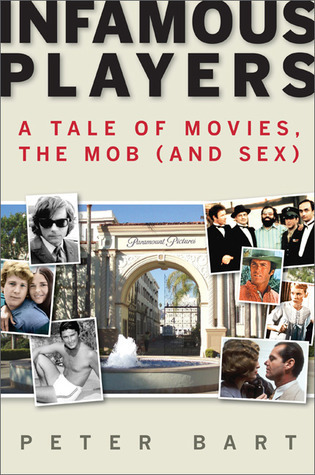
Infamous Players: A Tale of Movies, the Mob,

Rate this book
In 1967, Peter Bart, then a young family man and rising reporter for the New York Times , decided to upend his life and enter into the dizzying world of motion pictures. Infamous Players is the story of Bart's whirlwind journey at Paramount, his role in its triumph and failures, and how a new kind of filmmaking emerged during that time. When Bart was lured to Paramount by his friend and fellow newcomer, the legendary Robert Evans, the studio languished, its slate riddled with movies that were out of touch with the dynamic sixties. By the time Bart had left Paramount in 1975, the studio had completed a remarkable run with such films as The Godfather , Rosemary's Baby , Harold and Maude , Love Story , Chinatown , Paper Moon , and True Grit . But this new golden era at Paramount was also fraught with chaos and company turmoil. Drugs, sex, runaway budgets, management infighting, and even the Mafia started finding their way onto the Paramount backlot, making it surely one of the worst-run studios in the history of the movie industry. As Peter reflects on the New Hollywood era at Paramount with behind-the-scenes details and insightful analysis, here too are his fascinating recollections of the icons from that Warren Beatty, Steve McQueen, Robert Redford, Clint Eastwood, Jack Nicholson, Marlon Brando, Al Pacino, Francis Ford Coppola, Roman Polanski, and Frank Sinatra among others. For over five decades, first on the inside as a studio executive, and later as the longtime editor-in-chief of Variety , Peter Bart has viewed Hollywood from an incomparable vantage point. The stories he tells and the lessons we learn from Infamous Players are essential for anyone who loves movies.

274 pages, Hardcover

First published April 6, 2011

7 people are currently reading
188 people want to read

About the author

Peter Bart

32 books5 followers

Ratings & Reviews

What do you think?
Rate this book

Friends & Following

Create a free account to discover what your friends think of this book!

Community Reviews

5 stars
18 (11%)
4 stars
38 (25%)
3 stars
69 (45%)
2 stars
23 (15%)
1 star
4 (2%)
Displaying 1 - 30 of 33 reviews
Profile Image for Scott.
2,274 reviews270 followers
April 14, 2018
I can appreciate Bart being "in the know" from having a front-row seat (pun intended) as young studio executive at Paramount Pictures, as well as his earlier journalistic writing experience. But . . .

This book is far from perfect. First, the title is hyperbolic - it is not a crass or scandalous read (but that's a good thing). Next, the chronology can ping-pong to the point of distraction. Lastly, some of the stories will seem familiar or repetitive if you've read Easy Riders, Raging Bulls or other works.

Still, I don't want to make it sound all that bad or a waste of time. Bart has firsthand knowledge on some of the legendary productions, some good anecdotes on the various personalities involved, and Paramount's run of hits from the '67 - '75 era (Rosemary's Baby, Love Story, The Godfather series, Chinatown, to name on only a few) during his tenure was outstanding.
Profile Image for stephanie.
301 reviews18 followers
June 29, 2011
The title of this book really caught my eye, but the text fell flat in many places. This book is HARDLY about the mob. Peter Bart casually mentions mobsters maybe twice---leading up to a short passage about the making of The Godfather, but that's it. No intrigue. Oh yes, Hollywood was connected to the Mob in 60s and 70s. Something I already knew! And just like that, I gave up on believing this book had more to offer.
Profile Image for JUANJO.
60 reviews5 followers
January 30, 2023
Peter Bart (ejecutivo de Paramount y director de Variety, entre otros) relata la época dorada de la Paramount, los años 70. Reflexiona sobre los estudios de Hollywood contando historias que han hecho acordarme de la reciente película Babylon sobre los brutales excesos que se da esta gente. Esa época dorada también estuvo marcada por el caos y la convulsión entre los diferentes productores, presidentes y ejecutivos que rodeaban a la industria cinematográfica.

“Innegablemente, el consumo de drogas indiscriminado acortó muchas carreras, así como la egomanía desbocada. Pero las películas que triunfaron en los años sesenta y setenta eran narcóticos en sí mismos, y su mítico éxito convirtió a directores inmaduros en estrella del rock, con todos los riesgos y gratificaciones que ello conlleva. Lo repentino de su ascenso parecía imponer la obsolescencia instantánea”.

Bart desgrana también sus recuerdos con iconos de la época: Warren Beatty, Steve McQueen, Clint Eastwood, Robert Redford, Coppola, Al Pacino, Polanski, Sinatra… así como también nos cuenta sus impresiones sobre personajes de la talla de Charles Bluhdorn, Bob Evans, Henry Kissinger y otros muchos.
Me ha parecido muy interesante por las historias que cuenta y las lecciones que se aprende sobre la industria cinematográfica. Recomendado para todo amante al cine.
1,380 reviews98 followers
June 24, 2025
Surprisingly lame and inept attempt by supposed journalist to spin his years at Paramount into his own personal brilliance while pointing out the idiocy of others. As a former writer for the New York Times and the editor of Variety, he is the perfect example of a media reporter who fails to write true journalism but instead pushes his own self-serving agenda while distorting the truth and including a number of factual errors.

Those that want to defend the Times as the greatest news source in the country need to look no further than this guy's admission on breaking the basic rules of journalism in sharing drugs with the people he was reporting on or using his supposedly objective articles to push a progressive political agenda. Or how about this line: "My journalistic experience had taught me that reporters habitually write their stories in advance." Did you get that--he admits that at the giant New York Times the fake "journalists" WRITE IN THEIR MOINDS THE STORIES BEFORE THEY ACTUALLY DO THE INTERVIEWS AND GATHER OBJECTIVE FACTS. That means they are approaching "news" with subjective bias and gather details to support their warped viewpoints instead of digging first and reporting what they find later.

And those that celebrate his years at Variety will instead find here plenty of reasons to reinforce that Variety and other Hollywood trade publications are nothing more than deceptive PR propaganda for the liberal rich and famous.

The main problem with the book is that Bart withholds a lot of details, information and inside stories. This is more of an outline of a few well-known Paramount productions during his time there than providing any true insights into the films or employees involved. It's mostly shorthand about movies you want to learn a lot more about (The Godfather, Love Story) and bloated when it comes to dumb films that were so bad they don't deserve the space (Great Gatsby, Darling Lilli). Even the celebrated bombs that would have been fun to read about are glossed over, such as Catch-22. But how can this guy claim that he came up with the idea of John Wayne doing True Grit, yet there's only one short page about it?

Hmm...could it be because the Academy Award winning film starred a conservative Republican?

With the focus of the book being his wild liberal and sexually active colleagues at the production level, there's almost nothing about the actual making of these movies. He has a list in the back of all the movies that he was involved in over the years and you'll be shocked how many major winners and losers are not covered in this book. The bombs he was part of are legendary, no wonder he wants to skip past them. But Bart can't simply wash his hands of them--he was in on the meetings and admits to rarely having spoken up to stand against the dumb decisions. At least he admits in the book that the one thing he learned is no one in Hollywood has a clue about what will become successful.

Then there are the mistakes. They'd be laughable if this weren't the former head of the biggest show business publication in America who should have had some basic facts right. Especially with this written forty years after the fact, when he could have used 2011 online searches to fact check.

"The blockbuster mentality that began to overtake Hollywood in the 1980s when films like Jaws and Star Wars opened." HUH? Jaws was 1975 and Star Wars was 1977. This is movies 101 and for Bart to place them in the wrong decade is idiocy.

"Deep Throat (a famous porn film) represented, by all estimates, the highest-grossing movie in the history of the industry." Come on, to qualify such an absurd and silly statement in 2011 with "by all estimates" proves this guy doesn't know how to report objectively because the sex movie certainly didn't earn more that hundreds of blockbusters in the past fifty years.

He does this with a number of movies--claims some were hits that weren't, says others were bombs that actually did okay. No facts or numbers to back himself up, and zero footnotes to support any of his claims. He also overstates the importance of some films, calling Shampoo "distinguished," the horrible A New Leaf receiving "favorable reviews" and "clever," and that bizarre Being There "achieved its own special immortality." Have you watched those lately? Didn't think so.

Then Bart writes that when he "first learned that Paramount had acquired Paint Your Wagon," (one of the single worst film musicals ever starring Clint Eastwood) boss Bob Evans told him they'd hired a famous writer to do the script. Bart claims he objected to Evans, "Paddy Chayefsky writes movies like Network or Hospital. He writes great satire, but this is a period musical." One little problem with quoting yourself Peter--Network and Hospital happened a couple years AFTER Paint Your Wagon was made, so it would be impossible for you to quote yourself referring to them before Paint Your Wagon was made!

See what I mean--this is a former New York Times "journalist." Don't trust a word any of them write.

Most concerning is his admission that the "creative process" of show business involves lots of drugs, wild parties with plenty of nudity, breaking the law, aligning with the Mafia, and sexual favors demanded by male executives to give people jobs. He tries to distance himself from some of it but often admits he just went along with it all. Bart hilariously writes that the difference between himself and the others was that he has "a completely nonaddictive personality. I smoked the joints and welcomed an occasional cocaine high after an arduous day, and the hot tubs became habitual, as did the subsurface wandering hands...(but) my behavior probably was regarded as prudish." Later he boasts, "I had developed a casual fondness for cocaine, but to me it was a party drug--a once or twice a month plaything." And this is a man we trust to write objective stories about the industry? No wonder he's brain dead in spots and wants to push criminal and immoral Democrat propaganda.

He throws a few people under the bus but seems too quick to try to spin his boss Bob Evans into being a wonderful exotic playboy. And is totally biased when it comes to caricaturing rich business executives he seems jealous of or upset that they don't support the progressive political woke messaging.

And then there's the touching tribute that starts the book: "This book would not have happened without the prodding and encouragement of Harvey Weinstein." Wow. Peter Bart again proves himself to simply be a leftist Hollywood kiss up that didn't have the ability to be a true objective journalist willing to do the work required to dig up dirt on those he was reporting on. Nor take the right moral stances to make him be any different than the rest of the scumbags. He was too worried about becoming friends with, and getting rich off of, all the infamous players.
Profile Image for Ron Barta.
4 reviews13 followers
June 28, 2013
One really has to wonder if anyone really edited this book for Peter Bart. As a previous reviewer noted, "an out of order, repetitive mess." I must agree. For me the only revealing chapter was about "Harold and Maude" which is a personal favorite. I didn't do any research to verify actual production dates, but all too often he seems to get the chronologies wrong regarding movies that at least in my mind were released in a different order. He says or at least implies (because he never seems to attach a date to anything!) that Erich Segal penned the script for "Yellow Submarine" after "Love Story." He discusses how they were worried about casting Mia Farrow in "Rosemary's Baby" because like Ryan O'Neal, she too was from TV's "Peyton Place" and there were similar misgivings about his casting in "Love Story". Bart says casting her would be like "Ryan O'Neal all over again." "Rosemary's Baby" was released in 1968, "Love Story" in 1970. Bart seems to remember differently. There are other times when discussing an individual's career, the reader can't be sure what decade he's referring to.

It's as if no one actually did any fact checking of his stories. I'm just a casual movie fan, but there were quite a few instances like this. And as the previous reviewer stated, it is repetitive.

If I were an editor (and I certainly am NOT), I'd be asking him some basic questions like "Didn't you already mention that already?" and "Might we add some dates to clarify this?" etc.

I'm not even done with the book yet, but I've said "Wow, really?" to myself so many times so far, I felt compelled to write this.

For something that is fact based, the fact that there are such blatant errors, or at the very least, ambiguities, it unfortunately does cast doubt on all of his anecdotes.
Profile Image for Chris.
379 reviews22 followers
July 24, 2011
Peter Bart's tell-all of his time working for Paramount Pictures in the late '60's/early '70's has some really compelling tales about moviemaking during one of the last times Hollywood produced movies that blended art and commerce masterfully. I appreciated Bart's candid tell-all, wherein he neither plays the gloryhound nor does he shy away from telling it like it was during his tenure at Paramount. I admired Bart focusing equally on the ridiculous junk Paramount was making (Paint Your Wagon, Darling Lili) as much he did on the hits (Rosemary's Baby, The Godfather). Even there, Bart isn't precious when describing the movies with which he was involved- his take-down of the soppy, sentimental, but hugely successful Love Story is accurate and somewhat funny.

One major strike against Infamous Players : Bart decides not to tell his stories chronologically. This would be an interesting choice if Bart managed to keep the narrative threads of his memoir clear. Instead, his chapters spiral together confusedly. Stories get repeated over and over, to the point of diminishing returns.
Profile Image for Leila Cohan-Miccio.
270 reviews7 followers
June 6, 2011
As anyone who's seen The Kid Stays In The Picture knows, there's a really interesting story in Paramount's rise during the Bob Evans years. However, this book from Bart, Evans' bestie, decides to forgo telling that story linearly in favor of recalling themed anecdotes, which is much less satisfying. It's not all bad: there's some pretty good dishy star stuff, but overall, it feels like a missed opportunity.
Profile Image for Johan.
186 reviews
October 31, 2011
Interesting though it was, I was slightly disappointed. Also Peter Bart made a glaring error when he claimed that Alan Jay Lerner's Coco never went to Broadway; when as a matter of fact it did, starring the unique Katherine Hepburn. Anyway an eror like that, make you wonder about the truthfullness of the rest.
Profile Image for Matt.
120 reviews4 followers
May 24, 2015
This read was a little underwhelming. For a guy who was in the guts of a pretty historic time at Paramount, I expected more epic information.

Read almost seems a bit lazy and not all that well edited.

Not a terrible read. Just probably would have passed had I known the lack of interesting information.

I gave it a 2*
Profile Image for Lucie.
88 reviews9 followers
March 15, 2017
a disappointing, confusing, repetitive & out of order mess
Profile Image for Derek Ambrose.
107 reviews
March 2, 2015
Some familiar Hollywood stories and some new of the Evans/Bart Paramount era. A bit of mess. The book is not chronological so sometimes anecdotes are repeated twice or three times. A quick read
Profile Image for A Cesspool.
376 reviews5 followers
November 16, 2025
principle takeaway: DNF
Occasionally insightful, if only topically; Nowhere near as rewarding as Bart’s essential cautionary saga: Fade Out: The Calamitous Final Days of MGM .

Everything you really need to know about Infamous Players (regarding Bart’s 8-year tenure at Paramount) is it's essentially a byproduct of a catch-and-kill settlement. Just like his journalistic-counterpart, Peter Biskind, Bart only accepted Harvey Weinstein’s book contract (with Miramax Books) as compensation for Not writing about Weinstein’s libidinous atrocities – again, much like Biskind, Bart’s a Harvey-apologist.

A good chunk is either ported over from Robert Evans’ 2002 memoir’ish [nèe: revisionist history]: The Kid Stays in the Picture , or just re-framed by Bart [à la, 'What really happened...'].
The author primarily exploits this opportunity to take down old colleagues (legacy foes) and have a final say (or clapback), at Evan’s aforementioned version of events; Likewise re-aligning earlier POVs by Francis Ford Coppola, Albert Ruddy, or (especially) Frank Yablans.
New making-of insights or behind-the-scenes anecdotals are sorely lackin’, Bart can’t even bother with finally acknowledging what so many others previously reported: Paramount boss, Gulf + Western mogul, Charles Bluhdorn, didn’t theatrically-succumb to a sudden mid-air heart attack, rather, spent the last year of his life, reportedly sicker and sicker, hoping to beat the cancer that ultimately overtook him.
272 reviews1 follower
September 28, 2025
Peter Bart was a vice president at Paramount during Robert Evans’ heyday as chief of production at the studio (from 1967-the mid-70s). During that time, Paramount produced a dizzying number of hits including Love Story, The Godfather, and Chinatown. Infamous Players is Bart’s account of those heady years.

If you read Infamous Players as a good series of yarns about Hollywood, you will enjoy it. Bart has all kinds of tales and film buffs will enjoy them. Infamous Players is a good, short read that never bogs down.

Inevitably, there are some drawbacks. Bart is often negative about those with whom he has worked. As with my autobiographies, he is settling a few scores and puffing up his own contributions. (Though he clearly states that he didn’t write the book to make himself look good). If you can accept that Infamous Players is one piece of the truth, you will find it to be rewarding.
177 reviews3 followers
July 1, 2024
This is an interesting book, but, as so many other reviews mention, it is badly, terribly, woefully in need of editing. Among other things, editing is needed to keep the chronology straight. In a quote he provides from himself early in the book, Bart mentions the film Network as an example of something at a time well before Network came out. Later, he writes, "By 1973, fortified by the success of the two Godfathers" . . . even though Godfather II came out in 1974. There are countless examples like this, and they become really distracting after a while for readers who have even a basic grasp of 1970s films.
Profile Image for Sean Wicks.
115 reviews6 followers
June 26, 2018
If you've read any of Peter Bart's other Hollywood books, you've read many of these tales of 1970s Hollywood before. The usual suspects make their appearance - THE GODFATHER, LOVE STORY, Bludhorn, Evans, PAINT YOUR WAGON, Warren Beatty. The title itself is a bit misleading, seeming to promise an expose on a mob-run studio, but there is barely any of that at all. In fact, it feels like a retread of the same old stories (with a few new ones thrown in) in no particular order. The stories are great, it's the overall presentation that is lacking.
Profile Image for Adrian Brown.
715 reviews4 followers
September 30, 2024
From my uncle. Juicy gossip but the book was very poorly organized. He didn't choose to order it chronologically, but he also wasn't careful to explain things the first time they came up. He referenced stories that he hadn't told yet and didn't provide enough context to understand them until you got to the full story several chapters later. It was frustrating to try and figure out how different anecdotes related to each other in time, and whether they influenced each other. Not recommended.
Profile Image for Tim Kretschmann.
129 reviews2 followers
August 19, 2025
A well written history, if biased, by a person that was right there. Fascinating tales of a wild period at Paramount Pictures and the legendary Robert Evans, but I found the non-linear, non-chronological order telling of the story sometimes confusing. Nonetheless, I couldn't stop turning the pages and really enjoyed the experience.
Profile Image for Koren .
1,183 reviews40 followers
August 3, 2024
There are probably much more interesting books about the history of Paramount. This book focusses only on the years the author worked there and only what he worked on. He did work on some of the well-known movies of the 70's but this one seems to have more of a gossipy tone.
Profile Image for Brenden.
42 reviews
November 8, 2020
An interesting look into the history of Paramount Pictures.
Profile Image for Eden Thompson.
1,011 reviews5 followers
December 21, 2023
Visit JetBlackDragonfly (The Man Who Read Too Much) at www.edenthompson.ca/blog

Peter Bart has written several inside histories of the film business and I have loved them all. As a former New York Times reporter and Vice-President of Paramount Studios, as well as editor-in-cheif of Variety magazine for 20 years, Bart reveals the inside stories behind the great films of the 1970's, not just a witness to the deals, but instrumental in making them happen.

In the late 1960's, the Gulf & Western corporation purchased Paramount studios and started with fresh management. Producer Robert Evans and reporter Peter Bart became the new heads of the studio, inheriting a pile of over budget and overblown turkeys such as Paint Your Wagon (starring singing star Clint Eastwood) and Darling Lili (in which German spy Julie Andrews seduces Rock Hudson). The failure of those movies were covered up by shell companies, yet G&W saw Paramount going under and were ready to shut it down. People were gravitating towards personal films and one of the first from Bart/Evans was written by an unknown, starring an unknown model's assistant and an ex-soap opera star, Love Story. This phenomenal success began to turn the company around, and between 1967 and 1975 they aggressively recruited a colourful young cast of filmmakers resulting in the release of such films as The Godfather, Chinatown, Harold & Maude, Rosemary's Baby, Paper Moon, and True Grit.

Infamous Players is both a memoir of Hollywood sex and drugs excess in the 1970's, and a revealing look into the machinations behind the films, as Bart and others in the industry vie to create great movies with different combinations of actors writers and directors. The Great Gatsby could have starred Warren Beatty or Marlon Brando, Marlon and Al Pacino might not have been in The Godfather. Indeed, G&W were ready to shut down the studio in the final hours of filming Godfather, and it's squeaking through rose the company from the ashes. It also highlights the changing times as the mafia and big business take up a stake in Hollywood, mixing with its most important players.
It's a captivating read for any film buff, with frank perspectives that are not always flattering, but an honest look at how Hollywood really works. If you are into film history, it's a great treat from someone who was not only in the the room, but made the decisions that changed the course of moviemaking. It's an entertaining page-turner about a unique cultural moment.

Peter Bart has written several other books about the industry including The Gross, Shoot-Out Who Killed Hollywood?, and Boffo! How I Learned To Love The Blockbuster And Fear The Bomb. My favourite of his was Fade Out, the inside scoop on the calamitous last days of MGM as billionaire Kirk Kerkorian ran the studio into the ground and then sold the parts off. If you are into filmmaking and Hollywood, movie stars and directors, and want a first hand account, Peter Bart's books are highly recommended. They are all great.
For film nerds like me, who love the personal films of the seventies, Infamous Players is highly recommended!
Profile Image for Ronald Keeler.
846 reviews37 followers
July 26, 2015
This is a tale of movies; there is material about mob involvement, but it is more concentrated on the difficult relationships between studio executives and the demands of business corporate boards. It is still a good read for the insights into the development of rising stars such as Robert Redford, Warren Beatty, and Clint Eastwood. Then there are the tales of the decline of Marlon Brando, the rude public persona of Frank Sinatra, and the introvert nature of Coppola. These are the sort of insider stories we like to read without getting caught in a check-out line buying tabloids. While we can justifiably be skeptical about the truth of tabloid presentations, Bart brings the personal credibility of personal involvement so we feel comfortable that we, the readers, are getting accurate information. A reader with too much time on hand might want to go back to discover author bias in certain cited situations, but my overall impression is that there was just enough balanced presentation of, for example, corporate power play issues (that may have been grounded in drugs, sex, or personal ego foundations) to mitigate charges of author bias. A reader can race through this book in one sitting while watching some sort of classic movie channel with movies starring the characters highlighted in the book.
406 reviews1 follower
June 15, 2011
If you liked The Kid Stays In The Picture, this is a good parallel piece with a much more reliable narrator. Peter Bart was Robert Evans right hand at Paramount from 1967 to 1975. So, he was there when Rosemary's Baby, Love Story, The Godfather and Chinatown were made among others. A lot of those others were some incredibly bad movies it's almost hard to believe a major studio would output. What's disarming about the Bart is how quick he is to point out that he observed these classic movies coming together rather than taking credit. Evans, colorful as he is, claims a lot of credit for The Godfather that people have been refuting just as hard for 40 years. Bart also quietly observed the sex, drugs and treachery of studio and corporate politics. If this era interests you, than you will love this book and read it as quickly as I did. There are hundreds of little antidotes including one about how Paramount made money in lean times I won't dare spoil here. I wish all the execs of this era would write a book because I don't know nearly what I thought I did.
Profile Image for Eric.
159 reviews7 followers
September 12, 2011
A more restrained companion to the more Saturnalian (and much juicier) The Kid Stays in the Picture, Infamous Players is a fast, entertaining read, but it skims the surface far too much to get four or five stars.

Having seen The Kid Stays in the Picture, I enjoyed getting a second opinion that largely confirms the sex and drugs insanity that was Robert Evans calling card. I also enjoyed the overview of the dysfunctional office politics in Paramount and Hollywood as a whole. However, much of the book is surface; Mr. Bart was a quiet family man, and was more a sideline viewer to all the insanity that was occurring, and thus was relating the exploits of others more than his personal involvement. There is very little about the mob in the book (aside from stories about Mr. Korshak, nothing specific), and hardly any juicy specifics on sex. Mostly, it was generalities that Robert Evans and Warren Beatty had lots of sex. I had NO IDEA.

Still, it is a fun read and makes for an enjoyable afternoon.
Profile Image for Alex.
Author 8 books23 followers
June 27, 2012
Peter Bart was famously hired as a studio exec at Paramount in the late '60's, solely on the basis of being a smart New York Times reporter, at a time when all the old rules were being thrown out and no one seemed to know what audience wanted.

Bart, who later headed up Variety, is willing to own up to his mistakes -- fiascos he saw coming and didn't stop, or didn't see coming. He also takes some credit for some major good calls, like pushing LOVE STORY when no one wanted it.

It's a book of war stories. I don't know that anyone actually needs to know what Hollywood was like in the 1970's. But if you're in the biz, you're expected to be able to talk about the old days, even if you weren't there for them. It shows respect to the culture of the industry. It also reminds you that every movie legend has his share of flops and bad calls. And everyone in showbiz experiences ridiculous amounts of frustration over their career.
Profile Image for Ray.
238 reviews3 followers
March 8, 2016
I found this an interesting read, but a little scattered at times. Peter Bart was Robert Evans' right hand man at Paramount Pictures during an unusually prolific time (1967-1975). Movies such as The Godfather, Rosemary's Baby, Harold and Maude, Love Story, Chinatown, Paper Moon and True Grit were all produced during this period. Bart talks about the behind-the-scenes wrangling and fighting that went on, and the movers and shakers who helped (and hindered) the making of these films. What didn't work for me was Bart's jumping back and forth from the early years to the later years, then back and forth again and again. I wished he had been more chronological in his depiction of a fascinating era in film.
734 reviews16 followers
January 6, 2012
Okay memoir by Peter Bart. Not as juicy as I was hoping as he just kind of repeats all the stories that are already kind of public knowledge about some key figures in 1960s/1970s cinema. Bob Evans stories galore but if you've read Kid Stays in the Picture, none of this will be new to you. Wished it would have had even more stories about certain films but the tale usually was about Bart flying out to some shoot and then giving a very brief overview of discussions with a troubled director or star and then flying back to LA. I wanted more!
Profile Image for Rick Lenz.
Author 7 books44 followers
September 20, 2015
I don't think you can find a better, well-told, inside Hollywood story than Peter Bart's "Infamous Players." After being a reporter for the New York Times, he accepted an executive position with Paramount. He recounts stories of Robert Evans and the making of several of the biggest, and in some cases best, films of arguably the studio's most fascinating era. He was on the inside during the making of "The Godfather," "Rosemary's Baby," "Harold and Maude," "Love Story" and "Chinatown." If you love this kind of inside look at Hollywood, as I do, you will love "Infamous Players."
Profile Image for James.
329 reviews5 followers
May 30, 2022
Author Peter Bart worked at Paramount Pictures in the late 60s and 70s and saw the sea change of motion pictures at very radical time in movie history. Interesting =, but he makes a LOT of errors regarding dates, comments about films that didn't even exist at the time he talks about them and writes in a disconcerting meandering out of sequence manner. It's still a good read and a lot of stories of the famous are told.
Profile Image for Richard Nicholson.
86 reviews13 followers
October 24, 2011
Another great book about this period in Hollywood history. Though it doesn't, for me, flow (literature) stylistically as well as Peter Biskind's or Robert Sellers' books on same topic, it is at least written by someone who was there; and it's a much better account than Robert Evan's The Kid Stays In The Picture
Displaying 1 - 30 of 33 reviews

Can't find what you're looking for?

Get help and learn more about the design.