Jump to ratings and reviews
Rate this book

The Blue Guitar

Rate this book
From John Banville, one of the world's greatest writers, comes The Blue Guitar, a story of theft and the betrayal of friendship.

Adultery is always put in terms of thieving. But we were happy together, simply happy.

Oliver Orme used to be a painter, well known and well rewarded, but the muse has deserted him. He is also, as he confesses, a petty thief; he does not steal for gain, but for the thrill of it. HIs worst theft is Polly, the wife of his friend Marcus, with whom he has had an affair. When the affair is discovered, Oliver hides himself away in his childhood home. From here he tells the story of a year, from one autumn to the next. Many surprises and shocks await him, and by the end of his story, he will be forced to face himself and seek a road towards redemption.

Shortlisted for the Kerry Group Irish Novel of the Year 2016

250 pages, Paperback

First published January 1, 2015

236 people are currently reading
2324 people want to read

About the author

John Banville

133 books2,385 followers
William John Banville is an Irish novelist, short story writer, adapter of dramas and screenwriter. Though he has been described as "the heir to Proust, via Nabokov", Banville himself maintains that W.B. Yeats and Henry James are the two real influences on his work.
Banville has won the 1976 James Tait Black Memorial Prize, the 2003 International Nonino Prize, the 2005 Booker Prize, the 2011 Franz Kafka Prize, the 2013 Austrian State Prize for European Literature and the 2014 Prince of Asturias Award for Literature. He was elected a Fellow of the Royal Society of Literature in 2007. Italy made him a Cavaliere of the Ordine della Stella d'Italia (essentially a knighthood) in 2017. He is a former member of Aosdána, having voluntarily relinquished the financial stipend in 2001 to another, more impoverished, writer.
Banville was born and grew up in Wexford town in south-east Ireland. He published his first novel, Nightspawn, in 1971. A second, Birchwood, followed two years later. "The Revolutions Trilogy", published between 1976 and 1982, comprises three works, each named in reference to a renowned scientist: Doctor Copernicus, Kepler and The Newton Letter. His next work, Mefisto, had a mathematical theme. His 1989 novel The Book of Evidence, shortlisted for the Booker Prize and winner of that year's Guinness Peat Aviation award, heralded a second trilogy, three works which deal in common with the work of art. "The Frames Trilogy" is completed by Ghosts and Athena, both published during the 1990s. Banville's thirteenth novel, The Sea, won the Booker Prize in 2005. In addition, he publishes crime novels as Benjamin Black — most of these feature the character of Quirke, an Irish pathologist based in Dublin.
Banville is considered a contender for the Nobel Prize in Literature. He lives in Dublin.

Ratings & Reviews

What do you think?
Rate this book

Friends & Following

Create a free account to discover what your friends think of this book!

Community Reviews

5 stars
279 (15%)
4 stars
566 (31%)
3 stars
599 (33%)
2 stars
250 (13%)
1 star
114 (6%)
Displaying 1 - 30 of 372 reviews
Profile Image for Jim Fonseca.
1,163 reviews8,486 followers
November 11, 2025
The main character is a relatively famous and well-off artist but he has stopped painting. Apparently so he can have another affair and become even more self-absorbed than he already is. He’s 50-ish, older than both his wife and current lady friend. His woman friend tells him: “You didn’t see the car in the street? But of course you didn’t. You never notice anything that’s not yourself.” He’s too self-absorbed to really fall in love with either his wife or his woman friend.

description

He’s putting on weight. I liked these lines: “But I could no longer be fitted into the world she knew: I was the wrong shape, all blunt corners and slippery sides, cumbersome and unmanageable as a piano stuck in a doorway.”

The story revolves around the long-time friendship of two couples. We learn early on in the book of a big complication in the relationship: Things go downhill from there. The artist is also a kleptomaniac, mainly taking little keepsakes from other people’s houses.

He sees the world as an artist. The colors of a sky or a landscape remind him of a certain painter; a woman’s pose reminds him of a certain painting. The main character tells us he has no control over his life; of course, because he does not exercise control over himself. He muddles through.

There is very little dialog. Since we don’t read Banville for his plots, we read him for his excellent writing. So I’ll let him speak for himself:

“It has always seemed to me that one of the more deplorable aspects of dying, aside from the terror, pain and filth, is the fact that when I’m gone there will be no one here to register the world in just the way that I do.”

On his father’s final illness: “People passing by [the house] put their heads down and would not look in. The thought occurred to me that in a way my father was dead already, and everyone, including myself, was impatient for him to realize it and take himself off, out of our troubled sight.”

“Grief, like pain, is only real when one is experiencing it…..My mother had barely entered on her middle years when she fell ill and simply drifted away, her death seeming hardly more than an intensification, a final perfecting, of the general distractedness in which she had passed her lamentably brief life.”

On dreams: “…it’s only when I wake that I wonder what these visitations mean, or if they mean anything – after all, why should my dream life have a meaning, when my waking one does not?”

“I feel like an archaeologist of my own past, digging down through layer after layer of schist and glistening shale and never reaching bed rock.”

“A married couple never seem so married as when viewed from the back seat of a motor car, talking quietly together in the front. Polly and Marcus might have been in their bedroom already, so soft and intimate their converse sounded to me, as I sat there alertly mute behind the backs of their heads… What were they talking about? Nothing. Isn’t that what people always talk about when there are others around to overhear them?”

When the last descendant of the local earls asks him if he wants a lift: “How does he do it, how does he manage it, that grave, patrician sonority, so that the simplest things he says convey the weight of generations?”

On his art agent/gallery owner: “It is Perry’s policy to be always on the way to somewhere else, a place much more important than here.”

The author occasionally addresses the reader with lines like “You’re not paying attention…” and “…this is last year I’m speaking of, more than nine months ago, for it’s September now, do try to keep up.”

I mentioned above that we don’t read Banville for his plots but suddenly in the last chapter we have a baby, a funeral and a wedding and none of them would be what we would have guessed. Life goes on. Nice twists at the end!

description

This is my fourth Banville. The best I thought was The Sea (2005 Booker winner) which I added to my favorites. I gave a ‘5’ to The Untouchable and a ‘4’ to The Shroud. Blue Guitar I won’t add to favorites, but I think it deserves a ‘4.’ I'll also note that I'm in the minority on this one; its overall rating on GR is 3.4 which is low.

John Banville is a prolific author; by my count 36 novels and a couple of non-fiction books. Many are in series and some were written under pseudonyms. I still like his Booker Prize winner, The Sea, the best. Here are links to ones I have reviewed:

The Sea

The Untouchable

Mrs Osmond

The Infinities

Snow (#2 in the St. John Strafford detective series)

April in Spain (#3 in the St. John Strafford detective series)

Kepler: The Revolutions Trilogy (fictionalized biographies. The other two are Copernicus and Newton.)

Shroud (# 2 in The Cleave Trilogy. Cleave is a pathologist in 1950s Dublin)

Watercolor, Irish Countryside by Don O'Neill from bigcommerce.com
Photo of the author from irishtimes.com

[Edited for typos, spoiler hidden 8/30/23]
Profile Image for Dolors.
605 reviews2,811 followers
March 12, 2016
description
The Old Guitarist by Pablo Picasso.

“Are you still doing your stories?” Olive asked.
“Stories?” I said. “What do you mean, stories? It’s pictures I do – did. I’m a painter. Was.”
“Oh. I thought it was stories.”
“Well, it isn’t. Wasn’t.”


Or is it… was it?
The triviality of this short exchange between Oliver Orme and his older, gawky sister Olivia is far from inconsequential. And so it is the coincidence of names, the recurrence of vowels and the androgyny of its owners. Words and proper names are the true protagonists in this story because they engender the distorted echoes in the deceptive yet magnetic ebb and flow from self-obsessed delusion to lucid awareness, of the reverberating confession of a deeply anguished man, an artist of great talent, a snake charmer with many masks, confronting a midlife crisis.

But who is the real Oliver?
Can we trust his version of the story?
An artist who falls in love with a woman whose body resembles a cello.
And so he steals her to use her as his muse.
Now, abandoned and rejected, Oliver has stopped painting.
He might not be a painter, but he will always be a thief.
He doesn’t steal for money, but for the almost erotic pleasure of snatching objects cherished by others, for the rush of adrenaline of pilfering irresistible possessions, such as Polly, the wife of his best friend Marcus, and get away with it, uncaught.
But, on this occasion, before this reckless theft is brought to light only to unchain irreparable consequences for Marcus, Polly, Oliver and his wife Gloria, the shamefaced painter will seek the safe haven of his childhood home at the top of the hill to face his own demons.

Following the archetypical Banville-style; an absolutely delectable choice of words, a thoroughly studied pattern of symbolic motives that unfold in flawless poetic prose; the reader gets immersed, unbeknown to him, in the maelstrom of an inner monologue by, not only an unreliable, but often despicable narrator.
But beware of this modern Caliban! A hazy spectre with a body and without a conscience enslaved by his own talent shows only a partial picture of the truth.
And yet, does truth exist in absolute terms? In Oliver’s irreverently honest and self-deprecating admission of his foibles and mistakes, he ends up earning the respect of the reader because he is as repentant as incapable of making amends to those he has failed on repeated occasions. He tells his truth, which is as valid as any other. And isn’t that the greatest lesson for us, fallible human beings? That of recognizing a bit of ourselves in this murky portrait of a clueless man who has lost his way in the maze of life?

Tiepolo. Manet. Picasso. Matisse. Bonnard. Botticelli. Daumier. Courbet. Poussin.
Olier Otway Orme. O O O.
An absurdity? Or a mirror image of another artist-thief?
For, isn’t painting, like stealing, a fruitless effort to utterly possess?
And isn’t the creative output of these painters a representation of their particular understanding of the world, of their inimitable truths?
The gist of Banville’s works remains in the elliptical curves of his artistic talent, in the vast palette of his words, which will infuse color, with its unavoidable malignant shine, into the broken shadows in the corners of any heart who throbs ardently for the visual texture of a virtuoso at work, displaying his talent and unmasking himself and the spectator with one and only voice; that of a man who accepts his weaknesses and bears them with dignity.

“Things as they are
Are changed upon the blue guitar.”

Wallace Stevens.
Profile Image for Kalliope.
738 reviews22 followers
February 21, 2018


Well, Banville has done it again. Yet another of his books that has enraptured me. Of course there is his brilliant writing, but I will not attempt to discuss this too much. I can only put myself to shame babbling away in decrepit prose trying to paint his godly ability – his full control of every word he pins and pens down and his hand at effective and captivating turns of phrases

The novel picks up some familiar themes or elements already encountered in some of his other books. There is illicit love and there is a somewhat despondent male first person narrator (initials O.O.O.). As he is a painter, this novel is colourful and painterly. My updates have consisted on his art quotes and images. Banville is not a name-dropper when it comes to paintings; his eye and pen focus on a particular painterly feature on which he has obviously pondered carefully. Not for nothing does he hang around with art historians.

Of the many tones he applies, blue stands out. And if I chose Picasso’s canvas as the cover of my review, one of the editions presents the very apt blue of painted clouds with no guitar. Indeed, there is no stringing sound in the novel but the fleeting clouds against the blue of an otherwise empty sky are often displayed for contemplation. While the quiet guitar remains, essentially, as an object, for this novel is concerned with things and other things.

Through this narrator we also follow a plot, some sort of plot. Not very weighty but which follows a thread of time that some times unfolds and sometimes winds back (My chronology is getting shaky again warns O.O.O.), but which does pull the reader with a narrative. I used to think that Banville’s books were greatest when he could get hold of a story and develop it with his literary sagacity. With Blue Guitar the controversy has lost its relevance. My attention was fully devoted elsewhere – to the writing. And my impression is that for Banville too the concern for a plot has also disappeared.

What is my true subject? Are we talking authenticity here? My only aim always, from the very start, was to get down in form that formless tension floating in the darkness inside my skull, like the unfading after-image of a lightning flash.

Instead his narrative is about art and representation, and Kant and the claimed lunacy of the Ding an sich rigmarole, and the inert object or the zealous and eager subject, and the ‘qualia’ or senses with vision and colours as paramount for the artistic consciousness, and the possibility and realm of creativity.

May be some quotes will evoke Banville’s story better:

No things in themselves, only their effects! Such was my motto, my manifesto, my—forgive me—my aesthetic… for what else was there to paint but the thing, as it stood before me, stolid, impenetrable, un-get-roundable?

Don’t misunderstand me, my effort wasn’t to reproduce the world, or even to represent it. The pictures I painted were intended as autonomous things, things to match the world’s things, the unmanageable thereness of which had somehow to be managed.

I was striving the make the world into myself and make it over, to make something new of it, something vivid and vital, and essence be hanged.


No wonder then that Picasso’s blue guitar has no sound. It is just a painting.

But you can make this novel your own, if you read it.
Profile Image for Algernon (Darth Anyan).
1,838 reviews1,163 followers
February 7, 2017
Call me Autolycus. Well, no, don't. Although I am, like that unfunny clown, a picker-up of unconsidered trifles. Which is a fancy way of saying I steal things.

As opening lines go, this one is quite promising with its multitude of possible interpretations and even with the playful plagiarism (thievery) of the better known Herman Melville opening gambit. All artists 'borrow', don't they? Few though admit it so blandly as Oliver Ottway Orme, the self-styled Autolycus of the opening monologue. I'm guessing he's making a play for the reader's sympathy by coming clear right from the start with the fact that he is both a scoundrel and an artist, presumably living in a higher sphere where ethical and social scruples don't apply.

Note 1: according to wikipedia: " Autolycus obtained most of the same skills that his supposed father Hermes possesses, such as the art of theft, trickery, and skill with the lyre and gracious song. It was said that he "loved to make white of black, and black of white, from a hornless animal to a horned one, or from horned one to a hornless". He was given the gift that his thievery could not be caught by anyone.

Note 2 : later in the novel Autolycus morphs into the Minotaur, a horned monster hiding in darkness, lost in a labyrinth of his own design, refusing even Ariadne's (Polly?) offer of a way out. Banville does this allegory stuff so subtly that I believe there are at least twice as many classical and modern allegories that I missed and will only be revealed by an annotated edition and by a couple of re-reads.

Just as art uses up its materials by absorbing them wholly into the work, as Collingwood avers - a painting consumes the paint and canvas, while a table is forever its wood - so too the act, the art of stealing transmutes the object stolen. In time, most possessions lose their patina, become dulled and anonymous; stolen, they spring back to life, take on the sheen of uniqueness again. In this way, is not the thief doing a favour to things by dint of renewing them? Does he not enhance the world by buffing up its tarnished silver?

Orme argues that, by stealing trifles, ideas and women's hearts, he tranforms them into art, gives them meaning and beauty. That's a self-serving argument that I have heard before, and the aliteration in the name of the main character makes it easier to trace the original owner : Humbert Humbert, the dirty rotten scoundrel that people love to hate. Many reviewers have in fact pointed out the similarities in style and content between Banville and Nabokov. The plot, such as it is in this meandering novel that is more concerned with a meditation on art and mortality, is driven by the interactions between two middle-aged couples. Oliver Orme and his wife Gloria are trying to cope with the loss of a young daughter while Marcus Pettit and his wife Polly are living a conventional, bourgeois existence in the small coastal town where Orme was born. One man is a painter (Orme), the other a craftsman repairing old watches (Marcus). Both women seem to be the housewife type, unemployed. It's not much of a spoiler to tell you that the existential crisis is triggered by an affair Oliver has with the younger Polly, since it is mentioned in the opening pages.

Particularly unsettling was the look in her eyes, a mixture of fear and doubt and defiance, and utter, utter helplessness. Whyever did she let me wheedle my way into her heart?

When the betrayal is revealed, Oliver does the unchivalrous gesture and runs away, goes into hiding in his parents house. The rest of the novel is a long, non-linear and painful journey / intimate journal both into Orme's past and into the present turmoil, seen through the eyes of the man who both wants to swallow the world and to avoid the pain of emotional involvement.

Let me state it clearly. My aim in the art of thieving, as it was in the art of painting, is the absorbtion of world into self. The pilfered object becomes not only mine, it becomes me, and thereby takes on new life, the life that I give it. Too grand, you say, too highfalutin? Scoff all you like, I don't care: I know what I know.

Did I tell you that Orme is having a mid-life crisis? He may know the theory of art backwards, but when it comes to put it in practice he's stumped, he's lost his mojo, he hasn't put brush to canvas in years. His intimate journal is thus not so much a way to justify his 'stealing' but a lifetime quest to pin down the ineffable that transmutes the profane into the sacred. I know I'm using a lot of big words here, but that's what reading Banville does to you (same as Nabokov did a couple of years back). I was looking back through my bookmarks, and it took me hours to thin them down because I always ended up captivated by the flow of ideas and by the elegance of the presentation, re-reading favorite passages and being loath to trim down the lenghtier ones. Many times I noticed how Banville digs deep into his thesaurus for the most unsual words to add colour to his phrasing:

It's true, clandestine love is always spoken of in terms of stealing. Now, asportation, say, or even caption, in its rarest usage - yes, I have been rifling the dictionary again - is a term I might accept, but stealing I think too stark a word.

A painter, a writer, a musician, any artist worth his/her salt would know about these tricks of the trade, about how to grab the public's attention and turn their expectations on their head. Words, colours, sounds (smells are often used by Banville to create mood) - Orme is linking them all to a titanic struggle (at least in his own eyes) for meaning, a struggle in which he plays the role of the soldier defeated in battle, retired back to his ivory tower, licking his wounds and complaining about the unfair odds.

Everybody thinks it must be easy to be a painter, if you have some skill and master a few basic rules and aren't colour-blind. And it's true the technical side of it isn't so difficult, a matter of practice, hardly more than a knack, really. Technique can be acquired, technique you can learn, with time and effort, but what about the rest of it, the bit that really counts, where does that come from? Borne down from the empyrean by plump putty and scattered upon the favoured few like Danaean gold? I hardly think so.

Empathy, insight, talent - whatever it is that separates artists from the common people - Oliver Orme has misplaced it, and his attempts to rekindle the flame by stealing trinkets or by falling in love with another man's wife only serve to underline his impotence, his silence, his distance from the Truth.

I was striving to take the world into myself and make it over, to make something new of it, something vivid and vital, and essence be hanged. A boa constrictor, that was me, a huge, wide-open mouth slowly, slowly swallowing, trying to swallow, gagging on enormity. Painting, like stealing, was an endless effort at possession, and endlessly I failed. Stealing other people's goods, daubing scenes, loving Polly: all the one, in the end.

The sense of futility is reiterated on every other page, like the refrain of a popular tune that you cannot help humming for days, driving you crazy in the end. My early sympathy for Orme turned into revulsion over his self-pity and his almost catatonic response to the presence of other people in his life. His self-absorbtion is as monumental as his ambitions, and the fact that he acknowledges his selfishness is not enough for redemption in my eyes. I found it very hard to reconcile the beautiful, elegant arguments about the nature of art with Orme's unsavoury actions, sending me again back to Nabokov and the probably deliberate provocative nature of the story.

Strange to have the eye and the urge to paint and not be able to do it. I stand stooped before the world like an agued old man in impotent contemplation of a naked and shamelessly willing girl. Rue and Rheum, that's my lot, poor pained painster that I am. (probably another 'borrowing' here, the rust without the stardust of Humbert Humbert)

You see my predicament? I state it again, simply: the world without, the world within, and betwixt them the unbridgeable, the unleapable, chasm. And so I gave up. The great sin I am guilty of, the greatest, is despair.

also,
I could say that one day I woke up and the world was lost to me, but how would that sound? Anyway, hadn't I always painted not the world itself but the world as my mind rendered it?

>><<>><<>><<>><<

The million dollar question in Orme's case is: why waste my time reading the manic depressive confessions of a selfish brute, of a thief and a liar who wallows in self-pity and refuses to give life another chance? I would answer with another question: is Orme really a poseur, a 'phony' as Truman Capote called them, or is he a candid image of a passionate artist tormented by doubt. Being in my fifties and with little to show for it either financially or emotionally, I could decidely find things to relate to in Orme's dilemma:

The truth is, I think, I never started to live in the first place. Always I was about to begin. As a child I said that when I grew up, that would be life. Next it was the death of my parents I secretly looked forward to, thinking it must be the birth of me, a delivery into my true state of selfhood. After that it was love, love would surely do the trick, when a woman, any woman, would come along and make a man of me. Or success, riches, bags of banknotes, the world' acclaim, all these would be ways of living, of being vividly alive, at last. And so I waited, year on year, stage after stage, for the great drama to commence. Then the day came when I knew the day wouldn't come, and I gave up waiting.

also,
I'm tired of the past, of the wish to be there and not here. When I was there I writhed fretfully enough in my fetters. I'm pushing fifty and feel a hundred, big with years.

What exactly is it out there in the modern world to make us happy and optimistic? Aren't the comedians and the happy-go-lucky the true phonies who close their eyes and their minds to the loneliness and despair of existence, pretending to believe in a benevolent deity or in another chance at doing it right in an imaginary paradise? Remove the thin coat of bright paint and you find an underlaying layer of a deep blue, almost black despair. Orme tells us about his last project, the canvas that he could never finish when the incredibly vivid colours of sunny Provence clashed with his morbid northern hopelessness:

But take that last thing I was working on, the unfinished piece that finished me for good: look at the blimp-coloured guitar and the table with the checked cloth that it rests on; look at the louvred window opening onto the terrace and the flat blue beyond; look at that gay sailboat. This was not the world I knew; these were not my true subject.

picasso

Finally, we understand the title of the novel and the epigraph Banville borrowed from the Walace Stevens poem about art:

"Things as they are
Are changed upon the blue guitar"


Orme sees the world through the blue coloured glass of his depression. I might despise him for giving up, but I cannot deny the strength or the honesty of his feelings. My verdict in his case would be not a phony, just a lost soul.

The house around me hums faintly, so that I seem to be inside a large machine, a generator, say, on stand-by, or the engine of a steam train shunted into into a siding for the night and still trembling with memories of the day's fire and speed and noise. I will stop at a landing window and press my forehead to the glass and look out over the sleeping town and think what a Byronic figure I must cut, perched up here, solitary and tragic-seeming, no more to go a-roving. This is the way it is with me, always looking in or looking out, a chilly pane of glass between me and a remote and longed-for world.

>><<>><<>>><<>><<

The other argument for giving the novel full marks and adding it to my favorites is the way Banville goes from intellectual challenges / existential arguments to surprising lines of poetry, scattered like gemstones in the middle of a bland page ( ... so there is stardust in the world, after all!) . My remaining quotes will hopefully offer a glimpse of his masterful touch.

Pain, the painster's pain, plunges its blade into my barren heart.

- - - -

What I saw, with jarring clarity, was that there was no such thing as woman. Woman, I realized, is a thing of legend, a phantasm who flies through the world, settling here and there on this and that unsuspecting mortal female, whom she turns, briefly but momentously, into an object of yearning, veneration and terror.

- - - -

They leave so little trace, our lost ones; a sigh on the wind and they're gone.

- - - -

It strikes me that what I have always done was to let my eye play over the world like weather, thinking I was making it mine, more, making it me, while in truth I had no more effect than sunlight or rain, the shadow of a cloud. Love, too, of course, working to transform, transfigure, the flesh made form. All in vain. The world, the women, are what they always were and will be, despite my most insistent efforts.

- - - -

The tension of things: that was always the most difficult quality to catch, in whatever medium I employed. Everything is braced against the pull of the world, straining to rise but grounded to the earth. A violin is always lighter than it looks, strung so tensely on its strings, and when you pick it up you feel it wanting to rise out of your hand. [...] Did I ever achieve anything of that litheness, that air-aspiring buoyancy? No, I think. My things were always gravid, weighed down with the too-much that I expected of them.

- - - -

Do birds sing at this late time of year? Maybe their kind also has its bards, its rhapsodes, its solitary poets of desolation and lament, who know no seasons. The day wanes, the night comes on, soon I'll have to light my lamp. For now, though, I am content to sit here in the October gloaming, brooding on my loves, my losses, my paltry sins. What's to become of me, of my dry, my dessicated, heart?
Why do I ask, you ask? Don't you understand yet, even yet, that I don't understand anything? See how I grope my way along, like a blind man in a house where all the lights are blazing.
The day wanes.
Profile Image for Phrynne.
4,031 reviews2,726 followers
April 24, 2018
My first by this author and I will be looking out for more especially as many of the reviews tell me this is not his best book! It was still a very good book!

I think what I appreciated the most was the author's talent with words, many of which I have never come across before. I doubt that I will ever use asportation or haruspicate in conversation or in print but I am very glad that John Banville did. And it was not just his knowledge of vocabulary. He also has a gift for putting the words together to make magical phrases.

I guess this is not the kind of book you necessarily read for its story but The Blue Guitar does have a tale to tell. The narrator is not the nicest of men, nor is he totally reliable in his recall but a story does emerge and I was pulled in by it.

Really it is a short book, but dense and it needs to be read slowly to appreciate the way it is written as well as what it is about. I really enjoyed it.
May 13, 2020
Ποτέ δεν θα πάψω να εκπλήσσομαι με το πόσα συμβαίνουν μέσα μου εν άγνοια μου, η θυελλώδη μου φυγή προς την ελευθερία.
Ο πρώτος στόχος όταν η καρδιά σπαράζει απο ανείπωτο και ανελέητο πόνο απώλειας είναι μια αξιοθρήνητη αυταπάτη.
Μια ψευδαίσθηση πως τίποτα δεν άλλαξε, ένα ελαφρύ ανοιξιάτικο αεράκι απο κάποιον άλλο τόπο, μακριά απο τον τόπο της τραγωδίας που πιστεύεις πως θα καταλαγιάσει την οδύνη σου.
Μέγα λάθος. Δεν υπάρχει χειρότερο απο τη λιακάδα και το γλυκό αεράκι της ζωής όταν μέσα σου εσύ ματώνεις, αιμορραγείς, χάνεις με κάθε αναπνοή χρόνια απο τη ζωή σου, απο τον όλεθρο σου.
Το φως, τα χρώματα, η ευτυχία έστω και εικονική των άλλων, τα χαμόγελα, η καθημερινή πορεία των πραγμάτων που συνεχίζεται αψηφώντας τον δικό σου τάφο, οδηγούν με μαθηματική ακρίβεια στην παραφροσύνη.
Και αποζητάς τη λήθη, την λησμονιά την ελευθερία απο τα δεσμά του μόνιμου βασανιστηρίου σαν η ύπαρξη σου να είχε κερδίσει μια τέτοια ελευθερία,
που σχεδόν άλλος κανείς δεν την είχε κερδίσει
και σαν κανείς να μην τολμούσε να τον αγγίξει πια
ή να τον διώξουν ή έστω να του μιλήσει· αλλά
– κι αυτή η πεποίθηση ήταν εξίσου ισχυρή όσο
και η άλλη-
σαν να μην υπήρχε ταυτόχρονα τίποτα πιο παράλογο, τίποτα πιο απελπισμένο απ’ αυτήν την ελευθερία, αυτήν την αναμονή, αυτό το απαραβίαστο.

Το πάθος του πλάστη να παραγγείλει λέξεις για τη θάλασσα, λέξεις για τους αρωματικούς πυλώνες μισόφωτους απο άστρα που έχουν πεθάνει.
Και για εμάς, για τις καταβολές μας.
Με οροθεσίες πιο φασματικές, ήχους δριμύτερους. Ευλογημένο το πάθος για τάξη, το πάθος για το απαράλλαχτο, το επαναληπτικό, το προβλέψιμο.
Πόσος πόνος κρύβεται στα αποκαΐδια της αιφνίδιας απώλειας του.
Και τότε στο ντελίριο της φθοράς και της αφθαρσίας, τότε που δεν ξέρεις αν ζεις, ονειρεύεσαι, ή πέθανες, προσδοκάς με κρυφή αδημονία να σε προφτάσει κάποιος, όποιος να’ ναι, ο ίδιος ο διάβολος θα’ταν καλοδεχούμενος για να σε συλλάβει και σε σώσει.
Να σε σώσει απο τον ίδιο σου τον εαυτό.

Ας υπήρχε αστυνομία ηθών και τραγωδίας, με ένα ένταλμα σύλληψης, με την κατηγορία της βαρύτατης φαυλότητας, και την ετυμηγορία του εκτελεστικού αποσπάσματος. Θα’ταν μια λύτρωση, μια ίαση,
μέσω θανάτου της ζωής ή μέσω ζωής του θανάτου.

Ο Μπάνβιλ ειναι συγγραφέας γητευτής των παραπλανήσεων. Είναι εξομολόγος και απο καρδιάς ιερέας της δικής του εξομολόγησης.
Είναι ο συλλέκτης προσποιήσεων, ο μαγεμένος και καταραμένος ταχυδακτυλουργός της ασάλευτης στιγμής όπου όλα μπορεί να συμβούν ή όλα να παραμείνουν ανάλαφρα ακούγοντας την αέναη μελωδία του κόσμου.

Περιγράφει και αφηγείται σαν αναχωρητής μυσταγωγικών τελετουργειών που υποκαθιστούν
και εφορμούν παράλληλα σε οποίο συναίσθημα προσπαθήσει να ξεφύγει απο την παγίδα της αποπλάνησης των αισθηματικών λειτουργικών και ανθρωπολογικών αναγκών για ελευθερία.

Πόσο γλυκά πονάει το μαχαίρι που καρφώνει αίφνης
στα σπλάχνα του αναγνώστη ενώ παράλληλα
συνεχίζει την αποπλάνηση με τα τρυφερά του λόγια
και τις αντικατοπτριστικές απεικονίσεις πραγματικότητας και φαντασίας.
Σε μαγεύει, σε γοητεύει, σε παραπλανά, σε ταξιδεύει
και ενώ αρχίζει να εξομολογείται τα ανομολόγητα μυστικά του στρίβει το μαχαίρι στην πληγή που μόλις πριν λίγο είχε σταματήσει να αιμορραγεί απο αναμνήσεις και συναισθηματική ταύτιση ψυχικά αναδρομικής αναλαμπής με μια λάμψη που ανασταίνει κάθε θαμμένο πόνο,
κάθε θεραπευμένη οδύνη,
κάθε ναρκωμένη αυταπάτη λήθης.
Ο πρωταγωνιστής της ιστορίας μας στην μπλε κιθάρα είναι ένας παθιασμένος κλέφτης που βιώνει κάθε υλική, πνευματική και ειδικά ερωτική κλοπή με ένα βίωμα μυστικιστικού πυρετού για το θεϊκά ανεκτίμητο απόκτημα του.
Κάτι που φυσικά δεν αργούσε να το απομυθοποιήσει
απο τη στιγμή που το αποκτούσε και να το μετασχηματίσει, να το μεταπλάσει σε μια μορφή κοσμικής παρατήρησης που πνίγεται απο την αυτεπίγνωση της.

Πόσο αποκαλυπτικά ξεδιπλώνει το κουβάρι της συνειδησιακής διαμαρτυρίας μπροστά στην
παρόρμηση της στιγμής.
Μπροστά στο φιλήδονο καθήκον της έκστασης και της ηδονής πριν την αγανάκτηση.
Ένας ξετσίπωτος απατεώνας είναι ο ήρωας μας.
Ένας ξεδιάντροπος διαμαρτυρόμενος του πόνου που προκαλείται απο το καλύτερο βάλσαμο για μια λαβωμένη ψυχή.
Το αγκαθωτά μεταξένιο μαστίγιο της
αυτοτιμωρίας.
Αυτός ο δολογράφος που αρχίζει και τελειώνει τις ιστορίες του έχοντας δέσει τον αναγνώστη χειροπόδαρα σε ένα ντιβάνι κάπου σε ένα ηχομονωμένο δωμάτιο
του εαυτού του, φασκιωμένο με ζουρλομανδύα, να μουρμουρίζει μονότονα και ιδεοληπτικά πλέον μία και μοναδική λέξη, εγώ, εγώ, εγώ,εγώ!...

Αχ, βρε κόσμε κοσμένιε, αξιοθρήνητε και ανεπανάληπτε, κάποιο μεγάλο κομμάτι σου, ίσως το μεγαλύτερο το έχω χάσει κι εγώ οριστικά.
Το έχω χαμένο. Το έχω κρυμμένο, εγώ, εγώ εγώ!!...
🖤💖🖤

Καλή ανάγνωση.
Πολλούς ασπασμούς.
Profile Image for zumurruddu.
139 reviews151 followers
January 10, 2018
“Almeno sii onesto e ammetti di essere un bugiardo”

Inizialmente indecisa tra le tre e le quattro stelle, mi sono decisa per le quattro perché è un libro su cui mi sono fermata spesso a sottolineare e trascrivere, e questo direi che è un inequivocabile segno di gradimento.

Dico subito però che ho avuto i miei momenti di noia, in particolare verso i due terzi del romanzo, quando la storia sembrava impantanata in una interminabile serie di immobili digressioni di rilevanza non immediatamente percepibile. L’ultima parte riprende le fila e l’ho trovata decisamente ben riuscita.

Forse quello che è riuscito a tenermi attaccata alle pagine anche nei momenti di disorientamento è stata la scrittura, mentre leggevo mi balzavano continuamente davanti agli occhi colori e scene vivide, un’atmosfera cupa eppure mobile, viva: sarà stato per effetto dell’onnipresente pioggia, in tutte le sue varianti, del vento con i suoi sibili e scricchiolii, dei sempre cangianti colori del cielo… sembrava quasi dipingesse sotto i miei occhi quel che aveva da dire.

O forse quel che mi ha irretita è stato questo personaggio equivoco che si racconta con onestà, una certa dose di ironia, e una grande introspezione - e sottigliezza - psicologica. In generale, devo dire, mi piacciono i personaggi negativi. Trovo in loro amplificati anche i miei difetti, ed è un modo per rifletterci con un distacco che nei miei confronti non riesco ad avere. O forse invece è solo una scusa per potermi compiacere dei miei difetti, può essere.

Qui, in particolare, abbiamo un rappresentante della mia tipologia preferita di personaggi negativi: un ladro, un bugiardo, un fedifrago, ma essenzialmente un perdente. Una persona profondamente sola che immersa nel proprio mondo interiore non riesce a trovare un modo per raggiungere, conoscere, e sentirsi parte del mondo esterno (forse perché pensa che il solo modo di farne parte sia farlo suo); c’è il mondo fuori di lui è c’è il mondo dentro di lui, e tra i due una membrana impenetrabile:
“Qual era il problema? Era che lì fuori c’è il mondo e qui dentro c’è la sua immagine e tra i due si spalanca il crepaccio letale.”
“era il mondo, il mondo nella sua interezza, che dovevo affrontare. Ma il mondo oppone resistenza, vive dandoci le spalle, in felice comunione con se stesso. Il mondo non ci fa entrare”

eppure il mondo esterno è pressante, ammiccante:
“Sopra di me la pioggia sussurrava contro i vetri della finestra con una sconcia allusività furtiva”

La vita di quest’uomo consiste delle strategie messe in atto per conoscere/possedere il mondo; strategie non tutte lecite, ma nemmeno in fin dei conti efficaci.
“Dipingere, come rubare, era un infinito sforzo di possesso, che fallivo all’infinito. Rubare beni altrui, imbrattare scene su tela, amare Polly: tutta la stessa cosa, alla fin fine”

“procedo nel mondo come un funambolo, ma ho sempre l’impressione di essere a metà della fune, dov’è più lenta, più elastica”

L’estraneità del mondo - il sentirsi alieno - sono la sua ossessione e il suo incubo peggiore:
“[...] il mio inferno sarà una cosa irreprensibilmente ordinaria, piena di tutti gli ammenicoli ordinari della vita [...]. Nonostante l’apparenza quotidiana, però, c’è un grande mistero, di cui io solo sono consapevole, e che riguarda me soltanto. Perché nonostante la mia presenza passi inosservata e chiunque m’incontri sembri conoscermi, io non conosco nessuno, non riconosco nessuno, non ho idea di come sono o di come ci sono arrivato. Non che io abbia perso la memoria o stia subendo il trauma del disorientamento e dell’alienazione. Sono ordinario come tutti e tutto il resto, e proprio per questa ragione ho il dovere di mantenere un aspetto blandamente calmo e dare l’impressione di far parte del tutto. Ma non faccio parte del tutto, niente affatto. Sono un estraneo in questo posto in cui sono intrappolato, sarò sempre un estraneo, anche se perfettamente familiare a tutti, a tutti, vale a dire, eccetto me stesso.”
“il mio treno, l’unico treno su cui avrei potuto viaggiare, l’unico per cui era valido il mio biglietto, era partito da tempo, lasciandomi lì bloccato fra estranei sconosciuti”

Chissà se la vita sarà riuscita a insegnare qualcosa al nostro Oliver Orme. Chissà se una riconciliazione, tra lui e la vita, è ancora possibile.

A me, chiuso il libro, non so perché, è venuta voglia di canticchiare questa canzone:
http://www.youtube.com/watch?v=L5jI9I...

[Quanto alle stelle, scrivendo questo commento, trovo proprio che quattro siano assolutamente adeguate, anzi diciamo che sono passata da quattro meno meno a quattro più.]
Profile Image for Hugh.
1,293 reviews49 followers
December 23, 2016
At first glance this book's starting point is not promising - a mid-life crisis novel told by an unsympathetic, unreliable and self-pitying narrator, but Banville is too good a writer to be limited by cliche.

The narrator is Oliver Orme, a painter who has stopped painting and a petty thief, looking back at a series of events triggered by an affair with his friend's wife. Banville shows a painterly eye for detail, he is an expert at capturing moods and emotions, and there is plenty of dry humour. It is not always an easy read - Banville's classical education is often evident and some of the vocabulary is arcane* (though always deployed with precision).

Perhaps not the best place to start with Banville, but a stimulating and enjoyable read.

* I made a list of the words I looked up (in a few cases these were vaguely familiar but I wanted a precise definition): asportation, autochthon, bibelot, bleb, borborygmic, claustral, consistory, cullion, finical, foulard, glair, haruspicate, hypnogeny, imbricated, instauration, jorum, losel, oxter, phthisic, seriatim, soughing, volute
Profile Image for Chrissie.
2,811 reviews1,421 followers
January 25, 2018
Absolutely fantastic.

This is a book you read for its lines and what these lines conjure in your head.

So what will you think about as you read this? Love relationships – the good ones and those on the rocks. What makes them sparkle and what makes them go flat. Childhood memories. No, not just ones of our childhood, but all of them. Which are distorted, and which are not? Are any of them true? Suck on this line: “And anyway, who’s to say that what we see when we’re drunk is not reality, and the sober world a bleared phantasmagoria.” There is more to think about - theft and possession. What is painting but "an endless effort of possession." To paint you must observe. And what if observation becomes so obsessive, so clinical and so cold that you no longer feel? Then you need a good shake; you must be brought back to your senses. The final question: What has made the characters who they are?

The central protagonist, Oliver Orway Orme, is a man approaching his fifties. He is a painter who can no longer paint. He is a thief of women and trinkets. He steals the wife of his best friend. He has a stomach that bulges. His hair "clenches itself into curls that are as tight and dense as cauliflower florets." He is seedy, amoral and despicable, but he has such self-contempt that recriminations become superfluous. He is articulate. He is imaginative, to the extreme. What he says may not be quite correct. He muses. He is telling us this story. Is what he says reliable?

The writing is gorgeous. It is lyrical. It has humor. It has the density of poetry. It Is not only pretty, but it makes you think. Just a few examples are given here:

”I am tired of the past. Of the wish to be there and not here.”

“How treacherous language is. More slippery than paint.”

“A parent is an unfathomable mystery.”

“It is a wrong business being me.”

Those made you think. These are beautiful:

“Malignant blue-black clouds roll and roil.”

“It is late November and yet autumn has come back. The days smeared all over with sunlight, dense and shiny as apricot jam. Heady fragrances of smoke and rich rot in the air and everything tawny or bluely agleam.”

“….pained nostalgia, such as oddly I knew in childhood, sitting by the window say on a winter’s eve, chin on fist, watching the rain on the road , like a corps of tiny ballet dancers, each drop sketching a momentary pirouette before doing the dying swan before collapsing in on itself. Remember? Remember what they were like, those hours before the window?

I adore the quote comparing raindrops to ballet dancers! Here follows a dialog that should make you laugh:

Wife: “Are you growing a beard?”
Husband: “No, I am growing stubble.”

The audiobook narrated by Gerry O’Brien is certainly to be recommended. Oliver’s musings are superbly captured by O’Brien. We are hearing Oliver’s thoughts and he sounds just as he should.

I have given both the book and the narration five stars.

Please forgive me if I have not gotten the quotes exactly right; I have been listening, not reading.

In my view, Banville’s The Sea doesn’t come close to this. That I have given three stars.
Profile Image for lorinbocol.
265 reviews433 followers
January 9, 2018
guizzi descrittivi e felici, sparse, intuizioni. sulla superficie placida di un bacino d’acqua. troppo placida. yawn.
aggiungo che il lungo sfogo in prima persona da cui affiorano il dramma della morte dell’unica figlioletta, e il post-traumatico congelamento umano della moglie, e l’insistita ammissione di essere imperfetto e impostore ricordano troppo da vicino il canovaccio de la coscienza di andrew. romanzo di doctorow ben più potente, e in metà delle pagine.
tre stelle per generosità.
Profile Image for David.
1,682 reviews
April 2, 2017
I don't remember the source, but back in art college there was a saying that all artists are thieves. We steal or borrow freely an image, an idea to create our own. Then someone steals from us. What happens when the main character, an artist in John Banville's The Blue Guitar is actually a thief?

From young, Oliver Orme stole things. It was an almost perverse, erotic act that thrilled young Oliver. He kept doing this even as he established an art career. But the greatest act of theft, would be to steal another man's woman in the form of adultery (Oliver is married as well). This is a good premise for a book.

But what happens when the story seduces me to keep reading about something as distasteful as adultery? Even when I was disgusted by Olly Orme's treatment of his women, I wanted to know why? Or why was Polly cheating on her husband? And what about Orme's wife Gloria? Or the mysterious German prince? Perhaps Banville is robbing me? What? My values? Social norms? Time? But this is oh so good. I cannot stop reading.

I have read several books by Banville and just before I read this book, someone commented that Banville is such a great writer that most of his books are almost the same tale rehashed into a new form. I thought about this a lot as I read this book. Often his main male characters are weak, self deprecating men, who have issues with women, parents, children and getting through life. But take a look at the mirror, and maybe one sees a little of all of us (maybe mor male then female as his females are much better than the sad males) trying to get through our lives in some bumbling manner. Maybe not all of us are as bad as Orme but we all have our faults. So in a sense we read on. An entertainment? Perhaps. A moral lesson? Probably not.

One can dig deep or can remain shallow. His words are brilliant (shiny), seductive and very powerful. We are caught in the trance before he steals away our time. But we can remember scenes, phrases (painter painster) or just the pain, the love, the sorrow, the tryst, the words, the novel. No. It's just a novel.

God I loved this one.
Profile Image for Angie .
361 reviews68 followers
February 22, 2021
Πραγματεία πάνω στον Έρωτα, Επιγραμματική Εκδοχή
ΚΑΘΕ ΕΡΩΤΑΣ ΕΙΝΑΙ ΚΑΤΑ ΒΑΘΟΣ ΦΙΛΑΥΤΙΑ.
Εγώ,Εγώ,Εγώ!

Όταν σε τέτοιες εποχές λογοτεχνικής και πνευματικής ένδειας ανακαλύπτεις τόσο μεγαλειώδεις μορφές τέχνης, αγαλλιάζει η ψυχή σου! Πόσο υπέροχο το ταξίδι μέσα από την πένα του Ιρλανδού Τζων Μπάνβιλ! Πόσο ευάλωτοι και ρευστοί είμαστε όλοι απέναντι στην αγάπη και πόσο δέσμιοι των παθών μας! Κι αφού τα πάθη είναι σεβαστά, ο ήρωας του βιβλίου ,ο Όλιβερ, λαμβάνει απλόχερα τον δικό μου σεβασμό και κατανόηση. Η ιστορία του, σε πρωτοπρόσωπη αφήγηση,γεμάτη σχόλια και στοχασμούς, φτάνει στον αναγνώστη σαν ένας απολογισμός της ζωής του,με άμεσο και οικείο ύφος το οποίο δεν κουράζει σε κανένα απολύτως σημείο. Απογυμνωμένος από τα λάθη του παρελθόντος ,τα καταθέτει όλα μπροστά στα μάτια μας,και ποιοι είμαστε άλλωστε εμείς για να τον κρίνουμε! Ο αναμάρτητος πρώτος.....

“Το επιτακτικό καθήκον της αυτοσυντήρησης είναι ισχυρότερο από το ένστικτο της αναπαραγωγής και όλα όσα αυτό υπαγορεύει και συνεπάγεται. Ο καημένος ο έρωτας, τι εύθραυστο και λιπόψυχο άνθος που είναι”.

Ο Μπάνβιλ δικαιώνει τον χαρακτηρισμό του ως ένας από τους μεγαλύτερους στυλίστες της αγγλόφωνης λογοτεχνίας και κατορθώνει να σε καθηλώσει. Για μένα η επιτυχία αυτού του βιβλίου είναι ότι καταφέρνει αριστοτεχνικά αυτό που μάλλον επιδιώκει από την αρχή, να "ταυτιστείς" με τον ήρωα και να σε κρατήσει σε αγωνία για την τύχη του μέχρι και την τελευταία σελίδα.
Profile Image for Mandy.
3,621 reviews330 followers
September 25, 2015
I really struggled with this one. I’ve never enjoyed John Banville’s books and his latest hasn’t converted me. Too wordy, too much obscure vocabulary for no good reason, a self-obsessed narcissistic male narrator – none of it calls to me. This time he seems to be covering old ground again, with a very typical Banville protagonist, in this case Oliver Orme, a painter and a thief, a painter who can no longer paint and whose latest theft is that of his best friend’s wife. In order to escape the consequences of his misdeeds he has retreated to his childhood home, whence he pours forth a stream of consciousness monologue all about himself. An unreliable narrator whose ramblings really don’t amount to very much in the end. In fact the whole book doesn’t amount to very much, in my opinion. Read it all before. An exploration of love, marriage, fatherhood (a tiny bit of compassion for him crept in when he talked about his daughter, but further inward-looking musings soon put paid to that) friendship, and of course, art. You’d think there was plenty there to get your teeth into, but quite frankly I felt that I was sitting next to the most boring person on a long-haul flight who just won’t shut up. Not one for me, and it brought me no nearer understanding the fulsome praise his novels usually bring him. We shall have to agree to disagree.
Profile Image for João Carlos.
670 reviews316 followers
November 21, 2016
4 Estrelas Azuis
+
1 Estrela Mr. John Banville


John Banville - 86º Feira do Livro - Lisboa - Portugal (2016-05-28)

Oliver Otway Orme, o narrador de ”A Guitarra Azul”, o décimo sexto romance do escritor irlandês John Banville (n. 1945), é um Autólico - ”É o meu segredo vergonhoso, um dos meus segredos vergonhosos, do qual, todavia, não me envergonho tanto como devia. Não roubo por dinheiro. Os objectos, os artefactos, que furto – aqui está uma bonita palavra, contida e decorosa – têm, regra geral, pouco valor. A maior parte das vezes, os donos nem sequer sentem a falta deles, o que me incomoda e deixa confuso. (…) de que serve roubar uma coisa, se ninguém souber que foi roubada, a não ser o ladrão?” (Pág. 9)
Além de ladrão, Oliver Otway Orme ou O O O, revela-nos que “foi” um pintor famoso, ”Eu costumava pintar. Era a minha outra paixão, a minha outra propensão. Era pintor.” Mas agora é “pindor” - ”Em tempos fui pintor, agora entrego-me à dor. Enfim.
Devia parar, antes que seja demasiado tarde. Mas é demasiado tarde.”
(Pág. 9)
Orme é um homem de meia-idade - que um dia deseja “roubar” Polly, a mulher do seu melhor amigo, o relojoeiro Marcus Petit e a melhor amiga da sua esposa, Gloria - incapaz de viver e enfrentar os desafios no presente, refugia-se no passado, na casa da sua infância, indagando e reflectindo sobre as memórias dolorosas do passado: ”(…) estou cansado do passado, do desejo de estar lá e não aqui.”, ”O que quero dizer é o seguinte, que decidi, resolvi enfrentar a tempestade. A tempestade interior.” (Pág. 10) e ”Qual será o destino de todos nós?” (Pág. 228).
Na narrativa de ”A Guitarra Azul”, John Banville, introduz admiravelmente várias temáticas: o adultério, a morte, a culpa e o remorso, o fracasso e a decepção, os conflitos interiores e existenciais, a arte, a pintura e os pintores, a alusões incontáveis a escritores, como Wallace Stevens, Dylan Thomas, John Keats, Saamuel Taylor Coleridge, e muitos outros, mas igualmente, sobre a cor do céu, a luz e o mar.
A prosa de John Banville é deslumbrante, utiliza de uma forma eloquente e precisa o poder das palavras e a ironia, conjugando admiravelmente a originalidade e o encandeamento das ideias, a capacidade descritiva, destacando-se os conceitos subjacentes à arte, neste caso, à pintura, com inúmeras referências a artistas, como, Manet, Tiepolo, Picasso, Matisse, Bonnard, Botticelli, Poussin, Daumier, Bernini, Courbet, Dürer e outros.


Le Déjeuner sur l’herbe (1862–1863) - Édouard Manet

”A Guitarra Azul”, é um excelente romance do escritor irlandês John Banville (n. 1945) – que me concedeu o privilégio de assinar o meu exemplar na 86º Feira do Livro de Lisboa 2016 - um livro de leitura imprescindível.

Obrigado, Mr. Banville...


"A minha mente vagueia tanto, tentando evitar-se a si mesma que, no fim, acaba por esbarrar em si própria apanhando um susto terrível ao aparecer pelo outro lado." (Pág. 62)"

"Embora inquietante, profundamente inquietante, no pouco tempo que durou, não foi bem um fenómeno único: a vida, a vida resumida, é pontuada por vislumbres desses sobre o insondável mistério de estarmos aqui, todos juntos e irreconciliavelmente sós." (Pág. 83)

"A dor do luto tem efeitos estranhíssimos, acreditem que tem; a culpa também, mas essa é outra questão, guardada noutra câmara do coração transbordante e sofredor." (Pág. 92)

"Sempre achei as mulheres mais interessantes, mais fascinantes, sim, mais desejáveis, precisamente quando as circunstância em que as encontro são as menos adequadas ou promissoras. É uma fonte inesgotável de espanto e assombro saber que, por debaixo das roupas desenxabidas - (...) - se esconde algo tão intricado, abundante e misterioso como o corpo de uma mulher. (...) O corpo pensa e tem a sua própria eloquência, e o corpo de uma mulher tem mais para dizer do que o de qualquer outra criatura, infinitamente mais, (...)." (Pág. 110)

"Quando penso na possibilidade - ou talvez deva dizer na perspectiva - de castigo eterno, não imagino a minha alma sofredora mergulhada num lago ardente ou afundada até aos sovacos numa planície sem fim de gelo. Não, o meu inferno será uma coisa completamente trivial e inocente, ataviado com os acessórios banais da vida: ruas, casas, pessoas a fazerem as suas vidas normais, pássaros a voarem, cães a ladrarem, ratos a roeram os rodapés." (Pág. 123)


Entrevista

http://observador.pt/especiais/john-b...

http://www.dn.pt/artes/interior/cada-...
Profile Image for Ian "Marvin" Graye.
948 reviews2,783 followers
June 19, 2024
CRITIQUE:

A Cerebralist Picture of the World

Oliver Orme, the narrator of this novel, is a 50 year old painter who has lost the desire and will to paint.

A critic once dubbed Oliver the leader of what he called "the Cerebralist School".

At the time, when Oliver still painted, he painted the objects or things that were inside his mind, not the "objective day-to-day world of mere things".

So why did he lose the will to paint?:

"...What was the problem?

"...It was this: That, out there, is the world and, in here, is the picture of it, and, between the two, yawns the man-killing crevasse."

"...Hadn't I always painted not the world itself but the world as my mind rendered it?

"...One day I woke up and the world was lost to me..."
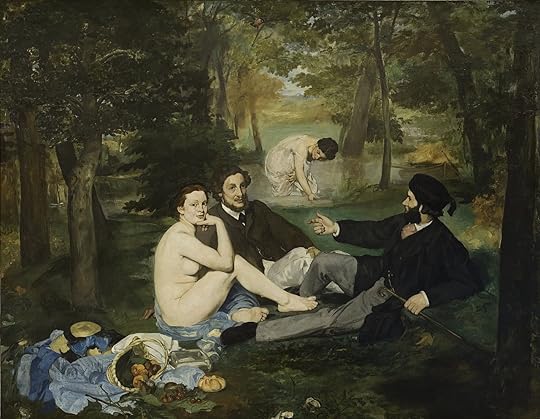


description
Edouard Manet - Luncheon on the Grass (Le Déjeuner sur l'Herbe)

"Languid and Bittersweet" Love (1)

More recently, Oliver has had an extramarital affair (which has since dissipated), as has his wife, Gloria. In both cases, the affair commenced at a picnic in the park attended by two couples, the other couple unknowingly swapping partners with Oliver and Gloria.

A large part of "The Blue Guitar" is a contemplation of the consequences of the affairs for Gloria, Oliver and the other couple (one of whom has since died in a car accident) - it's a "group portrait of the four of us, linked hand in hand in a round-dance".

The affairs aren't romanticised or idealised. The language with which Oliver describes them is languid and bittersweet. He muses and broods, and likens his portrait to "melancholy strummings on a blue guitar" (hence the title of the novel).

I didn't find this the most appealing of Banville's novels, but it is still a worthy achievement. If anything, what it lacks is the roguishness of his mid-career novels and those of Javier Marias. Perhaps, this time, true blue is too blue.


FOOTNOTES:

(1) Steely Dan - "Deacon Blues" lyrics:

"I crawl like a viper
Through these suburban streets
Make love to these women
Languid and bittersweet..."


SOUNDTRACK:
Profile Image for Bianca thinksGRsucksnow.
1,316 reviews1,144 followers
January 18, 2016
Occasionally, I feel uneasy and uncertain when it comes to writing a book review. But never as much as on this occasion. I felt totally self-conscious because I don’t have the skills to write a review that is worthy of such a tremendous novel. So bear with me as I stagger through writing this review.

This was my first John Banville novel. To be honest, I hadn’t heard of him, but when I saw that he’s a Man Booker Prize winner, the literary snob in me I decided that I should request it on NetGalley.

I’ve read some great books in my life, but I can’t remember the last time I was awed by somebody’s writing to this extent. My poor brain was exploding with enchantment, incredulity, and admiration.

It starts like this:

“Call me Autolycus. Well, no, don’t. Although I am, like that unfunny clown, a picker-up of unconsidered trifles. Which is a fancy way of saying I steal things.”

The Blue Guitar is about Oliver Orme. He’s a famous painter, who can’t paint anymore, and who likes to steal little things of no use, just for the thrill of it. He’s pushing fifty and is having some sort of delayed mid-life crisis.

“Childhood is supposed to be a radiant springtime but mine seems to have been always autumn, the gales seething in the big beeches behind this old gate-lodge, as they’re doing right now, and the rooks above them wheeling haphazard, like scraps of char from a bonfire, and a custard-coloured gleam having its last go low down in the western sky”.

This is a character driven novel. It’s Oliver’s musings throughout the entire novel. He’s not a particularly charming character, something that he’s well aware of and admits to it with an uncanny honesty. He’s simple, yet complex. He’s a famous artist who can’t create art anymore. He’s not unhappy but not particularly happy either. He just is. Many times you feel like yelling “get over yourself”! He knows it, too.

Banville has created a complex, three-dimensional character. Oliver is as real as they come. Through him Banville is asking what’s real. Who are we? What is our “true self”? Is there such a thing as a “true self”? Oh, there are so many things to contemplate and think about, it can get a bit exhausting. But don’t let my statement detract you from reading it. Because, while it’s not a fluffy, feel-good novel, it’s filled with humour - smart, sarcastic humour.

Banville’s way with words is astounding. I’ve never had to look up so many words as I had to do while reading The Blue Guitar. Don’t get dispirited by this, because you don’t really have to, you’ll understand the gist of it all, but why wouldn’t you? When was the last time you had the opportunity to learn a new word? I personally was mesmerised. And awed. And gobsmacked. And many other things I don’t have the vocabulary to express, at least not eloquently enough. In this world where the “lowest common denominator” is the status-quo, I feel grateful and lucky to have come across an author who raises the bar, without being cumbersome or arrogant.

Many novels these days include books and music references. The Blue Guitar brings up art, mainly painting references. That was another aspect I truly enjoyed about this novel.

Oliver’s irreverence and self-effacing ramblings made me smile on many occasions.

For instance, here’s how he describes himself:
“The fact is, whenever I made an overture to a woman, which I seldom did, even in my young days, I never really expected it to be entertained, or even noticed, despite certain instances of success, which I tended to regards as flukes, the result of misunderstanding, or dimness on the part of the woman and simple good fortune on mine. I’m not an immediately alluring specimen, having been, for a start, the runt of the litter. I’m short and stout, or better go the whole hog and say fat, with a big head and tiny feet. My hair is of a shade somewhere between wet rust and badly tarnished brass, and in damp weather, or when I’m by the seaside, clenches itself into curls that are as tight and dense as cauliflower florets and stubbornly resistant to fiercest combings. My skin – oh, my skin! – is a flaccid, moist, off-white integument, so that I look as if I had been blanched in the dark for a long time. Of my freckles I shall not speak.”

John Banville is a wordsmith. Every phrase is painstakingly crafted, as if it were precious glass that he’s carefully blown into art objects, but his are beautifully constructed phrases. His writing has a certain musicality, a cadence that’s quite unique. And he never ceases to surprise, amaze and delight. This is definitely a novel that’s going on my Favourites shelf. I can’t rave enough about it. While it’s not for everyone, if you love good literature, then I wholeheartedly recommend this splendid novel.

I’ve received this novel via NetGalley in exchange of an honest review. Many thanks to Penguin UK for allowing me to read and review this novel.


Profile Image for Domenico Fina.
291 reviews89 followers
November 30, 2017
La chitarra blu (2015), tradotto quest'anno da noi, comincia con i versi di Wallace Stevens: Le cose come sono / cambiano sulla chitarra blu. Wallace Stevens è oscuro e John Banville non lo è da meno. C'è un pittore in crisi d'identità e di ispirazione, si chiama Oliver Otway Orme, è sulla soglia dei cinquant'anni ed è sposato con Gloria, più giovane di lui di vent'anni. "Non avrei mai dovuto sposare una donna più giovane. Quella sua vivacità sbrigativa alla mia età non è più sopportabile".
Il suo amico orologiaio ha una moglie, Polly, anch'essa più giovane di Oliver. Saranno amanti per nove mesi, dopodiché Oliver scappa nella sua casa natale da solo a rimuginare sulla sua vita. Sembra stare via un secolo ma in effetti sta via per una settimana prima che riescano a stanarlo. "Non si è mai troppo vecchi per sentirsi rimproverati come dei bambini".

La chitarra blu è la sua vita, suppongo, mentre la sta vedendo e rivedendo. Ed è anche un quadro, in cui raffigura una chitarra blu che assomiglia a un dirigibile. Quadro che lascerà incompiuto. Ma poi accadono molte altre cose, soprattutto che Oliver è un personaggio comico, un osservatore strampalato del mondo, ruba piccoli oggetti senza nessun tornaconto personale, allo stesso modo sembra fare con le persone, un irresponsabile che come ama dire sua moglie, parlare con lui è come parlare col cuscino. Un libro bellissimo. Mi ha sbalordito la capacità di descrizione di Banville; un autentico pittore della parola. Tra i suoi libri avevo letto Il mare (2005), il suo più noto e premiato, ma in questo romanzo riesce ad avere una particolare, ispirata, comicità che era pressoché assente in quello. Ho preferito di gran lunga La chitarra blu che mi riconcilia con Banville, mi fa apprezzare finalmente il suo calor freddo.

Ho annotato alcune frasi illuminanti, eccole:

Una coppia sposata non sembra mai così sposata come quando la guardi dal sedile posteriore di un'automobile mentre parla sottovoce dai sedili davanti.

Nessun silenzio è come il silenzio che accompagna il ladro.

Ma il punto è questo. Era precisamente per le sue imperfezioni che l'amavo. E l'ho amata, sinceramente. Vale a dire, sinceramente, l'ho amata, non che l'ho amata sinceramente. Com'è infida la lingua, più sfuggente persino della pittura. Polly ha le gambe piuttosto corte e polpacci che una persona meno bendisposta di me potrebbe definire grassi. Ci sono anche le sue mani grassocce e le dita tozze e quel lieve tremolio gelatinoso nella carne pallida sul lato inferiore delle braccia. Ma queste erano, insisto, proprio le cose che amavo in lei, esattamente come il suo fondoschiena formoso e i suoi seni amabilmente penduli, la sua voce dolce e i suoi occhi grigi luccicanti, i suoi piccoli piedi delicati da geisha.

Resto immancabilmente sbalordito dalle cose che accadono in me senza che io lo sappia.

Non è straordinario come anche le situazioni più sconcertanti in un minuto o due si assestino in un'ordinaria normalità?

Ci aspettano sempre nuovi modi di soffrire.

Che tempo meraviglioso abbiamo avuto per il funerale, sì, una giornata assolutamente magnifica.

È fine novembre ed è tornato l'autunno, le giornate sono tutte spalmate di luce densa e brillante come confettura d'albicocca, fragranze inebrianti di fumo e intensa decomposizione pervadono l'aria e tutto è fulvo o risplendente d'azzurro. Nella notte la temperatura scende in picchiata e al mattino le rose, che ancora fioriscono, sono merlettate di brina; poi arriva il sole e chinano la testa piangendo per un'ora.
Profile Image for Carolyn Francis.
167 reviews60 followers
October 21, 2015
Perhaps this novel is more intelligent than I am. Then again, perhaps it's just a deliberately obscure enterprise which is overly enamoured with its own exasperating and self-indulgent vocabulary list. ("Haruspicating" anyone? "Borborygmic" perhaps?) The story centres on Oliver, a decaying artist suffering the midlife ennui of feeling more like a spectator than a participant in life. For a novel about someone longing for passionate experience it is remarkably cold-blooded and I didn't like it at all.
Profile Image for Giò.
58 reviews60 followers
January 11, 2018
Borgorygmic and just a little haruspicating


Banville ha un alter ego: scrive gialli con uno pseudonimo. In internet ho trovato un’intervista in cui dichiara che come Banville, la sua è una scrittura ricercata. Come Black invece usa un linguaggio più diretto.
In un’altra intervista invece, a proposito di un suo noto Banville-romanzo, che non ho letto, si esprime così:

mi auguro di non dare l’impressione di voler rendere le parole scritte il più possibile diverse da quelle pronunciate. Infatti il mio stile mi dà l’idea di una forma di retorica interna, un canto ritmico che è molto simile al modo in cui parliamo nella nostra testa. Il mio obiettivo è scrivere in un stile chiaro e diretto, e posso ben dire, sfacciatamente, di aver un certo successo a riguardo. Non c’è una frase nei miei lavori, che a livello sintattico, grammaticale e lessicale, che non possa esser capita da un bambino di otto anni munito di dizionario. Non mi aspetto che un bambino capti le sfumature di significato e la suggestione che le frasi evocano, ma tento di renderle limpide come uno specchio, con tutte le ambiguità che ciò implica.

In buona parte sono d’accordo co i commenti qui sotto di Mandy e Carolyn Francis.

Boring, Too wordy, too much obscure vocabulary for no good reason, a self-obsessed narcissistic male narrator – none of it calls to me…..frankly I felt that I was sitting next to the most boring person on a long-haul flight who just won’t shut up.


Perhaps this novel is more intelligent than I am. Then again, perhaps it's just a deliberately obscure enterprise which is overly enamoured with its own exasperating and self-indulgent vocabulary list. ("Haruspicating" anyone? "Borborygmic" perhaps?)

Secondo e ultimo Banville per me. Magari potrei tentare con Benjamin Black, chissà mai!
Profile Image for Asclepiade.
139 reviews79 followers
January 14, 2018
Da un po’ di tempo mia madre suole ripetermi che col passare degli anni sta diventando sempre meno paziente: ignoro se si tratti d’una questione genetica, eppure anch’io sento che sto diventando via via meno indulgente con gli scrittori nei quali m’imbatto; e così può darsi che nei confronti dell’irlandese John Banville, di cui questo è il primo libro che ho letto, qualche lustro addietro non avrei fatto il viso dell’armi: adesso invece lo trovo soltanto noioso e irritante. Sulle prime a dir il vero mi era parso di trovare qualche scaglia di luce nabokoviana nelle contorsioni narrative, nella vena memorialistica e nei disgusti capricciosi del pittore celebre ma in crisi che si racconta in prima persona in queste pagine, ma presto quest’impressione positiva ha iniziato a illanguidire per ceder luogo a un sentore di monotonia e insoddisfazione che il preziosismo stilistico, lungi dal mitigare, accresce e mette in evidenza. Il problema è che se in un romanzo il protagonista racconta di sé in prima persona, magari anche ricorrendo a qualche utilizzo, sia pur moderato, di stream of consciousness, è necessario che il personaggio sia o positivo o ad ogni modo simpatico, oppure, se è negativo e odioso e tale, insomma, da rendere ardua, se non impossibile dall’inizio, un’identificazione di qualche sorta col lettore, perlomeno grande nella sua negatività, e dunque perlomeno interessante. Al contrario, l’Oliver di Banville è una carognetta da mezza tacca, un ometto querulo, saccente, logorroico (ciarla senza sosta di stupidaggini per quasi quattrocento pagine), alquanto paranoico, incapace di vedere il buono e il bello negli altri, provvisto d’una stima di sé francamente soverchia, privo di qualsiasi empatia, tatto e garbo nell’agire e nel sentire. Uno schifo di uomo, insomma, che forse potrebbe serbare ancora qualche attrattiva letteraria se fosse, che so?, un dittatore, un generale, un cardinale, un onorevole, uno che fra tali miserie di natura e carattere calcasse la scena del mondo da protagonista di grossi eventi; almeno il conseguente risvolto di Denuncia Sociale o d’Impegno Morale aiuterebbe un po’, avventizio ma provvido eupeptico, colagogo e carminativo, a digerire l’uggia. Certo, in casi consimili quando si assiste a una pellicola ci si consola lodando, faute de mieux, la fotografia. Ma qui la virtuosistica cura dello stile, stridendo a lato della trivialità tematica, suscita una spiacevole impressione di leziosaggine inutile. E, quel c’è peggio, il libro ha ben trecentottantaquattro pagine.
Poscritto n°1 (all’autore). A un certo punto compaiono due campagnoli che lavorano attorno a un aeroplano: si chiamano Wilbur e Orville Wright. Non ho ben capito se questa voglia essere una forma di umorismo raffinato; e, se è tale, non l’ho capita.
Poscritto n°2 (al traduttore). Non capisco perché in italiano, fuori dai quadri orarî delle FF.SS., Ratisbona debba diventare Regensburg. Immagino che la traduttrice di queste pagine, conversando in famiglia, dica sempre che l’inverno prossimo si va tutti a London, ma prima si passa da Wien e da Paris; a Pasqua, però, lei andrà ad al-Qāhira.
Profile Image for Steven Godin.
2,782 reviews3,373 followers
November 17, 2021

The only time I'd previously read Baville was under the pseudonym Benjamin Black, in which he pinched Raymond Chandler's Philip Marlow and wrote his own crime noir mystery set in 1950's Los Angeles. We are a world away from that here. This was his 16th novel as Baville and there isn't really a reason I picked it other than just to see what a Banville novel was like. Part of me wanted to look forward to reading him again. Part of me just wanted to yawn. I've read of better and more interesting love affairs than here that's for sure, and the self-absorbed has-been artist Oliver Orme, who, despite the pity felt for the death of his only child, really wasn't at all likable. A compulsive stealer of small things as well as his best friend's wife. Banville's themes of memory, regret, and the whole idea of recessing one's past to help face up to the future were handled aptly, and I did like the fact he managed to deceitfully sneak in moments of humour in what was generally a painful read. Four stars for the writing, which was indeed impressive, but the overall story for me was nothing more than OK. I'll go for one of his earlier novels next time.
Profile Image for Eva.
417 reviews31 followers
June 14, 2017
Αυτό που μαθαίνεις από τον Μπάνβιλ είναι πως η ζωή είναι μια σειρά από μικρές απώλειες και τίποτα άλλο.
Profile Image for Leah.
1,732 reviews289 followers
October 7, 2015
The end of the affair...

Olly Orme used to be a painter, but his muse has left him. He's still a thief though. He doesn't steal for money – it's the thrill that attracts him. He feels it's essential that his thefts are noticed or they don't count as theft. Usually it's small things he steals – a figurine, a tie-pin. But nine months ago, he stole his friend's wife, and now that theft is about to be discovered.

This is Olly's own story, told directly to the reader in the form of a narrative being written as events unfold. The tone starts off light and progressively darkens, but there is a delicious vein of humour throughout the book, observational sometimes, self-deprecatory at others. Olly is a narcissist, but his ability to admit his faults with a kind of saucy twinkle makes him an endearing character. For all his knowingness, he is child-like in his lack of understanding of other people, and over the course of the book he will learn that the people close to him know him considerably better than he knows them.
What I really wanted to do was to kiss her lips, to lick her eyelids, to dart the tip of my tongue into the pink and secret volutes of her ear. I was in a state of heady amazement, at myself, at Polly, at what we were, at what we had all at once become. It was as if a god had reached down from that sky of stars and scooped us up in his hand and made a little constellation of us on the spot.

There isn't much plot in the book – an affair that becomes known, and its aftermath on the people involved. Normally I hate books that are light on plot, but the sheer enjoyment of reading Banville's luscious prose and wickedly perceptive characterisation kept me fully engaged. Olly's style is discursive and untidy, digressing mid-thought back to his past and then just as suddenly jumping off to discuss his style of painting or his thoughts on stealing. But underneath Olly's meanderings Banville is keeping tight control – all of Olly's detours and reminiscences serve Banville's central purpose, to gradually reveal to the reader all the complexities of the flawed and weak, but rather charming, character of Olly himself.
What I saw, with jarring clarity, was that there is no such thing as woman. Woman, I realised, is a thing of legend, a phantasm who flies through the world, settling here and there on this or that unsuspecting mortal female, whom she turns, briefly but momentously, into an object of yearning, veneration and terror.

One doesn't have to wonder if Olly is an unreliable narrator, since he tells us frequently that he is. He openly uses false names of the Happy Families variety for the incidental people he meets – Mr Hanley the Haberdasher, etc - and embellishes remembered conversations to make them sound more interesting, but then owns up to it. This all adds to the feeling of him as being child-like, an innocent... but then we also know he's intelligent and untrustworthy, so what are we to believe? He spends much time trying to work out why he can no longer paint, but the reader feels the answer might not be as complex as he likes to think. Even the world he describes has a mild air of unreality to it – solar flares and meteor showers, a world rather crumbling round the edges. It's almost as if the time is not exactly now or else the world is not exactly this one – or perhaps it's a projection of Olly's narcissism, that when his life is disrupted, the whole world shakes in sympathy.
How well I remember her face, which is a foolish claim to make, since any face, especially a child's, is in a gradual but relentless process of change and development, so that what I carry in my memory can be only a version of her, a generalisation of her, that I have fashioned for myself, as an evanescent keepsake.

It's only when he talks of a past tragedy in his life that one feels the truth of this man is within grasp. But then he will quickly spin away again, complicating his life more and more, and though he pictures himself as suffering, it's hard not to feel he is enjoying this drama of his own creation, perhaps hiding in it. Even his frequent self-criticism is just another aspect of his overwhelming narcissism – so long as Olly can talk about himself, one feels he will weather any storm.

This is the first of Banville's books that I have read, and I loved it. Looking at reviews from people who are familiar with his earlier books, there's a suggestion that this one doesn't have as much substance as they do. That may very well be true – I would agree that, other than Olly's character, there's nothing particularly original or profound here. But it's the language! The fabulous prose! I could forgive a lot to someone who makes me enjoy every word, whether deeply meaningful or dazzlingly light. And Banville dazzled me while Olly entertained me – I'll happily settle for that.

NB This book was provided for review by the publisher, Penguin Books UK.

www.fictionfanblog.wordpress.com
Profile Image for Cxr.
62 reviews16 followers
January 22, 2018
La Versione di Oliver

Arrivato alla soglia dei 50 anni Oliver Orme, pittore famoso e ormai benestante si trova costretto per una sequenza di “sfortunate” circostanze a fare un bilancio della propria vita. La conclusione del bilancio è a pagina uno del romanzo: “ero un pittore e adesso sono un esperto di dolore” (la traduzione è mia). Il resto del libro è un flusso di coscienza che con una continua sovrapposizione di piani temporali tra passato remoto, passato recente e presente racconta la versione di Oliver di come sia arrivato a quello che lui considera il suo fallimentare presente. Il tono è autoironico e la scrittura di Banville raffinata. La scelta precisa dei vocaboli dà colore al racconto come farebbe un pittore con i pennelli.
Ad esempio, nella versione inglese il bilancio della vita di Oliver è un brillante un gioco di parole, “Once I was a painter, now I am a painster”, che io non sono stata in grado di rendere in italiano. Painster è una parola che non esiste, creata da Banville a partire da pain (dolore) in assonanza con painter. La bravissima traduttrice del libro ci prova così “Una volta ero un maestro del colore, adesso sono un maestro del dolore”.

Questo lungo esempio per dare un’idea della ricchezza di sfumature linguistiche contenute nelle pagine del libro. Eppure non è solo la brillantezza della scrittura che mi ha conquistata,. C’è soprattutto la verità del protagonista che ammette la propria fuga di fronte all’impossibilità di “aggiustare” ciò che nella vita non funziona come dovrebbe. La fuga è una conseguenza della consapevolezza che non è possibile possedere il mondo, le persone e le cose che lo abitano perché, arriva a concludere Oliver, a differenza di ciò che aveva pensato da giovane, il mondo non è essere, ma relazione. E le relazioni non siamo in grado di possederle e quindi di controllarle.
Oliver in fondo è l’uomo che c’è dietro ogni donna infelice il cui principe azzurro si è ritrasformato in ranocchio. Ed è un ranocchio in cui almeno in parte ci rispecchiamo, che comprendiamo, a cui alla fine arriviamo a voler bene, se nella corso della vita abbiamo davvero imparato ad amare.
Profile Image for switterbug (Betsey).
936 reviews1,494 followers
July 22, 2015
Irish writer John Banville is known for his dark humor, patrician irony, and baroque, (but searing) prose. You don't read him for plot, and the story/characters are sometimes self-referential, or meta- sized; he will refer to characters or concerns that poke at previous novels, or even subtly refer to himself as he is perceived by other writers or critics. This is one novelist, I believe, whose novels can't be fully valued in isolation. To wholly appreciate Banville is to read his entire oeuvre. However, this is a review of just one Banville novel by a reviewer who has read only some of his books. I can only give you this limited lens; for those of you who have read his entire works, please excuse my inadequacies.

THE BLUE GUITAR is a portrait of Oliver Orme, a short, squat, married, middle-aged man, an inveterate pilferer of other people's things, and a poacher of another man's wife. Over the years, Oliver has morphed from an artist of some fame to a self-serving egoist who now calls himself the "painster," because he feels failed and frustrated as an artist. He's a navel-gazer, a confessor to the reader, a solipsistic bag of gusty, restless wind, a man who runs away when the heat is on him, but is yet sympathetic. Long ago, he and his wife lost their three-year-old daughter to illness. He's a man falling down, and a thief who hasn't been caught. Acquisition, art, loss, and grief, and the power of the imagination to transform reality--these are the themes I take away from this novel.

Throughout the book, Orme describes repeatedly, in forensic prose, the reason he quit painting. It boils down to his frustrating attempts to get to the essence of what he paints. He is obsessed with that liminal, ungraspable place between the material world and the representation of it, and it extends to his greater philosophy of experience, and his inability to find sanctuary and inner resolve. Oliver steals objects he doesn't need in order to reactivate the object's luminescence (essence), asserting that these objects have lost their glow, and lie inert in the owner's hands. He believes that when he "purloins" them, he transforms the impotent object with a renewed vitality.

"It's as if a single thing by being stolen were on the instant made in two: the thing that before was someone else's and this not quite identical thing that now is mine. It's a kind of...transubstantiation..."

Oliver ponders concepts that link love and stealing, or art and love, or sometimes stealing and loss. Throughout this vacillating narrative, and the protagonist's agitated wheedling, Banville brilliantly pivots from the jocular to the melancholy, as the hapless Oliver waxes wildly about his indiscretions--"I did steal her, picked her up when her husband wasn't looking, and popped her in my pocket. Yes, I pinched Polly; Polly I purloined." Almost imperceptibly, though, the author can segue from playful to melancholy, the restive Oliver arrested by loss. "Everything seemed hollow, hollow and weightless, like those brittle casings of themselves that dead wasps leave on window-sills at the dusty end of summer. Grief was flat, in other words, a flat dull empty ache."

And of his sequestration to his childhood home, Oliver laments: "Here it is forever the past, here I am stalled, stilled here, cocooned; I need never move again until the moment comes for the great and final shift."

The book is a dissection of Oliver through Oliver's fractured psyche, and a potent perception of art. He's an unreliable narrator who nevertheless reveals by dissembling, his voice a fallen mask. "How treacherous language is, more slippery even than paint." Panic and sorrow underscore Oliver's trenchant memories, even when he tries to play the bumbling foil.

In the first half, once Oliver's persona was established, I felt that that the author lingered a bit too much, and the pace became static, the narrative redundant. The prose was unparalleled, outstanding, but at times I felt that Banville indulged in his verbal linguistics and left the reader exhausted with his doomed protagonist. However, he gradually brought me back to the story. Although contemporary, I felt like I was in the midst of a Victorian setting--perhaps in a painting by his fictional painter, Jean Vaublin, whose name is a quasi-anagram of his own. But, even when Banville is writing for himself, I'll wait for him in the gloaming.
Profile Image for Joy D.
3,128 reviews329 followers
March 18, 2023
“How the past does cling, raking us lovingly with its tender claws.”

Introspective novel that focuses on the life of the narrator, Oliver Otway Orme, an acclaimed artist, and self-proclaimed thief. He feels blocked in his art due to an inability to capture anything meaningful beneath the surface of his subjects. Oliver comes across as a narcissist. The people around him serve as diversions for his whims. He thinks he is fooling everyone, but he may be in for a surprise or two. He “steals” his best friend’s wife to be his mistress. He and his wife grieve the death of their daughter. These two elements serve as the basis of a very slim plotline.

"Everything seemed hollow, hollow and weightless, like those brittle casings of themselves that dead wasps leave on window-sills at the dusty end of summer. Grief was flat, in other words, a flat dull empty ache."

Oliver delivers an inner dialogue of his thoughts and feelings about his relationships, family, friendships, and artistic pursuits, while the reader infers his less than admirable qualities. Subtle humor is embedded into the narrative. It is a story of aging, regret, and memory. Oliver’s life has become a big ball of yarn, and through his musings, he tries to untangle it. The primary attraction of this novel is the beautifully crafted language. John Banville is a wonderful wordsmith.

“It’s as if I had been standing for all my life in front of a full-length mirror, watching the people passing by, behind and in front of me, and now someone had taken me roughly by the shoulders and spun me about, and behold! There it was, the unreflected world, of people and things, and I nowhere to be seen in it.”
Profile Image for GiuseppeB.
128 reviews22 followers
January 14, 2018
Ecco, l'ho finito, finalmente sono riuscito a portare a termine quest'impresa titanica direi, o forse no. Forse si tratta soltanto di una lettura di una grande quantità di parole.
Certo la storia è interessante o, se vogliamo, potrebbe essere interessante per qualcuno a cui interessano storie di questo tipo.
Perché, vedi, lui ci racconta con sapiente uso di termini e con accurate descrizioni di particolari e situazioni che alla fine si rivelano di poco o nessun interesse, una storia che tutto sommato...
Ma insiste e altro e altro ancora ci racconta e alla fine riesce a riempire cento, duecento
forse trecento pagine e questo, si capisce, lo rende fiero di sè.
Ma il lettore alla fine si chiede se anche a lui è stato rubato qualcosa.
Di sicuro il tempo, questo dannato tempo di cui tutti vorremmo averne di più e poi per farne cosa?
E poi il tempo che passa ci spaventa e cerchiamo di fermarlo, ma poi non sappiamo come riempirlo
ma poi non possiamo perderlo e così leggiamo.
E leggiamo anche libri come questo e anch'io che, come un sasso piatto, lanciato da abile lanciatore con posa plastica sulla liscia superficie del lago effettua graziosi saltelli prima di affondare, sfioro le pagine cercando di trovare qualche significato in quello che leggo.
Insomma non posso, in tutta coscienza, dire che la lettura mi abbia troppo annoiato, anzi lo stile seppur troppo prolisso mi è sembrato e gradevole.
Ma insomma questo logorroico raccontare mi riporta alla mente quelle zie, o nonne, o suocere o eccetera che amano raccontare e raccontano e indulgono in particolari di nessuna importanza e di nessun interessa per l'ascoltatore il quale per buona creanza fa mostra di essere interessato e invece non vede l'ora che, cessato il vano chiacchiericcio, possa alla fine andarsene per i fatti suoi; così io non vedevo l'ora di terminare la lettura.
Certo non leggerò altro di questo autore.
Profile Image for Jim.
2,413 reviews800 followers
March 25, 2019
John Banville's The Blue Guitar is a superb novel about a painter named Oliver Otway Orme who has given up his art and finds himself, at or around the age of fifty, tired of his wife and itching for a relationship with his best friend's wife, Polly. He launches into an affair with her which sustains him until the friend is certain his wife no longer loves him, but not knowing with whom she has been unfaithful.

Oliver suddenly decides to leave home, but Polly hunts him down and rubs his nose into his fecklessness. In the end, he returns to his wife Gloria, who finds herself pregnant with another man's child.

Banville is described as a great stylist:I think of him rather as a writer who knows how to depict in clear prose the many oscillations and divagations of the human heart in its dealings with family and loved ones.
Profile Image for Vladys Kovsky.
198 reviews50 followers
July 26, 2020
Ever ask yourself this question: which contemporary English language writer has the most extensive vocabulary? If you read anything by John Banville, you would not ask, you would know the answer. Other wordy writers admit it. Ruth, the main protagonist of Niall Williams's 'History of the Rain', when describing the sound of a voice, has this to say: "He just made this low thrum. John Banville would know the word for it, I don’t".

Banville's word usage is precise. Granted, it is a bit extravagant, many would say unnecessarily complicated, but it creates a distinct voice, immediately recognizable, his own. Not everyone enjoys Banville's style, you would hear people referring to his vocabulary as obscure, self-indulgent, exasperating, labored, pretentious, snobbish, etc. Thus, a fair warning: don't read his books if you are not ready to peruse a dictionary once in a while, if you are happy with the shrinking vocabulary of the modern world.

Here is how this particular book starts:
"Call me Autolycus. Well, no, don't. Although I am, like that unfunny clown, a picker-up of unconsidered trifles. Which is a fancy way of saying I steal things... The objects, the artefacts, that I purloin - there is a nice word, prim and pursed - are of scant value for the most part. Oftentimes their owners don't even miss them. This upsets me, puts me in a dither..."

Oliver Orme does not strike you as a charming person from that very first paragraph, he becomes even less likable as we learn more of his story. Self-absorbed, insensitive to others, cowardly, he is not only an unreliable narrator, he is also not a reliable human being.

Did I really say a human being, a person? Oh yes, I know, he is a fictional creation, he is not of flesh and blood, but he is somehow more real than your neighbor, more real than your colleague, possibly more real than your friend. This is what Banville is capable of- his character is there with you in your living room shuddering with fear and writhing in pain. And "pain compels eloquence".

"... out there is the world and in here is the picture of it, and between the two yawns the man-killing crevasse". Orme, a former painter disillusioned with his art, steps into this yawning crevasse quite readily and tells us the story of his fall.

The fall is not scary at first, it is just another affair, he's had many behind the back of his grieving wife. He likes to self indulge in his quest for love. "Poor old love, what a frail and tremulous flower it is." However, this time he finds it hard to extricate himself. Even the tale is difficult to tell: "Damn it, here's another digression: there must surely be something or somewhere I don't want to get to, hence all these seemingly innocent meanderings down dusty by-roads". Orme keeps turning to his childhood, to his past: "... how the past does cling, raking us lovingly with its tender claws", to his dreams: "... after all, why should my dream life have a meaning, when my waking one does not?"

Is it not a moral story after all? Is this what Banville is getting to, that despite all the complexity of life simple choices we make are evident in their consequences? And that the responsibility for these outcomes rests with us? I won't tell you how the book ends and will let you decide for yourself.

Ultimately, it is not the plot or moral questions that make this book stand out. It's the palette of the painter, dominated by various shades of blue, it's the sudden transformations of prose into near-poetry, it is the pangs of sadness, moments of grief, which are never far away. It is the search for home, a place where we intimately belong: "where might that rare place be found, pale Ramon"?
Profile Image for Roger Brunyate.
946 reviews740 followers
May 31, 2016
Too Much Already!

I should have known. Banville is an author who requires long periods of recuperation for his readers between books. A few weeks ago, I reviewed the beautiful Everyman edition of Banville's The Book of Evidence and The Sea. Coming to him then, after a gap of several years, I was struck how well his florid gourmet style played against his subjects in each case, the one justifying the other. But this time, the style seems merely self-indulgent, and the story—a warming-over of all-too-familiar tropes—quite insufficient to justify it.

Style, first. Here's the end of one paragraph from early in the book and the start of the one following:
…But that's not nature, strictly speaking, is it? What, then? It's the all, the omnium, that I'm thinking of; the whole kit and boodle, mice and mountain ranges, and us, wedged in between, the measure of all things, God bless the mark, as they say in these parts.
There's nothing to eat in the house. What am I to do? I could go out into the wood, I suppose, and forage for sweet herbs, or delve for pig nuts, whatever they are.…
He's a wizard with words, no mistake. And there are times when he says something that is not merely clever but actually penetrating, as when he describes love as "being let into a place that she had been hitherto alone in." But usually you are just aware of the dexterity of his word-juggling, his fondness for obscure words: "the borborygmic blarings of a three-piece band" for example. And then there are the give-aways: "as they say in these parts" (not for the past 60 years they haven't) or "pig nuts, whatever they are" (if you don't know, why say it?). It gets exhausting very quickly.

And who is this monomaniac bent on enthralling us with his confessional monologue? Another of Banville's stock characters, an over-cultured middle-aged failure, Oliver Otway Orme, former painter and petty thief, offering us his memories of childhood, false-modest glimpses of his sexual escapades, and a meditation on his sorry state generally. Somewhere in there are would-be-profound thoughts on the act of appropriation, the way the artist and the pilferer both take from their surroundings, but I couldn't be bothered to disentangle them. All I saw was a pathetic adulterer describing an affair with his best friend's wife, glorifying both his lust and his cowardly desertion as though it were some Roman de geste. His ability to put his navel-gazing into flowery language does not make the lint any more edifying.
Displaying 1 - 30 of 372 reviews

Can't find what you're looking for?

Get help and learn more about the design.