

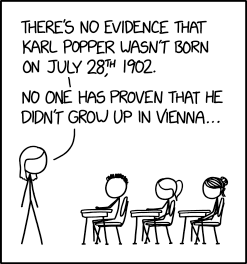
What do you think?
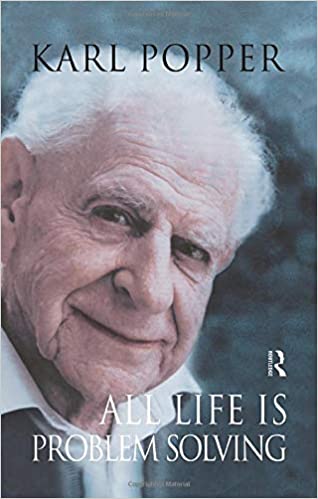
All Life is Problem Solving
'Never before has there been so many and such dreadful weapons in so many irresponsible hands.' - Karl Popper, from the Preface
All Life is Problem Solving is a stimulating and provocative selection of Popper's writings on his main preoccupations during the last twenty-five years of his life. This collection illuminates Popper's process of working out key formulations in his theory of science, and indicates his view of the state of the world at the end of the Cold War and after the collapse of communism.
All Life is Problem Solving is a stimulating and provocative selection of Popper's writings on his main preoccupations during the last twenty-five years of his life. This collection illuminates Popper's process of working out key formulations in his theory of science, and indicates his view of the state of the world at the end of the Cold War and after the collapse of communism.
184 pages, Paperback
First published January 1, 1994
About the author
Karl Popper
311 books1,794 followersSir Karl Raimund Popper, FRS, rose from a modest background as an assistant cabinet maker and school teacher to become one of the most influential theorists and leading philosophers. Popper commanded international audiences and conversation with him was an intellectual adventure—even if a little rough—animated by a myriad of philosophical problems. He contributed to a field of thought encompassing (among others) political theory, quantum mechanics, logic, scientific method and evolutionary theory.
Popper challenged some of the ruling orthodoxies of philosophy: logical positivism, Marxism, determinism and linguistic philosophy. He argued that there are no subject matters but only problems and our desire to solve them. He said that scientific theories cannot be verified but only tentatively refuted, and that the best philosophy is about profound problems, not word meanings. Isaiah Berlin rightly said that Popper produced one of the most devastating refutations of Marxism. Through his ideas Popper promoted a critical ethos, a world in which the give and take of debate is highly esteemed in the precept that we are all infinitely ignorant, that we differ only in the little bits of knowledge that we do have, and that with some co-operative effort we may get nearer to the truth.
Nearly every first-year philosophy student knows that Popper regarded his solutions to the problems of induction and the demarcation of science from pseudo-science as his greatest contributions. He is less known for the problems of verisimilitude, of probability (a life-long love of his), and of the relationship between the mind and body.
Popper was a Fellow of the Royal Society, Fellow of the British Academy, and Membre de I'Institute de France. He was an Honorary member of the Harvard Chapter of Phi Beta Kappa, and an Honorary Fellow of the London School of Economics, King's College London, and of Darwin College Cambridge. He was awarded prizes and honours throughout the world, including the Austrian Grand Decoration of Honour in Gold, the Lippincott Award of the American Political Science Association, and the Sonning Prize for merit in work which had furthered European civilization.
Karl Popper was knighted by Queen Elizabeth II in 1965 and invested by her with the Insignia of a Companion of Honour in 1982.
(edited from http://www.tkpw.net/intro_popper/intr...)
Popper challenged some of the ruling orthodoxies of philosophy: logical positivism, Marxism, determinism and linguistic philosophy. He argued that there are no subject matters but only problems and our desire to solve them. He said that scientific theories cannot be verified but only tentatively refuted, and that the best philosophy is about profound problems, not word meanings. Isaiah Berlin rightly said that Popper produced one of the most devastating refutations of Marxism. Through his ideas Popper promoted a critical ethos, a world in which the give and take of debate is highly esteemed in the precept that we are all infinitely ignorant, that we differ only in the little bits of knowledge that we do have, and that with some co-operative effort we may get nearer to the truth.
Nearly every first-year philosophy student knows that Popper regarded his solutions to the problems of induction and the demarcation of science from pseudo-science as his greatest contributions. He is less known for the problems of verisimilitude, of probability (a life-long love of his), and of the relationship between the mind and body.
Popper was a Fellow of the Royal Society, Fellow of the British Academy, and Membre de I'Institute de France. He was an Honorary member of the Harvard Chapter of Phi Beta Kappa, and an Honorary Fellow of the London School of Economics, King's College London, and of Darwin College Cambridge. He was awarded prizes and honours throughout the world, including the Austrian Grand Decoration of Honour in Gold, the Lippincott Award of the American Political Science Association, and the Sonning Prize for merit in work which had furthered European civilization.
Karl Popper was knighted by Queen Elizabeth II in 1965 and invested by her with the Insignia of a Companion of Honour in 1982.
(edited from http://www.tkpw.net/intro_popper/intr...)
Ratings & Reviews
Friends & Following
Create a free account to discover what your friends think of this book!
Community Reviews
Displaying 1 - 3 of 3 reviews

November 5, 2011
هذا النوع من الكتب يجعل عقلي يفكر ، يتسائل ، ويبحث عن الإجابات . مازلت في بدايته .
لنا عودة لاحقاً. مصطلحاته عميقة لا استطيع فهمها :)
لنا عودة لاحقاً. مصطلحاته عميقة لا استطيع فهمها :)

April 23, 2014
الجيد في الكتاب أنه مبسط وتفهم من الجزء الاول منه فلسفة بوبر العلمية بكل وضوح
الجزء الثاني كان عن التاريخ والسياسة ونقد الماركسية وضرورة السلام، مقالات متفرقة تستحق القراءة
الجزء الثاني كان عن التاريخ والسياسة ونقد الماركسية وضرورة السلام، مقالات متفرقة تستحق القراءة

May 7, 2020
اعمق وبنفس الوقت ابسط كتاب قرأته حد الآن
Displaying 1 - 3 of 3 reviews