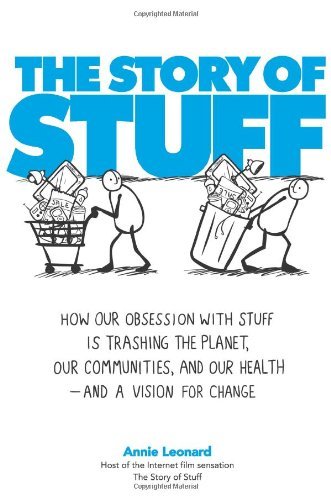
A classic exposé in company with An Inconvenient Truth and Silent Spring, The Story of Stuff expands on the celebrated documentary exploring the threat of overconsumption on the environment, economy, and our health. Leonard examines the “stuff” we use everyday, offering a galvanizing critique and steps for a changed planet.
The Story of Stuff was received with widespread enthusiasm in hardcover, by everyone from Stephen Colbert to Tavis Smiley to George Stephanopolous on Good Morning America, as well as far-reaching print and blog coverage. Uncovering and communicating a critically important idea—that there is an intentional system behind our patterns of consumption and disposal—Annie Leonard transforms how we think about our lives and our relationship to the planet.
From sneaking into factories and dumps around the world to visiting textile workers in Haiti and children mining coltan for cell phones in the Congo, Leonard, named one of Time magazine’s 100 environmental heroes of 2009, highlights each step of the materials economy and its actual effect on the earth and the people who live near sites like these.
With curiosity, compassion, and humor, Leonard shares concrete steps for taking action at the individual and political level that will bring about sustainability, community health, and economic justice. Embraced by teachers, parents, churches, community centers, activists, and everyday readers, The Story of Stuff will be a long-lived classic.
Annie Leonard is the author and host of our very own The Story of Stuff. She is author of The Story of Stuff, the book, published by Free Press of Simon and Schuster on March 9, 2010.
Annie has spent nearly two decades investigating and organizing on environmental health and justice issues. She has traveled to 40 countries, visiting literally hundreds of factories where our stuff is made and dumps where our stuff is dumped. Witnessing first hand the horrendous impacts of both over- and under- consumption around the world, Annie is fiercely dedicated to reclaiming and transforming our industrial and economic systems so they serve, rather than undermine, ecological sustainability and social equity.
Annie is currently the Director of The Story of Stuff Project. Prior to this, most recently, Annie coordinated the Funders Workgroup for Sustainable Production and Consumption, a funder collaborative seeking to address the hidden environmental and social impacts of current systems of making, using and throwing away all the stuff of daily life.
She has also worked with GAIA (Global Alliance for Incinerator Alternatives), Health Care Without Harm, Essential Action and Greenpeace International.
Annie is currently on the boards of International Forum for Globalization and GAIA and has previously served on the Boards of the Grassroots Recycling Network, the Environmental Health Fund, Global Greengrants India and Greenpeace India. She did her undergraduate studies at Barnard College, Columbia University and graduate work in City and Regional Planning at Cornell, both in New York. She is currently based in the Bay Area, California.
I think this is a really important book. There is a lot of bad news, and it is not what we want to hear, but we certainly need to. There is also good news - a long list of positive suggestions, with links, that point the way out of the trash and into a sustainable future.
I read dystopian novels, in part, to get a sense of what horrors the future may hold, and how people can or cannot adapt to them. The fact that many of those books are ripping good reads is also a big attraction. There is also (presumably) some sick fascination for me over the unspeakable crimes against Earth that were (presumably) committed by previous generations, and their ghastly aftermath.
I also read nonfiction books – like this one - about unspeakable crimes against Earth that are being committed today. I do this to get a sense of 1) why these horrors are happening – in this case, as a ‘cost-effective’ strategy to support a consumer-driven lifestyle and economy; 2) how the perpetrators are getting away with it, and how they might be impeded or stopped; and 3) what steps could be taken to diminish or avoid the dystopian world of those other books.
In The Story of Stuff, Annie Leonard has done the world, and the United States in particular, a huge favor. Drawing on her first-hand expertise on the flow of materials through the ‘pipeline’ of extraction/production/consumption, she shows in graphic detail the impossibly stupid way that we are living today, and the disastrous consequences that inevitably follow. She systematically dissects the textbook, business-school model of the production-consumption ‘pipeline’, and then asks and answers the obvious question: what happens to all the Stuff that comes out at the post-consumption end of the pipe? Hmmm.
Short answer: it gets dumped. Somewhere, anywhere, preferably where no one of any ‘importance’ will see it or have the means to stop it. In the textbook model, there is a cost for the act of dumping, but in general there are no costs – on the typical corporate balance sheet under current accounting practice – for the damage to the planet of all the Stuff that gets dumped. And that is a HUGE problem.
Leonard also shows that most of the dumping of Stuff actually takes place at earlier stages of the process – the extraction and manufacturing steps, in particular. Furthermore, a lot of toxic crap is put into the products at these stages, and the balance sheets don’t account for the effects of those, either. In general, the companies don’t bother to tell you about the toxins you are buying. In many cases, they are not required to list them on the product labels. Hmmm. A little legislative collusion, perhaps?
This is all very, very bad news - we seldom hear it, and would prefer not to know. That is the way our brains work, and companies know this. But ignorance of such things is not bliss, and knowledge of them is the beginning of power to change. Leonard hammers on both of these messages to great effect.
But the biggest strength of the book, in my view, is the discussion of practical, powerful, and happening steps that can begin to turn this monstrosity around. Issue by issue (with cartoon guideposts), she provides examples, practical advice, and links to hundreds of groups that are working in creative ways to right the wrongs. This is all very, very good news. It is also the biggest favor that the author does for the planet (the U.S. in particular).
For a quick (20 minute) guide to the bad news portion of the book, I strongly recommend the online movie that led to the writing of the book. The website has other movies and a lot of useful information, but here is the original movie:
Here are some quotes (in italics) and summaries to illustrate the bad news/good news quality of the book. I checked the links that are included, and added comments here and there:
In fact, all of us on the planet collectively are consuming more resources than the planet produces each year; we’re consuming about 1.4 planets’ worth of bio-capacity resources annually.
Unfortunately, we only have 1.0 planets.
It’s just not going to work. There isn’t enough for everyone to consume at this high bar. And if we were to make the selfish and immoral choice of going any farther down that path, then we would have to build bigger walls and fences and hunker down, because it would get ugly. As an official of the U.N. World Food Programme said, “A hungry world is a dangerous world. Without food, people have only three options: They riot, they emigrate or they die.”
Sounds a little dystopian, doesn’t it?
Lots of specific problems are discussed in the book, and allocation of fresh water is one of them:
Hardly anyone looks at a cotton T-shirt, a car, or a light switch and thinks about water. Virtual water is the amount of water embedded in food or other products based on how much water was needed to extract and produce that item. If you’re curious, you can go to www.waterfootprint.org and get a rough calculation of your own water footprint.
My rough calculation from this site was not pretty to look at.
Another problem is how electricity gets made:
I wanted to investigate any links between my own lightbulbs and blowing the tops off of mountains in Appalachia, so I went to the www.ilovemountains.org website, which allows anyone in the United States to type in a zip code and see which mountains were destroyed for your power.
Using this site, I found the mountain that was destroyed to provide my power, assuming that we used the standard provider for this area. Good news – we switched to green alternatives (wind/small hydropower) several years ago. We pay a little more for it, and feel a lot better about it.
A third major problem is the dumping of poisons. Some, but by no means all of these are reported (in the U.S.) in the Toxics Release Inventory (TRI):
Currently about 22,000 industrial and federal facilities are covered in the TRI. In 2007, those facilities reported that 4.1 billion pounds of 650 different toxic chemicals were released into the environment, including both on-site and off-site disposal. The data compiled in the TRI is available to the public through both government and nongovernmental websites. My personal favorite is Scorecard (www.scorecard.org), which allows you to look up major pollution sources and chemicals by zip code.
The scorecard for my county was not good. Here a toxic dump, there a toxic dump.
Now for some good news. For each problem, Leonard discusses ways and means for solving it:
Another revolution in the production of our Stuff is both necessary and possible. With existing and developing approaches, within a decade we could transform today’s most destructive processes and eliminate the most toxic ingredients from our factories and products.
Rather than focus on reducing any one population’s (like children’s) exposure to hazardous chemicals, the simplest solution is to phase out toxics altogether and replace them with safe materials…
She talks about two strategies for doing this: green chemistry and biomimicry:
Pioneering green chemists are designing new materials from the molecular level up to satisfy all our requirements, while also being fully compatible with ecological and human health. To learn more about green chemistry, visit Clean Production Action at www.cleanproduction.org.
The Biomimicry Institute notes, “nature, imaginative by necessity, has already solved many of the problems we are grappling with. After 3.8 billion years of research and development, failures are fossils, and what surrounds us is the secret to survival.”
In the meantime, we need ready access to better information about the toxins that are embedded in the products we buy. Leonard discusses a very powerful way to do that:
GoodGuide, a free online searchable database, allows you to get current data on the environmental, social, and health impacts of everyday products and their parent companies. In late 2009, GoodGuide launched its iPhone application that allows shoppers to simply point their phone camera at a product’s bar code and immediately receive environmental and health data on the product, far beyond what any label will reveal. GoodGuide provides all of us massively increased access to information about the supply chains of the products we use, so we can make better choices—better choices for our families, the workers making this Stuff, and the global environment. Some people call this “voting with our dollar.”
This is my strongest recommendation from the book:www.goodguide.com and/or the mobile app. It is a work in progress, but getting better and getting noticed. You can get a toolbar for your browser that will report on products as you look at them, on sites like Amazon and on Google searches. Don’t like the score for your product? Send feedback, with a few mouse clicks and specific comments. And buy a better product, from the list of alternatives that GoodGuide has rated.
Try it; I think you will like it. I canceled an Amazon subscription for an item that had a low GoodGuide score. Amazon asked for a comment about my reasons, and I told them. I also said that I would look for an alternative with a higher GoodGuide score. That easy.
I haven’t seen this film – I will probably need to track it down now. This brings together a lot of things I have been thinking about lately in ways I have also been coming to slowly. However, it was just about the last place I expected to find some of these ideas. What I was expecting was a kind of sermon on the death of the planet (which it almost was in part) – in the modern world it is environmentalists who are cast as the ‘hell-fire and brimstone’ preachers (“I’ve seen the light – I will do my recycling”) and possibly our dentists and Weight Watchers who are like the new ‘father confessors’. (“Yes father, and toffee and the occasional sugary drink – I promise to do two Our Flossings every day”)
The best of this book is that it points out that we are not going to save the world piecemeal. This is not a matter of one piece of garbage at a time. As she so beautifully points out, if saving the planet needs to wait until everyone agrees to do something then we are lost – there is no hope. Just as there would have been no end to slavery if we had to wait until everyone agreed to end it.
The distinction here is that the society we have created for ourselves – a society that is obsessed onto death with stuff – is one that is literally killing us all. It is poisoning the air we breathe, it is making us responsible even when we buy shoes for the exploitation of third world children, it has the blood of nations on our hands so we can drive our SUVs and, at the same time, it is working us to death to afford this crap.
As she points out, we are generally at our happiest when we are with friends and family. Imagine us needing to be told something like that – I mean, think about that for a second. Postman says somewhere that much of social research is about finding ways to get paid for stating the blindingly obvious. But the sick part of our society is that we are killing the planet so as to own stuff we don’t even want and in the process are killing ourselves at work so that we can get the money we need that will pay for the stuff we don’t need and all that does is keeps us away from the people who really do make us happy. Hardly a virtuous cycle.
We are living in the age of trinket capitalism – where far too much of our economic capacity is directed at producing crap no one needs so we can claim we have economic growth. And this fabled growth can only be defined ‘growth’ on the very limited terms on which GDP is framed.
I really don’t know enough about Economics, but what I do know is that it ought to be the study of incentives. I’ve really resisted this concept for too long. But we have created a system where there are too many perverse incentives. A world where it is cheaper to swallow mountains for low-grade coal than to invest in renewable energy AND where wasting resources on superfluous packaging, endless advertising and pointless ‘one use’ containers creates replacement mountains of junk.
We live in a society where the hollow word ‘freedom’ is used to justify every excess and so contorted that the very concept is lost. Where the notion of freedom is exhausted in the choice between fresh mint or spearmint toothpaste we really have given up our birth right too cheaply. Remember when we were citizens? No, probably not. Not now we are merely customers and clients. Customers can only feel they are always right by limiting the range of choices they have right down to where our every choice becomes actually wrong. We have to demand to be more than just customers – we need to demand our right to be citizens again.
We need to create incentives that encourage us to more equitably share our wealth and resources. A world where the US has 5% of the population but 20% of the world’s wealth is only sustainable by force and endless wars. The joke is that not only will this sharing make the planet better off, but it will make us better off too.
We need to reinvent that other C word – not only do we need to become better citizens (or rather, to become citizens again) but we need to do that by re-forming our communities.
One of the most distressing images I’ve seen recently in Australian politics has been the leader of the opposition protesting against the introduction of a carbon tax (that is, something designed to place a cost on carbon to thereby use market mechanisms to account for externalised costs – something a market fundamentalist ought to surely understand) by standing at a petrol station with petrol pump in one hand filling up oversized cars and complaining the tax will make petrol more expensive. Well, imagine that, a limited and diminishing resource might finally cost more per litre than milk. Clearly, we live in a world with perverse incentives that this man – a racist hell bent on killing the planet – can be the alternative leader of the country. No wonder the civilised West needs to spend decades and billions propping up tyrants only to bomb them into submission later to keep the flow of oil coming. We don’t need to worry about how the future will judge us – it is all too obvious.
Something I read recently suggested that a four degree increase in world temperatures will mean a human population of about half a billion. We currently have nearly 7 billion people on this planet. Is that a subtraction problem that disturbs you or not?
We need to do fundamental renovations to our society – we need to do so much more than just recycling. The solutions we need to find are political, not motivational. They need to be tackled by us as citizens, not as merely consumers.
at first i couldn't wait to pick this up... finally a book on the environmental impact of consumerism written by an environmental scientist! very quickly you realize that there is zero science beneath these pages.
I give this book 1 star solely because of the introductory chapter which does offer an appropriate representation of the current state of affairs in the US with just a slightly alarmist hint... which then gradually (and substantially) evolves to use of statistics and numbers for fear-mongering and extraordinarily partisan diatribes. Nothing Miss Leonard reports is fabricated, just highly 1-sided (and overwhelmingly elitist) with zero touch of realism.
Yes there may be many downsides to use of PVC or polysilicates... but to present from a perspective of "anyone who makes PVC-containing products is evil" or "Dow Chemical and Union Carbide are worse than Hitler" without providing any context as to why some chemicals are used today (yes there are actually very good reasons) or why people/companies make the decisions that they do (no, greed is not the only reason) is inappropriate and irresponsible. The "solutions" that Leonard offer are just as out of touch - we need to slow production lines down in order to decrease pollution (umm, yes that idea has no downside or impact to adverse impact on peoples' lives?), we need to ban PVC altogether (and... those who cannot afford alternative materials, sorry your kids don't deserve to have a backpack?), we need to decrease water consumption, decrease pollution, and increase recycling (brilliant! no thoughts on the "how", just a rigid "what"?).
This book is a great example of how it's not just those on the far right who see the world in black & white, but those on the far left are equally as bad. If written from the perspective of understanding, real-world practicality, and focus on solutions rather than unilateral griping, perhaps we could get somewhere. This book simply argues rather than presents an argument, has almost no ground in reality as takes no consideration into trade-offs. No capitalism is not perfect, but to consider it as purely terrible is just as wrong as considering socialism as purely terrible. I guess that we Americans just have to feel bad that our culture is wrong then and her way of life is the only one that can work... I do hope that at least Miss Leonard can find a way to marry Europe since she loves it so much.
Ah, yes--THIS is the book I've been waiting to read forever--I wish this had been around when I had taken Juliet Schor's "Shop Til You Drop: Gender and Class in Consumer Culture" course back in college. A smart, clear activist breakdown of our toxic materials economy and the massive and devastating environmental impact of consumption on the health of workers, the planet, consumers, communities, animals, etc... and what we can do about it.
Instead of the obnoxious and ineffective "personal green lifestyle purity" approach--where we're all supposed to just personally and voluntarily recycle and do research and buy "better" products, etc--Annie wants to fix the whole broken system itself, and put responsibility for the environmental and human rights and health disaster that is our current consumption-driven paradigm where it truly belongs. Which isn't to say she lets individuals off the hook--she encourages us to act as citizens, and not consumers, to agitate to take apart our broken systems and create a new sustainable future--before it's too late. Super inspiring, an easy read, and even entertaining, if terrifying, at times--I recommend this book to EVERYONE.
If you’re thinking that you might need to read this, that’s probably a good indication that you don’t. Are you for the environment? For human rights protections? Concerned with consumerist culture and overconsumption? Concerned about the steady increase in garbage and where it all goes? Are you for progress and against war? For time spent with other humans rather than with stuff? If so, you don’t need to read this. The point is to explain to people why they should think about these things. If you haven’t thought about these things before, this is the book for you. Or you could watch her 20 minute documentary on youtube. Or even better, you could watch George Carlin’s bit on “their stuff is shit and your shit is stuff”, it’s only 5 minutes and it’s classic (she even references him): https://www.youtube.com/watch?v=4x_Qk...
So the book seems to be preaching to the choir. It’s also written at about an 8th grade level; she defines “ecosystem” and explains that we need the planet to live. She has a whole chapter on vocabulary, explaining what she means by “consumption”, “corporation”, and even “Americans” (apologies to Canadians and South Americans; I think she missed an apology to Central Americans). It really feels like a “for Dummies” book. Still, there is some good info in here. The consumption chapter had some interesting things: for example, the average American has 6.5 credit cards? (Really, that’s average? I think I’d like to see the distribution underlying that statistic according to income levels.)
Overall, I found that reading the first sentence of every paragraph (occasionally a middle or end one too) was more than enough. Luckily I bought this bit of stuff used and will recycle it through Goodwill. Hopefully an environmentally conscious high school student will find it.
So, I've just read the opening pages of the book, and I thought she was doing really well at setting up how our pursuit of stuff will ruin us. However, even after making an excellent point that all human systems are subsystems of the earth's systems, she still makes the error that I think sabotages environmentalists everywhere. She claims that we are killing the planet. I don't think we have the capacity to kill the planet. I think the earth will easily outlast us, whatever we do. The thing we ARE doing is making the planet uninhabitable for US. That's what we're doing. I think this is a message that more people would respond to, since many people are numb to damages caused to the earth and its species. Anyway ... I'll keep reading, but it was disappointing to see her swap her systems right after getting them in order. The earth has outlasted many disasters. It can outlast us. Life may be different then, but it will still evolve and adapt.
UPDATE: Okay, so I read further in the book and I found that the author has a bad habit. When she is presenting her information, she will often tell it in such a way that it makes her point "stronger," but when the point is actually looked at, well, it falls apart.
For Example: She does an example of how it takes 98 tons of material to produce 1 ton of paper. Then she goes on about how wasteful that is. Okay, so let me give a counter example. Let's say I want to make a little pouch to keep things in. In order to do that, I need to acquire some fabric, thread, a sewing machine, a table to put the sewing machine on, a chair to sit on while I run it, a pair of sheers to cut the fabric, some little scissors to snip the threads with, some pins to hold the fabric together, and a piece of ribbon or something to thread through the top to close the pouch (or a zipper or clasp or whatever). So ... to get myself a little pouch, I need sooooooooo much more stuff than the little pouch by itself. Isn't that wasteful?
But here's the thing: I'm going to use that table, chair, thread, sewing machine, scissors, pins, etc., again and again and again as I make more things. The same holds true with MUCH of that 98 tons of material to produce 1 ton of paper. So, why doesn't she tell us how much of those 98 tons are only used once? Because then her point wouldn't be so overblown.
And that, I think, is the downfall of the book. She doesn't trust her information enough, so she gets a little frantic about it and ends up not quite telling the truth in enough instances that the alert reader begins to grow wary and wonder if sources need to be checked. This shouldn't have to the be the case. Especially when someone who already believes that we should consume so much less and change how we govern things in the world (me) feels skeptical while reading about this very topic.
Now, before I finish off, I want to say that she DOES say some very good things in this book. I liked how she showed that big companies like Nike don't make shoes, they *brand* shoes. They *market* shoes. Apple does the same thing. They don't *make* electronics. They brand them and market them. It's a good revelation of how the systems all work (or don't work). So, yes, she says good things, but I found that I couldn't relax and trust her, so I gave up on the book. Alas.
I have to DNF this, cause otherwise I will not stop crying. EVERYONE should read this (as long as You can, I have to stop cause I’m getting very anxious and emotional, maybe it’s not the best period to listen to this audiobook for me). I’m already practicing minimalism and low waste for years, but I will try to be better and better. PLEASE READ THIS BOOK!
I assigned The Story of Stuff to my college level writing class because they were focusing on environmental policy in their freshmen cluster classes. This book prompted a lot of good discussions about buying practices and our consumerist society and it did make some of my students question their habits but it also resulted in some of them feeling frustrated and overwhelmed with the wealth of problems out there. By the end, I had a few of them facetiously say, “I’m tired of the environment!”
The thesis of this book is Americans have too much stuff and we need to stop producing and buying so much stuff. Annie Leonard includes the expected descriptions of unfair labor practices, environmental pollution and degradation, horror stories of children working in mines, and workers toiling in dangerous clothing factories. We should never forget that workers and communities that work in and live near factories are almost always poor and minorities. She makes a very powerful argument and while reading this book I found myself declaring, “I will not buy any gold! I will only buy used clothes! I will not waste water!” I also appreciated her discussion of the insidiousness of planned obsolescence. You know how you can’t replace that iPod battery when it wears out so you have to buy a new one? Or how it’s cheaper to buy a new television than to fix your old one? Yeah, that’s planned obsolescence and companies do it on purpose. The origins of this “designed for the dump” concept are pretty fascinating. I also liked that she asks us to question cultural expectations like for example the diamond engagement ring. If your fiancé doesn’t buy you a diamond are you or your friends going to think they are a cheap shmuck? It’s almost impossible to source non-conflict diamonds and I liked that she never says, “Don’t get a diamond!” she says instead, “Buy a used one.” She understands people still expect things like a diamond but she asks that we be mindful of our choices.
I chose this book because it was engaging, relevant, and very accessible. Leonard is not just telling the reader that we are running out of resources but also showing us how we take so much for granted. She interjects much of the information and data in the book with her new found appreciation for her stuff and the steps she’s taken to reduce the amount of stuff she buys with. She gives us doable suggestion like avoiding PVCs and pressuring manufacturers to make changes and some that are not doable like giving up coffee and installing a pit toilet. While it isn’t exactly a handbook, it does contain a lot of useful information and I appreciated that she is totally optimistic in her outlook and her voice is that of an encouraging life coach.
I learned if you liked it then you shoulda put a ring on it but there better not be a diamond on that ring.
Americans live in a consumer society. We are constantly bombarded by advertising and encouraged to buy more and more. Purchasing something new is supposed to make us happy. We are even told it’s patriotic to shop, spend money, get the economy moving. But how many of us ever think about what it takes to produce all this stuff and ship it to stores or our homes and then haul it off to the dump to dispose of it when we are done with it. After reading The Story of Stuff, it’s difficult to look at ‘stuff’ the same way again.
I consider myself a green person. I reduce, reuse, recycle, conserve energy, grow my own veggies, compost everything I can and generally try to be a good citizen of the planet. After reading this book I have learned there is much more to the life cycle of a product than most of us ever realize. The author takes us through the five stages with a chapter on each: Extraction, Production, Distribution, Consumption and Disposal. Each stage consumes resources and creates pollution, and not just here in the US but around the world.
An eye-opener for me was learning that while recycling is good it’s not the solution. We are consuming resources faster than the planet can replenish them. The problem is excessive consumption. The author found that when she asked, “Are we consuming too much?”, it was not a very popular question. Our economy now depends on consumption at an ever accelerating rate.
As consumers we’ve become resigned to the fact that our stuff is disposable. It wasn’t always this way. Things used to last years and years. Now they are designed with planned obsolescence and fall apart quickly and cannot be repaired. That particularly resonated with me. A few months ago my printer stopped working. This was a perfectly good printer that I really liked and I wanted to get it repaired. Seems simple enough, right? Wrong. The cost to fix it was almost as much as buying a new one. I did some research and in the end I opted to fix it anyway because the ink cartridges it uses are half the cost of the newer models plus this kept my printer out of the landfill. All too often it doesn’t work out this way and the item ends up in the dump.
The Story of Stuff is a wealth of information and knowledge on the hidden costs of consumerism and what we can do to make it better. The author presents the facts without being preachy and writes in a humorous and engaging style. Ultimately we have to ask ourselves, does buying more and more stuff make us happier?
This book has made me rethink my choices daily. I am one of those people that plays consumer regularly, doesn't think about what I am throwing away and what effects my actions have on the environment. This book has opened my eyes to the fact that I need to understand the choices and how they are impacting the future of the earth. This book goes through how stuff is created and used from the very beginning of when forests are cut down or water is used all the way through to when you throw it out and it goes in that huge landfill. It is pretty disgusting how much trash we generate and throw out. Honestly, I couldn't believe it. I already have a list of things that I can change and do better with from this book. I want to start composting and reusing more. Recycling is alright, but I want to find better alternatives first. On top of that I will be making more conscience decisions about what I buy at the store and what products I use. I'm afraid that we're going to meet an unhappy reality in about 10 years unless corporations and the government start making huge changes.
I wish the Goodreads rating system had a way to mark "I just couldn't finish it," because I didn't get past the middle of the first chapter with this one.
I had heard an interview with the author on NPR and it was great, so I was very excited and waited for ages to rise to the top of this list and get this from the library. But (a) it turns out to be topics and information that I personally have read, heard, lived and worked for years. It might be a great book for people who don't already link consumerism with capitalism, third world working conditions with first world wealth, and social justice with everything.
My other issue is that the preface was 23 pages long and as dry and boring as could be. I might have liked the book better if I just started with Chapter 1, but I didn't.
A good book for some (if you start with chapter 1, anyway), but not for me.
Overall, this is a pretty useful and interesting read, but her dismissive tone (why would anyone want to watch TV when they could instead have a nice conversation with friends!?!) and failure to acknowledge her privilege really turned me off. I found some of her critiques really unpersuasive, especially with regard to online services/retailers and why and how people engage in fashion.
Also, Annie Leonard/her editors do not know the difference between rein vs. reign and positive vs. negative feedback loops.
6/5 sterren, het beste boek wat ik ooit heb gelezen. Het is intens; de ontzettende, rauwe waarheid over de impact van onze spullen, met diepgaande uitleg, bergen informatie en sterke bronnen. Het is erg soepel geschreven en bevat concrete handvaten die we kunnen (moeten) gebruiken ter verbetering. Een absolute must om te lezen.
Het boek houdt zich bezig met de vervuilende aspecten van het delven van grondstoffen, het productieproces van onze spullen en ons afval; de afgedankte spullen. Ik kan je zeggen, het gaat om óngelofelijk veel vervuiling.
Giftige vervuiling, waar niet alleen onze aarde onder lijdt, maar ook de vele mensen die met deze materialen (moeten) werken. We behandelen anderen totaal inhumaan, zodat wij beschikking hebben tot alle mogelijke spullen die je je maar kunt bedenken. Het is ronduit bizar om te lezen wat voor afschuwelijke omstandigheden we toelaten voor onze eigen 'groei'.
Ik dacht al best het een en ander te weten over vervuiling en overconsumptie, maar na het lezen van dit boek bleek ik nog maar het topje van de ijsberg te hebben aangeraakt. Dit is precies de soort informatie die we nodig hebben; volledig en onderbouwd.
En nogmaals; de concrete handvaten die de schrijver aanrijkt zijn ijzersterk. Het boek is niet alleen over verdoemenis, het geeft ook een sprankje hoop.
Wow! What an amazing and eye-opening book! I definitely should have read this years ago!
In this book, Annie Leonard gives a lot of in-depth information but at the same time keeps it easy to read and digest. For example, she shows you what goes on behind the scenes when making your favorite products such as cotton t-shirts, cosmetics and electronics. It is crazy and a bit frightening to read about all the toxins involved in for example bleaching paper or making furniture flame-retardant.
This is truly a must read for everyone and I cannot recommend it enough!
Wat een indrukwekkend boek! Ik heb me voorgenomen om het aan zoveel mogelijk mensen uit te lenen, want dit moeten meer mensen gelezen hebben. Vrienden/kennissen, als jullie één van die personen willen zijn laat het dan weten... en anders probeer ik jullie later wel via smerige manipulatietechnieken dit boek aan te smeren ;).
Ik vond het zo indrukwekkend, omdat er dingen in stonden die ik niet voor mogelijk had gehouden. Soms kijk ik op YouTube video's die Victorianen belachelijk maken, met hun giftige verf en babydrinkflesjes. Gewoon prettig, om een gevoel van superioriteit te voelen ten opzichte van mensen die daar toch geen nadeel van ondervinden. Echter, door dit boek ben ik erachter gekomen dat we tegenwoordig ook nog veel giftige stoffen in spullen gebruiken, waarbij niet goed is onderzocht hoeveel van het spul eruit lekt en wat voor gevolgen het precies heeft. Kortom: the joke's on me.
En zo staan er nog meer zaken in het boek waarvan ik niet wist dat we het zo stupide hadden geregeld met z'n allen. Ik heb er veel van geleerd en daarom vind ik het belangrijk dat andere mensen dit boek ook lezen. Dus... schuif maar aan in de leenrij!
P.S. Vier sterren i.p.v. vijf, omdat het boek een beetje deprimerend is.
Should be required reading. A little dated at this point (data from the days when I was carrying a backpack to middle school that said "Reduce Reuse Recycle" and wondering why I didn't have friends) but the message remains.
"The Story Of Stuff" is a thought provoking book, but also a bit depressing if you really think about it. Before picking up this book I thought I was doing my part to keep the planet green, I use freecycle regularly to get rid of my unwanted stuff, I also donate to Goodwill, and try to recycle as much as I can, but heck I learned that many of the things that I recycle have toxic material in them, so instead of recycling more I need to try and waste less.
The author does a great job of showing us the true value of the stuff, where it comes from, and what we do with it when we don't want it anymore, I was really surprised at the amount of garbage the average American produces a day, 4.6 pounds per person, while in China that number is only .70 per person. How can we change that, the author shares some easy ideas especially in the Appendix 2, which we can easily incorporate into our daily lives. I really was middle of the road with this book, while the author has some good ideas, some are very unrealistic, for example her view on e-books, she instead prefers local bookstores that she can walk or ride her bike to, or to use the public library, because she thinks like all other gadgets the e-reader will be updated every few years. I would think we are saving many many trees with the use of e-readers and now most libraries have e-books to lend, and for someone that lives 25 miles from nowhere, well, its a long pedal to the bookstore. So while there is plenty of fuel for thought in this book my approach is to continue doing what I am doing to keep the planet green, even if it doesn't really make any difference at all.
rating 3.75/5
I was provided a complimentary copy of this book by the publisher in exchange for an honest review.
I wanted to read this book so much that I did not mind reading it in Spanish, the only available version at my local library. I am glad that I did. Although zero waste and minimalism have been in my life for several years already and I am constantly updating myself on new tips, statistics, and initiatives in these fields, I have never come across such a powerful source of information summing up the mess behind consumerism. In the book, Annie Leonard walks the reader through different stages of the consuming process, including the stages which are not so frequently talked about.
Unlike some other readers, I did not find the tone of the book discouraging or depressing. I believe that a conversation about the current crazy rates of consumption is needed and the uncomfortable truth needs to be shared so that some change can happen, hopefully at a global level.
A well-researched, compelling and comprehensive treatise in support of “voluntary simplicity” and against the mostly American propensity for over-consumption. Though published more than 10 years ago, “The Story of Stuff” unfortunately remains relevant today.
The book is engagingly read by the author herself. Bravo for both writing a book so broad in scope with detailed facts and figures, as well as giving strategies to those readers who want to dial back their consumption, and for reading it passionately and with obvious intelligence and conviction.
This was a great (albeit depressing) read on the impacts of overconsumption. And considering the fact that this book is ten years old, I shudder to think of how much worse the statistics would look now. I read a physical copy of the book so I don’t have highlights to post, but I’m adding my notes/thoughts to this review for future reference.
-Our mindset regarding economic growth needs to be updated. Instead of using GDP as a measure of success, we should be focused on fundamental goals such as making sure basic needs are satisfied, creating healthier communities, greater equality, cleaner energy, etc. The GDP doesn’t distinguish between economic activities that make life better and those that make it worse. This was also tied into the fact that greater economic growth country-wide historically does not equal happier citizens. Increased unhappiness results from our deteriorating social relationship. Yet we are working more than ever to afford and maintain all this ~stuff~ and spending more time alone and less time with family and friends and our community. -Even though I am familiar with water scarcity as a concept, I have not been taking it as seriously as it should be. Unfortunately, it’s been one of those ‘out of sight, out of mind’ things that I take for granted. After reading the section on water scarcity and thinking about how unethical corporations may take advantage of that, I started looking up companies that are focused on sourcing water globally. And wow, water stocks are growing so fast as the issue becomes worse. Michael Burry (the first person to recognize and profit from the mortgage crisis) is now focusing on investing in water. It is crazy and disturbing that people are profiting from this tragedy. -A lot of this just made me feel guilty. Like the section on the amount of paper that goes into making books. :( And the process of mining and creating jewelry. :( And the horrible working conditions and environmental impact of making just one simple t-shirt. :( And Disney in general. :( I am trying not to regret every single thing I have ever bought, but instead attempting to get motivated to really examine future purchases, and look into how and where the product is made, and by whom, and using what materials. -Based on a mention in the book, I joined my neighborhood’s Buy Nothing group. And it is active and awesome! I am looking forward to meeting people and getting more involved with the community. -I wrote down this quote, mostly just due to some Oberlin hometown pride: “As Oberlin College professor David Orr writes, ‘The emergence of the consumer society was neither inevitable nor accidental. Rather, it resulted from the convergence of four forces: a body of ideas saying that the earth is ours for the taking; the rise of modern capitalism; technological cleverness; and the extraordinary bounty of North America, where the model of mass consumption first took root. More directly, our consumptive behavior is the result of seductive advertising, entrapment by easy credit, ignorance about the hazardous content of much of what we consume, the breakdown of community, a disregard for the future, political corruption and the atrophy of alternative means by which we might provision ourselves.’” -It is so hard to get away from the toxins in, well, everything. The fact that so many toxins are being found even in breast milk now is so disturbing. Also, PVC is the worst and the US really needs to hop on board with other countries in restricting its use. This is another one that I googled, thinking that maybe in the last ten years things have changed, but nope. -In general, thinking about overconsumption as more than just a personal lifestyle choice stood out to me as being so important. It is a health threat, and causes human rights violations, and poverty, and other injustices. It seems almost impossible to fight without some major policy changes. But I did enjoy the short appendices to provide slight optimism at the end. The first appendix notes promising policies on the areas mentioned in the book (extraction, production, distribution, consumption, and disposal.) And the second appendix offers ideas for individual action. So while the majority of this book may read like a dystopian novel, it is also encouraging to try and stretch my citizen muscle for once and work towards a better future. 4.5
The point of this book is very important. I really like how the author went to great lengths to experience injustice on trash herself, to eventually write about it in this book.
However, the points she makes are backed up by usually emotional, very far fetched reasons. I felt annoyed quite a few times. For every problem, a far fetched explanation is described. Plus, for things like recycling there is more negative attention than positive.
So, good messages, and really makes you think about the stuff we use and the society we live in. But sometimes a bit annoying and far fetched.
While a little dry at times, Leonard does a good job of really helping us look at the big picture by evaluating our everyday actions (and the consequences) on a smaller scale and relating the two. Also I work in transportation, so I found all the supply chain aspects so interesting.
The info can just be a bit chunky at times, but Leonard never comes across as condescending and manages to leave the reader with a bit of hope that there's still time to make a difference and help the environment.
This is an excellent book. Parts of it are a bit hard to get through; it drags, and the five section headings are perhaps deliberately chosen to be not-exciting: "Extraction," "Production," "Distribution," "Consumption," and "Disposal." I read probably 80%-90% of the whole thing. However, I noticed that it picked up in the last section ("Disposal"), which is evidently Leonard's special expertise and passion. The story about how toxic stuff winds up in Haiti and Bangladesh, and various people's reactions to this, was quite illuminating.
The thing I liked most about the book is that the author understands that there is a connection between our material standard of living and the environment. This seems like an obvious point, but 99% of the population and virtually 100% of our national political leaders don't understand this. We're being promised "green growth" -- we'll still have stuff, but it will somehow be produced without harming the environment. She understands that this is a mirage.
A lot of our materials extraction (not to mention production, distribution, consumption, and disposal) is dependent on energy supplies, and thus as energy supplies decline or become more expensive, our materials will also decline or become more expensive. I think she understands this point -- she discusses it on pages 29-34 -- but then tends to separate the two issues, saying that solar and wind can pick up the slack.
So let me get this straight: does this mean that we will be able to extract the same amount of materials using clean energy, but shouldn't do so because it would still trash the planet? Or does she think that the whole system of producing stuff will decline as energy supplies decline? It's not clear. If I had written this book, I would have given "peak oil" and "peak coal" a bit more play than they got; and this might have lent a structural theme to what is driving this whole process.
She explicitly excluded food from this process. For me, this is a logical way to proceed; she wants to limit her book to those areas in which she is clearly an expert.
But I look forward to a future book on "The Story of Food." In fact, food is part of our whole extraction, production, distribution, consumption, and disposal process. We extract materials to power our industrialized agriculture, then we produce the food, distribute and consume it (making some people fat, and leaving others without enough to eat), and then dispose of the waste products, which include methane in the atmosphere and water pollution from livestock manure.
One final thing: while I saw the video "The Story of Stuff" before I read this book, what really attracted my attention was "The Story of Cap and Trade." This short video (in the same style as "The Story of Stuff") was quite a bit more controversial within the environmental community, but Leonard was exactly right, of course, and it's this kind of sharp commentary which really shows that this is someone we can respect and admire in the environmental community.
This book goes way beyond exhorting readers to recycle (in fact, author Annie Leonard actually speaks the heresy that recycling carries some negative implications). This book follows our Stuff from extraction to production to distribution to consumption to disposal.
The result is a horror story. It is a story in which I’m completely implicated – to my great discomfort, because I like my Stuff.
I found reading the book uncomfortable – like watching a documentary about things that are horrible and bring great moral outrage, but are so big and systemic that one can do nothing about them. Really, it’s a shame, an absolute shame and horror what we’re doing to this earth. This litany of horrors is endless, discouraging, and compellingly presented.
And to make it even more uncomfortable, that “we” includes me. I see more clearly now that I have truly bought into a consumerist lifestyle and attitude. My particular consumerism doesn’t include McMansions, or multiple cars, or ostentatious living. But I still consume and waste so very easily. This book brought that fact home.
Yet the strength of The Story of Stuff is that it focuses on the big picture. The book is best read in increments. I found that the story became more compelling as begins to picks up where I entere the picture as a consumer.
Read this book and you’ll never look at your stuff the same way.
Overall this was a good book. I definitely learned new things about how things are made, how materials are extracted, etc and all the toxic waste that is made from those processes. It's a little overwhelming in that the problems seem so huge and what am I, one person, supposed to do about it. I also thought that she could have given more suggestions and ideas for people living in different circumstances than she does. She owns a house in Berkeley and has the means (which you have to have if you can afford to own a house in Berkeley) to put solar panels on her roof, have an electric car, institute rain collection systems, etc. But I am a renter in Berkeley and I don't have the ability as a renter to make all these upgrades to our crappy apartment. As renters, we are itinerant and it's difficult to build up or inject ourselves into a supportive, ride-swapping, meal sharing, babysitting exchanging, etc community when as DINKs we don't fit the profile. Anyway, I learned some things but wish the author had more flexible ideas/suggestions for the rest of us.
Un libro muy interesante e instructivo que nos hace reflexionar sobre la cantidad de cosas que tenemos en nuestra sociedad y el problema que se plantea por el final de la vida útil de todas esas cosas. Algo que afecta a nuestro planeta, el único que tenemos, y que debería hacernos pensar en nuestro futuro próximo. Es un libro que se lee muy rápido, que dice las cosas claramente, sin florituras. Porque de nuestras acciones depende nuestro futuro.
Lots of fascinating facts and info but Leonard comes us as real, Realll snooty at times.. and her overall message that we should work less and buy less is just not possible for us minimum wagers