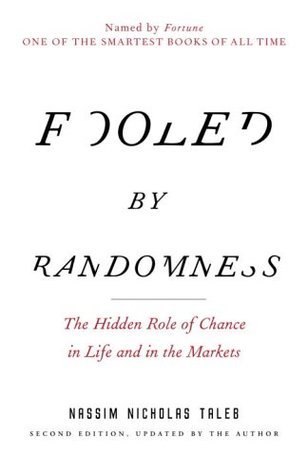
by
3.94 of 5 stars
“[Taleb is] Wall Street’s principal dissident. . . . [Fooled By Randomness] is to conventional Wall Street wisdom approximately what Ma... read full description

reviews

Nov 18, 2008
Trevor rated it: 4 of 5 stars
Yeah, you see. I’ve just checked and most of the other reviews of this book do pretty much what I thought they would do. They complain about the tone. This guy is never going to win an award for modesty and he probably thinks you are stupid and have wasted your life. And it gets worse – like that quote from Oscar Wilde that has tormented me for years: “Work is the refuge of people who have nothing better to do”, this guy reckons that if you work for more than an hour or so per day you are pr More...
20 comments like (25 people liked it)
Dec 17, 2009
Steve rated it: 2 of 5 stars
Renowned statistician George Box once said, “All models are wrong, but some are useful.” The author of Fooled by Randomness is all over the first part of this statement, but apparently doesn’t consider it part of his job as an iconoclast to say anything about the second. Taleb goes to great lengths to point out how some of the original assumptions made in investments and finance have blown up in people’s faces. Yes, unusual events do happen more often than a normal distribution suggests. Yes More...
3 comments like (8 people liked it)
Aug 25, 2007
Nicholas rated it: 3 of 5 stars
"Expect the unexpected" -- an aphorism that almost completely summarises the book. Cliches exist for a reason, but 196 pages later I feel the point has been well made.

Taleb is a stock market trader. As a trader, he believes that there is no way in general to predict the stock market -- that there are so many variables that the resulting stock price is indistinguishable from pure noise. Unfortunately, his profession is filled with people who believe that they *can* predict t More...
0 comments like (5 people liked it)
Dec 14, 2008
Carolyn rated it: 5 of 5 stars
This is the best book I have read all year, closely followed by his other book, The Black Swan. Fooled by Randomness is one of that select group of books that changes your mind entirely. Once I read it I could never look at the world the same again, nor could I take my old assumptions for granted.

We are so accustomed to looking at the world and seeing patterns that we do not always understand that we may be seeing randomness and imposing a pattern where none belongs. Taleb talks abou More...
1 comment like (3 people liked it)
Jan 01, 2009
Philip rated it: 3 of 5 stars
I love the theses that he has in the book, but jesus christ, this is horribly written.

I think the powerful ideas could have been condensed down to a New Yorker length article:
1. We tend to see the "survivors"; by hiding those who have failed, our understanding of many systems is skewed.
2. Leveraged betting on conventional wisdom provides consistent returns in the short run, but can explode when something weird happens (his "black swan idea").
3 More...
1 comment like (5 people liked it)
Dec 16, 2009
Tony rated it: 5 of 5 stars
This is one of the best books I have ever read. It has everything in a book that I yearn for....interesting ideas...some of which I don't grasp because hey are too clever for me...a smug narrator who seemingly knows more than everyone else...and a well-written and pleasing style.

Here is the crux of the book. Brokers have a very common weakness. They fail to appreciate that the likelihood of an event can not be the only factor one looks at when deciding to make a move. The likelihood, More...
0 comments like (1 person liked it)
May 16, 2010
Gordon rated it: 4 of 5 stars
This is a book by a trader with an intellectual streak -- although he might say he’s an intellectual with a trading streak. Nassim Taleb's book is highly idiosyncratic and personal, which is both what lends it a lot of its interest and what occasionally makes it irritating. Overall, he does not seem like a likeable man, and in fact is probably proud of that fact. But, it does get kind of tiresome to be told for the 5th or 10th time how unimpressed by wealth he is. In fact, he is clearly impr More...
1 comment like (3 people liked it)
May 28, 2008
Kate rated it: 3 of 5 stars
Well, if you can get beyond the fact that Nicholas T Taleb most likely hates you, his arguments are valuable. The idea of the book is that we discount the true probablistic picture of most situations and make decisions that we think are smarter than they are... we are lucky enough just not to get caught. He hates people who think they made wise decisions but were, in fact, just fortunate not to experience the bad outcomes. Hates them. They are so incredibly stupid. The neat idea I found mys More...
0 comments like (1 person liked it)
Jul 14, 2007
todd rated it: 4 of 5 stars
This is a reread of Taleb's first discourse on probability and markets, which I wanted to reread after reading The Black Swan earlier this year. I still found the ideas important and well organized. There was just a hint of the author's attitude that literally permeated the second book, making this a much more effective read.

Anyone reading both books might get the impression that this guy is an infalible trader. He is, if there are regular market catastrophes. He started his ow More...
0 comments like (2 people liked it)
Dec 16, 2009
CJ rated it: 3 of 5 stars
The book is an easy read and most of what it offers can be gleaned from undergraduate level statistics and psychology classes. Specifically: a catalog of unintuitive statistical results, and explanations/anecdotal examples of many psychological biases, and a lecturer with a swollen ego.

I read a used copy of this book lent to me by a friend who peppered it with wonderful marginalia. My favorite of these captured the narrative tone well in response to the author making a fairly mil More...
0 comments like (1 person liked it)
Feb 10, 2012
Steve rated it: 3 of 5 stars
Nassim Taleb has to be a strong contender for the title of Most Pretentious Author of the 21st century. Despite his obnoxious writing style, he has created an interesting synthesis of existing ideas that speak powerfully to societies inability to appreciate the role of chance when looking back at events, and to underweight the probability of extremely unlikely outcomes.

Unfortunately these ideas come littered with classical references, none of them properly explained, that do little More...
0 comments like (1 person liked it)
Aug 06, 2011
Andrew added it
We live in a world of excessive information. Financial news journalists try and explain a daily 1.5 points fall in the Dow (which stands at above 10,000). Such an insignificant change is most probably attributed to randomness. The author argues that most of the timeseries data we observe is ridden with randomness which is useless to explain and even more futile to predict. We should extend the timeseries to infinity as this, by construction, reverts the data to its steady state (ergodicity). In More...
Jul 29, 2011
Nilesh rated it: 5 of 5 stars
It is a must read for any professional. It has so many new arguments even for its theories’ most dogmatic believers that it has to be re-read every once in a while. One wonders why Mr Taleb felt the need to write the second one which has nothing not covered well and better here.

Still I would have taken half a star away. The extreme views against newspapers, MBAs, analysts are plain wrong within Mr Taleb's own framework, even if they made an interesting read. Let me briefly explain how (not that More...
Jul 24, 2011
Tara rated it: 2 of 5 stars
One of my business school professors raved about this book. I expected to get an entertaining and informative investment professional's take on how our irrational tendencies keep us from applying basic probabilities that would help us make better decisions.

Instead, this book read like a pretentious, ranting diary. In the introduction, the author brags that he ignored nearly all of the suggested changes his book editors made (he labels book editors along with journalists, MBAs, and mo More...
0 comments like (3 people liked it)
Jul 19, 2011
Jan-Maat added it
I'm not certain if it was this book I read or "Black Swan" by the same author. Importantly I not convinced by the blurbs or the reviews that there is any great significance in this.

I found it one of those books with an interesting premise that grew steadily less interesting as I read. And as I read I had the growing feeling that the book could have been conveniently summerised in a dozen and a half bullet points with a few anecdotes tacked on for amusement. This naturall More...
Jul 18, 2011
Andrew rated it: 3 of 5 stars
I've now read this book twice. The first time I read it (about 5 years ago) it opened my mind to a lot of new ideas. The second time I read it (about 3 months ago) I was greeted with mixed emotions. The author warns of the dangers of randomness and noise, and yet his book moves in random fashion and is filled with distracting asides (i.e. noise). As a result, I had to work really hard to extract the valuable material from this book. Another problem that shines through is the author's arrogance a More...
Jun 07, 2011
David rated it: 3 of 5 stars
It appears to me that Taleb wrote this book by stringing together a collecting of thoughts on probability and the role of randomness in the world, as I found the writing rather disjointed; but this gives a possible clue to his approach to writing. Taleb’s inimitable style is pedantic with haughty sarcasm and self-aggrandizement, yet he is quick to admit his own susceptibility to randomness errors—he just does it with style, or so he thinks. “I’m not capable of avoiding being fooled by randomne More...
May 20, 2011
Andy rated it: 3 of 5 stars
People look for patterns in an effort to make sense of events. Not a big surprise here but that may be due to the fact that this was discussed during grad school. Is this something most people don't realize or it is a new topic that is hot now? Don't know. I don't know what to think of the author - is he a rebel of sorts in the investment game, making fun of people with MBAs and the like; or is he a self-indulgent twerp who uses a basic understanding of probability and statistics to poke fun More...
May 16, 2011
Lars J. rated it: 4 of 5 stars
A really enjoyable book although somewhat idiosyncratic and un-even. The author does not apologize though and have even refused to even it out for the later editions. That way it stays personal and interesting. Another word on the style, it is easy to misread it as an attack and only see the snark, whereas the author is failry clear about his goals, he puts them clearly down, but it's easy to loose them on the way. I didn't care though, as I found it hilarious at times.

The content is More...
Oct 02, 2011
Colin rated it: 4 of 5 stars
The bottom line is that our brains are really hyper active pattern matchers. We see patterns where they don't really exist and we have an over tendancy to see causation where it isn't (aka "hind-sight" / "survivor" bias). Put another way, our brains are ill equipped to handle probability and decision making in uncertainty. We tend to believe stupid things and make poor decisions because of these deficiencies. It takes a lot of extra work to overcome our own propensities towar
0 comments like (1 person liked it)
Jan 23, 2011
Mangoo rated it: 5 of 5 stars
In his witty, informative, sober yet often ludicrous and sarcastic tone, Taleb expounds on the simple yet unsolvable problem of inference. This problem is as old as Solon at least, who already warned against the human tendency to infer from little empirical evidence rules and predictions expected to apply in general context, especially in the future. The echo of Solon's warning comes across the book and is embodied by Popper's (naive, as some say) falsificationism and his suggestion not to take More...
Dec 05, 2010
Jim rated it: 2 of 5 stars
The problem I had in reading this book was that I couldn't remove two comedy characterisations from my mind. The first was that the narrative voice reading the text in my head was that of Artie Ziff, he of the "busy hands" on The Simpsons.
The second was the Harry Enfield character who is "Considerably Richer Than You". If you bumped into Mr Taleb at a dinner party, you'd be expecting him to quickly interrupt your conversation with the observation, "Excuse me, I coul More...
Jul 01, 2010
Jonny99 rated it: 3 of 5 stars
The prairie home companion to ”The Black Swan” Not such a long time ago, 5 centuries or so, through its ingenuity and special place in the universe humankind was the epicenter of a predictable, orderly world subservient to its intentions. Then science fucked it up. Astronomers (e.g., Galileo) pointed out that we effectively sat on a chunk of rock pulled through space by the influence of a gargantuan entity (the sun). Biologists (e.g., Darwin) showed that our humans were one of millions of ev More...
Feb 17, 2010
Joe rated it: 3 of 5 stars
The main point of this book is this: people assign meaning, and find patterns, in phenomenon that are simply random. The author himself says the basic framework of his idea is this: We favor the visible, the embedded, the personal, the narrated, and the tangible; we scorn the abstract.

The majority of the book focuses on specific examples of people assigning purposeful meaning to random results. The author's favorite examples are taken from his career as a financial trader.

S More...
Jul 05, 2009
Shehab rated it: 4 of 5 stars
nassim nicholas taleb, the improbable best selling author of the black swan believes that success is illusionary (at times it seems he believes everything is illusionary – it’s all random, all luck!). his main thesis is that luck is often behind what we normally perceive to be success and that humans are hard-wired to under-estimate the role that randomness plays via various biases:


sample bias. (over-generalizing or generalizing based on unsuitable data sets, winners only for i More...
Mar 01, 2010
gargamelscat rated it: 3 of 5 stars
This has got to be the worst written most useful book in a long time.

I read the first 200 pages hating it - it would have been a 1 star review, then left if down for several months and when I picked it up again was far more receptive.

It's a hodgepodge of different areas from math & behaviourial science - without achieving any kind of synthesis.

The main message - whioch I agree with - is that skepticism is the most useful tool for the modern world, with a bit o More...
0 comments like (1 person liked it)
Feb 05, 2011
Mike rated it: 4 of 5 stars
On the basis of a co-worker's suggestion, I read "The Black Swan" before this 2nd, enlarged edition of "Fooled by Randomness". Both are excellent books and I can fully understand and agree with my friend's sentiments on why TBS might be best before FBR, but I also regret having read them in reverse order.

For someone who is less mathematical, or needs some introduction (literary foreplay!) into the topic(s), then TBS is definitely the better to book to read, and, pe More...
Apr 08, 2009
John rated it: 3 of 5 stars
Talib is one of the few people that saw the coming economic collapse and actually profited from it, from what I understand. I thought this would give some good insight into why he was able to see this coming and gain some wisdom from him.

The book was good--mostly a trader's view on the randomness of the market and life in general. His thesis is essentially that human beings are not equipped to think rationally about the world and are wired to find patterns where there is only rando More...
May 07, 2011
Raghu rated it: 2 of 5 stars
I took up reading this book with some trepidation. I had read his much-acclaimed book , 'The Black Swan' and found it a somewhat difficult read. The title of this book made me wonder if this book also recycles the same idea in different words as another book - just as many writers do after a hugely successful book. But then, I found an excellent review of this book in an essay by Malcolm Gladwell in 'The New Yorker' and decided to read it.

This book also turned out to be a difficult rea More...
Jun 11, 2010
Lynn rated it: 4 of 5 stars
This book definitely had an effect on my confidence in efficient market theory. Taleb is so convincing that I feel I should get a second opinion opposing his views. I could not come up with very good arguments against his skepticism in efficient markets or other random things which have such a direct impact on our lives. I’m probably more skeptical than most about the rationality of life events, but Taleb’s book was disconcerting, and even a little depressing.

I’m fascinated with t More...