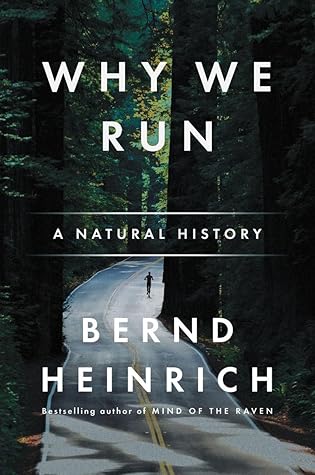
When Bernd Heinrich decided to write a memoir of his ultramarathon running experience he realized that the preparation for the race was as important, if not more so, than the race itself. Considering the physiology and motivation of running from a scientific point of view, he wondered what he could learn from other animals. In Why We Run, Heinrich considers the flight endurance of birds, the antelope's running prowess and limitations, and the ultra-endurance of camels to understand how human physiology can or cannot replicate these adaptations. With his characteristic blend of scientific inquiry and philosophical musings, Heinrich offers an original and provocative work combining the rigors of science with the passion of running.
Bernd Heinrich was born in Germany (April 19, 1940) and moved to Wilton, Maine as a child. He studied at the University of Maine and UCLA and is Professor Emeritus of Biology at the University of Vermont.
He is the author of many books including Winter World, Ravens in Winter, Mind of the Raven, and Why We Run. Many of his books focus on the natural world just outside the cabin door.
Heinrich has won numerous awards for his writing and is a world class ultra-marathon runner.
He spends much of the year at a rustic cabin that he built himself in the woods near Weld, Maine.
This book suffered from an identity crisis. From the very title, you anticipate that it will be a natural history of the human body, the impulses that led us to walk upright, the impetus that provoked us into running short, and later long distances. At some point you would expect to read about theories about the human physique and how it correlates to talents at long-distance running.
Bernd Heinrich's book does this, but it gets confused along the way. It begins as a memoir, a look into his life as a child in eastern Europe. He enjoys describing the landscape and letting us even smell what his formative years were like. The problem is, these stories and locations don't come back later in the book to provide any reflective lessons or allow us to look back on his life with any new information. Secondly, the framing of the book is a bit self-serving. It begins with Heinrich lining up to run a championship 100k race in Chicago in 1981. From there it steps back to his childhood, then leapfrogs to descriptions of the aerobic mechanics of various animals, from frogs to pronghorn antelopes, birds, and dogs.
This, for me, was the best part of the book. He discusses each animal's strengths and weaknesses when it comes to endurance, from describing their physical composition to meticulously breaking down their abilities to take in air, perform and preserve energy. We get insight into the camel's ability to stay hydrated, the cheetah's competitive advantage in explosive strength and an enlightening view of the pronghorn antelope's status as the best ultrarunning animal of its kind.
But then once that is over, we come back to his 100k race, where he describes in huffs and puffs what it is like to run very fast for very long. He doesn't neatly weave back the lessons he's taught us in the previous chapters to any real relevance -- were he to describe his actions while running and compare them to other animals, I'd get a sense of cohesion. This, however, wouldn't solve the irrelevance of his childhood vignettes.
Sadly, this book wasn't as interesting as I was hoping it would be and it only served to show that I can read a book on running and not love it.
I really love running, but I really don't love many books on the subject at all. Murakami's What I Talk About When I Talk About Running I enjoyed very much, but that's hardly "on the subject". Lore of Running is an amazing wealth of information - but hardly enjoyable reading material. And don't get me started on that Springsteen copyright infringement piece of manure.
This is why I treasure this one so much. Bernd Heinrich's enthusiastic mixture of biology and evolution and his own experiences is quite irresistible. His theories and methods are told matter-of-factly rather than implying he knows how to do it. I love his quirky ideas, such as running from his office to his car (so that his body would get used to running as primary means of self-powered transportation) or when he searches for the 'perfect' fluid to maintain him during really long runs. (Even if the 'scientific' me could argue, or at least suspect, that there's not one ultimate drink here, but that maybe they should be varied across the course of a run. Maybe testing one at a time was what ultimately disqualified beer for instance...)
Anyway, it's been a long time since I read this (and it's certainly up for a re-read), so if you want a better review have a look at this one I found here -> Jared's review of 'Why We Run'.
Award-winning ultra-marathoner, biologist, and writer Bernd Heinrich weaves a warm, persuasive narrative with threads of scientific data from his studies as a biologist and also with personal stories from his life as a dedicated runner. Indeed, Why We Run brings together elements of an autobiography, of research notes on animal physical endurance, and of storytelling for distance runners. The result is a bid to understand that ordinary people poses the ability to run the distance and acquire even other desirable athletic abilities. But the invitation comes in a most unusual way. In the book, the author finds meaningful connections among otherwise disparate topics. Bees, antelopes, the Nandi tribe, the runner Barney Klecker, and even cranberry juice all help explain the nature of running. With this unique approach, the reader may seem pulled in different directions, but the reading flows surprisingly easily and interestingly. And eventually, Heinrich’s colorful narrative helps the reader realize that all humans can become runners, and those who already are may improve on it.
Heinrich starts and ends the book by recounting a 100-kilometer championship in 1981 Chicago. Corresponding with his warm-up for the race is a small amateur, but inspiring view of running history. Then the author moves back in time to describe his personal childhood with flashes from friend’s experiences in WWII. After that, the story moves on to the Heinrich’s experience in the African plains, college, and scientific animal research. While telling all these stories the author also reveals how cases of other animals’ experiences with bodily movements relate directly to that of humans. Some example are the camel’s complex adaptation to the desert, the bird’s anatomy and its diet, and the frog’s loud and continuously sustained croak shed light into our own capacity for stamina and physical endurance.
Enter the modern runner’s world. Still outlining his running philosophy, Heinrich establishes an experiential reality of running that even explores some popular running myths. He points out that most of the record-breaking Kenyan ultra-marathoners come from the laborious Nandi tribe, where running is a vital, natural ability for hunting food. The author also shares some personal gems of wisdom and results of makeshift experiments with running exercises and diets. For example, he downplays the usefulness of stretching, and yet believes that modern cross-training techniques are reasonable for long-distance runners. The book finally concludes in a full circle with the account of the 100-kilometer race against All-American ultra-runners.
In the end, Why We Run is a worthwhile read for those interested in the animals’, but particularly in humans’ ability to survive, adapt and move. However, Heinrich’s book may give the impression of having a different purpose. Probably to the surprise of many, the book is not a how-to-be-an-athlete, an instructional guide, or a customary piece of writing. Why We Run simply tries to answer the same question the title is asking.
Movie: An Uncommon Curiosity: at home & in nature with Bernd Heinrich
I started this in July?! Geez, my reading really has suffered this year.
This was a strange book. Part biography, part how to manual, part biology, part evolutionary biology, this book is ultimately the story of Bernd’s 1981 win of the 100km ultramarathon in Chicago.
When the book is about that, I found it great. When it dived into antelopes, camels and frogs, I was so NOPE.
Interesting, but a bit of a trudge. Not surprising it took so long to finish.
Worst running book I’ve ever read. More of a history of his running career and a creepy obsession of beetles and birds. Gives a lot of reason why a couple other animals are better at some aspects of running than humans are, but it’s mostly biology based and out of our control. Very little “history” of human running. Not really anything I expected.
Know what you're getting into. The cover and title are misleading.
I loved Winter World and felt that Heinrich was a magnificent writer and scientist. This book muchly undid that feeling.
Firstly, what this book is not about: antelope, prehistorical man, the Olympics, modern running, Bernd's life, how to run, or why we run.
It is, instead, partially about all of these things and more. It sounds like they might combine fabulously. But if you look at the other reviews, you'll see that for many it falls piteously short, because it tries to cover several topics without smoothly combining them. It seems distinctly cut into near-disconnected chunks, and never covers any one topic completely.
The main reason it comes off this way is simple: people interested in competitive running aren't usually interested in the complex physiology of animals; and people interested in explanatory, descriptive nature writing aren't usually interested in the names, times, and general specifics of competitive running. As a result, most people feel that only half or less of the book was of interest.
But as others have opined, the writing isn't that good either. In fact, I'll go so far as to say that if Bernd wasn't already well-established, this book would not be in print, or at the very least doing anywhere near as well as it is. It almost seems unfair, honestly. If my rating (which is due to the book having many insightful comments and containing interesting biological information) weren't a 3, it wouldn't be a 4, if you take my meaning.
If this all weren't enough, Bernd comes off as egotistical yet tries to seem humble, and it detracts from the book. His continual determination to win is sometimes weakly masked by comments like, "I did not record my finishing pace (I think I was third)..." and his praise for his opponents followed by his pleasure at defeating them is especially annoying. I just wish he'd be more upfront about the fact that he wanted to be first and the best in everything he attempted.
Finally, I love animals in the lovey sense, not just the "you are cool" sense. For some scientists, animals are wonderful and fascinating; and they're even more fascinating once you grind them up whole to measure lactic acid or shoot them down and observe them in detail. Don't think I didn't notice your brazen justification for meat-eating and hunting, Bernd, cuz there's only one group one would feel the need to argue against on that point. So...I normally don't mind these things (I did find the frog-grinding highly disturbing), but once that justification was added, I definitely felt a little annoyed.
In short, most people would benefit by skipping this book. I don't have much interest in running (I picked it up thinking it involved early man and animals like antelopes, which I love), so I haven't gone into this, but I suggest looking up a book that better covers that interest, or whichever one you have. If you're strongly interested in Heinrich, how animals expend energy, AND competitive running, then give it a shot.
I really wanted to love this book, which I happily chanced on at a second-hand bookshop at a time when I am trying to double down on my training. But though I eagerly lap up non-fiction science books, this came as a complete and utter disappointment.
The author is a supposed ultramarathoner and biologist but the output lacked method and rigor, often jumping from one idea to the next without any sensible thread and dishing out a ton of “I suspect” and “probably” out of thin air, for example surmising out of the blue that women’s inferiority to men’s in running may be due to shorter feet, or selective pressure, then jumping next to talk about animals he encountered in the wild.
I was also startled and taken aback by the naked and brazen display of hubris by the author, thinking himself head and shoulders over his hometown peers, without giving them the benefit and courtesy of context, as shown by this astounding paragraph thick with self-congratulatory glee one could almost hear him beating his chest and patting his own back while admiring himself in the mirror:
“Many of the people close to me in rural Maine did not appear to strive for great things. I saw them carrying their black lunch pails, with a thermos and sandwich, each morning on their way to the dreary bowels of the claning wooden mill. In the evening they came back, milked the cow, and went to bed. After some years of the same endlessly repeating routine, they died, usually in the same hospital they were born. I wanted to do something different.”
The only saving grace perhaps are the interesting running quotes scattered in modest measure in a few pages, but otherwise, this is like hearing your overly-effusive uncle in your family reunion drunk (in his own kool aid) slurring while romanticizing and boasting about his latest exploits and the bygone days of his sport of choice through shoddy science and select scattershot anecdotes. For all his unadulterated navel-gazing and chest-thumping, the author might as well have called this “Why I Run.”
For a long time, I would only praise two books, when it came to running. Murakami's book and the Chi of Running. Having read more than 10 other books on running before this one, I can confidently say that this is a MUST READ book for every runner. Even non runners should read as it will inspire them to at least try running!
In this book, Biologist, award-winning nature writer, and ultramarathoner Bernd Heinrich explores a new perspective on human evolution by examining the phenomenon of ultraendurance and describes the physical, spiritual and primal drive to win.
Analysing diet, physique and habits of various animals and birds, Bernd has juxtaposed that with the human body, our endurance and our ability to run long distances for hours at stretch.
At once lyrical and scientific, Why We Run shows Heinrich's signature blend of biology, anthropology, psychology, and philosophy, infused with his passion to discover how and why we can achieve superhuman abilities.
I loved how he has described in detail his own running journey and how he built up his stamina and speed over time through dedication and hard work.
The detailed walk through of his first 100km run in Chicago and description of the race in grotesque detail is just amazing. Was amazed that a race he ran in 1981, he could describe it in such precise details after 20 years.
For anyone who loves to run and is in some sense a naturalist, this book goes hand in hand with "Born to Run". Heinrich looks at what we have to learn about running from all sorts of animals, from pronghorn antelope to bees, and I learned a good bit from that, though I'd probably get more out of these sections if I'd studied bio and was more of "naturalist". However the book offers much more. Heinrich is man who's lived an interesting life and it's worthwhile to hear his stories, from his childhood in Germany during WWII, to growing up in the Maine woods, and other journeys, such as his time in East Africa. But what I really loved about the book is that it's an ode to running, and as someone who loves running, I love to hear Heinrich sing its praises.
Gave up 12% in, as the author can scarcely go a sentence about running without veering off into a multi-page treatise on beetles. Like the most boring person at a party, who has neither the ability to read the room or stop talking, the author seems unaware that we would perhaps be more interested in the title subject than his passion for insect zoology. Shame, because I quite liked the author's writing style, in those fleeting moments when it was on-topic.
And if the book finally does settle on the subject of running, then please redirect my ire to the editor, who preposterously allowed such tangents to be front and center.
One of my favorite books of 2018. I had never heard of it until I was browsing the sale section on iBooks and decided to take a chance.
There were three main components on running included in this book. 1) Physiology and science behind running. You'll learn what is actually happening in your body when you run. Fair warning, it can get a little technical in places, but Bernd is a talented author that makes the hard science really interesting. 2) We can learn a lot about running by looking at animals and studying their running and endurance capabilities. The chapter on antelopes is worth the book alone. They can maintain sprint speeds for long distances and have been reported to run 7 miles in 10 minutes. Oftentimes they'll race cars and trains for the sheer enjoyment of a "running" competition. 3) Bernd Heinrich was the world record holder of the 100k (62 miles) in addition to being a distinguished professor of zoology. He included many philosophical tangents about his love for running. Running is a primitive act that connects us with our ancient ancestors. From the beginning of mankind, humans have had to run and hunt with a specific goal in mind in order to survive.
While I was once adamantly opposed to running, after training for my first half marathon I believe I activated that primitive desire to run with a goal in mind and fell in love with the very first sport of human existence. I plan on reviewing this book before my first marathon.
This book was very different than I expected. I though it would be a history of running, perhaps about the Tarahumara.
The first third was biography. Just as I reconciled myself to reading a biography, it switched to the metabolism details of specific insects. Then running metabolism of large mammals.
When we got to the last third of the book it was about his running training as an adult. At least twice he ignored medical advice and pressed on. In his case, he survived without permanent injury. He also told of some training that was misguided & he learned from those mistakes-steps.
Through the course of reading this book I went from disappointment, to learning something, to being interested in the outcome of his training.
He said that ultra distance runners have 1%-6% body fat. Really? I thought 4% was the lowest viable BF% for men. Research: https://www.trainingpeaks.com/blog/id... Says about 8% for elite runners (not ultra). So, perhaps ultra runners do get that low. I didn’t find any numbers for ultra runners in the time that I had available to do research.
A good indication that you may be growing tiresome of a book: you find yourself leafing ahead in the book to see exactly how many pages have been dedicated to the anatomy of antelope, frogs, birds, camels etc.. but I did learn a lot about the physiology of many different birds, moths and animals, so that was interesting.
We human animals, are in fact, evolved to run. The hair on our head to the splay of our toes, and the rhythm of our lungs, heart and limbs while running, indeed proves that we are just a bunch of wild monkeys, monkeying around, evolved to avoid being killed, and to kill others. Like a long distance race, I had my personal doubts half way through this, but the book finished strong and left me feeling good by the end of it.
أعتقد أن هذا الكتاب لا يعد "تاريخيًا" كما ذكر عنه في غلاف الكتاب، فقد تشعّب في طرحه من خلفية علمية وتفاصيل مملة، ولكن إذا تعمّقت في قراءته وحاولت فهم ما يحويه -من وجهة نظر لعالم أحياء- فهو يقدّم منظورًا مختلفًا للعداء والجري.
ذكر هاينريش رحلته الخاصة كعداء، وأوضح من خلاصة تجاربه مفاهيم علمية بحتة -قد تكون مملة- في البيولوجيا التطورية والفسيولوجية للجري، وشرَّح مفصلًا تكيف البشر والحيوانات الأخرى على قدرتهم التحمل، وكيف استطاع البشر الأوائل التغلُّب على الحيوانات واستراتيجياتهم في الصيد، مستفيدين من قدرتهم على الجري لمسافات طويلة رغم ظروف الطقس والمناخ وبدائية الأسلحة المستخدمة للوصول إلى الفريسة.
An early book about running tied to anthropological study about why and how humans evolved, their early days as hunters, comparison/contradiction to other species; interwoven is author’s story of becoming ultrarunner, his trials with nutrition, training programs, advice, self-motivation. Well-written, self-deprecating.
Thank you Bill Sanford for this book, a nice pairing of biology, zoology, and running detailed through the shoes of the author Bernd Heinrich. 10/10 underrated running book, more science than BTR and a far more personalized, exciting story. Reminder running is both good and natural
I really enjoyed this! I initially picked it off the shelf of a second hand bookshop for inspiration for a character I'm writing, but just really liked the memoir/natural history vibe. All the biology info went over my head a little, but I found it all interesting and really liked the ending :)
Fun to read this about a fellow biologist training for a 100k as I do the exact same thing! Some running facts in the book are definitely outdated. Overall, weaving animal physiology and locomotion into the science of human running was super interesting
Fascinating book that examine the natural history of running. Memoir intertwined with very accessible writing on the anthro-biology and physiology of running.
"Why We Run" has been on my bookshelf for years. I "borrowed it" from my grandmother and haven't returned it to Maine. I picked it up this week because I've been contemplating a return to racing (my last race was Twin Cities Marathon in October 2017). I've had some much needed time away from running, but I've been slowly returning to the sport.
I have entire shelves packed with running books, and Why We Run is nowhere near my favorite. That said, I like parts of it. Heinrich is a professor in the biology department at the University of Vermont. He knows a lot about animals and a lot about running. The last two chapters of the book describe Heinrich's training for the 100 km National Championships (he ran up to 140 miles per week). This part of the book is exciting and beautifully written. Overall though, Why We Run feels like an outdated take on the sport (especially in relation to women in competition). It was published almost 20 years ago (Heinrich was 60 at the time). In a section describing why men are better suited to fast running than women, Heinrich writes: "When women do run as fast and far as men (as many can), they likely do so at a reproductive cost. They must lose so much body fat that ovulation ceases."
There's a lot wrong with this statement. While it's fair to say that many female runners struggle with amenorrhea / female athlete triad, it is not fair to say that women can only be fast "at a reproductive cost." It's just false. If you run 100 miles per week and take in enough calories (that's a lot of calories), you will continue to get your period and likely beat many male athletes. Many of America's fastest women get a regular period. Amenorrhea is not a sign of fitness or speed (**you don't need to stop getting your period to be fast**). There's also plenty of evidence that male marathoners tend to have have decreased sperm counts due to lower levels of testosterone. Generally, endurance running tends to reduce semen quality. Men sometimes get fast "at a reproductive cost." Heinrich doesn't mention it.
There are other lines like this throughout the book that bother me. I blame this on the fact that the book was written 20 years ago, by a 60 year old man. There's another piece of this book that I struggled with though: long, dense sections (with many diagrams) describing the anatomy of birds and insects. I understand why these pieces are included. Perhaps I was just not in the mood. Biology majors / insect lovers will enjoy this section more.
If you're a runner, this is worth reading. You'll really enjoy parts of it (maybe just skip to the last two chapters). I don't feel at all confident that non-runners will enjoy this book. Perhaps one of you will prove me wrong.
This was an interesting take on running. Heinrich is a zoologist, and views running through that lens. Over the course of his own training for his first 100-mile race, he talks about the ways various animals run, and compares their physiology to that of humans. For example, he explains what makes migratory birds such excellent distance athletes. They can fly thousands of miles with little rest because they are so light, their lungs and hearts are made for it, and many of them double their weight before migration so that they have the fat to burn.
In addition to having lots of interesting information, he wrote of training for an ultramarathon in a way that didn't seem nearly as crazy as they often do. And the writing was often quite beautiful. I don't know that I'd recommend it for non-runners, but if you've got any interest, give it a go.
I read it while training for my first mini-marathon, and it was interesting and kept running on my mind. While I'm not sure that it inspired to train any better, it was a good time to read it.
The second book I have read by Bernd Heinrich, "Racing the Antelope" was more interesting to me as a runner than "Winter World". Bernd Heinrich writes about his many experience with running, culminating in his account of his impressive American record and quite possibly world record setting 100K race. We are introduced to the many ultra marathoners of the natural world and, like in "Winter World", learn of the many adaptations that they employ. Bern Heinrich has thus far consistently sparked my interest in nature and what we, as animal ourselves, can learn from it. While not intended as a training manual, I felt that l learned a lot about the way in which one should approach training from this book, if not specific tips about running. Bernd Heinrich's rich scientific background makes this book an exceptional one that take the "running book" to a whole different level. I recommend this book to all runners who wish to find real meaning in their sport.
This is an excellent book if you are interested in anthropology and the biology associated with running. It analyses the relationship between humans and animals in an attempt to find out why it is that we run and why we are able to run as far as we do. The author himself is an ultra-marathon runner, and the book chronicles his journey to one particular race, his first 100km ultra. This part of the story is well written and engaging but I was left wanting more, more analysis of his own journey, the trials and tribulations. I was particularly interested in the knee injury he suffers close to the race, but I was not satisfied by how this was discussed. Maybe that's because I am a runner with an injury and I am looking for stories to make myself feel better. Ultimately this is a fascinating book and worth while reading. A few grammatical and tense errors along the way but the narrative is strong enough to keep you turning the pages.
Stole this paperback from the Husbo last night and read the first half straight through. Great book in many respects—a compelling mix of memoir, running theory, and anthropological study. But my favorite part is what a total bird-creeper the author is. I feel so understood.
Page 40, childhood memory: "I spied a tiny owl, no larger than a coffee mug. The yellow eyes of the saw-whet owl looked at me in surprise, and I looked back in wonder. I needed this creature. I craved it…" [child-Heinrich stuns the owl with a slingshot] "It revived soon after I had it in my hand. I could not get enough of the little owl and maneuvered it into a cage in a hiding place up in a spruce tree in the woods. I felt the bird would be at home there and I could see it frequently. But after a few days my memory of it was secure, and I let it go to live free in the woods."
Perhaps there is something about the act of long-distance running that lends itself to meditative writing; I have read several good books by writers (Murakami, Cheever), humorists (Zweibel), and now can add this one by a research biologist to the list.
This book is wonderful reading for non-runners and runners alike. Part memoir, part training diary, and part evolutionary history; that list sounds like a monstrous chimera, but like the capacity for running that the author describes it somehow evolves beautifully to become more than the sum of its parts. The biology is fascinating, and the transparency of the writing is up there with Stephen Jay Gould. The author's love for his subject is contagious.
What begins as walk down memory lane of Bernd life, slowly develops in a fast read, fueled by the anticipation that only a major personal challenge is about to take place.
Bernd uses his preparation for the 1981 100k ultra race, as the end towards which the book is driven.
Using comparisons between animal biology, backed up by his scientific knowledge, Bernd suggest that maybe our biologic evolution, and some of our particular human features derive from the act of running.
Without being to filled with facts or memoirs, the book flows just the way the author might actually run. If you have some interest in running and the biology behind it, this book is a must.
The author is a biologist and ultramarathoner, completely obsessed with both. This book romanticizes the sport/art of running with lots of anecdotes, and includes many lessons to be learned from different species about how to improve one's endurance and speed... although often this amounts to just marveling at the evolution of different types of runners and flyers ("endurance athletes"), which I still enjoyed. It is a book where any one page, or even one paragraph, may discuss both how best to tie your shoes and how a particular insect regulates its body temperature via the thin skin of its thorax. Crazy? Charming? I liked it.