36th out of 52 books
—
7 voters
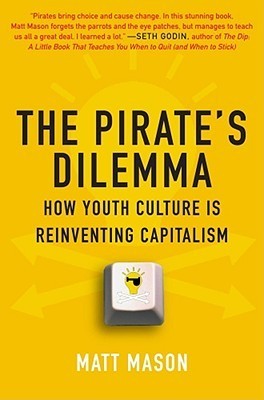
The Pirate's Dilemma: How Youth Culture Is Reinventing Capitalism
by
Matt Mason
It started with punk. Hip-hop, rave, graffiti, and gaming took it to another level, and now modern technology has made the ideas and innovations of youth culture increasingly intimate and increasingly global at the same time.In "The Pirate's Dilemma," "VICE" magazine's Matt Mason -- poised to become the Malcolm Gladwell of the iPod Generation -- brings the exuberance of a...more
Hardcover, 313 pages
Published
January 8th 2008
by Free Press
(first published January 8th 2007)
Friend Reviews
To see what your friends thought of this book,
please sign up.
Community Reviews
(showing
1-30
of
877)
Occasionally Mason is a good storyteller, but his argument has many flaws. He lumps all "pirate" activity together, and lauds it as disrupting evil, greedy capitalistic forces, but he doesn't recognize that it is quite possible to be a greedy, self-interested pirate...and actually many of the situations that he describes ARE self-interested.
The opening situation in the book is of a guy silencing all radios within a 30 foot radius of his car, using a modified iTrip. It silences an annoying boomb...more
The Pirate's Dilemma tells the story of how youth culture drives innovation and is changing the way the world works.
RWD magazine founding editor-in-chief Matt Mason suggests that at the heart of innovation lies an intersection of piracy, youth and business, and concludes piracy to be just another business model. Given this, the dilemma should not be about how we compete against pirates and how we treat them but becomes more about how we can become better by recognising and capitalising on pirat...more
This review has been hidden because it contains spoilers. To view it,
click here.
Solid book laying out the argument for why pirates and youth subcultures from punk & hip hop to open source software developers are all 'Punk Capitalists' reinventing business models and creating new markets and revenue opportunities. Author, Matt Mason makes a compelling argument for openness, collaboration and the value of altruism (vs. self interest) in business and why the best strategy for responding to pirates is to compete with them, not try to shut them down.
Mason is also well verse...more
A good book detailing the rise and fall of youth culture, hip-hop, graffiti, medicine patents, and many other things. Also includes a great analysis of the open-source community and the economic and political motives behind all of it. It's a very music-centric book, linking what we see in the physical world of art with what we are doing online.
This book is available online as a free PDF.
This was a fun read with some interesting points, but taken as a whole Mason's argument is a little facile.
Most of the book consists of examples of (generally youth-oriented) subcultures that developed into major commercial or cultural successes. Mason's examples include punk (focusing on its D.I.Y. ethos as an example of the pirate spirit), hip-hop, early disco, etc. All of these subcultures were created and expanded outside of the mainstream before being absorbed or incorporated (some would sa...more
Brilliant. Insightful. A great account of modern-day piracy. A clarion call for all to embrace the pirate within us. Mason makes the term 'pirate' cool.
The part I found most profound was how marketers nowadays are quickly latching on to the latest fad/'in-thing' as a way to connect with their consumers which I think is a terrible thing to do (and this coming from an ad person). That latest fad or craze could've have become part of modern culture but instead it becomes commercialized. Instead of...more
I began reading this book because it was a free download on this site. I’m loving my free eBooks for the reasons of both environmental conservation & market freedom, true market freedom, not the kind sprouted by laissez faire economists to benefit the wealthy. I really didn’t expect much from this ‘free’ book.
The first few chapters while interesting seemed to rub me up the wrong way initially, portraying the punk scene as a new free economic force paving the way for the do it yourself freedo...more
Dec 07, 2010
Dan Solomon
is currently reading it
So far, pretty disappointing -- it's mostly Mason offering shallow analysis of things that most people who'd care to pick up his book are already well-versed in. (You mean blogs are popular now?) He also fairly gushes over anyone who figures out a way to make money off of something with anti-establishment credentials (he uses the term "punk capitalists" over and over) and is basically a giant turn-off. I'm nearly to the end of chapter three, and I'll give him another 20-30 pages before I give up...more
Mason's core argument on piracy is persuasive, and his observations are good - particularly on the digital music revolution. His closing chapter distills the 'dilemma' very nicely. But he has approached the topic very broadly, and uses it as an excuse to go off on lengthy tangents about related stuff that he knows and likes - largely the history of popular music. His evidence is also a bit suspect at times - some of the stats and facts he drops in raise more questions than they resolve. Still, t...more
Yet another non-fic that connects to Gladwell's The Tipping Point. However this was a nice little variation on Gladwell's definitions of viral connections, and I thoroughly enjoyed the anecdotes contained within. This book takes the reader on a merry jaunt through the roots of piracy and the adaptation of various media to give the public what they want and to fill empty niches. My biggest complaint about this book is that the author's connections to the music industry mean that the VAST majorit...more
Aug 11, 2008
Bruce
rated it
3 of 5 stars
Recommends it for:
anyone who likes reading Malcolm Gladwell
According to Matt Mason in The Pirate’s Dilemma, “Copyright laws are encroaching on the public domain, but if the history of pirates is anything to go by, such laws are not often observed, become impossible to enforce, and eventually change.” (p. 99)
Okay, folks, get ready for a rather lengthy review of The Pirate’s Dilemma, or rather, a brief review of Matt Mason’s book, followed by a more extended discussion of some of the ideas contained therein as they relate to two recent DC Bar-sponsored p...more
Corporations have a choice to make--become pirates or suffer at the hands of pirates. Mason is a music journalist, so he backs up his arguments with anecdotes from the music industry. I didn't expect to end up with a clearer understanding of hip-hop, disco, grime, and underground radio, but unexpectedly I did. I know Mason's thesis does apply and will apply to every industry, it certainly works beautifully with the music industry--I just wish I could more cleanly apply it to publishing.
What thi...more
What thi...more
The first 3/4 of the book is about examples of how artists used music and cultural to subvert societal norms and question the status quo, mainly about the hip hop, punk, disco, rave, and grime, pirate radio, pop art, video game moding, and graffiti culture movements of the last 50 years or so. The last quarter explains the actual dilemma itself which is pretty simple: companies should use work of pirates to their advantage and stop spending resources to fight them.
I was hoping for more historica...more
ugh. i read this for a book group that i didn't even attend, but i kind of wish i'd been able to, just for a better opportunity to complain about it. there's nothing seriously flawed in his argument here, i just found the whole thing really tiresome. lots of examples of "pirates" changing culture, and lots of SAYING "look man, we need to embrace this" but... i don't know, maybe i'm coming into the conversation to well-informed already, but this book didn't tell me anything that made me stop and...more
I really got a lot out of this book - I would recommend it to anyone who owns or is interested in owning a small business! It had some interesting information and tips on creating a different type of work culture based on youth countercultures (both present day and previous). There was a little too much repetition in many spots, and a couple of editing errors. There were also several interruptions in the flow of thoughts, but still a lot of good ideas on the changing business environment.
Discussion on the ethical and cultural issues regarding the drive of capitalism in a world that has open source sharing and DRM. The link between popular cultural and social networking is obvious to most yet Mason uses it to argue for a new model of marketing and consumerism that addresses the lack of a generation gap and the rise of branding. Appreciated the Prisoner's Dilemma as to whoever confesses first has a higher chance of getting away or serving less time.
Mason begins with some interesting stories. However, he paints the world with extremely broad strokes, and the titular "Pirate's Dilemma" doesn't even really make sense. Mason is also obsessed with the idea of 3-D printers and the thought that soon, everything will be downloadable. That may happen one day, but it's centuries off.
By the end, I was tired of the book and Mason's generalizations, I'm afraid. I can't recommend this book.
A very good summary of the evolution of the music business, as well as how intellectual piracy can actually benefit some industries. Its handling of general (including biotech) intellectual property law is somewhat cursory and a little mis-informed, but as it pertains to the music industry it is quite good. I also picked up a few great music recommendations in the hip-hop and electronic music generas.
great concepts, but really not a great writer. the core idea here is that in order to thrive as a business in a world of infinitely replicable goods, we take the prisoner's dilemma (where game theory states its always in our best interest to work solely in our personal best interest) and factor in the good of society in our decision making. if we can benefit society with our business model, AND monetize the new value that the pirates have discovered, then theres hope for a new type of business t...more
This is a really interesting book. I stumbled across it while researching for books to teach in my comp class, and it reminds me of Abbie Hoffman's stuff, except without the LSD. Mason delivers a very powerful argument; piracy of intellectual property is driving change in today's capitalist scene, and that change is ultimately a good shift.
From flash mobs, to underground music, pirate radio, and punk capitalism, Mason shows how youth culture is turning the tables on traditional concepts of adve...more
There are no discussion topics on this book yet.
Be the first to start one »