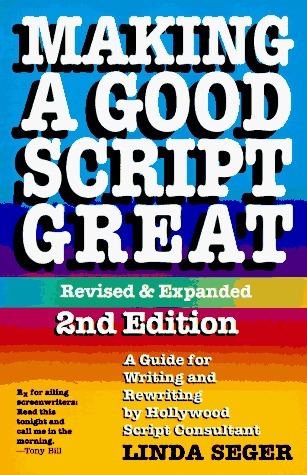
Making a good script great is not just a matter of having a good idea. Nor is it a matter of just putting that good idea down on paper. In scriptwriting, it's not just the writing but also the rewriting that counts. Making a Good Script Great focuses on the rewriting process and offers specific methods to help you craft tighter, stronger, and more workable scripts.
While retaining all the valuable insights that have made the first edition one of the all-time most popular screenwriting books, this expanded, second edition adds new chapters that take you through the complete screenwriting process, from the first draft through the shooting draft.
If you're writing your first script, this book will help develop your skills for telling a compelling and dramatic story. If you're a veteran screenwriter, this book will articulate the skills you know intuitively And if you're currently stuck on a rewrite, this book will help you analyze and solve the problems and get your script back “on track.”
Dr. Linda Seger has a Th.D. in Drama and Theology, and created her script consulting business based on her dissertation project about the elements needed to make a script work. She explored the integration of Drama and Spirituality during her five years in seminary. She holds three M.A. degrees: Drama from Northwestern University, Religion and the Arts from Pacific School of Religion, and Feminist Theology from Immaculate Heart College Center. She has a broad religious background. She grew up Lutheran and did several years of spiritual seeking in her 20s. She became a Born-Again Christian and then joined the Quakers (Society of Friends) and is a member of The Colorado Springs Friends Meeting. Throughout the years, she has meditated at a Zen Buddhist center, attended New Age conferences, has done the spiritual exercises of Saint Ignacious, and has read and taken classes in the religions of the world. Dr. Seger's thoughts about how spirituality influences her work:
“Many readers are surprised and even confused when they see I’m the most prolific writer in the area of screenwriting, an international screenwriting consultant and a screenwriting teacher. Yet, I also do theology/spiritual books. Some of this comes from having an M.A. In Drama, 2 M.A.s in theology and a ThD in Theology and Drama. They seem to be separate, but they are actually integrated.
Drama shines a light on the human condition. It explores the conflicts, struggles, doubts, uncertainties, and possibilities for transformation and redemption. Even secular drama deals with hope and goodness and the struggle for authenticity and love.
When I consult on scripts, I am trying to help the writer reach deeper into the truth about who we are as humans and what are our possibilities. When I write books on spirituality, I am doing the same thing – digging deeply into our experiences and struggles, and then shining the light of Scripture and theology on making some sense out of what we see and feel. I am trying to get at The Truth and to dig deep into our experiences. So, I never look for easy answers, and I don’t try to pigeonhole either our stories or our spirituality.”
Дуже гарна книга з купою практичних порад щодо написання сценаріїв. Починаючи від самих азів (перша ідея, розробка персонажів, красномовні деталі) і до остаточного шліфування.
У чіткій та зрозумілій формі розкриваються прийоми, за допомогою яких можна формувати очікування аудиторії, готувати до розв'язки/обманювати публіку, викликати симпатію до персонажа, змушувати співчувати та вболівати за нього. На реальних прикладах розбираються принципи композиції (особливо - взаємодія кількох логічно завершених та повноцінних сюжетних ліній, що працюють на одну, головну історію), маніпулювання точками зору (втішає розбір невдалого рішення у фільмі "Підміна" та пропозиції, як можна було цієї помилки уникнути), правильна підготовка сюжетних поворотів, що мають не лише вражати публіку, а й досконало вписуватись у розказану історію.
Окрема подяка авторові за постійно й наочно повторюваний принцип: "Показувати, не розповідати", неслідування якому зіпсувало вже не одну кінострічку/роман.
Втім, є невеличкі зауваження стосовно перекладу. Місцями перекладач чи то поспішав, чи просто полінувався дослідити питання, і це виливається у фрази на зразок "Ми бачимо як Ейміш (замість "аміші") йдуть додому". Постійна "кавказька раса" замість "європеоїдної" не лише муляє око, а подейкуди й збиває сприйняття (все ж на "кавказьку зовнішність" асоціації інші). У останньому розділі кількість помилок та неточностей раптово зростає, складається враження, що книжку треба було негайно здавати до друку, і редактура не була доведена до кінця належним чином. У той же час деякі місця дуже втішили адекватною адаптацією, взяти хоча б "кружку/філіжанку кави" як приклад регіонально-специфічного лексикону.
Загалом: рекомендую всім, хто хоче створювати історії (не обов'язково сценарії - для романів, ігор, коміксів майже всі поради залишаться актуальними, хіба що метод їхнього застосування дещо зміниться).