Jump to ratings and reviews
Rate this book

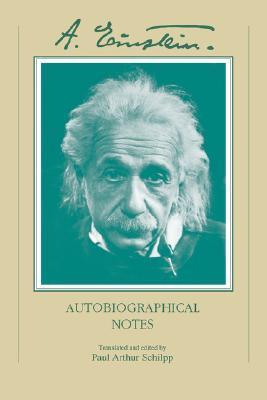
Autobiographical Notes

Rate this book
Delivered with warmth, clarity, and humor, this brief work is the closest Einstein ever came to writing an autobiography. Although a very personal account, it is concerned solely with the development of his ideas, saying little about his private life or about the world-shaking events through which he lived. Includes parallel German and English texts.

95 pages, Paperback

First published January 1, 1979

Loading...
Loading...

About the author

Albert Einstein

1,032 books9,746 followers
Special and general theories of relativity of German-born American theoretical physicist Albert Einstein revolutionized modern thought on the nature of space and time and formed a base for the exploitation of atomic energy; he won a Nobel Prize of 1921 for his explanation of the photoelectric effect.

His paper of 1905 formed the basis of electronics. His first paper, also published in 1905, changed the world.
He completed his Philosophiae Doctor at the University of Zurich before 1909.

Einstein, a pacifist during World War I, stayed a firm proponent of social justice and responsibility.

Einstein thought that Newtonion mechanics no longer enough reconciled the laws of classical mechanics with those of the electromagnetic field. This thought led to the development. He recognized, however, that he ably also extended the principle to gravitational fields and with his subsequent theory of gravitation in 1916 published a paper. He continued to deal with problems of statistical mechanics and quantum theory, which led to his explanations of particle theory and the motion of molecules. He also investigated the thermal properties of light, which laid the foundation of the photon.

Best known for his mass–energy equivalence formula E = mc2, dubbed "the world's most famous equation," he received "for his services to theoretical physics, and especially for his discovery of the law of the photoelectric effect". The latter was pivotal in establishing quantum theory.

He visited the United States when Adolf Hitler came to power in 1933 and went not back to Germany. On the eve of World War II, he endorsed a letter, alerting Franklin Delano Roosevelt, president, to the potential development of "extremely powerful bombs of a new type" and recommending that the United States begin similar research. This recommendation eventually led to the Manhattan project. Einstein supported defending the Allied forces but largely denounced the idea of using the newly discovered nuclear fission as a weapon. Later, with Bertrand Russell–Einstein manifesto highlighted the danger of nuclear weapons.

After the rise of the Nazi party, Einstein made Princeton his permanent home as a citizen of United States in 1940. He chaired the emergency committee of atomic scientists, which organized to alert the public to the dangers of warfare.

At a symposium, he advised:
"In their struggle for the ethical good, teachers of religion must have the stature to give up the doctrine of a personal God, that is, give up that source of fear and hope which in the past placed such vast power in the hands of priests. In their labors they will have to avail themselves of those forces which are capable of cultivating the Good, the True, and the Beautiful in humanity itself. This is, to be sure a more difficult but an incomparably more worthy task... "

("Science, Philosophy and Religion, A Symposium," published by the Conference on Science, Philosophy and Religion in their Relation to the Democratic Way of Life, Inc., New York, 1941).

In a letter to philosopher Eric Gutkind, dated 3 January 1954, Einstein stated:
"The word god is for me nothing more than the expression and product of human weaknesses, the Bible a collection of honorable, but still primitive legends which are nevertheless pretty childish. No interpretation no matter how subtle can (for me) change this."


(The Guardian, "Childish superstition: Einstein's letter makes view of religion relatively clear," by James Randerson, May 13, 2008)

Great intellectual achievements and originality made the word "Einstein" synonymous with genius.

The institute for advanced study in Princeton, New Jersey, affiliated Einstein until his death in 1955.

More: http://en.wikipedia.org/wiki/Albert_E...

http://www.nobelprize.org/nobe

Ratings & Reviews

What do you think?
Rate this book

Friends & Following

Create a free account to discover what your friends think of this book!

Community Reviews

5 stars
47 (42%)
4 stars
27 (24%)
3 stars
23 (20%)
2 stars
10 (9%)
1 star
4 (3%)
Displaying 1 - 1 of 1 review
Profile Image for Andréa Carvalho .
57 reviews9 followers
January 25, 2023
Difícil avaliar esse livro. Principalmente pela minha deficiência em conhecimentos básicos de física. Deu um pouquinho de trabalho, parando para pesquisar conceitos e poder seguir (de forma deficitária) as linhas de raciocínio do Autor. Tenho certeza que deixei muita coisa passar sem compreender na profundidade requerida.

Por outro lado, me vi presa e até mesmo empolgada com a oportunidade de entrar na cabeça do cientista.

Não é uma biografia sobre a vida do autor. É sobre o processo de pensamento do mesmo.

"...Para um ser humano do meu tipo, o essencial está precisamente naquilo que pensa e como pensa, e não nas coisas que faz ou que lhe são feitas..."

Logo no comecinho já nos damos conta de onde se centrou o foco da sua vida.

Quanto a experiência de vida a única que citou foi relativa a sua educação básica e fundamental e faz uma crítica, bastante válida, ao sistema de ensino.

"...Na verdade, é quase um milagre que os métodos modernos de instrução não tenham exterminado completamente a sagrada sede de saber, pois essa planta frágil da curiosidade científica necessita, além de estímulo, especialmente de liberdade; sem ela, fenece e morre. É um grave erro supor que a satisfação de observar e pesquisar pode ser promovida por meio da coerção e da noção do dever. Muito ao contrário, acredito que seria possível eliminar por completo..."

O livro segue com o autor puxando a linha do novelo evolutivo das teorias da física para chegar a sua teoria da relatividade geral que rendeu ao autor o prêmio Nobel.

Aprendi bastante, mas tenho certeza que os físicos ou pessoas com maior entendimento da matéria desfrutaram e tiram muito mais proveito que eu com essa obra. acabei a leitura querendo aprender mais 😉

Ele era elegante na sua busca pela simplicidade teórica, reconhecia a parte intuitiva primordial às descobertas e me abriu os olhos quanto a dificuldade de se ter uma filosofia positivista para aceitar novos conceitos e até mesmo dar liberdade para novos pensamentos e ideias. Essa observação pode ser aplicada em todos os ramos da ciência e busca de conhecimento.

"...Esse modo de pensar só é possível quando não se leva em conta a livre escolha dos conceitos, os quais, por meio dos resultados positivos e longo tempo de uso, parecem estar diretamente ligados ao material empírico."
Displaying 1 - 1 of 1 review

Join the discussion