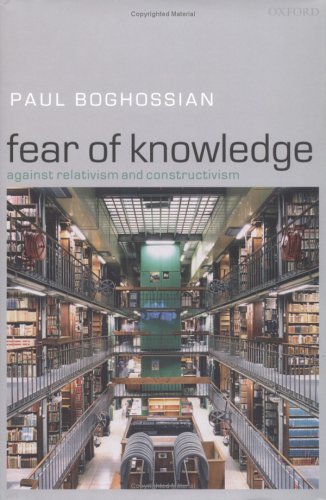
Relativist and constructivist conceptions of truth and knowledge have become orthodoxy in vast stretches of the academic world in recent times. In his long-awaited first book, Paul Boghossian critically examines such views and exposes their fundamental flaws.
Boghossian focuses on three different ways of reading the claim that knowledge is socially constructed--one as a thesis about truth and two about justification. And he rejects all three. The intuitive, common-sense view is that there is a way the world is that is independent of human opinion; and that we are capable of arriving at beliefs about how it is that are objectively reasonable, binding on anyone capable of appreciating the relevant evidence regardless of their social or cultural perspective. Difficult as these notions may be, it is a mistake to think that philosophy has uncovered powerful reasons for rejecting them.
This short, lucid, witty book shows that philosophy provides rock-solid support for common sense against the relativists. It will prove provocative reading throughout the discipline and beyond.
Paul Artin Boghossian is Silver Professor of Philosophy at New York University. He was the chair of the department from 1994 to 2004 and, as of 2022, is the current chair as well.
He is also director of the New York Institute of Philosophy and Distinguished Research Professor of Philosophy at the University of Birmingham.
Dr. Boghossian received his PhD from Princeton University in 1987. His research interests include epistemology, the philosophy of mind, and the philosophy of language.
Oltre ad essere laureato in filosofia, Paul Boghossian è laureato anche in fisica, e si vede - se non altro dal rigore dell’esposizione. Più che commentare (andrei certamente ultra crepidam), evidenzierei * un passaggio dalla prefazione che inquadra bene il tenore del libro: “Dal momento che le questioni affrontate (…) suscitano interesse ormai presso un vasto pubblico, ho cercato di rendere questo libro accessibile a chiunque abbia a cuore l’argomentazione rigorosa. Non so quanto ci sia riuscito, ma so che avevo completamente sottovalutato la difficoltà del compito”. e * un passaggio dall’epilogo che secondo me fornisce il messaggio più rilevante: “(…) le idee costruttiviste sulla conoscenza sono strettamente connesse ai movimenti progressisti come il postcolonialismo e il multiculturalismo perché forniscono loro i mezzi filosofici con cui difendere le culture oppresse dall’accusa di avere idee false o ingiustificate. Ma (…) se il potente non può criticare l’oppresso, perché le categorie epistemologiche fondamentali sono inesorabilmente connesse alle rispettive prospettive, ne segue anche che l’oppresso non può criticare il potente. Il solo rimedio (…) è accettare apertamente il doppio standard: è concesso criticare un’idea discutibile se è sostenuta da coloro che si trovano in una posizione di potere – il creazionismo cristiano, per esempio – ma non se è sostenuta da coloro che sono oppressi dai potenti – come il creazionismo degli Zuni, per esempio.”.
Esattamente ciò che (troppo) spesso avviene. Al che consegue, a ben vedere, che nei fatti il relativismo riconduce (e riduce) il mondo a rapporti di forza (anche se a volte paradossalmente invertiti).
Fear of Knowledge è un eccellente libro per comprendere il senso e i limiti del costruttivismo e del relativismo. È scritto con uno stile piano e chiaro, inusuale per la filosofia in generale ma fortunatamente tipico di molti analitici contemporanei (Williamson, per esempio). In pratica si può definire una confutazione completa e definitiva del relativismo epistemologico, posto che si accetti il terreno comune della logica classica. Posto che.