

What do you think?
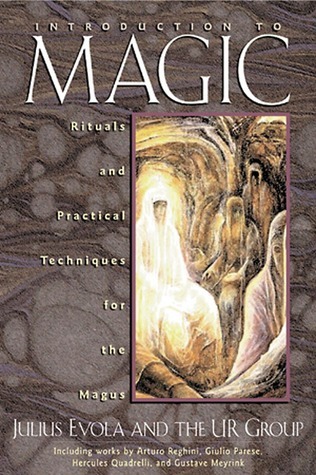
Introduzione alla magia #1
Introduction to Magic: Rituals and Practical Techniques for the Magus
The rites, practices, and texts collected by the mysterious UR group for the use of aspiring mages. • Rare Hermetic texts published in English for the first time.
• Includes instructions for developing psychic and magical powers.
In 1927 Julius Evola and other leading Italian intellectuals formed the mysterious UR group. Their goal: to bring their individual egos into a state of superhuman power and awareness in which they could act "magically" on the world. Their methods: the practice of ancient Tantric and Buddhist rituals and the study of rare Hermetic texts. So successful were they that rumors spread throughout Italy of the group's power, and Mussolini himself became quite fearful of them. Now for the first time in English Introduction to Magic collects the rites, practices, and knowledge of the UR group for the use of aspiring mages.
Included in Introduction to Magic are instructions for creating an etheric double, speaking words of power, using fragrances, interacting with entities, and creating a "magical chain." Among the arcane texts translated are the Tibetan teachings of the Thunderbolt Diamond Path, the Mithraic mystery cult's "Grand Papyrus of Paris," and the Greco-Egyptian magical text De Mysteriis. Anyone who has exhausted the possibilities of the mundane world and is ready to take the steps necessary to purify the soul in the light of knowledge and the fire of dedication will find a number of expert mentors here.
• Includes instructions for developing psychic and magical powers.
In 1927 Julius Evola and other leading Italian intellectuals formed the mysterious UR group. Their goal: to bring their individual egos into a state of superhuman power and awareness in which they could act "magically" on the world. Their methods: the practice of ancient Tantric and Buddhist rituals and the study of rare Hermetic texts. So successful were they that rumors spread throughout Italy of the group's power, and Mussolini himself became quite fearful of them. Now for the first time in English Introduction to Magic collects the rites, practices, and knowledge of the UR group for the use of aspiring mages.
Included in Introduction to Magic are instructions for creating an etheric double, speaking words of power, using fragrances, interacting with entities, and creating a "magical chain." Among the arcane texts translated are the Tibetan teachings of the Thunderbolt Diamond Path, the Mithraic mystery cult's "Grand Papyrus of Paris," and the Greco-Egyptian magical text De Mysteriis. Anyone who has exhausted the possibilities of the mundane world and is ready to take the steps necessary to purify the soul in the light of knowledge and the fire of dedication will find a number of expert mentors here.
416 pages, Paperback
First published August 1, 1955
About the author
Julius Evola
207 books1,113 followersJulius Evola, born Giulio Cesare Andrea Evola, was an Italian philosopher and esoteric scholar. Born in Rome to a Sicilian family (often claimed to be landed gentry, giving Julius the title of Baron, though his birth certificate lists his father's occupation as "Mechanic," while his mother worked for the post office), Evola was raised a strict Roman Catholic. Despite this, his life was characterised by 'an anti-bourgeois approach' hostile to both 'the dominant tradition of the West—Christianity and Catholicism—and to contemporary civilization—the 'modern world' of democracy and materialism'.
By turns 'engineering student, artillery officer, Dadaist poet and painter, journalist, alpinist, scholar, linguist, Orientalist, and political commentator', he has been described as a 'rare example of universality in an age of specialization'. Yet behind it all lay a singular emphasis on, and pursuit of, a 'direct relationship to the Absolute'. For Evola, 'the center of all things was not man, but rather the Transcendent.' This metaphysical conviction can be seen to have determined both Evola's stance on socio-political issues, and his antipathetic attitude towards 'all professional, sentimental and family routines'.
The author of many books on esoteric, political and religious topics, his best-known work remains Revolt Against the Modern World, a trenchant critique of modern civilisation that has been described as 'the gateway to his thought'. Since his death, also in Rome, his writings have influenced right-wing, reactionary and conservative political thought not only in his native Italy, but throughout continental Europe and, increasingly, the English-speaking world. Nevertheless, he should not be considered primarily as a political thinker, but rather as an exponent of the wider Traditionalist School that encompasses the work of such individuals as René Guénon, Titus Burckhardt and Frithjof Schuon.
By turns 'engineering student, artillery officer, Dadaist poet and painter, journalist, alpinist, scholar, linguist, Orientalist, and political commentator', he has been described as a 'rare example of universality in an age of specialization'. Yet behind it all lay a singular emphasis on, and pursuit of, a 'direct relationship to the Absolute'. For Evola, 'the center of all things was not man, but rather the Transcendent.' This metaphysical conviction can be seen to have determined both Evola's stance on socio-political issues, and his antipathetic attitude towards 'all professional, sentimental and family routines'.
The author of many books on esoteric, political and religious topics, his best-known work remains Revolt Against the Modern World, a trenchant critique of modern civilisation that has been described as 'the gateway to his thought'. Since his death, also in Rome, his writings have influenced right-wing, reactionary and conservative political thought not only in his native Italy, but throughout continental Europe and, increasingly, the English-speaking world. Nevertheless, he should not be considered primarily as a political thinker, but rather as an exponent of the wider Traditionalist School that encompasses the work of such individuals as René Guénon, Titus Burckhardt and Frithjof Schuon.
Ratings & Reviews
Friends & Following
Create a free account to discover what your friends think of this book!
Community Reviews
Displaying 1 - 1 of 1 review
July 22, 2021
Non do quasi mai le 5 stelle proprio per riservarle a libri che mi colpiscano e mi facciano vibrare come questo.
Emozionante, istruttivo; una parola...magico. Ho finito di leggerlo ma di fatto è qualcosa che terrò sempre sul comodino; come guida, verrebbe da dire come abbecedario.
Sono infinite le riflessioni che impone la sua lettura che possono sfociare in un viaggio stupendo dentro se stessi.
Lo consiglio? No. Questi sono libri che si devono sentire e non possono essere presi in mano su sollecitazione di terzi.
Quanto sarà il momento, lo saprai. Sarà lui a venirti a cercare.
Emozionante, istruttivo; una parola...magico. Ho finito di leggerlo ma di fatto è qualcosa che terrò sempre sul comodino; come guida, verrebbe da dire come abbecedario.
Sono infinite le riflessioni che impone la sua lettura che possono sfociare in un viaggio stupendo dentro se stessi.
Lo consiglio? No. Questi sono libri che si devono sentire e non possono essere presi in mano su sollecitazione di terzi.
Quanto sarà il momento, lo saprai. Sarà lui a venirti a cercare.
Displaying 1 - 1 of 1 review