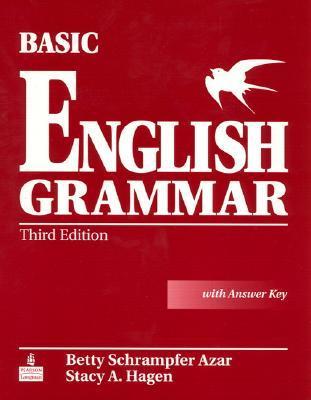
Blending communicative and interactive approaches with tried-and-true grammar teaching, "Basic English Grammar, " Third Edition, by Betty Schrampfer Azar and Stacy A. Hagen, offers concise, accurate, level-appropriate grammar information with an abundance of exercises, contexts, and classroom activities. New features of "Basic English Grammar," Third Edition: Increased speaking practice through interactive pair and group work. New structure-focused listening exercises. More activities that provide real communication opportunities. Added illustrations to help students learn vocabulary, understand contexts, and engage in communicative language tasks. New Workbook solely devoted to self-study exercises. New Audio CDs and listening script in the back of the Student Book.
Student Book is available with or without Answer Key. Student Book and Workbook are available in split versions.
اگه سطح مبتدی هستین و دنبال درسنامههای کمحجم و تمرین و تکرار زیادین، این سری میتونه انتظاراتتون رو برآورده کنه. اما اگه درسنامههای مفصلتر و تمارین کمتر میخواین، سری گرمر این یوس* میتونه مفید واقع شه.
In my experience of teaching English here in Korea, I come from the teaching philosophy that is based more on the communicative approach. Grammar is important and a strong foundation can make communication much easier. However, a big issue here in Korea is that most of English education is based off of the grammar-translation method which leads to many students not being able use the English language to communicate and produce English sentences based on Korean grammar. This preamble should help frame my review of this book.
As for this book, there is a lot of information that explains simple basic grammar patterns and some aspects of pronunciation (-s, -es, -ed). Information was organized into charts that made the information easier to follow. There were quite a few “Aha!” moments as I discovered an easy way to explain certain grammar points. I have been able to apply some of the knowledge to my classroom.
However, most of the exercises in the book consisted of fill in the blank activities that focused mostly on the form. Teaching in a country where English is treated as a multiple choice test, I tend to view these types of activities as a hindrance instead of a foundation. There were some speaking activities in the book, but a lot of them seemed to be teacher centered and a verbal form of drilling.
Using this book to teach beginning adults only in English will probably be overwhelming. Young learners who already have a foundation in the English language will probably find this book helpful in reviewing English grammar through the English way of thinking.
Mission 2026: Binge reviewing all previous Reads, I was too slothful to review back when I read them.
Reading Betty Schrampfer Azar’s 'Basic English Grammar' in 2023 was one of the strangest experiences on my reading list, not because the book is obscure or difficult, but because it occupies a category we rarely treat as literature at all.
This is not a book one usually 'reads' in the conventional sense. It is consulted, drilled, underlined, and answered. And yet, spending sustained time with it revealed something quietly profound: grammar books are ideological documents disguised as neutral tools.
Azar’s grammar is famously clear, methodical, and pedagogically conservative. It assumes a learner who wants structure, certainty, and rules that behave consistently. Each chapter introduces a grammatical concept, explains it with minimal theory, and reinforces it through exercises that progress from mechanical to contextual. The presence of an answer key reinforces the book’s worldview: there are right answers, and mastery is measurable.
What struck me first was the book’s tone. It is calm, patient, and almost reassuring. There is no irony, no flourish, no intellectual vanity. Azar writes as someone who believes deeply in clarity as kindness. For learners navigating a foreign language, this tone matters. It reduces anxiety, builds confidence, and creates the illusion—sometimes necessary—that language is a solvable system.
But that illusion is also the book’s most interesting limitation. English, as lived, is chaotic, idiomatic, and full of exceptions shaped by history, power, and context. 'Basic English Grammar' presents a cleaned, standardised version of the language, one that prioritises correctness over expression. This is not a flaw so much as a choice, but it is a revealing one.
Reading this book alongside philosophy, political theory, and literature made me more aware of how grammar functions as gatekeeping. Mastery of standardised English opens doors — academic, professional, and social. Failure to master it often results in exclusion. Azar’s book does not acknowledge this politics, but it participates in it by defining what counts as 'proper' English.
The examples used throughout the book are deliberately bland. Everyday activities, polite interactions, neutral settings. There is little conflict, no cultural friction, and no emotional intensity. This neutrality serves pedagogical clarity, but it also drains language of texture. English becomes a tool rather than a living medium of power, persuasion, and identity.
Yet there is something admirable in this restraint. Azar resists the temptation to overcomplicate. She does not drown the learner in linguistic theory or exceptions. Instead, she builds a scaffold sturdy enough to support basic communication. In a world obsessed with complexity, there is value in such disciplined simplicity.
The answer key itself is an interesting artefact. It embodies a particular philosophy of learning: autonomy through verification. The learner is encouraged to attempt, err, and self-correct. This reinforces grammar as a skill rather than a performance. In contrast to social media’s performative fluency, this quiet, solitary engagement feels almost old-fashioned.
What surprised me was how meditative the book became when read slowly. Working through exercises requires attention, patience, and humility. You confront your assumptions about language and discover how much of what you 'know' is intuitive rather than explicit. Grammar exposes the skeleton beneath fluency.
In the context of my 2023 reading, this book functioned as a kind of reset. After wrestling with Nietzsche, Juvenal, and political theory, Azar’s grammar reminded me that thought itself depends on structure. Before argument comes syntax. Before critique comes clarity. This does not mean grammar determines thought, but it shapes how thought travels.
The book is not without blind spots. It privileges a particular variety of English, largely American and standardised. Dialects, sociolects, and creative deviations are absent. This absence reinforces the idea that correctness is singular rather than plural. For learners whose lived English diverges from this norm, the book can feel alienating.
Still, judging the book by what it does not attempt would be unfair. 'Basic English Grammar' succeeds precisely because it knows its role. It is not a manifesto or a cultural critique. It is a tool, refined through decades of classroom use, shaped by feedback rather than theory.
What lingered after reading was a renewed respect for pedagogical writing. To explain something simple without distorting it is difficult. To do so across cultures and levels of proficiency is harder still. Azar’s achievement lies in her refusal to condescend or mystify.
In a reading year dominated by grand narratives, ideological battles, and historical catastrophes, this modest book offered a reminder: before we argue about the world, we must learn how to describe it. Grammar may not be glamorous, but it is foundational.
'Basic English Grammar' will never be reread for pleasure, but it deserves recognition as a quietly influential text — one that has shaped how millions encounter English for the first time. Its power is subtle, procedural, and enduring.
حوصله م نکشید که کامل بخونمش ولی کتاب خوبی بود. یعنی در واقع کاری که می خواست انجام بده رو خوب انجام میداد. یه بخش قابل توجهی از کتاب (حدود 95 درصدش و بلکه بیشتر) تمرین و تکراره