Jump to ratings and reviews
Rate this book

Autobiographical Notes

Rate this book
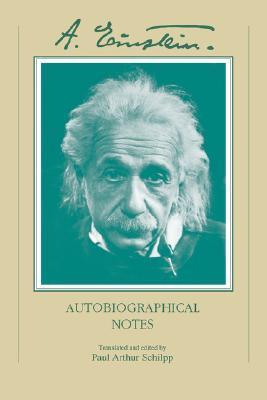
Delivered with warmth, clarity, and humor, this brief work is the closest Einstein ever came to writing an autobiography. Although a very personal account, it is concerned solely with the development of his ideas, saying little about his private life or about the world-shaking events through which he lived. Includes parallel German and English texts.

95 pages, Paperback

First published January 1, 1979

Loading...
Loading...

About the author

Albert Einstein

1,032 books9,746 followers
Special and general theories of relativity of German-born American theoretical physicist Albert Einstein revolutionized modern thought on the nature of space and time and formed a base for the exploitation of atomic energy; he won a Nobel Prize of 1921 for his explanation of the photoelectric effect.

His paper of 1905 formed the basis of electronics. His first paper, also published in 1905, changed the world.
He completed his Philosophiae Doctor at the University of Zurich before 1909.

Einstein, a pacifist during World War I, stayed a firm proponent of social justice and responsibility.

Einstein thought that Newtonion mechanics no longer enough reconciled the laws of classical mechanics with those of the electromagnetic field. This thought led to the development. He recognized, however, that he ably also extended the principle to gravitational fields and with his subsequent theory of gravitation in 1916 published a paper. He continued to deal with problems of statistical mechanics and quantum theory, which led to his explanations of particle theory and the motion of molecules. He also investigated the thermal properties of light, which laid the foundation of the photon.

Best known for his mass–energy equivalence formula E = mc2, dubbed "the world's most famous equation," he received "for his services to theoretical physics, and especially for his discovery of the law of the photoelectric effect". The latter was pivotal in establishing quantum theory.

He visited the United States when Adolf Hitler came to power in 1933 and went not back to Germany. On the eve of World War II, he endorsed a letter, alerting Franklin Delano Roosevelt, president, to the potential development of "extremely powerful bombs of a new type" and recommending that the United States begin similar research. This recommendation eventually led to the Manhattan project. Einstein supported defending the Allied forces but largely denounced the idea of using the newly discovered nuclear fission as a weapon. Later, with Bertrand Russell–Einstein manifesto highlighted the danger of nuclear weapons.

After the rise of the Nazi party, Einstein made Princeton his permanent home as a citizen of United States in 1940. He chaired the emergency committee of atomic scientists, which organized to alert the public to the dangers of warfare.

At a symposium, he advised:
"In their struggle for the ethical good, teachers of religion must have the stature to give up the doctrine of a personal God, that is, give up that source of fear and hope which in the past placed such vast power in the hands of priests. In their labors they will have to avail themselves of those forces which are capable of cultivating the Good, the True, and the Beautiful in humanity itself. This is, to be sure a more difficult but an incomparably more worthy task... "

("Science, Philosophy and Religion, A Symposium," published by the Conference on Science, Philosophy and Religion in their Relation to the Democratic Way of Life, Inc., New York, 1941).

In a letter to philosopher Eric Gutkind, dated 3 January 1954, Einstein stated:
"The word god is for me nothing more than the expression and product of human weaknesses, the Bible a collection of honorable, but still primitive legends which are nevertheless pretty childish. No interpretation no matter how subtle can (for me) change this."


(The Guardian, "Childish superstition: Einstein's letter makes view of religion relatively clear," by James Randerson, May 13, 2008)

Great intellectual achievements and originality made the word "Einstein" synonymous with genius.

The institute for advanced study in Princeton, New Jersey, affiliated Einstein until his death in 1955.

More: http://en.wikipedia.org/wiki/Albert_E...

http://www.nobelprize.org/nobe

Ratings & Reviews

What do you think?
Rate this book

Friends & Following

Create a free account to discover what your friends think of this book!

Community Reviews

5 stars
47 (42%)
4 stars
27 (24%)
3 stars
23 (20%)
2 stars
10 (9%)
1 star
4 (3%)
Displaying 1 - 3 of 3 reviews
Profile Image for Carlos Hurtado.
19 reviews1 follower
November 13, 2018
El libro es un conjunto de profundas reflexiones fisicas de una de las mentes
mas brillantes que ha producido la humanidad.
Es un libro para leerlo una y otra vez, en diferentes epocas de maduracion y compresion cientifica. Einstein reflexiona sobre 4 temas principales. La mecanica de Newton, la teoria especial de la relatividad, teoria general de la relatividad, mecanica cuantica y termina mostrando
lo que el cree es el camino mas factible para una generalizacion de todo lo anterior. Para comprender sus reflexiones se necesita obviamente un nivel avanzado de fisica y matematicas. No es un libro de divulgacion, por tanto no esta recomendado para gente sin conocimiento previo de los temas que discute.
Profile Image for Lisandro Casanova.
28 reviews19 followers
September 26, 2022
Es hermoso y revelador leer directamente sus palabras pero para los simples mortales hay momentos en los que el libro se pone muy complicado.
Displaying 1 - 3 of 3 reviews

Join the discussion