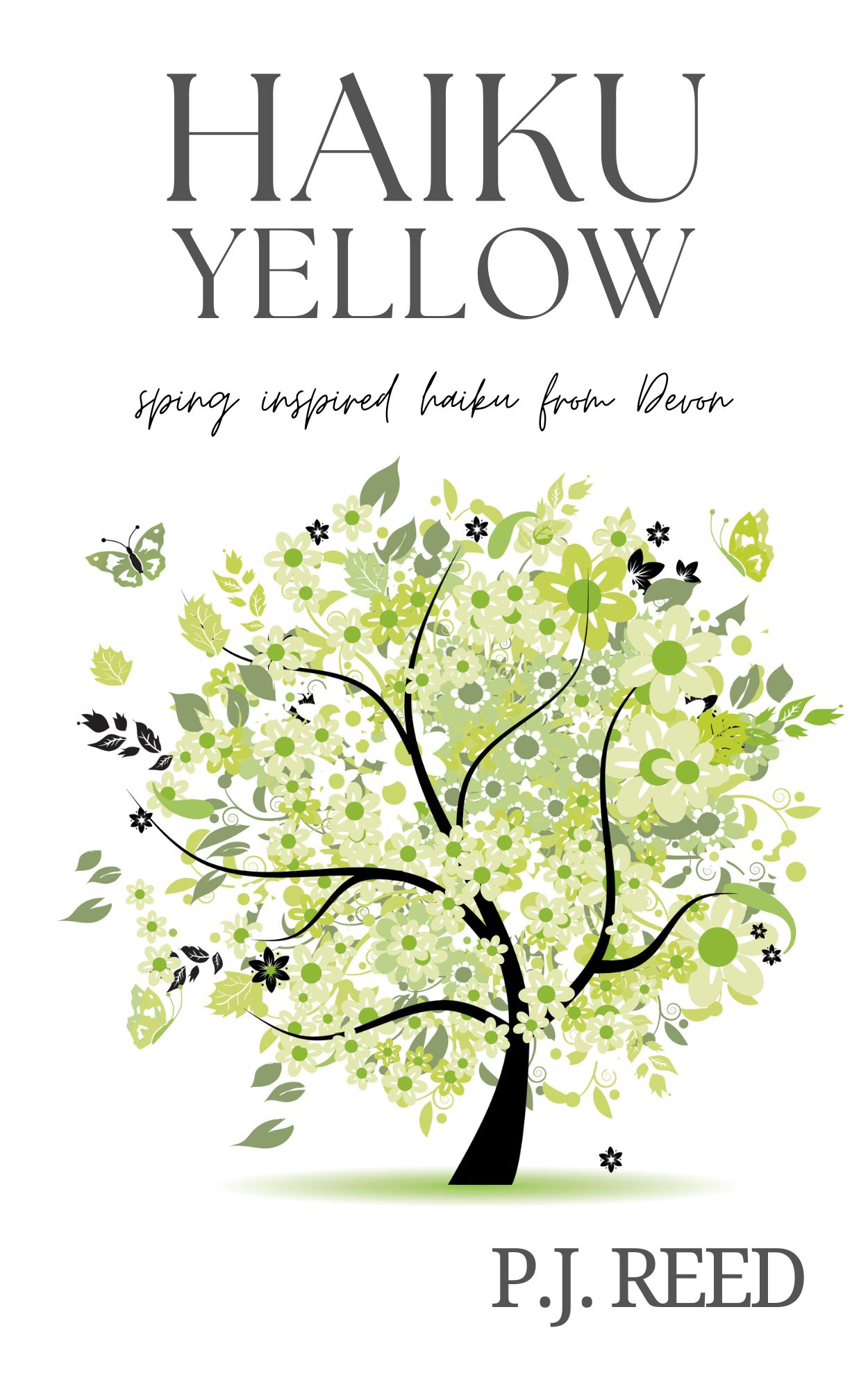
Haiku Yellow is a breathtaking collection of stunning images captured and written in haiku verse from the contemporary English poet P.J. Reed. This collection explores the excitement and drama as the yellow of springtime bursts through the bleakness of winter throughout the Devon countryside in a series of dramatic moments captured forever in her fresh, crisp verse. The world in springtime is a joyful place full of possibilities and hope. P.J. Reed has looked into the beauty of a world reborn and clothed in yellow springtime glory. This study has resulted in a series of outstanding word pictures, thoughts and emotions written in haiku by P.J. Reed.
P.J. Reed - writer of warlocks and other magical creatures. She also writes under the penname of Pami Reed.
P.J. Reed is a writer and poet from England. She holds a BAEd from Canterbury Christ Church University, an MA from Bradford University and has dabbled in psychology with the OU. She is an outrageously eclectic writer. Her work has appeared in a wide variety of online and print magazines, books, collections, and podcasts. In 2015, she was shortlisted for the National Poetry Anthology award. In 2018, P.J. won the Forward Press Poetry 'Circle of Life' competition for her poem 'The Empty Chair.' While in 2024, P.J. had the honour of being asked to write a poem as part of the UNESCO cities of Literature, 'Illustrating The World' literary exhibition. In 2026, P.J. had the great honour of being accepted onto the Haiku Register.
I must confess the modern day vogue for writing haiku as a form of micropoetry extremely annoys me intensely. You don't write a sonnet with x lines containing x number of syllables you want just because you can't write thirteenth century Italian, so just because very few people write in seventeenth century Japanese it doesn't mean you can throw the rule book out the window and do any tiny bit of prose and label it haiku. . Obviously, haiku cannot be written as one vertical line of 17 'ons' or Japanese sound units. To counteract this issue Western Haiku has its own set of rules and if you don't follow them I am not classing said work as haiku. That being said I am open to reviewing haiku books but it's a brave person that sends me their work.
I was sent a copy of Haiku Yellow to review, which arrived all the way from Devon, which makes it stand out from the more city-centric poetry books I normally receive. I have read P.J. Reed before and I must confess I agree with her writing attitude. Haiku Yellow is her interpretation of the excitement of Spring as the landscape explodes into colour. For Reed, the colour of spring is vibrant yellow and brings in a rush of new life, hope and wonder.
This collection is full of fascinating microscopic observations of nature undergoing its seasonal wardrobe change. Often there is humour sometimes sorrow but I find her work original and stimulating. Some of my favourite haiku in this book are the conjoining of humour and nature such as
a blackbird listens paused in her twig collection woodpecker knocks twice
and
a frowning sky smiled people burst from houses tails wagging in the sun
I also found some of the haiku to be thought provoking, almost philosophical in their content
empty mountain winds scatter thoughts of solitude still the raven calls
and
grass bound we wander through dreams of thundering waves the land gull and I
There is also a haunting sadness to some of her haiku which adds an extra depth to her work with such pieces as
left leaves cry and cling to barren swaying branches wind whispers be free
and
melancholia silent sorrow hides in joy as emotions fade
This book is crammed full of haiku treasure. I would thoroughly recommend this book to lovers of thoughtful, sometimes witty and always beautiful, vibrant haiku poetry.
Haiku Yellow by P.J. Reed is available from Amazon and to order from all good bookstores.
Disclaimer: I requested and received this book from book sirens. MyOpinions are my own.
"Haiku Yellow" is the first of P.J. Reed's work I have read and I enjoyed it. I love poetry both reading and writing it. I struggle with restrictive forms of poetry , but this book has inspired me to try to do it more often.
When it comes to rigid forms of poetry you must choose your words wisely, at this Reed excels. She paints such vivid pictures of spring moments. It made me feel like I was experiencing Spring instead of the Autumn I am actually actually living . My favorite poems of the collection are "18th April", "3 May", "17 May", and "21 June". Aside from the Poetry itself I greatly appreciate the "forward", "how to write haiku", "a brief history of haiku" sections, and the "glossary". I learned a lot from this book and I recommend picking it up yourself. I'm excited to read more of Reed's Haiku collections. I wonder what the winter collection will be like.
this was so sweet and made me excited for the spring thaw :) I have recently really began to love haiku! Reed’s poems have a really nice flow while being descriptive. Some are a little repetitive, but it is about spring. I enjoyed the notes about writing haiku at the end, and laughed at this except, “I have often been asked by the few passersby what I was doing, as I stood and memorized the mechanics of a droplet of water falling from a leaf. In these occasions it is always better to reply that you are writing haiku and not in fact watching a leaf.”
I love to read poetry, however it's rare that I come across a book full of beautiful haiku. I also love the idea of using each day in Spring, you could read each one on the day for inspiration. The April and May haiku really stood out to me, most of my favorites were in those two months. I wish there were illustrations to go with some of them, they really conjure up beautiful visuals. I can't wait to read all of the other seasons.
*Provided a DRC (digital review copy) from the publisher for review. All opinions are my own.
This is a lovely little book. The haiku are short (of course) and sweet, with an amazing depth - you need to read and re-read them and, having done that, read them all yet again. They conjure up such vivid images of nature and they bring a smile to your face as you relate to those images - “oh, yes”, you say, “that was how I remember it” and/or “that was my experience, too”. I’m going to go back to the start of the book and thoroughly enjoy them all again.
I received an advance review copy for free, and I am leaving this review voluntarily.