Did you know the melting point of gallium is so low that it will melt in your hand because of your body heat? Or that four new man-made elements were officially named as recently as 2016?
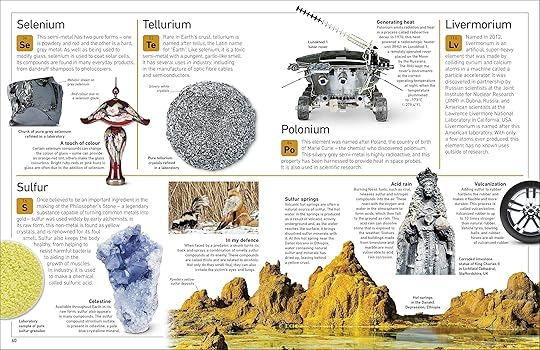
Packed with striking new photography, DK Eyewitness The Elements walks you through all 118 elements in the periodic table. From the history of when the periodic table was first created to the scientific classification of the elements into groups, DK Eyewitness The Elements is an exhaustive guide to everything elemental.
The book details what elements are and explains what lies at the core of each one of them. It then delves into the origin of every element (both naturally occurring and synthetic), where they are found, and how they are used. Explore elements such as carbon and oxygen and learn why they are essential to our survival. See how precious gold protects astronauts in space, and why the metal mercury can be both a solid and a liquid.
Filled with clear, easy to understand facts, DK Eyewitness The Elements is an essential addition to every budding scientist's bookshelf. Also included is a pull-out poster for easy reference, perfect for the bedroom or classroom.
In preparation for reading Primo Levi’s memoir, The Periodic Table, and because of its seductive and, well, elemental, quality, I picked this 2018 book as my second foray into the lusciously-illustrated DK Eyewitness series. This worthwhile book is aimed at young adults, older children, and, really, anyone who wants a short introduction. It explains succinctly what an element is, the history and logical organization of the periodic table, and then devotes most of the book to brief, fascinating illustrated summaries of each element, its natural (or induced) occurrence and some of its practical uses (if any). A great teaching resource.
The green color of the Northern Lights results when particles from the Sun collide with the element Oxygen in Earth’s upper atmosphere. The blue and violet colors are the result of the Sun’s particles colliding with the element Nitrogen. These plentiful elements are among the most critical to Life on Earth.
Who knew that exploring the periodic table of the elements could be such a surprising delight?
Appropriately enough, the element Europium is mixed with the ink used to print Euro bank notes. It glows red under ultraviolet light.
So many seemingly obscure elements have some unique purpose in industry, agriculture, and even medicine. On the other hand, halfway through the book I was stopped cold in horror by the image of a mushroom cloud on two pages devoted to uranium and plutonium, which made the bombs dropped on Hiroshima and Nagasaki. But, in contrast, most of the illustrations and examples are of great beauty and beneficial use. (That being said, I’m aware that mining them is not necessarily a pretty picture.)
Gas tubes filled with the element Neon (a “noble,” that is, unreactive, gas) are used in red signs and lights. The other colors are produced by other elements: Argon (purple), Mercury (blue) and Helium (yellow or purple). (Tiger image from Let There Be Neon.)
A tiger seems a most appropriate image for many of the elements, powerful and rare, dangerous and beautiful.
Nice, easy-to-follow book in the usual DK Eyewitness style, but only a third the size of their more impressive The Elements Book: A Visual Encyclopedia of the Periodic Table, (which I have just started because my own copy* finally arrived - woo-hoo!!).
Fascinating subject matter aside, I got an additional kick out of this books layout, as it kept reminding me of an old high school yearbook (since I have no idea what a new high school yearbook looks like or if they even still have them) - you could see that they were trying to say something nice about everybody, but it was still easy to tell who the popular kids were ("go Sulfur!") and who were, well...not (sorry, Livermorium, who has "no known uses outside of research" - ouch).
Stuff I wrote down: 4 elements on the Periodic Table named for Swedish village called Ytterby: terbium, erbium, yttrium, ytterbium; catalytic converter converts carbon monoxide, hydrocarbons, and nitrogen oxides to carbon dioxide and water; uranium-based bomb = Hiroshima = Little Boy; plutonium-based bomb = Nagasaki = Fat Man; Enrico Fermi created first nuclear reactor; "Ivy Mike" = 1952 = first hydrogen bomb blown up in Pacific; LED = light-emitting diodes; chalcogens = oxygen group; halogens = fluorine group; sublimation is a solid changing directly to a gas; PVC = polyvinylchloride; DDT = dichloro-diphenyl-trichloroethane; galvanization = the process of covering steel with zinc to prevent corrosion
I am totally not above grabbing books in the children's section to learn something.. you get all the facts in laymen's terms. This is a fun fact filled book, and I learned a lot of surprising things about various elements that I did not know before!
I reviewed this book as a classroom resource. Although probably geared for elem/middle school, it is actually visually appealing to older students as well.