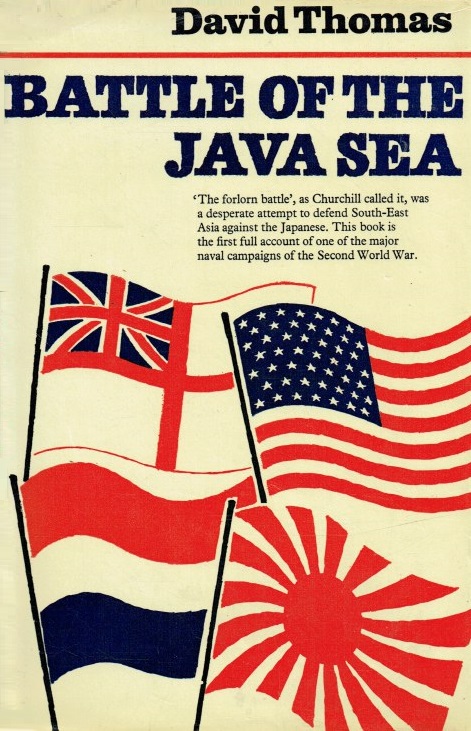
This is the first full account of what Winston Churchill called "the forlorn battle," the attempt by a desperately small fleet of British, Australian, American and Dutch ships to stem the Japanese advance into Southeast Asia in the days immediately following Pearl Harbor.
The battle was forlorn because the Allies were outnumbered, outclassed, and outfought. Against a navy that was revealing itself as one of the best in the world, they had only a handful of cruisers and destroyers. The great capital ships that were intended to defend Singapore, Prince of Wales and Repulse, were among the first victims, sunk by aircraft in the Gulf of Siam, sacrificed by commanders who still believed the battleship could survive under air attack.
Mr. Thomas has reconstructed an hour-by-hour record of those grim days, days during which the Allied ships battled against confusion, muddle, misinformation, and plain bad luck, and one by one went to the bottom. His lucid analysis of these events is an important contribution to the history of the Second World War.
Librarian Note: There is more than one author in the Goodreads database with this name. Please see:David A. Thomas
David Arthur Thomas is the former director of technology at the National Archives, where he was responsible for systems, the online catalogue, the website and the preservation of digital records. He has a long-standing interest in crime, imprisonment, and poverty, and has written extensively on these topics for family history magazines.
Immediately following the attack at Pearl Harbor, Japanese forces began extending their empire into South Asia, capturing American, British, and Dutch colonial possessions as they swept south. They were confident and had every reason to expect continued success. The American fleet was still recovering from Pearl Harbor and could only muster their small Asiatic fleet of outdated ships. The British fleet was spread thin around the world and would only release token forces from the "home waters" of the Atlantic to the Pacific Theater. The Dutch fleet was small and would constitute the bulk of this small Allied force. These Allied fleets faced a large, modern, and determined navy which outclassed them in every aspect of the battle. The result, an overwhelming Japanese victory early in World War II.
The Battle of the Java Sea is a good book. It describes the naval operations in and around the Java Sea from December 1941 to March 1942. It did an excellent job of discussing the political background of the early Pacific War. The tactical details of the engagement were also well written and very detailed. The book begins with a prelude of events leading up to the opening of hostilities. Next, the disastrous sinking of the Prince of Wales and the Repulse, two modern British warships sunk by Japanese aircraft, is described. It continues as the Philippines and Singapore are lost. The formation of the Allied Combined Fleet and the difficulty of communications and logistics experienced by these new Allies is also discussed in great detail. Finally, the worthless sacrifice of men and ships in the closing days of the battle is described. I feel the term worthless is appropriate because most leaders must have known the battle would end in defeat. The Battle of the Java Sea would be avenged, but this book makes clear that the Allies were unprepared to defend their territory or work together in the early days of World War II.
There were several items previously unknown to me that I found interesting. I was struck by the heroism of the Royal Netherlands Navy. I do not know much about their actions in World War II and should learn more. I did not know that the Netherlands East Indies was HOME to many Dutchmen, including several Captains and Admirals who had been born and raised in these colonial possessions. Next, the author suggests that FDR may not have wanted an American to command the Allied fleet because he knew the battle would be lost. I don't know if this is true, but either way, it is interesting to think about. Finally, the sinking of the Prince of Wales and the Repulse ended the era of the battleship. The Allied and Axis powers thus learned in December 1941 that "Big Gun" Battleships were no match to attack from the air, yet it is amazing how long it took many leaders to acknowledge and accept this.
In general, I thought this book was good, but I would only recommend it to someone who has read extensively about the Pacific Theater of World War II and wants to learn more specifically about this battle.
La batalla del mar de Java no es sino el final del principio de la II GM en el Pacífico. En doce semanas los japoneses arrasaron con todo lo que encontraron a su paso y tomaron pleno dominio de las colonias europeas en el sureste asiático, llegando a atacar Darwin en el norte de Australia (recuerdo que hace unos años paseé por un parque que tiene una estupenda vista del mar en Darwin y fui leyendo las placas que tienen puestas a modo de pequeños monumentos recordando a los muertos y a los héroes de aquel ataque. Aquí todo el mundo recuerda su historia menos nosotros). Toda la campaña del mar de Java dura desde el ataque a Pearl Harbor hasta la propia batalla del mar de Java, en la que pierde la vida el contralmirante al mando de la flota, que navegaba en el buque insignia holandés, el crucero De Ruyter. Entre medias, doce semanas en las que cada enfrentamiento se saldaba con pérdidas para los aliados o con escapadas por los pelos del gran desastre. Salvo una, en la que cuatro destructores americanos pillaron a la flota de desembarco de noche y a contraluz contra los depósitos de combustible en llamas (política aliada de tierra quemada) y pudieron lanzarles unos cuantos torpedos y huir, hundiendo cuatro barcos. Básicamente, los japoneses tenían el dominio del aire y mejores armas que las que pudieron juntar los Aliados en pocas semanas. El autor recalca en un par de ocasiones la innecesaria crueldad de los japoneses al ametrallar náufragos o impedir a un buque hospital aliado que vaya a recoger supervivientes tras una victoria japonesa. Al autor parece a veces que le da morbo ("...en tan solo unas horas, estos dos intrépidos comandantes que compartían una agradable charla se hallarían en el fondo del mar junto a sus barcos."), pero en general es conciso y serio y describe muy bien las situaciones tácticas, aunque se echa de menos algún mapa de batalla por fases. En general una buena lectura, culturizante y hasta entretenida a pesar de ser un mal adjetivo para hablar de la II GM.
I read the dutch language version, which is a special version because a dutch naval historian (lcdr F. van Oosten) has added details which were missing in the original version. He also added remarks which, makes it an even more interesting read. David Thomas has written one of the best books of the 2nd largest sea battle of the modern era. Only the battle of Jutland had more war ships fighting each other. If you want to learn about the biggest sea battle of WW2 , this is your book.
A well written account describing the background leading up to the Japanese attacks in December 1941 and the subsequent actions and naval engagements leading up to the invasion of Java and the actual battle of the Java Sea. Well worth a read! :-)
This is an OK book. The writing is a bit dry and there are quite a few mistakes with basic facts but overall not a bad read. There are other books that cover the campaign and battle better.