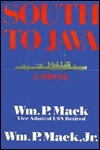
In writing this novel, William P. Mack wrote what he knew. He served as a junior officer on a destroyer at the beginning of World War II. He knew the mannerisms and attitudes of those that surrounded him, and he knew the operational characteristics of a US destroyer at sea. The overall result is one of convincing naval realism. In my mind, South to Java presently holds its place at the top of the naval warfare genre sitting alongside another great book of the class, The Cruel Sea by Nicholas Monsarrat.
The place and setting of the book contribute to its intriguing content. At the beginning of WWII, our South Pacific forces were essentially echoes left over from the Spanish American War nearly forty years earlier and were only minimally upgraded during and after WWI. These relatively isolated forces were required to fight the full force of the expanding Japanese empire, and as a consequence, they were repeatedly defeated and pushed back to safer areas where they were required to hold the line as best they could. South to Java places a WWI-class destroyer and its men on the front line of this aggression.
My criticism of this book may be a consequence of it being Mack’s first novel, or it may be a consequence of a 37-year military career where interactions with peers must have always been somewhat guarded. Whatever the reason, the characters all exhibit a sort of inner stoic restraint that did not allow for their deeper thoughts on life and death during times of war to be explored or expressed. However, I do hold high hopes for Mack. By the end of this first novel, he started to breach this final barrier. It may be that Mack was finally starting to discover his sea legs as a writer.
When the authors stuck to what they knew--the Asiatic Fleet of yore and its old ships, this was an interesting narrative of a time and place in American history pretty much forgotten. It was kind of a continuation of "The Sand Pebbles" in that regard. I like details of how life and work were in the past, and now I know how anti-submarine warfare was conducted in those days, as well as surface actions, both night and day, anti-aircraft defense, the difficulties of maintaining an old steam powerplant.... But when the authors talked about the Army Air Force and it's P-40s and B-17s, it was clear that they had done no research and were just retailing mid- or early post-war gossip. The whole tale about the B-17s not getting off in time to wipe out the Japs because of MacArthur staff bungling is wrong, as decades of historical research before this novel was written testify. In any case, a handful of D-model B-17s flying blindly to attack Formosa without any target intelligence, even if they had sortied before the Japanese opened hostilities, would never have accomplished much. And when the authors have one of the navy protagonists, a junior officer, talk about Claire Chennault and the Flying Tigers having been fighting the Japanese before Pearl Harbor and warning the Army about how great was the Japanese Zero, I got really annoyed. Even the minimum of research would have told them that the Flying Tigers didn't engage the Japanese until weeks after Pearl Harbor. It would have further told them that the Flying Tigers fought the Japanese Army air force, which didn't use the Zero--which was used by the Japanese naval air force--but Nates and Oscars. I know that just from reading a bit of WW2 history--apparently more than the authors' bothered to do. Oh, and also denigrating the P-40 as a fighter plane and its pilots as incompetent boasters--not cool Monsoirs Mack, not cool. And wrong. In any case, how would a junior officer in the Asiatic fleet learned of communications between Chennault and the State Department (not the Army)? Oh, please. There were a couple of other instances of things like this that I noticed, and I'm sure someone more familiar with the history of those times would probably notice more.
A love of mine for some time has been the Southwest Pacific and the campaign fought there. I was first turned on to this area when I read The Fleet the Gods Forgot and The Ghost that Died at Sunda Straits. Merging this with a love of flush decks and four stacks (no, I don’t know what it is about these destroyers I love other than they did what they shouldn’t have) made getting this book a must. While the story itself is fictional (the ship and the crew), the scene being played against and the situations occurring are more real than might be believed. The Mack’s (Vice Admiral and his son) undoubtedly used Vice Admiral Mack’s experience aboard the USS John D. Ford (DD-228 of the Asiatic Fleet) for the ship’s situation and crewmembers of the USS O’Leary (a fictional ship). Mr. Mack’s use of his father’s experience and letting it flow through the novel and drive certain aspects of the story line really makes this the highlight of the story! My only negative aspect of the story honestly is the second rate romance story (yes, it may have happened, I don’t know. The telling of it though is something from a romance novel of that era though). It’s a nice side story and at times I was looking forward to see what happened but it’s addition didn’t make the book. Rating wise this one’s a very strong 4 star book because of the insight into flush deck destroyers and the men of the Asiatic Fleet. I loved the different crewmen and their view on their situations and their love of their ship; I’m certain this was Vice Admiral Mack’s opinion and view of his ship in a very trying situation that very few people are aware of. What really would have made this a 5 star book though is if Vice Admiral Mack would have written more as his personal feelings and thoughts of the situation and then let his son provide a little color.
Mack and Mack Jr. are no Herman Wouk or James Michener- however, they do serve up a solidly satisfying novel about the first days of World War II on the "Asiatic Station". I couldn't find much background information about Mack Sr., but it does seem like he used his own experiences as a destroyer officer (who participated in the same battles enumerated in the book) as the basis for the main protagonist and plot strands in the book. His anger at the incompetence Douglas McArthur and his staff are palpable. His reflections on the tragedy and horror of war are poignant.
Little remembered, the story of the ABDA (American, British, Dutch Australian) command, is one of courage in the face of a well trained, armed and motivated enemy with what little weapons, ships and planes could be brought to bear in the Dutch East Indies.
So it was quite a surprise to find a piece of naval fiction that not only centered on the plight of the sailors of the American Asiatic Fleet serving in ABDA, but authored by a man who had been there himself! Admiral Mack (Sr, his son co-authored the book) was assigned the the USS John. D Ford, Destroyer-Division 59, during the Java Sea Campaign, and he brings this experience aboard a "Four Piper" destroyer to good use in describing like aboard a vintage warship crewed by old salts, at times held together by sheer will more then rivets.
South to Java, follows the fictional USS O'Leary from the opening days of the war in the Pacific, bombs falling on Cavite Naval yard in the Philippines, her mad dash to the Dutch colonies to the South, and her time with the ABDAFLOAT in trying to hold off the Japanese Navy. The Mack's do a great job of bringing the ship to life with both her crew, angry CPOs, crazed snipes and eccentric officers in command, who sailed with the Asiatic Fleet in the early days of the war, alongside painting a picture of the state of the war in those early days.
South to Java is not without fault, it drags in some places, but it's a first hand account of combat aboard a U.S Destroyer in the Java Sea Campaign, if that's something you want to learn about straight from the scuttlebutt, then need i say more?
From a literature point of a view this is a three star book, but if you were/are in the Navy and especially if you were a WESTPAC sailor then the book is a five star. So a four star rating seemed just about right. Highly recommended for midshipmen or junior officers.