This book is part of the Time-Life Library of Art, and comes in a box. The library bin where I got this for pennies also has the volumes on Goya and Leonardo and some others, but I only took this one. It's excellent. The text is sober, jargon-free, informative, and the photos/prints well-chosen, not always the obvious ones, and well done, mostly in color. An all around good book, esp. for 2 bucks.
Delacroix is a far more important artist than I had realized, and it was Kenneth Clark, in his book on Romanticism, that first made me understand this. Prideaux only reenforces this view.
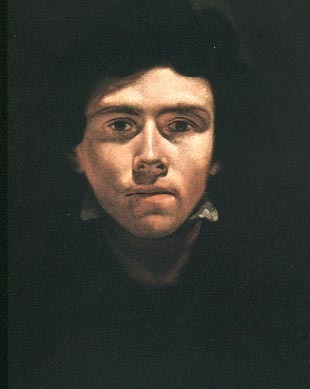
Here is Géricault's portrait of Delacroix, painted c. 1818, about the time that Géricault was doing the Raft of Medusa (for which Delacroix was one of the models):
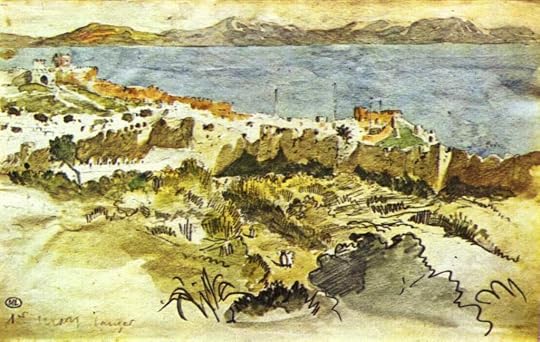
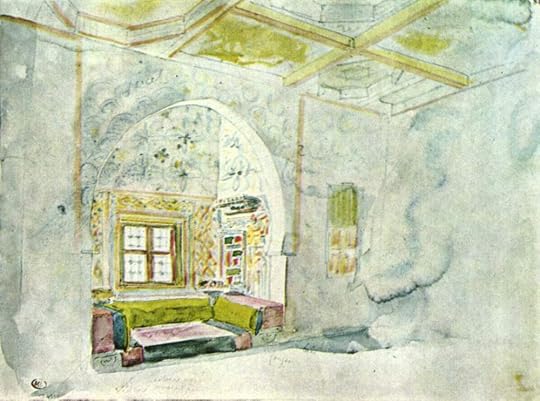
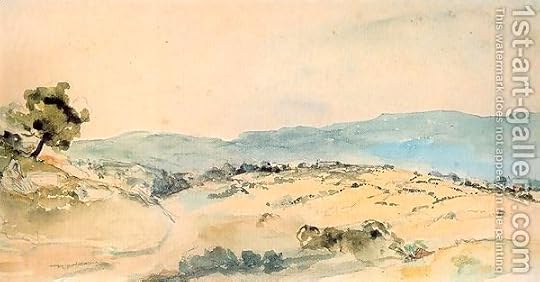
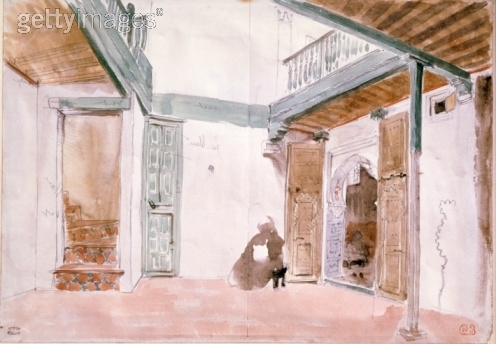
What really astonished me in this volume, however, were the Moroccan watercolors, done en plein air, in a sketch book.... look at these... and remember that this is 1832... I'm hardly an expert on art, but I can't think of anything quite like this that is earlier -- the freedom, the colors, the light palette..., the colors... (!)
I completely tanked my second semester in college: directionless, depressed, orphaned, bewildered by the systems of the world; absolutely unable to trust any adult or ask for help from anyone, I avoided all my classes, antagonized my professors, was disavowed by my assigned advisor, and failed everything but the art fundamentals class in which my professor gave me a gentleman's C because he really liked one sculpture I had done. So, my sophomore year, getting my act together a little bit, I was somewhat scrambling to catch up on credits so I could graduate on time. Towards the end of the year, in one of those strange moments of the world's generosity towards me, someone asked me, while I was working in the art building, whether I would be interested in going to a summer program in France? If they didn't find enough students, they would have to cancel that year, and they just needed a couple more people. I could go to France, do art there, and get credit enough to graduate in four years for a lot cheaper than another year of school would be. I said yes.
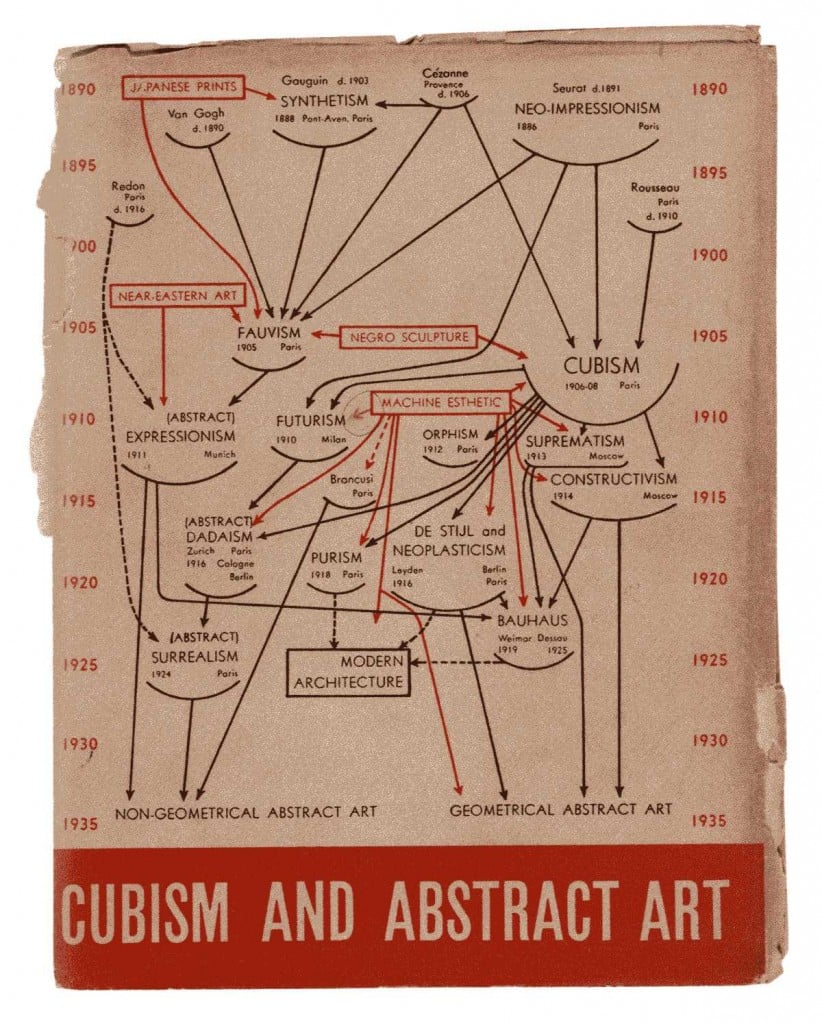
While I was there I got to know the peculiar stance of artists/art professors, who were (maybe this is still true but it's been 20 years) more or less postmodernist in their work but thoroughly modernist in their pedagogy -- they taught art exactly like the infamous Alfred Barr diagram, where the only respectable art is purely formal and increasingly abstract, that art history hinges entirely on the creation of Cubism. Since the school was in Cezanne's neighborhood (we painted Mont Sainte-Victoire and visited his studio in Aix) it was in some ways appropriate to overemphasize his approach and that of his disciples Braque and Picasso, but it was still puzzling to me, so I turned to the single bookshelf "art library", up the hill in a cool dark room, to try to understand.
I spent hours and hours in that room, alone, pulling down books and old copies of art magazines and flipping through them. (One of my professors, unforgettably, wandered by one day and asked, astounded, "John, are you reading art history??") There was a book on Cubism, and a back-and-forth set of cranky articles (one by William Rubin, as I recall) about the origins of the style in 70s issues of Art in America, and I did learn to appreciate and eventually to love it. (On the other hand, I can still take or leave Cezanne.) There were books on Vermeer, on Schiele, on Velazquez. And there was this book. I had never even heard the name Delacroix. But the paintings in here transfixed me, particularly the later murals, with their incredible deep greens.
Time-Life Books are of course a sort of emblem for lower-middlebrow series of superficial treatments of topics from aliens and cryptids to World War 2, divided into bite-sized sections and chock-full of large, quality photographs and illustrations. I can't think of any better possible format for an artist's biography, and I mean that. Artists' life stories do not really matter, and are rarely very interesting; biography is only ever interesting as an approach to setting a historical stage, and artists' interactions with history are essentially visual. Deeper analysis is pointless. On the other hand, deep-dive art history works best in short articles; book-length treatments tend to be dogmatic and boring, and the best monographs, in my opinion, are huge and heavy with reproductions, with a few interesting articles, and very little biography (unless in the form of 'chronology', tracing the subject's every move, day by day, the sort of quotidian detail biographers have no time for). This book presents the facts of Delacroix's life and times quickly and punchily, uses the Time-Life chapter style (alternating black and white text and full-color illustrations) to introduce contemporary artists or detailed looks at certain of Delacroix's works, like his remarkable 13 entries in the 1827 Salon, or the works based on his famous trip to Morocco. It has a very well-curated set of his works, from the largest and most famous icons like The Death of Sardanapalus or Liberty Leading the People to selections of his sketches and watercolors done on scrap paper or in his journal, showing the breadth of his work. For a book published in 1963 the reproductions are quite incredible quality.
Delacroix's art and life both fit and resist the teleological Modernist narrative of art history. His legacy is bifurcated: on the respectable, formal side, the Impressionists, the first Modernists, were his immediate followers and worshipful disciples, taking direct inspiration from his post-Morocco use of color instead of value. On the disreputable side, the "matter" side, the Orientalist academicians were no less in his debt, and doubtless considerably nearer to his own understanding of painting as a literary endeavor, communicating important Truths about humanity and the self, and the love of exotic detail and arresting moments of excitement and drama. The last of the great history painters, his greatness prevents us from ignoring either side, resists categorization: the perfect fate for the great Romantic, who resists even that label, Romantic.
When I left France, having seen no one else use the library my entire time there, and certain no one else would ever appreciate it like I did, I stole this book, slipping it into my suitcase wrapped in a T-shirt. My only time spent in Paris was going to and from the airport, but I had an extra hour, which I spent at the Louvre. With such a tiny amount of time for one of the world's largest museums, I decided I would only look at one artist -- Delacroix. That hour was spent sprinting, because there is so much of his work there to see. And it was glorious.
Eugene Delacroix is not a name you might have heard, but you know one of his most famous works: Liberty Leading The People. This, ironically, wasn't a hit in its day and spent most of Delacroix's lifetime at a relative's home. But he produced many other great works as well and was one of the great revolutionaries in using colour.
I knew none of this, but yet again a book in Life's The World Of series filled me in on quite a lot. A balance between art, history and biography, this book compares well to the others in the series: the writing is interesting but concise, the art is represented in gorgeous photographs, and the information is broad and accommodating, but not pedantic or condescending.
The book is a great read. I'm very glad it introduced me to an artist and a world I knew nothing of (but thought I did).
What a great series this was. Learned more thatn I'd ever thought to know or need to know about Delcroix, but as promised, got a great understanding of the world he lived in. Amazing to realize the people he knew in literature (Hugo, Flaubert, Dumas) and music (best friends with Chopin) as well as art. And the history he witnessed, from Napolean to the 2nd Empire. Even got a glimpse into his relationships with women. The geography of Paris, his homes and studios. Plenty to absorb, but Prideaux makes it come alive. Loved the reproductions, especially the details of the murals. Most of them are still there, and I'm thinking it would be really something to visit those places in Paris some day.
I liked this excerpt from Delacroix's journal: "The merit of a painting is undefinable, and that is exactly what precision lacks: in a word, it is what the spirit adds to color and line that appeals to the soul." Page 177
4,5 Heb 10 boeken uit deze serie bemachtigd, kan niet wachten om de rest te lezen. Naast een diepgaande biografie schetst het ook een helder beeld over de tijd waarin Delacroix leefde.