Set in rural Japan at the height of the bubble economy, Distant Thunder tells of a farming village gradually effaced by urbanization, corruption, and greed. After Matsuzo Wada has sold off the family's lands and left his wife for another woman, his son Mitsuo is determined to support himself and his mother in the traditional manner, farming. All that remains of his ancestors' lands is a hothouse, in which he grows tomatoes to sell to the housewives from the nearby apartment complex, built on a former rice field. When his childhood friend, Koji, becomes entangled in an adulterous love affair which ultimately destroys him and those around him, Mitsuo begins to see how the town's hedonistic excesses are laying to waste not only the landscape, but also the communal and familial bonds and the values that once sustained them all.
A story of urban encroachment and how it impacted the life of a family on the outskirts of a big city in Japan. The story is told from the perspective of a younger son who wanted to stay with the land as a rice farmer. But his father sold off almost all of the land that is now covered in high rise apartments. All the young man has left is barely enough space for a greenhouse in which he grows tomatoes to sell to the apartment residents. His older brother has fled for a white-collar job in the city and hardly ever comes home. There is also some commentary about the environmental damage of these changes.
Meanwhile his father has split – he left the boy’s mother and lives with a mistress. Even so, apparently in Japanese culture, the daughter-in-law still feels responsible for her elderly, doddering, live-in mother-in-law (the young man’s grandmother) so she takes care of her. (This was the identical situation in another Japanese book I read, Out by Natsuo Kirino.) The mother-in-law fills us in with the historical background as she tells rambling stories of hardship in the old days when they were rice farmers on the land.
The young man has on-and-off affairs with women, including some married women who buy tomatoes from him. He agrees with his mother urgings to go to a marriage broker to find a wife. He does so, and seems to hit it off with his intended bride. There is some graphic sex. Meanwhile his best male friend gets seriously involved with one of the married women the young man was also involved with and there is a dramatic life-changing event.
It’s a decent story that kept my attention although I can’t say there is anything special about the writing.
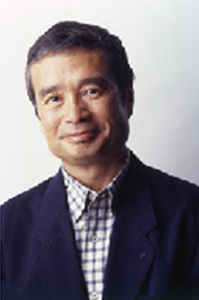
The author (1947-2010) wrote a few novels including several with a Zen Buddhism theme although according to GR only two of his books have been translated into English.
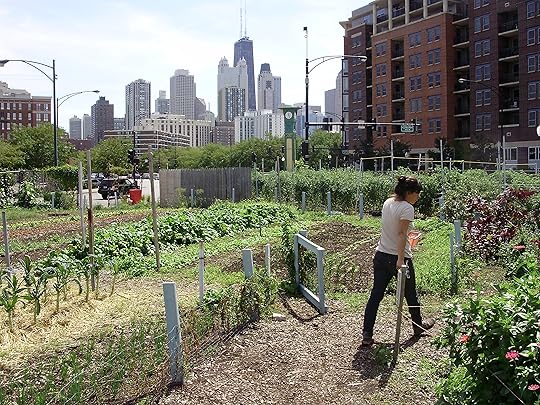
Top photo of an urban garden in Japan from milligansganderhillfarm.files.wordpress.com The author from discogs.com
So, in his glasshouse amongst those ugly new houses, Mitsuo doesn't dance his legs down to the knees, he grows tomatoes and fucks girls.
Which sounds cool. But he's not happy. You see, his village sold out to the developers.
"And oh, the plans they weave, And oh, the sickening greed. But they could have said no, if they'd wanted to. They could have said no, if they'd wanted to."
A farmer without a proper farm, he's left with unsatisfying nights out with ugly girls, racing Toyotas and arguing with his bastard father. Sadly, this is his life. Yet there's the tomatoes .... "And when that fails to recoup? Well, maybe, he just hasn't earned it yet, baby."
"But they could have said no, if they'd wanted to. He could walk away, ...couldn't he?
He touches Ayako at the omiai. She has no real way of knowing ... in her heart she begs "Take me with you ... I don't care where you're going..." "You're just the same as I am, What makes most people feel happy, Leads us headlong into harm."
Koji, another child from those ugly new houses, is in trouble. In the sitting room in those ugly new houses, he makes his confession and concedes his defeat.
The marriage has to go ahead; Ayako's pregnant. It takes place on the first floor of those ugly new houses. Everyone's forgotten the rites and remembered the bawdy songs.
At the wedding party, on his hands a dead Grandma ... Mitsuo's poor neglected Grandma, the only link to the past they all wanted to return to ...
"But they can never taint you in my eyes. No, they can never touch you now. No, they cannot hurt you, my darling. They cannot touch you now."
"Distant Thunder" has to be my most working-class Japanese read. Kawabata's families always have servants, Mishima's rough trade is always ... well, someone with a university education's rough trade. Oe's characters make a living reading Thomas Mann and William Blake in the original. "Distant Thunder" felt so very different, I loved it! Mitsuo has his name written on a bottle of Suntory! He's always wanking! His mother does that flag waving thing at a Japanese construction site! How cool is that? A woman "laughs flirtatiously, not bothering to cover her mouth with a hand."
Cute: "'I didn't expect you to help me. I just wanted to take one last look at you' Koji looked down with a smile and slowly chewed a piece of sushi. Suddenly his head fell forward and shook violently. His tears splattered upon the tatami. In a high-pitched voice, Mitsuo yelled, 'It's all the fault of those damn apartments! The bastards came and brought us nothing but evil!' 'Maybe so, but we took their money, so there ain't nothing we can do about it,' Koji sniffed."
Set in a 1980's rustic, rural community, a farmer & his bonded family lead a simple life devoted to crop growing; far from the refinements of cultural modern society. Highly descriptive and with raunchy sex scenes, surprisingly explicit for Japanese.
Before I read this book I had an impression that most Japanese literatures have a very slow flow... kind of boring to me. This book proved it wrong :P.
bought it on a big discount for only Rp20.000,- slow at first, but getting a lot more interesting as it came to the end of the story. it left me crave for more ending.