

What do you think?
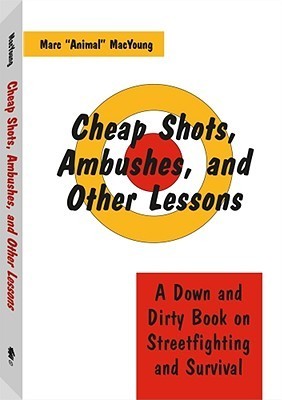
Cheap Shots, Ambushes, and Other Lessons: A Down and Dirty Book on Streetfighting and Survival
Streetfighting is a down and dirty topic, and the author, an ex-streetfighter, shares his hard-learned lessons here. Want to know how to recognize a mugging setup? How to avoid getting sucker punched? It's all here, as well as tips on bullies, weapons, martial arts vs. streetfighting and more.
- GenresMartial ArtsNonfiction
264 pages, Paperback
First published January 1, 1989
About the author
Marc MacYoung
37 books50 followersMarc "Animal" MacYoung is a teacher of self-defense.
Ratings & Reviews
Friends & Following
Create a free account to discover what your friends think of this book!
Community Reviews
Displaying 1 - 11 of 11 reviews

January 20, 2019
*Really 3.5 stars*
Out street walking on a Saturday night
Looking for the man, staying out of sight
Trying to find something to ease my mind
Traffic lights a-blinkin' and I'm right on time
Come around a corner on 4th and Main
Joint was a -jumpin', people going insane
Jukebox a-flappin' on through the night
I think all the boys are starting up a bloody reunion...
I've been a fan of Marc MacYoung's work on self-defense and violence dynamics for several years, ever since I stumbled on his No-Nonsense Self Defense website while doing research for a book. Since then, thanks to the connective power of social media we've ended up acquaintances and professional colleagues - I contributed an essay to his compendium Beyond the Picket Fence. So there's my statement of bias...however, I'd like to point out that I became a fan of what he has to say before I ever interacted with him.
MacYoung has been producing material on self-defense for thirty years, however a good chunk of his early work was published through Paladin Press, which is now out of business and thus rendered all his early works out-of-print and hard to find. Recently he elected to re-release his back catalog as ebooks, and Cheap Shots is his first title to be released. I jumped at the chance to finally read it cheaply. After getting it on my phone, I sat down on my porch with a six-pack, my smokes and my iPod blasting Molly Hatchet and chewed my way through it.
By the way, 'with a six pack, smokes and Molly Hatchet' is the best way to read this book. Vintage AC/DC is acceptable as an alternate.
With that in mind, let's get started...
Time Capsule
Well she grabbed me and asked me if I had a name
She told me she was interested to see if I could play the game
She said her name was victory, she didn't want to know the rules
That's just the way I wanted to play, in a game designed for fools...
MacYoung's main goal in re-releasing his old books was to introduce his newer readers to his roots and where his knowledge base comes from. As to that, it comes from having been in his own words "a paranoid, violent jackass" in his teens and twenties. Due to a combination of living conditions ( the bad part of Los Angeles in the 70s and 80s) and bad life decisions MacYoung found himself having regular encounters with gangbangers, bikers, pimps, pushers or what he refers to collectively as the "Saturday Night Knife & Gun Club". Cheap Shots was written while MacYoung was still in the process of transitioning out of that lifestyle...and boy howdy, is that ever obvious to a reader.
While the author clearly comes off as intelligent, man is there a lot of profane language in here. Cussing, crude sexual references/metaphors, politically incorrect terminology and salty language run amok through the prose. So too does an unapologetic "I am what I am and this shit is what it is" attitude which can easily be mistaken for arrogance (and some of it is - the author freely admits it now) but its leavened with a genuine honesty and saved from macho buffoonery by moments of self-effacing humor and acknowledgement of his limitations as a person.
Also, martial artists might view Cheap Shots as a straight-out attack on their way of doing business, and it a sense it is...or rather was; back in 1989 'reality-based martial arts' were a long way off, and thanks to Hollywood nonsense and blatant commercialization there were serious technical problems with what was being taught as 'self-defense'. MacYoung has built his career on calling these problems out with the intent of keeping students out of prison (or worse a coffin), and while his stance on the martial arts has become more nuanced of late back when Cheap Shots hit the shelves it said what needed to be said. It and the author have been a controversial figure in the MA world ever since.
Its very interesting to compare what MacYoung says now versus what he said back then. Some of the differences are him changing, others are the world changing...but its even more interesting to compare then and now and see how much hasn't changed.
Example; there's a section in Cheap Shots about 'woofing', which is vintage street slang for the verbal posturing that precedes a fight (or follows an almost-fight where one party backs down). That section was so completely spot-on with my personal experiences regarding the behavior that I literally sat back and said "holy shit, I've *SEEN* that!" It wasn't the only time that happened while reading this, which leads to the book's biggest strength...
Crude but Honest - and Accurate
He's tall, he's short, he's fat, he's thin
He's out for vengeance, he's out to win
The road he walks is dark and dim
Don't let him catch you out on a limb
He'll cut your throat, baby, stick you in the back
Drive off in your Cadillac
He's more trouble than you think
He'll kill your sugar, leave you in the drink
Say, it's gonna be a cold dark night
Oh, when The Creeper come along...
Crude language aside, where Cheap Shots truly shines is in the searing honesty with which the author tackles the broad subjects of violence, martial arts and self-defense. The narrative is also buoyed up by MacYoung's distinctive voice; one early reader characterized the book as "like sitting down with a six pack and an old friend...a twisted, dangerous old friend", and the comparison is apt. It does ramble and take asides, like a good storyteller does, but the rambles and the asides are usually entertaining - and sometimes insightful.
The weakest section of the book is the one on various types of strikes. Its both too specific and too general, MacYoung's metaphors and terminology are hard to follow and the pictures provided don't do all that great a job of showing what the text wants us to know. Thanks to its late-80s release the outfits and the 'ghetto' setting are quite amusing, though. Most instructors would have too much pride to be photographed wearing a 'SHIT HAPPENS' t-shirt, but MacYoung does stuff his own way.
The strongest sections of the book are the parts which discuss how criminals and nasties set up their victims; in these, MacYoung dispenses with any attempt at fancy prose and lays out in instruction-manual terms how muggers, murderers and other types of violent criminal set up their ambushes...then explains just as directly how one stays out of them. I did appreciate the emphasis on prevention and avoidance, a position not often taken by books of this type. Also, despite the book being thirty years old, most of the tactics haven't changed all that much - although thanks to how everyone has a camera in their pocket some criminals have gotten more concerned with witnesses than they used to be.
There's also a section I just have to bring up because it was too funny, and a great example of the author's capacity for outside-the-box thinking. He opened a bit on home defense by saying he vastly prefers swords over guns for home defense, and suggests them, particularly for women. Yes, you read that right, swords. At first I shook my head, rolled my eyes and wondered how many drugs MacYoung was on when he came up with that idea...and then I read the list of reasons why he suggested it. By the end, I couldn't help but think "that...that's crazy enough to work". Its nutty-but-eye-opening sections like this which made this book so much fun to read.
Stories
If I were a gambler, you know I'd never lose,
And if I were a guitar player,
Lord, I'd have to play the blues.
If I was a hatchet my blade would be razor sharp.
If I were a politician, I could prove that monkeys talk
Arguably the most polarizing aspect of Cheap Shots is MacYoung's liberal inclusion of stories from his crazy past. Some readers have taken digs at him for needlessly massaging his own ego through his work, and MacYoung has admitted yes, there was some of that going on.
However, speaking as a reader with a few 'crazy stories' of my own, I didn't find his all that unbelievable, nor did I ever get the impression the author was trying to paint himself as some kind of towering, unstoppable bad-ass who never lost a fight. Indeed, its often the opposite. He comes clean about the pain and the fear of, say, having someone nearly plant a knife in your ribs (result; the assailant didn't, but the story ends with MacYoung throwing up in the bathroom and wondering why adrenaline shock never happens to Clint Eastwood's characters), the ball of ugly emotions that can be uncorked in a serious fight, and other bits of realism.
I've listened to people with real stories and I've listened to people trying to make themselves sound cooler than they are (or were) and Cheap Shots mostly stays on the former. Your mileage may definitely vary though.
In the end, I cannot recommend Cheap Shots as a self-defense manual. Not that the information isn't good (it is), its that there's just too much crude language for the 21st century reader (who isn't a construction worker like me) to choke down and get around to absorb said information. Besides, MacYoung passes on basically the same wisdom more effectively (and politely) in his books What You Don't Know Can Kill You and In the Name of Self-Defense. If you're interested in his stuff, I advise starting there.
Who do I recommend Cheap Shots to? Crime authors who want to write "grittier" characters. MacYoung is not the only reformed criminal I've ever had dealings with, and there's a certain attitude those who are (or were) deep in "the Life" all share. Its very seldom depicted accurately in fiction; if I had to sum it up, it is a macho-but-self-aware fatalism crossed with hard-nosed pragmatism and spiked with black humor...the ability to laugh at situations most people would not find funny. Thanks to how MacYoung hadn't fully transitioned out of that way of thinking when he wrote Cheap Shots, said attitude is fully on display for writers who want to do better villains (and anti-heroes) to take in. For that, I can't say enough good about it.
Also, if you're somebody with a tolerance for harsh language who wants to read an informed, accurate and at-times hilarious book on violence, crime and fighting, you can do far worse than this one.
Just, you know, have that Molly Hatchet handy.
Out street walking on a Saturday night
Looking for the man, staying out of sight
Trying to find something to ease my mind
Traffic lights a-blinkin' and I'm right on time
Come around a corner on 4th and Main
Joint was a -jumpin', people going insane
Jukebox a-flappin' on through the night
I think all the boys are starting up a bloody reunion...
I've been a fan of Marc MacYoung's work on self-defense and violence dynamics for several years, ever since I stumbled on his No-Nonsense Self Defense website while doing research for a book. Since then, thanks to the connective power of social media we've ended up acquaintances and professional colleagues - I contributed an essay to his compendium Beyond the Picket Fence. So there's my statement of bias...however, I'd like to point out that I became a fan of what he has to say before I ever interacted with him.
MacYoung has been producing material on self-defense for thirty years, however a good chunk of his early work was published through Paladin Press, which is now out of business and thus rendered all his early works out-of-print and hard to find. Recently he elected to re-release his back catalog as ebooks, and Cheap Shots is his first title to be released. I jumped at the chance to finally read it cheaply. After getting it on my phone, I sat down on my porch with a six-pack, my smokes and my iPod blasting Molly Hatchet and chewed my way through it.
By the way, 'with a six pack, smokes and Molly Hatchet' is the best way to read this book. Vintage AC/DC is acceptable as an alternate.
With that in mind, let's get started...
Time Capsule
Well she grabbed me and asked me if I had a name
She told me she was interested to see if I could play the game
She said her name was victory, she didn't want to know the rules
That's just the way I wanted to play, in a game designed for fools...
MacYoung's main goal in re-releasing his old books was to introduce his newer readers to his roots and where his knowledge base comes from. As to that, it comes from having been in his own words "a paranoid, violent jackass" in his teens and twenties. Due to a combination of living conditions ( the bad part of Los Angeles in the 70s and 80s) and bad life decisions MacYoung found himself having regular encounters with gangbangers, bikers, pimps, pushers or what he refers to collectively as the "Saturday Night Knife & Gun Club". Cheap Shots was written while MacYoung was still in the process of transitioning out of that lifestyle...and boy howdy, is that ever obvious to a reader.
While the author clearly comes off as intelligent, man is there a lot of profane language in here. Cussing, crude sexual references/metaphors, politically incorrect terminology and salty language run amok through the prose. So too does an unapologetic "I am what I am and this shit is what it is" attitude which can easily be mistaken for arrogance (and some of it is - the author freely admits it now) but its leavened with a genuine honesty and saved from macho buffoonery by moments of self-effacing humor and acknowledgement of his limitations as a person.
Also, martial artists might view Cheap Shots as a straight-out attack on their way of doing business, and it a sense it is...or rather was; back in 1989 'reality-based martial arts' were a long way off, and thanks to Hollywood nonsense and blatant commercialization there were serious technical problems with what was being taught as 'self-defense'. MacYoung has built his career on calling these problems out with the intent of keeping students out of prison (or worse a coffin), and while his stance on the martial arts has become more nuanced of late back when Cheap Shots hit the shelves it said what needed to be said. It and the author have been a controversial figure in the MA world ever since.
Its very interesting to compare what MacYoung says now versus what he said back then. Some of the differences are him changing, others are the world changing...but its even more interesting to compare then and now and see how much hasn't changed.
Example; there's a section in Cheap Shots about 'woofing', which is vintage street slang for the verbal posturing that precedes a fight (or follows an almost-fight where one party backs down). That section was so completely spot-on with my personal experiences regarding the behavior that I literally sat back and said "holy shit, I've *SEEN* that!" It wasn't the only time that happened while reading this, which leads to the book's biggest strength...
Crude but Honest - and Accurate
He's tall, he's short, he's fat, he's thin
He's out for vengeance, he's out to win
The road he walks is dark and dim
Don't let him catch you out on a limb
He'll cut your throat, baby, stick you in the back
Drive off in your Cadillac
He's more trouble than you think
He'll kill your sugar, leave you in the drink
Say, it's gonna be a cold dark night
Oh, when The Creeper come along...
Crude language aside, where Cheap Shots truly shines is in the searing honesty with which the author tackles the broad subjects of violence, martial arts and self-defense. The narrative is also buoyed up by MacYoung's distinctive voice; one early reader characterized the book as "like sitting down with a six pack and an old friend...a twisted, dangerous old friend", and the comparison is apt. It does ramble and take asides, like a good storyteller does, but the rambles and the asides are usually entertaining - and sometimes insightful.
The weakest section of the book is the one on various types of strikes. Its both too specific and too general, MacYoung's metaphors and terminology are hard to follow and the pictures provided don't do all that great a job of showing what the text wants us to know. Thanks to its late-80s release the outfits and the 'ghetto' setting are quite amusing, though. Most instructors would have too much pride to be photographed wearing a 'SHIT HAPPENS' t-shirt, but MacYoung does stuff his own way.
The strongest sections of the book are the parts which discuss how criminals and nasties set up their victims; in these, MacYoung dispenses with any attempt at fancy prose and lays out in instruction-manual terms how muggers, murderers and other types of violent criminal set up their ambushes...then explains just as directly how one stays out of them. I did appreciate the emphasis on prevention and avoidance, a position not often taken by books of this type. Also, despite the book being thirty years old, most of the tactics haven't changed all that much - although thanks to how everyone has a camera in their pocket some criminals have gotten more concerned with witnesses than they used to be.
There's also a section I just have to bring up because it was too funny, and a great example of the author's capacity for outside-the-box thinking. He opened a bit on home defense by saying he vastly prefers swords over guns for home defense, and suggests them, particularly for women. Yes, you read that right, swords. At first I shook my head, rolled my eyes and wondered how many drugs MacYoung was on when he came up with that idea...and then I read the list of reasons why he suggested it. By the end, I couldn't help but think "that...that's crazy enough to work". Its nutty-but-eye-opening sections like this which made this book so much fun to read.
Stories
If I were a gambler, you know I'd never lose,
And if I were a guitar player,
Lord, I'd have to play the blues.
If I was a hatchet my blade would be razor sharp.
If I were a politician, I could prove that monkeys talk
Arguably the most polarizing aspect of Cheap Shots is MacYoung's liberal inclusion of stories from his crazy past. Some readers have taken digs at him for needlessly massaging his own ego through his work, and MacYoung has admitted yes, there was some of that going on.
However, speaking as a reader with a few 'crazy stories' of my own, I didn't find his all that unbelievable, nor did I ever get the impression the author was trying to paint himself as some kind of towering, unstoppable bad-ass who never lost a fight. Indeed, its often the opposite. He comes clean about the pain and the fear of, say, having someone nearly plant a knife in your ribs (result; the assailant didn't, but the story ends with MacYoung throwing up in the bathroom and wondering why adrenaline shock never happens to Clint Eastwood's characters), the ball of ugly emotions that can be uncorked in a serious fight, and other bits of realism.
I've listened to people with real stories and I've listened to people trying to make themselves sound cooler than they are (or were) and Cheap Shots mostly stays on the former. Your mileage may definitely vary though.
In the end, I cannot recommend Cheap Shots as a self-defense manual. Not that the information isn't good (it is), its that there's just too much crude language for the 21st century reader (who isn't a construction worker like me) to choke down and get around to absorb said information. Besides, MacYoung passes on basically the same wisdom more effectively (and politely) in his books What You Don't Know Can Kill You and In the Name of Self-Defense. If you're interested in his stuff, I advise starting there.
Who do I recommend Cheap Shots to? Crime authors who want to write "grittier" characters. MacYoung is not the only reformed criminal I've ever had dealings with, and there's a certain attitude those who are (or were) deep in "the Life" all share. Its very seldom depicted accurately in fiction; if I had to sum it up, it is a macho-but-self-aware fatalism crossed with hard-nosed pragmatism and spiked with black humor...the ability to laugh at situations most people would not find funny. Thanks to how MacYoung hadn't fully transitioned out of that way of thinking when he wrote Cheap Shots, said attitude is fully on display for writers who want to do better villains (and anti-heroes) to take in. For that, I can't say enough good about it.
Also, if you're somebody with a tolerance for harsh language who wants to read an informed, accurate and at-times hilarious book on violence, crime and fighting, you can do far worse than this one.
Just, you know, have that Molly Hatchet handy.

September 14, 2020
Everyone needs to be aware of the tactics their enemy might use. This book consolidates illicit strategies that fighters use to earn less than honest victories. A diligent awareness of these underhanded tactics will prevent them from being deployed. Additionally, it can be useful to spruce up one’s own fighting form with a couple of these shocking techniques, just in case of an unstoppably rampaging opponent.

August 18, 2010
You gotta love someone who inserts a quote at the beginning of each chapter, setting a tone for the section, and those quotes range from the Bhagavad Gita to Tweety Bird. :)
Such is the range of reading and experience Marc "Animal" MacYoung brings to his writing. It also demonstrates his very down-to-earth style of writing, the book taking on the tone of a bunch of friends down at the pub, sharing a cold drink and life experiences.
That said, this is an outstanding reference. How can you choose to ignore someone who's an expert in all the nasty stuff that can happen with violence, simply by virtue of his still being alive. After all, that's how you gain such experience: living through it.
This book is well-organized with great information and suggestions as well as real-world examples. There is definitely a lot of theory, but like anything, you have to practice it to take it from theory to practice. MacYoung does a great job of telling you what to practice that could possibly save your life one day. He also delves into the realm of what could get you killed some day, especially concepts and techniques taught by instructors who are trying to make a buck without regard for their students, or are simply too ignorant of the topic to know better.
I recommend this book for anyone and will definitely recommend it to all advanced and adult students at my school. Hopefully they won't find themselves in circumstances where they have to apply anything from this book or what they've been taught in class, and if they've paid any attention to lessons about awareness, they won't. But if they do, some nugget from this book, along with constant practice in life, might just make a positive difference for them.
Such is the range of reading and experience Marc "Animal" MacYoung brings to his writing. It also demonstrates his very down-to-earth style of writing, the book taking on the tone of a bunch of friends down at the pub, sharing a cold drink and life experiences.
That said, this is an outstanding reference. How can you choose to ignore someone who's an expert in all the nasty stuff that can happen with violence, simply by virtue of his still being alive. After all, that's how you gain such experience: living through it.
This book is well-organized with great information and suggestions as well as real-world examples. There is definitely a lot of theory, but like anything, you have to practice it to take it from theory to practice. MacYoung does a great job of telling you what to practice that could possibly save your life one day. He also delves into the realm of what could get you killed some day, especially concepts and techniques taught by instructors who are trying to make a buck without regard for their students, or are simply too ignorant of the topic to know better.
I recommend this book for anyone and will definitely recommend it to all advanced and adult students at my school. Hopefully they won't find themselves in circumstances where they have to apply anything from this book or what they've been taught in class, and if they've paid any attention to lessons about awareness, they won't. But if they do, some nugget from this book, along with constant practice in life, might just make a positive difference for them.
May 31, 2020
The bottom line here is Marc has never been in a fight.
How do I know? The book is shot through with statements about technique that would be instantly disproven if he had ever tried them.
At one point, he has a diagram of proper punching form that shows "the correct way to punch" as having your wrist 45 degrees out of alignment with your forearm. Do me a favor and try that against a heavy bag.
How do I know? The book is shot through with statements about technique that would be instantly disproven if he had ever tried them.
At one point, he has a diagram of proper punching form that shows "the correct way to punch" as having your wrist 45 degrees out of alignment with your forearm. Do me a favor and try that against a heavy bag.

March 18, 2021
I read this book back in the '90s. My most important take-away from it was that it got me thinking about Situational Awareness, which has been my most useful self-defense tool ever since. At the time, I was training in Kenpo, and this book got me to thinking about the huge differences between Dojo training and real-life situations. Now, it's been nearly 30 years. I'm training in BJJ now, but I still keep Marc's advice foremost in my training.

October 7, 2015
" This is really just a drop of piss in your toilet bowl of a life"
-My oldest brother, while driving me to an academic event in middle school that was making me very nervous.
So, my dad came up to me, raving about this book, and told me to read it. Now, I'm a psychotic book organizer, and I read books in a very specific order.
So my initial thought was:
There's no easy way to say this, Daddio, but this would really mess up my reading schedule, so...no.
What I then thought: you know, my dad is such a good guy, and I'll just read this quickly to make him happy and then get back on the regular reading train. We can also have a book club, which I live for. Also, he had so much common sense, maybe this book will help me gain some of that.
What I said: Sure.
This ended up being an enlightening read! Seriously, I feel like I'm much more aware and I've learned so much. Plus, Macyoung wrote with a readable humor. I enjoyed his quotes at the beginning of each chapter, and I just have a new way of thinking!
To explain my quote at the beginning, which I added in honor of all of Macyoung's quotes: this book, though I don't think it was the point, made me feel very good about myself! He had some wise things to say about the school-system and knowing what really matters in life. I now know I shouldn't let stressful academic situations get to me, because they really don't matter in the grand scheme of things, just like my brother said!
I'm glad I read this book, because now I know a lot more, and I also made my dad happy.
-My oldest brother, while driving me to an academic event in middle school that was making me very nervous.
So, my dad came up to me, raving about this book, and told me to read it. Now, I'm a psychotic book organizer, and I read books in a very specific order.
So my initial thought was:
There's no easy way to say this, Daddio, but this would really mess up my reading schedule, so...no.
What I then thought: you know, my dad is such a good guy, and I'll just read this quickly to make him happy and then get back on the regular reading train. We can also have a book club, which I live for. Also, he had so much common sense, maybe this book will help me gain some of that.
What I said: Sure.
This ended up being an enlightening read! Seriously, I feel like I'm much more aware and I've learned so much. Plus, Macyoung wrote with a readable humor. I enjoyed his quotes at the beginning of each chapter, and I just have a new way of thinking!
To explain my quote at the beginning, which I added in honor of all of Macyoung's quotes: this book, though I don't think it was the point, made me feel very good about myself! He had some wise things to say about the school-system and knowing what really matters in life. I now know I shouldn't let stressful academic situations get to me, because they really don't matter in the grand scheme of things, just like my brother said!
I'm glad I read this book, because now I know a lot more, and I also made my dad happy.

January 29, 2011
So far this book is proving to be a fun and interesting read, though its not obviously one of those "one read" books, but one you have to read and put into practice. Marc's style of writing is fun, its more like hanging out in a garage, drinking beer with a kick ass bunch of guys who are trying to teach thier friends a little something about how not to get "owned".
Okay, finished the book and I can somewhat say that I'm proud of myself that I can say (thanks to my daddy) a decently aware individual. The book covers quite abit of things in its sort of small package, from personal mindset, psychology, to actual steps and moves to help keep yourself safe. It made me think, which, to me, is the most important thing a book like this can do for a person.
Okay, finished the book and I can somewhat say that I'm proud of myself that I can say (thanks to my daddy) a decently aware individual. The book covers quite abit of things in its sort of small package, from personal mindset, psychology, to actual steps and moves to help keep yourself safe. It made me think, which, to me, is the most important thing a book like this can do for a person.
May 16, 2011
Decent book on streetfighting.

December 27, 2013
This book is a pretty good basics on self-protection that I see expanded into his later books now. I did a lot of highlighting and note taking as I read
June 2, 2016
shockingly intelligent; great bibliography

November 27, 2012
A diamond in a colemine, this twinkling gem is a real, practical manual of real life Self-Defense.
Displaying 1 - 11 of 11 reviews