Jump to ratings and reviews
Rate this book

Among the Great Apes: Adventures on the Trail of Our Closest Relatives – First Access in a Decade to Charismatic Cousins in Native Habitats

Rate this book
“A fantastic book. . . . Anyone who cares about animals will benefit hugely from reading it.” —Shaun Ellis, star of Animal Planet's "Living with the Wolfman" and author of The Man Who Lives with Wolves Award winning adventure journalist Paul Raffaele’s Among the Great Apes is the first book in over a decade—and possibly the last ever—to take its readers into the lives of our charismatic cousins the great apes in their native habitats. Raffaele, a feature writer for Smithsonian magazine, has been called “nothing less than a one-of-a-kind world treasure” by renowned author Alvin Toffler.

384 pages, Paperback

First published January 30, 2010

Loading...
Loading...

About the author

Paul Raffaele

12 books3 followers

Ratings & Reviews

What do you think?
Rate this book

Friends & Following

Create a free account to discover what your friends think of this book!

Community Reviews

5 stars
31 (26%)
4 stars
50 (42%)
3 stars
28 (23%)
2 stars
3 (2%)
1 star
5 (4%)
Displaying 1 - 18 of 18 reviews
Profile Image for Will Byrnes.
1,373 reviews121k followers
December 4, 2025
…through the observations in Africa and Southeast Asia of scores of primatologists spawned by Fossey and Goodall, we have discovered great ape species each have their separate character. The orangutans are introspective loners; gorillas laid back and largely undemonstrative; the bonobos gleeful hedonists; and chimpanzees the thugs, by far the most destructive and murderous… from the Prologue
But, to varying degrees, and for diverse reasons, they are all disappearing from the wild.

description
From the Universitad Pompeo Fabra in Barcelona

The author wanted to see what he could of them in their native haunts while there was still the opportunity. He looks at gorillas, chimpanzees, bonobos and orangutans, the first three in Africa, the last in Borneo. What he finds is both fascinating and alarming.

Paul Rafaele is a certified character. In 2007, he was interviewed by Peter Carlson for The Washington Post. Carlson characterized him as
a professional adventurer, perhaps the last in a long line of popular writers who ventured into wild places and returned with electrifying tales of fearsome animals and strange humans.
"He's the last of a breed," says Carey Winfrey, Smithsonian magazine's editor in chief. "I don't want to use the word 'throwback,' but he is a throwback."
He's a throwback, Winfrey says, to such 19th-century British explorer-writers as Richard Burton and John Hanning Speke and to the American writer Richard Halliburton, who traveled to Devil's Island and swam the Sea of Galilee and followed Cortez's route through Mexico and wrote about it all in countless articles and best-selling books in the 1920s and '30s.
"He has a childlike curiosity and enthusiasm for people and places," Winfrey says. "His world is a world of infinite possibilities and infinite heterogeneity. It's the world as seen through the eyes of a 16-year-old schoolboy
The last apes the Aussie adventurer reported on in book form were the naked variety, and he was looking into the predilection of some for feeding on their own. Not so much with our furrier cousins.

description
This image graces the inside rear flap of the book, and does as good a job as any of portraying the author

Gorillas

Diane Fossey made the world aware of gorillas, but not all of them. Turns out there are several sub-species. She specialized in the mountain variety, the largest of the four. There are eastern and western lowland varieties and the one you almost certainly never heard of, the Cross River gorillas, which are undoubtedly the most endangered of them all. Sorry, none from Skull Island or any other islands for that matter.

description
The best known gorilla of all time

Raffaele interviews a host of field experts and fills us in on how gorillas live. We get a look at their family structure, group interaction, diet, child rearing, and the problem infants face should troop leadership change hands. We also learn that gorilla vocalization includes higher-pitched tonal calls, similar to humans humming and singing, favored by younger troop members. Can’t you damn kids keep it down? (toga, toga, Toga, Toga, TOga, TOga, TOGa, TOGa, TOGA, TOGA) Sometimes the musicality spreads. Raffaele quotes gorilla expert Amy Vedder:
One individual would start a low rumbling sound, breathing in and out in a modulated tone. This might remain a solo performance, and last no more than a minute. Often, however, others would join, adding gender- and age-specific basses, baritones, tenors and sopranos in a mix. The result was a chorus of entwined melodies, rising and falling in a natural rhythm that might continue for several minutes; a gorilla Gregorian chant in a Virunga cathedral.
Bet ya didn’t see that coming. We learn a bit about the differences among the subspecies. The Cross River offers the most unique experience of the four gorilla habitats. No, our furry friends are not punting back and forth across a waterway on bespoke rafts. Their particular brand of gorilla is named for the Cross River, where they live. It took greater effort for Raffaele to get to them than it did to reach any of the others. He was not exactly a kid when he headed out there, a trek that included significant life-threatening passages. It is particularly exciting to read of that leg of his adventure. The Cross River gorillas are the least interfered-with of any gorilla population. The animals are not at all habituated to humans, and their protectors want to keep it that way.

The plusses and minuses of habituation to people come in for considerable discussion here, for all the species under review. All the gorilla sub-species face enormous challenges. Eliminate near-constant civil wars, locals setting traps by the thousands in gorilla habitat to catch bush meat of various sorts, corrupt officials selling off protected land for logging and making charcoal, and our cousins’ chances of surviving into the 22nd century would skyrocket. If wishes were horses, though, a lot of these folks would probably kill and eat them. The fear is quite real that someday in the 21st century, because of greed and corruption, when we think of gorillas in the mist, the only thing remaining will be the mist.

Chimpanzees

If Kong was the prototypical image many of us had of gorillas, there is a chimpanzee of comparable familiarity, although of much more modest dimensions.

description
Doctor Zira in Planet of the Apes (1968)

No, but nice try. There was a much earlier representative of the species, one that remained in the public consciousness long after the films in which he appeared had become quaint. I speak, of course, of a matinee idol.

description
Why, Cheeta, of course, ever helpful, ever reliable, Jungle Man’s best friend

The reality of chimpanzee life in the wild is not quite so comforting. Raffaele learns about how culture is transmitted from generation to generation, relative educability of male and female young, age-based mate preference by males (it is not what you might expect), their use of medicinal plants, including A. pluriseta, an abortifacient. They are also quite willing to form gangs and murder members of their own troop. They show a decided predilection for violence. Chimpanzees are clever, and use their intelligence for dark ends.

Bonobos

Bonobos are very similar to chimps in appearance, seeming to be a slightly smaller version. But there are significant differences between the species. Carston Knott, keeper of great apes at the Frankfurt zoo, told Raffaele,
I tell new keepers that if you throw a screwdriver in with the gorillas, they wouldn’t notice it for weeks on end unless they sat on it. The chimpanzees would use it to destroy something within minutes, but the bonobos and orangutans, within thirty minutes, would figure out how to use it to unlock the cage door and escape.
Considerable differences are noted here between chimps and bonobos, the latter being the closest ape to humans, DNA-wise. It is summed up nicely in one simple statement: Chimps are from Mars, bonobos are from Venus. Well, one aspect of their existence anyway
Chimpanzee females come into heat for only a few days a month, and so competition for them among the males can be fierce, with the dominant male granting more mating rights to his allies. But bonobo females are receptive to the males for most of each month, and that means there is hardly any fighting by the males for their favors.
The lively sex lives of bonobos is not restricted by age or gender. Monkey business is just fine for bonobos, whatever their age, with partners of both genders, with plenty of positional creativity being applied. Another element that differentiates bonobos from chimps is that bonding with mom persists for a lifetime. Chimpanzee maternal bonds are a lot more fragile. Unlike their larger ape cousins, bonobos do not kill other bonobos.

Orangutans

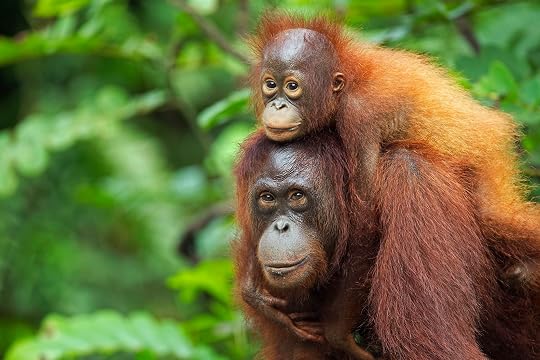
The orangutan is the largest arboreal creature on earth. Unlike their African cousins, orangutans are primarily solitary, slow moving creatures. They do not really need to get anywhere in a hurry. The orang habitat is under considerable assault, as the government clears large swaths of native forest in order to plant palm oil trees to satisfy a growing international demand. Raffaele picks up a bit of intel on the orang sex life. It includes oral. He spends some time looking at an operation in Borneo that aims at rehabbing orphaned orangs and returning them to the wild, paying particular attention to some serious problems with the program. One unusual feature about orangs is that there is dimorphism among males. The leader of the pack grows large and sprouts those facial flanges that look like rubber add-ons. Should the big guy slip on a banana peel and take a header, the vacuum will indeed be filled. And the successor will sprout the same extra bits.

description
Clyde’s seems an appropriate response to the eco-vandalism the Indonesian government is committing against the orangutans’ habitat

Raffaele does take breaks from his extended nature travels to stop in at facilities doing relevant research in various parts of the world. These outings are quite interesting. He is not a fan of zoos, but does acknowledge that the finer institutions of that sort do offer real potential benefits to the species with which they work. He also has a riveting conversation with the head of a tribe whose members, he says, can transform themselves into gorillas and back again. Very Castaneda.

You may or may not go ape for Among the Great Apes, but you will certainly want to hoot and holler for all that you will learn on this journey, and might even want to thump your chest a bit when you are done, thus letting those around you know just how big and powerful your brain has become. And as for the 800 pound gorilla in the room, it is probably two gorillas inside an over-sized gorilla suit. Real gorillas only grow to about four hundred pounds. It might not even do them much good were they to begin growing to double their natural size. The challenges all the great apes face are unrelenting and deadly. The long-term prospects for all the creatures addressed here are far from great. But you will learn a heck of a lot following Raffaele on his quest, or I’m a monkey’s uncle.

First posted November 11, 2013

============================EXTRA STUFF

PR on Facebook

PR on Twitter

Interview with the Washington Post

The Smithsonian page for Raffaele includes links to several articles he wrote for them over the years. The information reported in several of these was incorporated into the book

Ok, I really tried to figure out how to get this image into the body of the review, but I just could not force it in. So, in a fit of self-indulgence, I am dropping it down here. Any look at a book about apes, and yes I know this is not supposed to be an ape, but a Homo Sap predecessor, seems incomplete without it.

description
If you do not recognize this, you may have more evolving to do

April 26, 2016 - Just came across this sad news piece by Rachel Nuwer in the NY Times about some simian cousins - New Gorilla Survey Supports Fears of Extinction Within Decade

September 10, 2016 - An interesting piece in the NY Times about bonobo girl-power - In the Bonobo World, Female Camaraderie Prevails by Natalie Angier

November 8, 2016 - A video item in the NY Times reports on research showing similarities between human and bonobo vision - The Aging Eyes of Bonobos

December, 2016 - National Geographic Magazine - Inside the Private Lives of Orangutans - By Mel White - Photographs and Videos by Tim Laman - Pretty interesting stuff

description
A Sumatran orang branching out - from the article

September 2017 - National Geographic Magazine - The Gorillas Dian Fossey Saved Are Facing New Challenges - By Elizabeth Royte

October 2017 - National Geographic Magazine - How Jane Goodall Changed What We Know About Chimps - by Tony Gerber

description
Flint was the first infant born at Gombe after Jane arrived. With him she had a great opportunity to study chimp development—and to have physical contact, which is no longer deemed appropriate with chimps in the wild. - photograph by Hugo can Lawick – Image and description from article above

October 24, 2017 - Wild and Captive Chimpanzees Share Personality Traits With Humans - by Karen Weintraub

November 2, 2017 - NY Times - New Orangutan Species Could Be the Most Endangered Great Ape - by Joe Cochrane

description
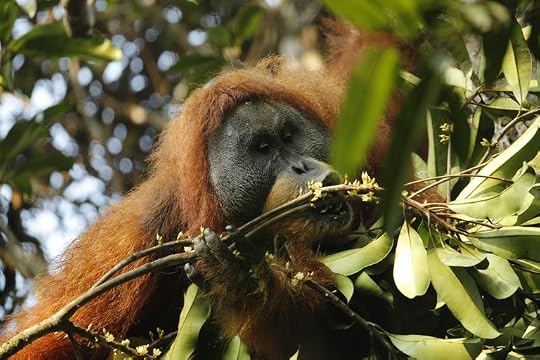
An orangutan from the Batang Toru region of the island of Sumatra in Indonesia, which researchers say is a distinct, third species of great apes. Credit Tim Laman
Text and image from the NY Times article above

November 4, 2017 - NY Times - Smuggled, Beaten and Drugged:The Illicit Global Ape Trade – by Jeffrey Gentleman

description
A female bonobo feeding fruit to her baby at Lola Ya Bonobo. Since 2005, United Nations investigators say, tens of thousands of apes have been trafficked or killed. - Credit Bryan Denton for The New York Times
Image and text from above NYT article

April 27, 2018 - NY Times - Stand up and pay attention. Researchers may have found a clue in a particular population of chimps that helps explain how humans began to walk upright - Hints of Human Evolution in Chimpanzees That Endure a Savanna’s Heat - by Carl Zimmer

description
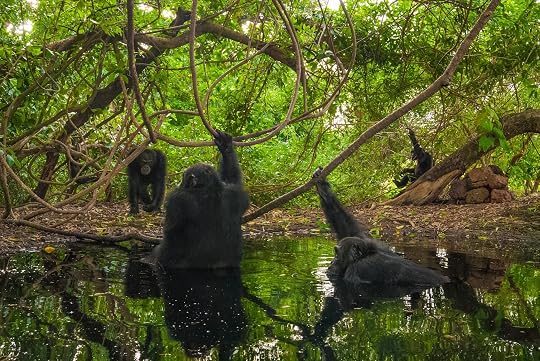
Early hominins might have used some of the strategies documented in Fongoli chipmanzees, like staying near water. Humans have skin glands that let us sweat much more than chimpanzees, and the origin of our upright posture might have been an adaptation to stay cooler.CreditFrans Lanting/lanting.com - Image and text from above article
Profile Image for Nathan.
523 reviews4 followers
January 14, 2011
I really wanted to like this book. Paul Raffaele does the sort of things that make for good reading: set off into the jungles to see his subjects firsthand. But this wasn't good reading. It's not a well-told story; too much of Raffaele gets in the way. I wanted to read more about what he learned about the great apes, and less about his exploits and cleverness in dealing with the natives. What information on the apes there is is completely unoriginal.

I think it's a well-intentioned book. Raffaele does end his book with a call to protect the apes. But the preceding material does nothing to inspire any enthusiasm for the cause. It's boring, and it had no excuse to be; the material is there. Raffaele just wastes it.


Profile Image for Laura.
657 reviews19 followers
April 20, 2022
There is a hush over the river just before dawn. The sultry heat is soporific. Nothing moves, not even the insects, and there is no cackle or warble from the thousands of birds that perch shut-eyed in the trees along the riverbank. Then, silvery beams of light splinter the forest gloom. A silky white mist begins to lift over the water as a troop of pygmy elephants, about two-thirds the size of their African cousins, plod with slow-motion grace down the riverbank and slip into the muddy water up to their necks. They are practiced swimmers, even the toddlers, and hold their trunks above their heads as they swim to the other side. Led by a wise old matriarch, they climb up the riverbank and disappear into the jungle's shadows.

description

Raffaele does an excellent job painting a verbal picture of the Borneo jungle in my opening quote. This vanishing jungle is one of the few remaining natural homes for Orangutans, one of my favorite great apes. To quote Carsten Knott, great ape keeper in the Frankfurt, Germany zoo--"I tell new keepers that if you throw a screwdriver in with the gorillas, they wouldn't notice it for weeks on end unless they sat on it. The chimpanzees would use it to destroy something within minutes, but the bonobos and orangutans, within thirty minutes, would figure out how to use it to unlock the cage door and escape."

First two sentences: Great apes are our wildlife cousins, the animals most like us. This common bloodline--we share up to 98 percent of our DNA--is why they are among the most popular exhibits at zoos around the world.

My two cents: Raffaele has great intentions with his novel. Great apes were critically endangered when he wrote the book in 2010, and conditions have only grown worse since then. I learned many facts which I did not before reading--the subspecies of gorillas, the differences in bonobo and chimpanzee society, and just how devastating palm oil is--to name a few. So why not a higher rating? Like other reviewers, I felt that the concept of this book could have been great. But instead Raffaele rambles, he recollects previous years of his life, he talks about many, many other researchers in the field...basically he does a lot of things besides tell an exciting, cohesive story of exploration. So while I learned interesting facts, I didn't feel moved like I perhaps would have been otherwise. Given a rating of 2.5 stars or "above average". Still worth a library checkout if you love great apes.

Other favorite quotes: Stick-limbed boys play barefoot soccer in the dust, women in flamboyant cotton gowns return from the markets bearing parcels balanced on their heads, and grizzled old men huddle on stools doing what such veterans of life do all over the world--solve the world's problems day after day over puffs of tobacco and jugs of local beer.

~~We trek for about an hour through the jungle gloom, and then Wasse holds up a hand to halt us. HIs dark eyes flit from side to side and his nostrils flare as he tests the air for scent. Visibility is just a few yards, and he points toward the undergrowth. I freeze. In the dim light, I see a mother elephant and calf a few steps ahead of us. The mother's huge head and ivory tusks thrust defiantly through the leaves. The calf nestles by her front leg, unafraid, imitating its mother's belligerence. A lack of fear must be your birthright when your mother is one of the biggest and meanest creatures in the jungle.


Further Reading: An article from Scientific American discussing the role that human activity has on the decline of great ape populations. https://www.scientificamerican.com/ar...

~~Raffaele is very vocal in his criticism of zoos. Here's a counter argument. https://aeon.co/ideas/there-is-a-mora...
Profile Image for Joy.
185 reviews13 followers
March 23, 2016
It shocks me that a book on such a potentially fascinating topic could be written so badly.

I plodded through the first 180 pages, the facts about the apes themselves keeping me engaged enough. Then I read this line: "The CAR was colonized by the French, and it is still tied tightly to Paris by economic, defense, and cultural links. Over the long colonial rule, the locals obviously took a liking to the emotive Gallic body language."

Wow. WOW. For real?

A few pages earlier: "Hordes of girls have tramped in from the impoverished villages and are offering their charms all over town... The most beautiful of the girls, Corinne, is barely 16. She latches on to me and flashes a scintillating smile even when I am not alone. As she serves me she maneuvers her spectacular breasts, barely contained by a skin-tight T-shirt, as close as decently can to my face and throws me a suggestive glance. My white skin, meaning rich man, is the lure."

Oh and... a few pages before that, describing a female scientist, Claudine Andre: "An attractive redhead, Claudine looks more like the middle-aged manager of a classy Parisian bar than a savior of the bonobos."

HOLY SHIT.

I did not highlight such quotes as I went along. No, the entire account is FULL of this stuff. I could open to practically any page and find bullshit. I am slightly appalled with myself for reading as much as I did, but I was genuinely interested in the apes. Ah, the overwhelming irony. Such strong sexist, bigoted tones in a book about primates... :(

So, in addition to the author having no real concept of how to fashion facts into a gripping, linear narrative (the style was more like a series of crappy Reader's Digest articles, which unsurprisingly, Raffaele has written for), he is also simply INTOLERABLE.

There are PLENTY of brilliant books written about apes. This isn't one of them.
Profile Image for Ms.pegasus.
839 reviews185 followers
January 26, 2023
Author Paul Raffaele tells an astonishing story occurring on the last day of his visit to Virunga National Park in the Democratic Republic of the Congo (DRC). A silverback gorilla named Humba stands a scant yard from him. Humba is a mountain gorilla who lives in the wild with his family. He is accustomed to humans thanks to the efforts of researchers. He is not aggressive – as long as a human maintains a respectful distance and a submissive posture. Still, he is wild. Humba had stuffed his mouth with leaves, a gorilla signal of peacefulness. Uncharacteristically, he initiated the approach. Raffaele states: “It is too late for me to retreat. Perhaps my imagination is given free reign by my delight at being so close to this enormous and powerful cousin of ours, but I get the sense that Humba seems to be saying that he intends no harm to us, and wishes that we do not harm him and his family. Then he disappears into the undergrowth.” (p.155) This is only one of many fascinating stories he tells in this book.

Raffaele visits mountain gorillas like Humba who dwell on the border between Rwanda and the even more dangerous DRC. These are the gorillas Dian Fossey studied and wrote about before her murder in 1985. The Karisoke Gorilla Research Center which she founded carries on her work. In his quest to view four species of great apes, Raffaele also travels to the Dzanga-Sangha Dense Special Forest Reserve in the Central African Republic (CAR) inhabited by western lowland gorillas and to Cameroon along its highland border with Nigeria to view the extremely rare Cross River gorillas. He views the forest chimpanzees in Uganda's Kibale Forest National Park and bonobos in the northeastern rainforests of the Congo. He concludes his journey with the orangutan of Borneo.

All great apes can make tools, but their capabilities go far beyond that. Mountain gorillas can make meaningful vocalizations signaling moods and reassuring their group. They also utter a high-pitched noise of unknown purpose which sounds like humming! An alpha male chimpanzee named Imoso is observed forging alliances with subordinate males in his troop through acts of reciprocity in order to secure his leadership position, according to Richard Wrangham, a Harvard primatologist. Raffaele has a unique encounter with an orangutan, a species researchers believe communicates through eye contact. Attempting to get a better shot with his camera, he moves a bunch of bananas out of reach. His camera bag laden with expensive equipment was lying nearby. “...she reached across the divide, took hold of my camera bag, and placed it by her side. She followed this with another meaningful look into my eyes. Even to a dumb human like me, it was obvious what she was signifying. I had taken away something she valued, and so she had taken away something I valued. Give mine back, she seemed to say with her eyes, and I'll give back yours.” (p.303) He gave back her bananas.

Intimate encounters like this are interspersed with heart-wrenching incidents of human brutality. A family of mountain gorillas Rafaele had met were later murdered. Rangers had recently cracked down on the illegal charcoal trade, highly destructive to the forests but highly lucrative for the criminals, netting an estimated $30 million a year. Such a large-scale business could not operate without the cooperation of government officials. Not only was there little attempt to stop the trade but Congolese army trucks would transport the charcoal to the city of Goma. Shortly thereafter Honore Mashagiro, Director of Virunga National Park was arrested for charcoal trafficking.

Poachers are a major problem. Snares that they set to catch antelope are known to amputate the feet and hands of hapless gorillas. The amputees were doomed to die of infection or starvation until the Mountain Gorilla Veterinary Project was established. Nevertheless, its veterinarians are unable to monitor conditions on the DRC side of the mountains because it is too dangerous. Rival gangs of heavily armed militants, often proxies of the actual governments, roam freely across the permeable Rwanda/DRC border, murdering not only gorillas but the trackers and rangers stationed to protect them.

Although illegal, the bushmeat trade continues to flourish. In CAR a village of Bayaka pygmies were de facto slaves of the local Bantu landowner named Bikono. He directed them to kill a set number of gorillas. The pygmies were alotted a portion of the meat. Bikono pocketed huge profits as a middleman. With diminishing populations and receding habitats, even the smallest intentional killings are significant. Bushmeat fetches high prices abroad. Jane Goodall has said: “It's not about feeding hungry people, but about pandering to the cultural preferences of the urban elite for wild animal flesh.” (p.221) The trade has even concerned U.S. authorities who fear an Ebola outbreak from contaminated meat. Because the great apes and humans share such a large percentage of genetic material, they are susceptible to human diseases like polio, measles and Ebola.

Environmental destruction is occurring on a massive scale. In Cameroon Raffaele watches a steady stream of logging trucks making their way to Douala. The valuable hardwood will be shipped to buyers in China, Japan and the U.S. The general population gains little from this commerce. Meanwhile, President Biya can afford to spend months each year at a luxury hotel in Switzerland. On Borneo smoke sometimes clouds areas a thousand miles away. The smoke comes from burnoffs to extend the land available for palm oil plantations. Palm oil is a nearly ubiquitous ingredient in such consumer products as chips, ice cream and cosmetics. It usually appears in ingredient lists as “vegetable oil.”

During his travels Raffaele also visits a number of animal sanctuaries for orphan primates. Many are victims of the wildlife trade. Having described how these animals learned and behaved in their natural habitats, he is able to point out the difficulties involved in de-traumatizing the animals, providing them with sufficient space and attending to their social as well as medical well-being. Despite public pre-conceptions, few of these animals will successfully be re-wilded. The cultural learning they would have acquired from their mothers in the wild is forever lost to them.

Raffaele catalogs many of his personal travails on these trips. Dangers from political upheavals and discomfort from extremes of heat, cold, insects, and dense forests pale by comparison to a trek through the Borneo rainforest. He wakes up to feel something crawling deep in his ear canal. There is much bleeding. Finally, his guide Mincho tweezes out a leech with a pair of twigs.

This book was written in 2010. It remains relevant today. It demands that we look at economic activity with two questions. Who is profiting? Who is being hurt by that profit? In this book we repeatedly find that a handful of corrupt government officials and business heads make millions while the rest of the population is mired in poverty. We see forests cut down and animals poache
d in order to line the pockets of eco-criminals. They flourish because there is systemic corruption.
(CONTINUED in my comment below)
Profile Image for Gail Double.
25 reviews
May 11, 2011
I really enjoyed this book. It describes the plight of the great apes and inspires me to continue what I've been doing for the planet. Example, leading a vegetarian lifestyle, recycling, taking measures to save water. I really think this book "humanized" these animals. I did get the feeling that the author thought that the great apes more than other animals should be saved because they are most like us. But I hope I'm wrong.

As for those readers who thought he was not very politically correct when he described the young girl prostitutes who haunted the cafes and hotels he stayed at, I think he was just describing his environment. Unfortunately, people but women and children in particular are destitute in these parts of the world. Which makes saving the great apes for these people not as high on the priority list. What they need is basic needs fulfilled. If we in the developed world helped these people, we might help the great apes at the same time.
Profile Image for Brianna.
400 reviews9 followers
March 7, 2011
I enjoyed this book for the most part. It is not a book that is purely focused on great apes. It is also a travel book and talks about getting to the great apes and other things that are happening as well. The one thing I didn't like about this book was that the author seems to make sexist comments, including one that said a beautiful scientist seemed more like she would be a model or some such thing than a scientist. I found this insulting to women in science as it seems to imply that beauty and brains do not go together. Other than this, I enjoyed reading about the travels to the great apes. Overall, not focused on science as the writer is a journalist and if you are interested in this topic you will likely know most of the information in this book to begin with.
Profile Image for Amanda Morris.
87 reviews4 followers
October 9, 2010
Getting to see all four of the great ape species. How amazing would that be! The author of this book gets to do that. Not only does he detail his encounters with these amazing animals, he also talks of the environments/countries in which they live and how in danger they are of extinction. It is a very powerful book. The author is not as pro-zoo as I am but does acknowledge the necessity of zoos for species survival. I think this is a really important book to read to learn about our closest animal relatives and also to learn how in danger they are in and that everything possible needs to be done to protect them.
Profile Image for Brandon.
450 reviews
May 5, 2019
This was a well written alarm call for the conservation of great apes. I greatly appreciated the comparison and synthesis of the varying species ecologies and the conservation threats they face. All great apes face similar conservation issues of habitat destruction and hunting for the pet trade and bushmeat.
I also particularly appreciated Raffaele's honest assessment of zoos and their role in conservation. I agree with him in that although some may play an important role in fundraising and conservation of genetics, the vast majority are profiting from the imprisonment of intelligent, sentient, creatures that draw large crowds of the gawking public. If a few do need to be kept in zoos for legitimate conservation purposes, at the least they should be kept in large habitats where they can escape the public gaze, and we should name them what they are - sacrificial animals.

Raffaele's writing style is simple but enjoyable. He gives plenty of information on the natural history and ecology of the apes, entertaining stories and asides, and a deep connection to apes and our shared living experiences. I would say our shared humanity but that's not quite the right word and I don't know if the right word exists yet. We obviously experience similar emotions, wants, needs, and interactions with others of our kind and the world as the other great apes. This comes through in Raffaele's writing and I thoroughly enjoyed this.

I did not particularly enjoy his not infrequent referrals to his personal physical injuries and hardships. It gives it more the air of a 19th century explorer celebrating his toughness in traversing darkest Africa. I also thought that Raffaele didn't give sufficient context to a lot of the societal conflicts surrounding great ape conservation. For example he is too quick to make sweeping generalizations about the Rwandan genocide or the 2 DRC civil wars. He condemns big man African politics, but doesn't acknowledge that Mobutu's rule of the DRC was a direct result of Belgian colonial policies and documented US intervention by the CIA. I agree that preserving the great apes is a paramount conservation and moral objective, but it will never be successful if attempts ignore the context of the countries the apes live in.
Profile Image for Brian Hamilton.
8 reviews
October 17, 2024
Started off nice with the mountain gorillas, and really slowed down after. It was decently insightful, but leaned on a lot of Fossey, Goodall quotes for actual information on the gorillas, when I would’ve liked to see longer behavioral descriptions, as that was what I wanted to get from this book

I could’ve rated 3 stars, but I have to give him a break, because these places were not easy to access or track over a long period of time without getting shot over some African BS political stuff which is everywhere throughout the book. He took to other places like rescues for further education, albeit those offer a much different look into the apes as behavior is dissimilar in controlled environment, especially the gender dynamics with Bonobo’s, and lack voyages of young apes as they search for new troops.

As others have said it was a bit too heavy on the authors adventures. It took up a large chunk of the second half of the book while looking for the more remote ape species. It involved a lot of African Tribal material, which would be fine if there was a common dynamic between Human and Ape in these remote places then I would understand, but it seems like the encounters are few and far between. This did work well with mountain gorillas as they were often included in domestic and international conflicts sometimes used as blackmail in the Virunga National Park.

He got in the way a little when visiting sanctuaries, which included what I viewed as self-righteous bickering. Most easily described by those conversations you’ll see online regarding if zoos are good places or not, with the author getting in squabbles aligning with disdain for such places.

I found some of the political climate talks necessary, especially involving corruption, which obviously can have a trickle down effect on animal welfare. However, there was times where I felt that maybe this could’ve been its own book and sometimes got in the way of the real “monkey business”. A couple of odd inserts about political leaders preforming acts with minors, didn’t fit in with a book about Apes, but would’ve been interesting anecdotes if I was reading about African politics.

The book makes me less inclined to go to Africa, which I wasn’t going to go to anyways.

3.6/5

Profile Image for Carlos.
3 reviews3 followers
October 4, 2021
This was a wast of time. The whole reads like the fast food version of other famous books on primates. I would recommend reading "gorilas in the mist" and any of Jane Goodall's books instead. The author just read those books and paraphrase them.
Profile Image for Riversue.
1,021 reviews12 followers
May 30, 2022
Good coverage of most of the last stands of wild great apes. More of a travelogue than a scientific study.
Profile Image for Lucy.
19 reviews
February 24, 2017
This book was frustrating. The information Raffaele presented about the apes is interesting, but unoriginal. If you're new to great ape studies, read chapter one of each section and you'll learn a lot. However, I don't recommend reading much beyond that.

Other reviewers have noted his misogynistic tones. There is a sharp contrast to how he presents men and women in this book. For example, he introduces Claudine Andre (founder of Lola Ya Bonobo), by calling her "An attractive redhead...[who] looks more like the middle-aged manager of a classy Parisian bar than a savior of the bonobos." Meanwhile, Richard Wrangham (who is featured on the cover with a glowing endorsement) is quoted, referenced, and even revered frequently throughout the book. Raffaele introduces Wrangham without mention of his appearance, only praise for how influential his work has been.

Beyond this, however, is the author's and editors' failure to catch glaring mathematical errors. I stumbled several times as I read flawed statistics. One example is in reference to African pygmies. "For thousands of years the pygmies were masters of equatorial Africa, but today there may only be 100,000 of these seminomadic hunter-gatherers left. There may only be about 200,000 in the [Central African Republic]."

Obviously, I wasn't a fan of the book. The way it was written and the author's apparent attitudes toward different researchers and conservationists, as well as unreliable stats, ruined a book that had great potential to become a favorite.
3 reviews
February 19, 2016
Some interesting comparisons between the great ape species were investigated. I think that the book could have included more details on the general biology and behavior of each species instead of placing a lot of emphasis on the authors travel difficulties in studying the animals in the wild. The later did make the book a fairly interesting and easy read while avoiding the "text" book feel and provided a lot of explanations on why these species are facing extinction in the wild. Personally, I would have liked more in depth information about each species, but if you are looking for a primer on the diversity of great apes and the threats they are facing to survive, this book will be great for you.
638 reviews38 followers
Read
October 7, 2010
This book was really interesting in terms of information I hadn't encountered before about the great ape species. However, there were tangents that didn't really seem to further the story.

Beyond that, the style of writing drove me nuts. Just not a great writer. And stupid details he included for god knows what reason. Did we need to know the child prostitute serving you tea in that cafe had "spectacular" breasts? No. Does it make you sound like a nasty person to mention it? Yes.
Profile Image for Debbie.
374 reviews
July 7, 2011
I am so glad that Paul Raffaele wrote this book. I realize I'm in a small segment of the population that finds this book so interesting, but for those of us, most of whom will never travel where he did or experience what the author did, I'm glad that I could read about all that he wrote.

I intend to buy it and read parts of it again. This book was randomly displayed at the library and it caught my eye - kudos to the librarian that picked it to set out.

Profile Image for Colleen.
5 reviews1 follower
August 8, 2013
Though a spectacular insight into the lives of the great apes, there were times when I felt Raffaele went too far away from the point. Long tangents about the country he was in, back stories that made no sense. Overall a decent book, I just wish he stuck more to the stories of the apes.
Profile Image for Janet.
32 reviews
August 3, 2012
Fantastic adventure travel read. The best book I've read this year. Interesting, educational, and a page turner.
Displaying 1 - 18 of 18 reviews