Jump to ratings and reviews
Rate this book

Iron Horse

Rate this book
Iron Horse is a poem written by Allen Ginsberg. It is an important part of his The Fall of Poems of These States sequence of poems written in the mid-to-late 1960s. Iron Horse was published in January 1973 by Coach House Press of Toronto, Canada. Also in 1973 in Göttingen, Germany by Udo Breger's Expanded Media Editions. The first American edition was a 1974 booklet by City Lights, San Francisco. The first part of Iron Horse was composed July 22, 1966, as Ginsberg rode a train from the West Coast to Chicago. It was initially dictated to tape and later transcribed. The second part of the poem takes place on a Greyhound bus. The poem is typified by its fluctuating observations, and uses many of the same devices and expressions found in other poems in The Fall of America. Some of the topics Ginsberg touches upon in the poem a group of soldiers riding the train some of them probably on their way to Vietnam and their mentality; a nostalgic feeling for his past and youth, ruminations on his own public persona, entertaining the thought of retiring to some solitary life; current events, headlines, conversations (overheard or imaginary) taking place on the train, and sights; both on and off the train.

Paperback

First published January 1, 1972

Loading...
Loading...

About the author

Allen Ginsberg

519 books4,160 followers
Allen Ginsberg was a groundbreaking American poet and activist best known for his central role in the Beat Generation and for writing the landmark poem Howl. Born in 1926 in Newark, New Jersey, to Jewish parents, Ginsberg grew up in a household shaped by both intellectualism and psychological struggle. His father, Louis Ginsberg, was a published poet and a schoolteacher, while his mother, Naomi, suffered from severe mental illness, which deeply affected Ginsberg and later influenced his writing—most notably in his poem Kaddish.
As a young man, Ginsberg attended Columbia University, where he befriended other future Beat luminaries such as Jack Kerouac, William S. Burroughs, and Neal Cassady. These relationships formed the core of what became known as the Beat Generation—a loose-knit group of writers and artists who rejected mainstream American values in favor of personal liberation, spontaneity, spiritual exploration, and radical politics.
Ginsberg rose to national prominence in 1956 with the publication of Howl and Other Poems, released by City Lights Books in San Francisco. Howl, an emotionally charged and stylistically experimental poem, offered an unfiltered vision of America’s underbelly. It included candid references to homosexuality, drug use, and mental illness—subjects considered taboo at the time. The poem led to an obscenity trial, which ultimately concluded in Ginsberg’s favor, setting a precedent for freedom of speech in literature.
His work consistently challenged social norms and addressed themes of personal freedom, sexual identity, spirituality, and political dissent. Ginsberg was openly gay at a time when homosexuality was still criminalized in much of the United States, and he became a vocal advocate for LGBTQ+ rights throughout his life. His poetry often intertwined the personal with the political, blending confessional intimacy with a broader critique of American society.
Beyond his literary achievements, Ginsberg was also a dedicated activist. He protested against the Vietnam War, nuclear proliferation, and later, U.S. foreign policy in Latin America. He was present at many pivotal cultural and political moments of the 1960s and 1970s, including the 1968 Democratic National Convention and various countercultural gatherings. His spiritual journey led him to Buddhism, which deeply influenced his writing and worldview. He studied under Tibetan teacher Chögyam Trungpa and helped establish the Jack Kerouac School of Disembodied Poetics at Naropa University in Boulder, Colorado.
Ginsberg’s later years were marked by continued literary output and collaborations with musicians such as Bob Dylan and The Clash. His poetry collections, including Reality Sandwiches, Planet News, and The Fall of America, were widely read and respected. He received numerous honors for his work, including the National Book Award for Poetry in 1974.
He died of liver cancer in 1997 at the age of 70. Today, Allen Ginsberg is remembered not only as a pioneering poet, but also as a courageous voice for free expression, social justice, and spiritual inquiry. His influence on American literature and culture remains profound and enduring.

Ratings & Reviews

What do you think?
Rate this book

Friends & Following

Create a free account to discover what your friends think of this book!

Community Reviews

5 stars
11 (30%)
4 stars
17 (47%)
3 stars
5 (13%)
2 stars
3 (8%)
1 star
0 (0%)
Displaying 1 - 8 of 8 reviews
Profile Image for Jack Waters.
299 reviews116 followers
December 27, 2014
The sweetheart bohemian bard moves quickly from from prurient ponderings to Vietnam misgivings in this gorgeously designed book.
Profile Image for M.W.P.M..
1,679 reviews29 followers
January 18, 2022
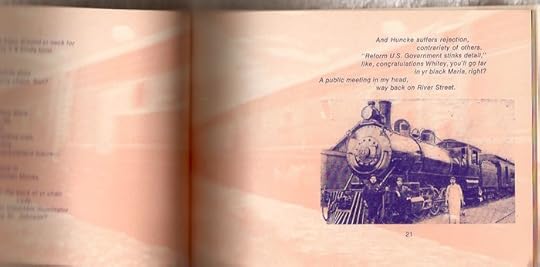
Ginsberg's long poem "Iron Horse" belongs in the sequence The Fall of America . Why it was published apart from this sequence is unknown to me. But I must commend Coach House Press for creating a handsome edition of Ginsberg's long poem, complete with stock photographs...

description

There is a passage from "Iron Horse" that reminds me of a passage from one of Denise Levertov's poems...
And the French Army surrounded Madrid,
and the Spanish Army'd marched simultaneously surrounded Paris.
Then they found out
it was hopeless.
Generals sent messages,
Call off the attack!
and the Armies rushed to a neutral place confronted
& killed each other.
They just wanted to fight,
no question of Madrid or Paris, then.
- & Johnson backed
Saigon's latest conditions:
N. Vietnam withdraw all aid,
Dissolve Withdraw Viet Cong.
These are conditions,
contradicting Johnson's Unconditionals.
These languages are gibberish.
John Steinbeck thy language is gibberish,
thou't lost the language war,
cantankerous phantom!
Newspaper language ectoplasm fades -
Everybody sneeze!
- Allen Ginsberg, "Iron Horse"


Children in the laundromat
waiting while their mothers fold sheets.
A five-year-old boy addresses
a four-year-old girl. 'When I say,
Do you want some gum? say yes.'
'Yes . . .' 'Wait! - Now:
Do you want some gum?'
'Yes!' 'Well yes means no,
so you can't have any.'
He chews. He pops a big, delicate bubble at her.

O language, virtue
of man, touchstone
worn down by what
gross friction . . .

And,
'"It became necessary
to destroy the town to save it,"
a United States major said today.
He was talking about the decision
by allied commanders to bomb and shell the town
regardless of civilian casualities,
to rout the Vietcong.'

O language, mother of thought,
are you rejecting us as we reject you?

Language, coral island
accrued from human comprehensions,
human dreams,

you are eroded as war erodes us.
- Denise Levertov, "An Interim" (from Relearning the Alphabet)


I believe "Iron Horse" (1966) was written before "An Interim" ( Relearning the Alphabet was published 1970). In any case, it's interesting to observe the similarities between two poems that share a common theme. Ginsberg and Levertov were both vehemently against the war in Vietnam, and I admire them both for having the courage to speak out against it publicly and in their poetry.
Profile Image for Brad Wojak.
320 reviews4 followers
November 30, 2023
Coach House did a beautiful job on the design of this book. The two stars are for the design. As I get older, I care less and less about Ginsberg…
Profile Image for Craig Werner.
Author 16 books220 followers
August 13, 2016
Part of Ginsberg's Sixties Whitmanesque epic, most of which was published as The Fall of America. Like "Wichita Vortex Sutra," the other segment of the long poem published elsewhere, Iron Horse is most effective as part of the larger structure. Also like WVS, it stands decent on its own, though the opening scene featuring Ginsberg's masturbatory fantasy form a sleeper coach on a cross country Santa Fe railroad trip is likely to jar the vast majority of readers much more here than it would in Fall.
The major theme is the way in which a debased commercial/political language entwines with the moral evasions of the Vietnam War.
Profile Image for Alex Budris.
625 reviews
March 8, 2023
I found a signed copy of this long Ginsberg poem and this morning I took the time to read it. A train-trip travelogue. A desolate view of the American industrial landscape - accompanied by constant radio chatter of doomed politics and hypocrisy. It's what you would expect from Ginsberg, maybe one of his better ones. This edition consists of only 1,000 copies, issued unsigned.

"Their metaphor mixed with machinery/No one knows where flesh ends/The robot Polaris begins... Under smokestack with a broken lip/Magnetic cranes drop iron scrap like waterdrops"
Displaying 1 - 8 of 8 reviews