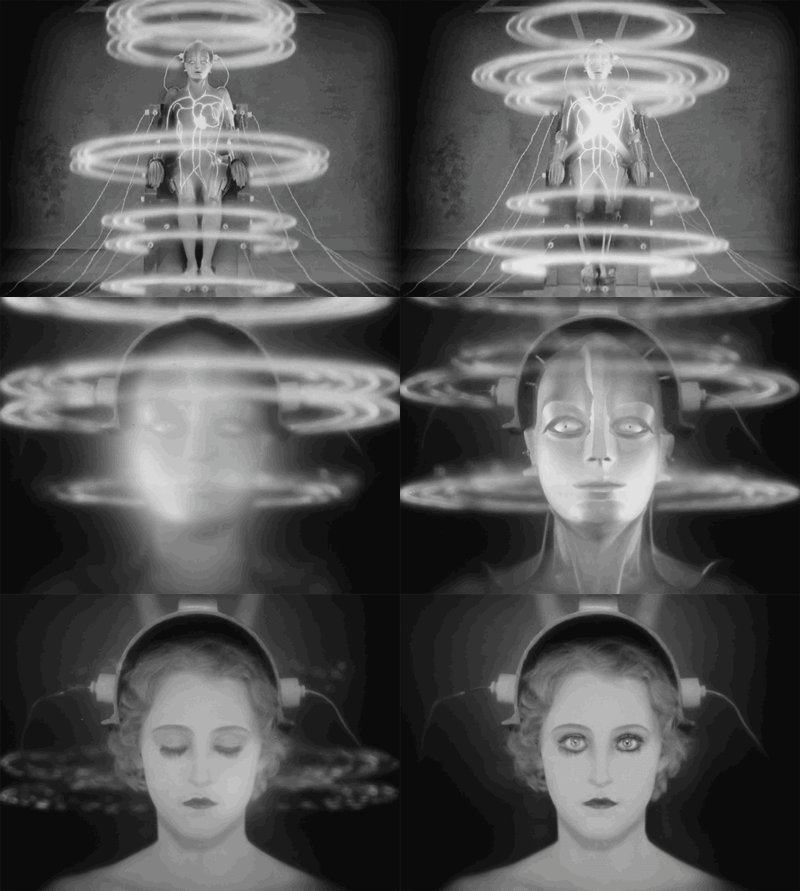
The Rough Guide to Sci-Fi Movies is a comprehensive guide to the ''final frontier'' of film. It explores our fascination with space exploration, time travel, fantastical worlds and alternative futures. This guide explains how everything from the philosophy of Plato to classic Victorian tales and cult comic books have helped to create one of cinema''s most engaging genres. Discover the classics from Mexico, Russia and Japan, not forgetting the Anime science fiction tradition, along with everything else you need to know from Metropolis to Star Wars, via Blade Runner, 2001 and Alien. The Rough Guide to Sci-Fi Movies is your essential guide to a galaxy of film unbounded by time or space.
John Scalzi, having declared his absolute boredom with biographies, disappeared in a puff of glitter and lilac scent.
(If you want to contact John, using the mail function here is a really bad way to do it. Go to his site and use the contact information you find there.)
Surprisingly comprehensive look at Science Fiction media including films, production, directors, actors, TV, merchandising, games etc etc. Importantly it appears to be targeted at the 'non-fan' and gives a fair and non-partisan analysis of the Sci-Fi genre, for example daring to point out the weaknesses of the Star Wars, Star Trek, Matrix etc films. Interestingly it also looks at non English speaking films. 7 out of 12, Three Stars. 2010 read
I picked this one up because (1) I’m a fan of Scalzi’s fiction and (2) I’m a fan of science fiction films from way back. It turns out to be a very useful combination of obscure information, literary and cinematic theory, film history, and pure, unadulterated fandom. (I knew I was in the right book when the author paused at the very beginning to explain the difference, to fans, between “SF” and “sci-fi.”) He selects fifty films from the past century as his “Canon” and discusses them in detail, pointing out the many interconnections and derivations, and tossing off scores of highly quotable lines; of Buckaroo Banzai (one of my own favorites), he comments, “Don’t be ashamed to laugh at this movie; just be aware of what that laugh says about you.” But he also provides a “warp-speed” history of the science fiction cinema, which allows him to give brief mention of many other films, both good and bad (and very, very bad). Likewise, there’s an idiosyncratic chapter on the “faces of sci-fi film,” crossover films, the pseudoscience that backs them, and the state of SF film-making in various countries.
There’s a great deal of good stuff here and I began making a list at the very beginning of films I hadn’t seen that I wanted to (not many of those) and those I’d seen in the past and now wanted to see again (lots and lots of those). It’s a shame, then, that the copyediting was so poorly done; it’s difficult to find three pages in a row without a horrendous typo, misspelling, or apparent missing word. (And, no, you don’t capitalize every single word in an italicized title.)
I picked up this book on a lark mainly due to its author, John Scalzi. I loved his novel Old Man's War and enjoyed his comedic novel Redshirts. His "meta" take on the Star Trek formula in that latter novel made a guide to sci-fi movies by Scalzi intriguing to me. Alas, this book is not very good.
Firstly the amount of typos and grammatical errors is very off-putting. I am by no means a spelling or grammar "Nazi" but too many instances and the craftsmanship just feels shoddy. I imagine most of this issue lies the feet of the editor, not the author, but the end product is still flawed.
As for the actual content, it's obvious this book was written more as an introduction to science fiction movies and even science fiction in general. The first few chapters are a whirlwind history of science fiction. Scalzi even admits some of the items he includes in this history are a bit of a stretch to be classified as "science fiction." Other small asides, like the debate over the terms "science fiction", "sci-fi", and "SF" are mostly common knowledge among entrenched science fiction fans.
One of the biggest problems with the content is the little movie blurbs sprinkled throughout. Any movie that isn't part of the "canon" gets a little note at points where something about the movie is brought up. For example, an entry for a noteworthy director will have a few of his movies listed. This makes reading the book cover to cover enticing but makes going back to find a specific movie's description a chore.
The chapters on science fiction from various countries and blending science fiction with other genres were very hit or miss. Some countries and genres could have easily been left out as the movies are not very noteworthy. For example, Italy is noted as being mostly knockoff imitations, while examples of science fiction musicals are few and poor quality. I suppose if the book is trying to be a complete survey of science fiction movies then it is necessary to include as much as possible, but it's labeled as a "rough guide" and I'm sure is not totally exhaustive.
The movies included in the "canon" contain something for everyone to love and something everyone to hate. Any such list is destined to be a source of debate amongst fans. There is a good focus on the history of science fiction movies, those that laid the groundwork for modern spectacles. Still, the descriptions don't reveal enough new information for those familiar with the movies. Instead the descriptions can lead fans to new movies to fill in the blanks.
This book makes for a better reference manual and/or checklist of movies rather than a book to read cover to cover.
Picked this one from the library just because it's written by John Scalzi.
At first I thought it was going to be one of those "50 scifi movies you should watch..." anthologies, but it's so much more.
It is divided into several sections: Origins, History, Canon (this is the longest section, with 50 iconic movies), Icons (faces of scifi: characters, actors, directors, technicians), Crossovers, Science, Locations, Scifi films around the world and More Information.
The concept of this book was fascinating, and there were moments where the story really shone. However, the pacing was inconsistent, with certain chapters dragging on longer than necessary. The characters were engaging, but some of their actions felt contrived. The ending was satisfying, tying up loose ends, but I couldn’t help feeling that it could have been more impactful. It’s worth reading, but it didn’t quite meet my expectations.
A page-turner from beginning to end! The twists and turns kept me guessing, and the characters were richly developed. I loved the unexpected surprises that were sprinkled throughout. It’s rare to find something that keeps you hooked like this. Definitely one of the best reads this year!
Listed as a 'rough guide', but with tons of information ranging from history of the genre, history of print and film production, seminal movies and characters, and even international projects. The only complaint that I have is that the book is a few years out of date and talks about movies in production that have already come out, however that is only a complaint because I want to know what the author thought of them! I would read more by this author and plan on reading more of the 'rough guide' series in the future!
Good resource for sci-fi films. Basic, but yet it has enough trivia and details that even the most seasoned sci-fi fan might learn something new. It starts with brief info about sci-fi authors that shaped the genre. And then lots of film info/reviews -- from classic silent era to blockbuster films, to crossover genres, to TV, to games.
Published in 2005 it obviously is missing newer titles, but still provided me with film suggestions for my "to watch" list.
After I found out that the author of the highly enjoyable Agent to the Stars also writes nonfiction, I became interested in this book. In a nice bit of synchronicity, Rose gave it to me for my birthday without being aware of my newfound interest. Meant to be read, wouldn't you say? Entertaining,informative, and enjoyable as billed in the synopsis.
3.5 stars - Lots of information and commentary packed into a streamlined structure. If you want a short primer by an author who's not afraid to state his opinions, this is for you. I'd have given it 4 stars if not for all the typos; that's not Scalzi's fault, but it was super distracting. Genre reference/coffee table books deserve editing TLC too. :(
Sure, this is a rough guide, but there is definitely enough information for you to decide whether you want to spend your time on a movie or not. I particularly like the canon, even though I don't agree with all their choices. Here you get some really cool inside information about the movie production, directors and actors.
If you like sci-fi movies... this rough guide is for you!
Aside from the chapters on influential sci-fi films, there are also some good chapters on influential sci-fi novels, the close connection with fantasy films, influential sci-fi shows and finally, a round-up of sci-fi films from around the world. A handy reference book to have around.
Although this book is titled The Rough Guide to Sci-Fi movies, it's pretty exhaustive. I really enjoyed it though, learning more about the writers, directors, and movies themselves that I love.