

What do you think?

Death in the Community: Memorialization and Confraternities in an Italian Commune in the Late Middle Ages
Ratings & Reviews
Friends & Following
Create a free account to discover what your friends think of this book!
Community Reviews
Displaying 1 - 1 of 1 review

October 22, 2013
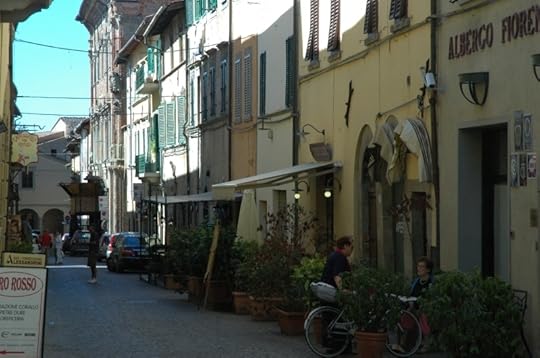
I really enjoyed this book a lot. It's very small in scale: it explores the religious life of lay people in the small Italian town of San Sepolcro from about 1250-1450 and never ventures very far beyond its borders. I think it's better for that. It tells a small story, but there's something very tangible and real about it. You get the sense of the town, and the people who lived it, more than you often do in books on regular people in the medieval period. James Banker's book tells the rather simple story of how a relative lack of regular clergy in a town during the 13th century created a flowering of lay religious life, and how the unity of lay piety slowly fractured outward into a constellation of different forms amidst the disorder of the 14th century. I don't usually post pictures along with reviews, but I've gotten weirdly attached to this little place. Here's Sansepolcro today:
Banker argues that – regardless of their multifarious purposes – confraternities existed primarily to help people face death with a group of their neighbors. Death was a big deal in this period (he rejects Philippe Ariès idea that death was essentially 'tamed' and not feared in the earlier Middle Ages), as can be seen through elaborate funeral regulations and mourning practices, and confraternities offered some genuine communal comfort and support.
The confraternity of San Bartolomeo dominated the religious landscape of San Sepolcro in the 13th century. It consisted of upwards of 1/3 of its households and included men and women from all social classes. Even the leaders included relatively humble members of the community. The whole thing was surprisingly equitable – members donated whatever they would like, and then the whole community would use the proceeds to give to the poor of the town. They would also regularly get together in order to communally recite the names of the dead, under the assumption that their charity upping the efficacy of their prayers.
But by the beginning of the 14th century there was a shift: male enrollment dropped, female enrollment increased, and the confraternity became increasingly concerned with the administrative task of managing the estates bequeathed to them. They still did charity, and were still involved in funeral practices (they collected a funeral tax and used proceeds to give funerals to the poor who couldn’t afford one), but it was a very different organization. The social equality also declined, and most leaders were from the town’s leading families.
Around the same time, a plethora of other confraternities popped up around San Sepolcro, particularly the laudesi confraternity of Santa Maria della Notte and a slew of flagellant groups. They were markedly different in character, featuring a smaller, exclusively male membership and were much more concerned with cultivating an atmosphere of holiness and sanctity within their own community than with the town as a whole.
It's a lovely little book. Well researched, well written, and very compelling despite being so small in scale.
Banker argues that – regardless of their multifarious purposes – confraternities existed primarily to help people face death with a group of their neighbors. Death was a big deal in this period (he rejects Philippe Ariès idea that death was essentially 'tamed' and not feared in the earlier Middle Ages), as can be seen through elaborate funeral regulations and mourning practices, and confraternities offered some genuine communal comfort and support.
The confraternity of San Bartolomeo dominated the religious landscape of San Sepolcro in the 13th century. It consisted of upwards of 1/3 of its households and included men and women from all social classes. Even the leaders included relatively humble members of the community. The whole thing was surprisingly equitable – members donated whatever they would like, and then the whole community would use the proceeds to give to the poor of the town. They would also regularly get together in order to communally recite the names of the dead, under the assumption that their charity upping the efficacy of their prayers.
But by the beginning of the 14th century there was a shift: male enrollment dropped, female enrollment increased, and the confraternity became increasingly concerned with the administrative task of managing the estates bequeathed to them. They still did charity, and were still involved in funeral practices (they collected a funeral tax and used proceeds to give funerals to the poor who couldn’t afford one), but it was a very different organization. The social equality also declined, and most leaders were from the town’s leading families.
Around the same time, a plethora of other confraternities popped up around San Sepolcro, particularly the laudesi confraternity of Santa Maria della Notte and a slew of flagellant groups. They were markedly different in character, featuring a smaller, exclusively male membership and were much more concerned with cultivating an atmosphere of holiness and sanctity within their own community than with the town as a whole.
It's a lovely little book. Well researched, well written, and very compelling despite being so small in scale.
Displaying 1 - 1 of 1 review