

What do you think?
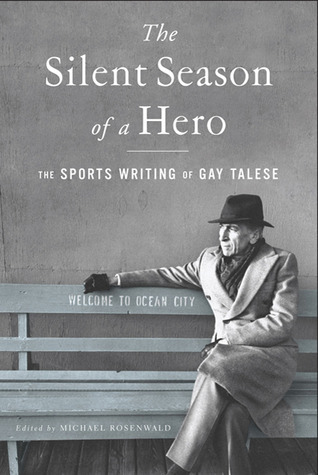
The Silent Season of a Hero: The Sports Writing of Gay Talese
One of America's most acclaimed writers and journalists, Gay Talese has been fascinated by sports throughout his life. At age fifteen he became a sports reporter for his Ocean City High School newspaper; four years later, as sports editor of the University of Alabama's Crimson-White , he began to employ devices more common in fiction, such as establishing a "scene" with minute details-a technique that would later make him famous.
Later, as a sports reporter for the New York Times , Talese was drawn to individuals at poignant and vulnerable moments rather than to the spectacle of sports. Boxing held special appeal, and his Esquire pieces on Joe Louis and Floyd Patterson in decline won praise, as would his later essay "Ali in Havana," chronicling Muhammad Ali's visit to Fidel Castro. His profile of Joe DiMaggio, "The Silent Season of a Hero," perfectly captured the great player in his remote retirement, and displayed Talese's journalistic brilliance, for it grew out of his on-the-ground observation of the Yankee Clipper rather than from any interview. More recently, Talese traveled to China to track down and chronicle the female soccer player who missed a penalty kick that would have won China the World Cup.
Chronicling Talese's writing over more than six decades, from high school and college columns to his signature adult journalism- and including several never-before-published pieces (such as one on sports anthropology), a new introduction by the author, and notes on the background of each piece- The Silent Season of a Hero is a unique and indispensable collection for sports fans and those who enjoy the heights of journalism.
Later, as a sports reporter for the New York Times , Talese was drawn to individuals at poignant and vulnerable moments rather than to the spectacle of sports. Boxing held special appeal, and his Esquire pieces on Joe Louis and Floyd Patterson in decline won praise, as would his later essay "Ali in Havana," chronicling Muhammad Ali's visit to Fidel Castro. His profile of Joe DiMaggio, "The Silent Season of a Hero," perfectly captured the great player in his remote retirement, and displayed Talese's journalistic brilliance, for it grew out of his on-the-ground observation of the Yankee Clipper rather than from any interview. More recently, Talese traveled to China to track down and chronicle the female soccer player who missed a penalty kick that would have won China the World Cup.
Chronicling Talese's writing over more than six decades, from high school and college columns to his signature adult journalism- and including several never-before-published pieces (such as one on sports anthropology), a new introduction by the author, and notes on the background of each piece- The Silent Season of a Hero is a unique and indispensable collection for sports fans and those who enjoy the heights of journalism.
320 pages, Paperback
First published August 24, 2010
About the author
Gay Talese
52 books598 followersGay Talese is an American author. He wrote for The New York Times in the early 1960s and helped to define literary journalism or "new nonfiction reportage", also known as New Journalism. His most famous articles are about Joe DiMaggio, Dean Martin and Frank Sinatra.
Ratings & Reviews
Friends & Following
Create a free account to discover what your friends think of this book!
Community Reviews
Displaying 1 - 23 of 23 reviews

April 16, 2011
In 2000, I took "Literary Journalism" with Craig Vetter at school, and it told me what kind of a writer I wanted to be. That was when I started my subscription to "The New Yorker" and have received the magazine for the 11 years since, without respite. When I was a teenager, I wanted to be a fiction writer and I have closets full of great novels with beginning chapters that went nowhere. I went to journalism school because my high school counselor told me it would at least guarantee a paycheck and somewhere along the way, I developed a taste for real, actual people and happenings, but just could not contain it within the staccato'd paragraphs of hard news reporting. My word counts always caused bile to rise in the throats of the Daily Northwestern editors. So, to know that legends such as Tom Wolfe, John McPhee, Gay Talese, and others, propagated a New Journalism in the 1960s - now, literary journalism - gave me new hope that I could actually make something out of this profession, honorably.
Any writer worth their salt knows "Frank Sinatra Has a Cold" by Talese, which is one of the most exemplary showcase of literary journalism, in which an entire profile is written of a subject without the subject actually being interviewed nor present. Because I've always felt that there isn't quite the stage, arena, scene nor set-up for drama like in sportswriting, I was very interested when a compendium of Talese's sportswriting was published - it was like setting up a pitch from Dennis Eckersley to Kirk Gibson, who obviously delivered. Unlike a lot of sportswriting, which can be action-driven and propelling (as it ought to be), Talese scores the characters and personalities instead, letting their off days tell the story from the bench and dugout - locker room literature, rather than stadium sensationalism.
I'm not sure I appreciate the chapter introductions, which often give away some of the best lines to come without the promise of discovery - particularly when some of these are story-ending punchlines! But, there is much salvation to be found in Talese's work. Droll, witty, and completely tweetable, the book begins with his early work for The New York Times, which are totally The New Yorker Talk of the Town vignettes. I would never compare myself to the Great Gaylord Talese, but he makes me feel better about my run-on sentences, and the fact that the key I type most often might just be the comma. And he is the embodiment of the most effective technique in sportswriting, the smart simile. Consider this from 1966's "The Silent Season of a Hero" from Esquire, widely considered Talese's best sports story: "DiMaggio is a kind of male Garbo." Nothing more is needed. Just as Talese takes his time in setting up a scene in flows of prose, he just as soon punches in imagery in just six words. That is Talese talent.
Last Sunday morning over breakfast, I read the "Dr. Birdwhistell and the Athletes" piece, about a social anthropologist who studied the world of the (male) American athlete in the late 1950s and early 1960s. Then I went and played softball and watched all the mechanisms Talese astutely picked up and portrayed play out during a modern-day recreational co-ed game. It was Talese unfolding before my very eyes across a baseball diamond, like each letter of his piece taking their places on the bases, in the outfield, on the mound, at the plate, in the dugout. Talese's observations were current, still. I'm not saying he is a seer. Not in the crystal ball sense, but in the notebook, fly-on-the-wall, best type of reporter sense. He definitely called it like it is, like he saw it, and like any legendary writer, he has remained relevant.
One of the first lessons I learned at journalism school was that you don't need to go to journalism school to be a journalist. True - why not just read and learn from one of the masters?
Any writer worth their salt knows "Frank Sinatra Has a Cold" by Talese, which is one of the most exemplary showcase of literary journalism, in which an entire profile is written of a subject without the subject actually being interviewed nor present. Because I've always felt that there isn't quite the stage, arena, scene nor set-up for drama like in sportswriting, I was very interested when a compendium of Talese's sportswriting was published - it was like setting up a pitch from Dennis Eckersley to Kirk Gibson, who obviously delivered. Unlike a lot of sportswriting, which can be action-driven and propelling (as it ought to be), Talese scores the characters and personalities instead, letting their off days tell the story from the bench and dugout - locker room literature, rather than stadium sensationalism.
I'm not sure I appreciate the chapter introductions, which often give away some of the best lines to come without the promise of discovery - particularly when some of these are story-ending punchlines! But, there is much salvation to be found in Talese's work. Droll, witty, and completely tweetable, the book begins with his early work for The New York Times, which are totally The New Yorker Talk of the Town vignettes. I would never compare myself to the Great Gaylord Talese, but he makes me feel better about my run-on sentences, and the fact that the key I type most often might just be the comma. And he is the embodiment of the most effective technique in sportswriting, the smart simile. Consider this from 1966's "The Silent Season of a Hero" from Esquire, widely considered Talese's best sports story: "DiMaggio is a kind of male Garbo." Nothing more is needed. Just as Talese takes his time in setting up a scene in flows of prose, he just as soon punches in imagery in just six words. That is Talese talent.
Last Sunday morning over breakfast, I read the "Dr. Birdwhistell and the Athletes" piece, about a social anthropologist who studied the world of the (male) American athlete in the late 1950s and early 1960s. Then I went and played softball and watched all the mechanisms Talese astutely picked up and portrayed play out during a modern-day recreational co-ed game. It was Talese unfolding before my very eyes across a baseball diamond, like each letter of his piece taking their places on the bases, in the outfield, on the mound, at the plate, in the dugout. Talese's observations were current, still. I'm not saying he is a seer. Not in the crystal ball sense, but in the notebook, fly-on-the-wall, best type of reporter sense. He definitely called it like it is, like he saw it, and like any legendary writer, he has remained relevant.
One of the first lessons I learned at journalism school was that you don't need to go to journalism school to be a journalist. True - why not just read and learn from one of the masters?

May 11, 2011
Collection of Talese's sports writing going all the way back to the columns he wrote for his high school paper.
Talese found his best subject by far in Floyd Patterson whose intelligence comes right off of the page and stands in sharp contrast to other subjects of Talese such as Joe DiMaggio, Joe Louis and Muhammad Ali.
Talese was a dabbler in sports and doesn't really get inside his milieu the way boxing writers such as A. J. Liebling, John Lardner and W. C. Heinz did and he certainly doesn't write with the humor of a Liebling or Lardner. In fact, I was surprised by the lack of humor throughout the collection.
Talese found his best subject by far in Floyd Patterson whose intelligence comes right off of the page and stands in sharp contrast to other subjects of Talese such as Joe DiMaggio, Joe Louis and Muhammad Ali.
Talese was a dabbler in sports and doesn't really get inside his milieu the way boxing writers such as A. J. Liebling, John Lardner and W. C. Heinz did and he certainly doesn't write with the humor of a Liebling or Lardner. In fact, I was surprised by the lack of humor throughout the collection.

February 14, 2024
Appreciated the narrative approach with the unique perspective. Never followed big stories of superstars but waited to see in the shadows and illuminated them. He did a great piece on an aging DiMaggio.
February 4, 2011
Reading this book made me depressed about sports, sports journalism and, by extension, journalism and by further extension journalism.
Talese is arguably one of the best at writing about sports, but so what? So what the he wrote some telling pieces about Floyd Patterson that made him seem human. So what thet he can tell me how Joe Dimaggio ages? So what that he can illustrate that Muhammad Ali was declining somewhat gracefully in Cuba where the dictator was faring similarly?
I mean, this is near the top of a genre I've been reading for as long as I've been able to read, and I'm still constantly underwhelmed. What is it telling me, teaching me, showing me?
If you like sports journalism, you'll dig this because Talese is talented. The Patteron series was excellent. The comments by Michael Rosenwald were pointless. I suppose it is difficult to edit yourself out of a book you're editing.
If you doubt that sports journalism can be well-written, read this, and you'll be surprised.
If you're looking for meaning, well, this book might teach you, like me, that this is not the place.
Talese is arguably one of the best at writing about sports, but so what? So what the he wrote some telling pieces about Floyd Patterson that made him seem human. So what thet he can tell me how Joe Dimaggio ages? So what that he can illustrate that Muhammad Ali was declining somewhat gracefully in Cuba where the dictator was faring similarly?
I mean, this is near the top of a genre I've been reading for as long as I've been able to read, and I'm still constantly underwhelmed. What is it telling me, teaching me, showing me?
If you like sports journalism, you'll dig this because Talese is talented. The Patteron series was excellent. The comments by Michael Rosenwald were pointless. I suppose it is difficult to edit yourself out of a book you're editing.
If you doubt that sports journalism can be well-written, read this, and you'll be surprised.
If you're looking for meaning, well, this book might teach you, like me, that this is not the place.

March 27, 2013
Although I check the sports pages of my local paper for baseball scores, I don't read much sports-writing that is not about baseball. The title piece is a profile of Joe DiMaggio fifteen years after his retirement, so technically it is about baseball, but most of these pieces, long or short, are about sports I have little or no interest in. They are fascinating reading, however, because Talese never wrote for sports aficionados. All of these pieces tell stories about people, people as obscure as a boxing timekeeper and as famous as DiMaggio, Joe Louis and Muhammad Ali. Each person is fascinating and each piece is compelling.
March 29, 2012
Love Talese's essay at the start and the openings by editor Michael Rosenwald. The actual DiMaggio profile "Silent Season of a Hero" is my all-time favorite profile, more so than "Frank Sinatra has a Cold".
Talese, in many, many ways, is my hero. I seek to emulate him in many ways, right down to the threads. In this game of writing, he's my DiMaggio and this might just be his silent season. It comes for us all.
Talese, in many, many ways, is my hero. I seek to emulate him in many ways, right down to the threads. In this game of writing, he's my DiMaggio and this might just be his silent season. It comes for us all.

August 5, 2025
Love his choice of subject and his silly little tone. Can’t get 5 bc some Racial and Woman things that bothered me and some characters fall a little flat/tropey but he’s so sharp and stylish and I like the way he thinks about people like the guy who makes all the horseshoes and the guy who designs the golf courses and the fairest ref in boxing and what happens to heroes when they’re old and washed up
July 10, 2025
There was a lot more reporting compared to opinions than I had expected—much detailed descriptions on how people looked and moved.
Some of my favorite stories were:
- The Loser
- Silent Season of a Hero
- The Loneliest Guy in Boxing
- Portrait of a Young Prize Fighter
- Ali in Havana (the lede was amazing)
Some of my favorite stories were:
- The Loser
- Silent Season of a Hero
- The Loneliest Guy in Boxing
- Portrait of a Young Prize Fighter
- Ali in Havana (the lede was amazing)

August 3, 2020
Enjoyable compilation of Talese's writings.
"Swan Song For Gay Talese," his last article for the Ocean City (NJ) Sentinel Ledger where he worked for two years on the sports desk before heading off to college, demonstrated Talese's solid writing skills at an early age.
"Swan Song For Gay Talese," his last article for the Ocean City (NJ) Sentinel Ledger where he worked for two years on the sports desk before heading off to college, demonstrated Talese's solid writing skills at an early age.

December 28, 2022
Ojalá utilitzar el punto y coma tan bien como Gay Talese: «(…) y de repente miles de personas se pusieron en pie de un salto, como locos, gritando de alegría: el gran DiMaggio había vuelto; volvían a ser jóvenes; era ayer».
February 11, 2019
This is great sports writing. The one about DiMaggio is kind of sad.

June 30, 2019
Décimo libro del año. Colección de columnas deportivas que esconden una interesante radiografía de la cultura estadounidense.
August 23, 2026
A wonderful writer.
November 29, 2010
I am a big Gay Talese fan. This new collection of his sports writing includes some of his better known, beautifully written pieces such as his profiles of Joe Louis and Joe Di Maggio, both originally published in Esquire. I had never read most of the work in this new book, much of it from the New York Times, going back to the 1950s. Editor Michael Rosenwald includes some Talese stories about a few female athletes like Gerry Murray, a roller derby skater; Judy Frank, a golf champion; and Lui Ying, a Chinese soccer player who missed an important goal in the 1999 women's world cup. And there are pieces on boxers--Sonny Liston, Floyd Patterson--one with a title I love: "Patterson, Indifferent at First, Finally Turns on Barking Dog." One article on baseball, "On the Road Going Nowhere, with the Yankees." first appeared in the New York Times in 1979.
What a great Christmas present for all the sports fans on your list. I bought three copies. Read this one!!!
What a great Christmas present for all the sports fans on your list. I bought three copies. Read this one!!!

October 28, 2010
Yeah I loved this. I found myself wanting to read 'just one more piece' nearly every time I picked up the book until I was finished. Gay Talese certainly has a way of bringing his athlete subjects to life. They become human and sad rather than mere giants of sport and celebrity. My favorite selection is The Kick She Missed. I like it so much that I want to read the book it originally comes from. Other notables are the entire Floyd Patterson series and of course The Silent Season of a Hero. If I were a bit older, I could imagine myself awaiting any new column or feature from Gay Talese as they were published.

October 18, 2011
I appreciated Talese's narrative approach to his stories and his unique perspective. He never followed the big stories or the superstars, but looked for the athlete in the shadows and illuminated his or her story. I especially liked his story on Floyd Patterson entitled "The Loser." You felt like you knew the former champion like a friend after reading it. Most of the earlier articles I didn't enjoy. In fact, I wasn't struck by his writing until about p. 111 when some of his longer pieces from Esquire began appearing. "The Silent Season of a Hero" was a brilliant portrait of an aging DiMaggio.

July 31, 2017
What a wonderful book. I've long admired the long-form sports writers such as Gary Smith, and more recently Wright Thompson, but it wasn't until recent years when I learned that Gay Talese was such a groundbreaking figure and a giant on whose shoulders the likes of Smith and Thompson later stood on. This is a wonderful collection of Talese's writing, from his early days through to exquisite, in-depth long stories on sporting greats and lesser-knowns. A must-have for anyone who enjoys narrative non-fiction and sports tales that go outside the lines.

November 29, 2011
Loved some of the stories here like, "The Loser," recounting Floyd Patterson and his interaction with bullies at his daughter's school, Liston, and not looking opponents in the eye. Also loved "Joe Louis: The King as a Middle Aged Man," and of course, "Silent Season of a Hero," with DiMaggio in all of his quintessential American male splendor and greatness. Other stories were less memorable, but well worth the time.

August 6, 2013
Talese is probably the best, and most influential, magazine writer of the 2nd half of the twentieth century, and this is a great collection of some of his best sports features, including some of his boxing pieces -- "The Loser," about Floyd Patterson, "Ali in Havana," and "The King as a Middle-Aged Man," about Joe Louis. Plus, the titular piece, about a retired, mercurial Joe DiMaggio. Great, great stuff.

November 16, 2012
An accumulation of articles by Gay Talese, a long-time sports writer. Under the appropriate moniker of literary journalism, Talese explores aspects of sports not typically encountered with other sports writers. I especially liked his pieces on "Race, Reporters, and Responsibility", the Heiden's, Joe Dimaggio, and Muhammed Ali's visit to Cuba and Castro.

December 8, 2010
This collection is arranged chronologically, which allows us to see the growth of a craftsman from his college newspapering days into a writer at height of the "New Journalism." It's encouraging to all who toil at the typewriter to see hard work and lived in wisdom continues to show on the page.

August 18, 2011
While mainly a baseball guy, my wife gave me this for my birthday and I devoured it because of Talese's unusual choices for subject matter and wonderful writing style.

January 20, 2012
Masterful
Displaying 1 - 23 of 23 reviews