Jacques Rancière (born Algiers, 1940) is a French philosopher and Emeritus Professor of Philosophy at the University of Paris (St. Denis) who came to prominence when he co-authored Reading Capital (1968), with the Marxist philosopher Louis Althusser.
Rancière contributed to the influential volume Reading "Capital" (though his contribution is not contained in the partial English translation) before publicly breaking with Althusser over his attitude toward the May 1968 student uprising in Paris. Since then, Rancière has departed from the path set by his teacher and published a series of works probing the concepts that make up our understanding of political discourse. What is ideology? What is the proletariat? Is there a working class? And how do these masses of workers that thinkers like Althusser referred to continuously enter into a relationship with knowledge? We talk about them but what do we know? An example of this line of thinking is Rancière's book entitled Le philosophe et ses pauvres (The Philosopher and His Poor, 1983), a book about the role of the poor in the intellectual lives of philosophers.
Most recently Rancière has written on the topic of human rights and specifically the role of international human rights organizations in asserting the authority to determine which groups of people — again the problem of masses — justify human rights interventions, and even war.
In 2006, it was reported that Rancière's aesthetic theory had become a point of reference in the visual arts, and Rancière has lectured at such art world events as the Freize Art Fair. Former French presidential candidate Ségolène Royal has cited Rancière as her favourite philosopher.
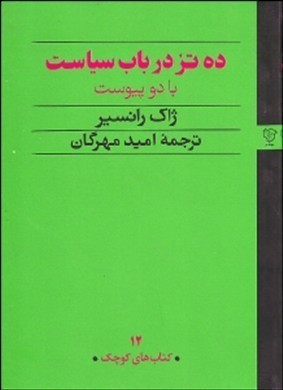
یک سال و نیم پیش این کتاب را آغاز کردهبودم و امروز برای همیشه بستمش! هنوز نمیدانم چه کسی این کتاب را پیشنهاد کردهبود و اصلا سر چی؟ کتاب همانگونه که در آخر گفتوگوی نویسنده میخوانیم بهشدت فشردهشده است گویا سبک نویسنده همین است.هفتهی پیش یک گفتوگو از فرهاد اکبرزاده دربارهی رانسیر در یوتیوب دیدم که فهمم از رانسیر را بهتر کرد ولی در نهایت به کسانی که دنبال کتاب سادهفهم دربارهی سیاست میگردند هرگز پیشنهادش نمیکنم، شاید اگر عمری باشد و سیاست را تخصصیتر فهم کردم، سراغ رانسیر بروم، ولی احتمالا این شاید همان هرگز باشد!
فهرست: یادداشت مترجم ده تز در باب سیاست پیوست 1: از سیاست به استتیک؟ پیوست 2: سیاست همیشه ممکن است/ گفتوگوی پیتر هالوارد با ژاک رانسیر
In zehn kurzen Anschnitten, die trotz des Titels eher Beschreibungen als Thesen sind, definiert Rancière die Politik wieder als ein dynamischer Prozess, die sie vielleicht erst mit dem arabischen Frühling wieder zu werden sucht. Eine Anomalie, die sich die "normale" Entwicklung der Herrschaftsstrukturen und der Machtverteilung nach dem Prinzip der Geburt und dem des Reichtums wiedersetzt und den ungezählten, anteil- und anspruchslosen demos (immer) wieder miteinbezieht.
Die unterscheidende Gegenüberstellung "Polizei - Politik" ist interessant. "Die Polizei ist nicht das Gesetz, das das Individuum aufruft [...], [s]ie ist zuerst die Erinnerung an die Evidenz dessen, was es gibt, oder eher dessen, was es nicht gibt: 'Weiterfahren! Es gibt hier nichts zu sehen.' Die Polizei sagt, dass es auf einer Fahrbahn nichts zu sehen gibt, dass es nichts zu tun gibt, als dort weiter zu fahren. [...] Politik besteht darin, diesen Verkehrsraum in den Raum der Demonstration eines Subjekts umzuwandeln."