

What do you think?

Michelangelo: a Collection of Fifteen Pictures and a Portrait of the Master; 1901
This work has been selected by scholars as being culturally important and is part of the knowledge base of civilization as we know it. This work is in the public domain in the United States of America, and possibly other nations. Within the United States, you may freely copy and distribute this work, as no entity (individual or corporate) has a copyright on the body of the work. Scholars believe, and we concur, that this work is important enough to be preserved, reproduced, and made generally available to the public. To ensure a quality reading experience, this work has been proofread and republished using a format that seamlessly blends the original graphical elements with text in an easy-to-read typeface. We appreciate your support of the preservation process, and thank you for being an important part of keeping this knowledge alive and relevant.
- GenresNonfiction
136 pages, Hardcover
Published September 9, 2021
About the author
Estelle May Hurll
51 books14 followersEstelle May Hurll (1863–1924), a student of aesthetics, wrote a series of popular aesthetic analyses of art in the early twentieth century.
Hurll was born 25 July 1863 in New Bedford, Massachusetts, daughter of Charles W. and Sarah Hurll. She attended Wellesley College, graduating in 1882. From 1884 to 1891 she taught ethics at Wellesley. Hurll received her A.M. from Wellesley in 1892. In earning her degree, Hurll wrote Wellesley's first master's thesis in philosophy under Mary Whiton Calkins; her thesis was titled "The Fundamental Reality of the Aesthetic." After earning her degree, Hurll engaged in a short career writing introductions and interpretations of art, but these activities ceased before she married John Chambers Hurll on 29 June 1908.
Hurll was born 25 July 1863 in New Bedford, Massachusetts, daughter of Charles W. and Sarah Hurll. She attended Wellesley College, graduating in 1882. From 1884 to 1891 she taught ethics at Wellesley. Hurll received her A.M. from Wellesley in 1892. In earning her degree, Hurll wrote Wellesley's first master's thesis in philosophy under Mary Whiton Calkins; her thesis was titled "The Fundamental Reality of the Aesthetic." After earning her degree, Hurll engaged in a short career writing introductions and interpretations of art, but these activities ceased before she married John Chambers Hurll on 29 June 1908.
Ratings & Reviews
Friends & Following
Create a free account to discover what your friends think of this book!
Community Reviews
Displaying 1 - 3 of 3 reviews

January 24, 2013
Free download available at Gutenberg Project
PREFACE
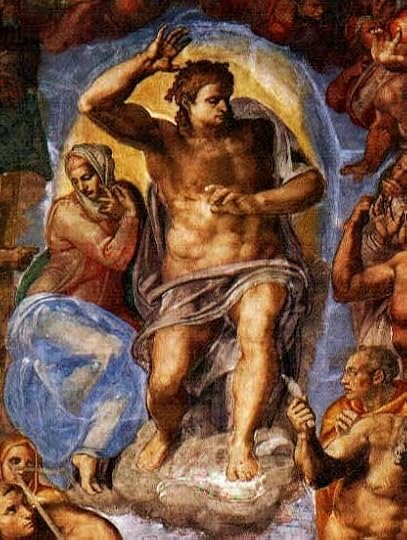
In making a collection of prints from the works of Michelangelo, it is impossible to secure any wide variety, either in subject or method of treatment. We are dealing here with a master whose import is always serious, and whose artistic individuality is strongly impressed on all his works, either in sculpture or painting. Our selections represent his best work in both arts. These are arranged, not in chronological order, but in a way which will lead the student from the subjects most familiar and easily understood to those which are more abstract and difficult.
PREFACE
In making a collection of prints from the works of Michelangelo, it is impossible to secure any wide variety, either in subject or method of treatment. We are dealing here with a master whose import is always serious, and whose artistic individuality is strongly impressed on all his works, either in sculpture or painting. Our selections represent his best work in both arts. These are arranged, not in chronological order, but in a way which will lead the student from the subjects most familiar and easily understood to those which are more abstract and difficult.

Read
December 5, 2022read for my art history review final essay

April 25, 2017
I had an amazing time reading this short yet precious book on Michelangelo and fifteen of his masterpieces in painting and sculpture. You will find great details on the history of these works, the historical stories and biblical verses behind them, the history of executing them, and the poems written on some of them. It also contains discussions for the skills of Michelangelo, the similarities and differences between his art and the Greek sculpture he adored. I liked the poems in the book, especially those by Milton, Dante and Michelangelo himself. I discovered new information on the Medici Family and its ruling Florence. It is a worth reading book with its artistic value and rich biblical, historical and biographical details. You will read on Daniel, Jeremiah, The Holy Family, Jesus Christ, Delphic and Cumean Sybil, Lorenzo and Giuliani di Medici, and others. The book shows how Michelangelo, like me and ancient Greeks, prefer decorating his works with human bodies instead of landscape.
Quotes:
Michelangelo has been compared to two great masters of dissimilar arts, Milton and Beethoven. There are striking points of similarity in the men themselves, in stern uprightness of character, in scorn of low and trivial, in lofty idealism. The art of the three is too far above the common level to be popular; it requires too much thinking to attract the superficial. In poetry, in music, and in sculpture, all three utter the profoundest truths of human experience, expressed in grand and solemn harmonies.
Love betters what is best, Even here below, but more in heaven above.
Thus it was that when he came down the people were afraid to come near, for “the skin of his face shone,” or “put forth beams,” as the expression reads in some Bible translations. In the old Latin version made by Jerome in the fifth century, and known as the Vulgate, translated into what is now called the Douay Bible, we read that “Moses’ face was horned.” This is why all the old artists, who were guided by the Vulgate, represented Moses with horns. These horns became, as it were, symbols of Moses’ inspiration as a prophet.
The creation of man picture was painted long before there was any knowledge of electricity, of electric sparks, and electric currents. Yet, if we did not know otherwise, we might fancy that Michelangelo had some of these wonderful ideas of modern science in mind, as the symbols of the great thoughts he was trying to express.
Life is a dream between two slumbers; sleep is death’s twin-brother; night is the shadow of death; death is the gate of life – such is the mysterious mythology wrought by the sculptor.
Quotes:
Michelangelo has been compared to two great masters of dissimilar arts, Milton and Beethoven. There are striking points of similarity in the men themselves, in stern uprightness of character, in scorn of low and trivial, in lofty idealism. The art of the three is too far above the common level to be popular; it requires too much thinking to attract the superficial. In poetry, in music, and in sculpture, all three utter the profoundest truths of human experience, expressed in grand and solemn harmonies.
Love betters what is best, Even here below, but more in heaven above.
Thus it was that when he came down the people were afraid to come near, for “the skin of his face shone,” or “put forth beams,” as the expression reads in some Bible translations. In the old Latin version made by Jerome in the fifth century, and known as the Vulgate, translated into what is now called the Douay Bible, we read that “Moses’ face was horned.” This is why all the old artists, who were guided by the Vulgate, represented Moses with horns. These horns became, as it were, symbols of Moses’ inspiration as a prophet.
The creation of man picture was painted long before there was any knowledge of electricity, of electric sparks, and electric currents. Yet, if we did not know otherwise, we might fancy that Michelangelo had some of these wonderful ideas of modern science in mind, as the symbols of the great thoughts he was trying to express.
Life is a dream between two slumbers; sleep is death’s twin-brother; night is the shadow of death; death is the gate of life – such is the mysterious mythology wrought by the sculptor.
Displaying 1 - 3 of 3 reviews