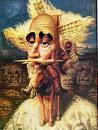
Alfonso Stephen O'Kelly'O known as Stephen, son of rumoured former bootleggers, ex-naval gunner, unemployed compuser, student of dairy cattle in Wisconsin and of music in Italy, has little to recommend him as a marriage prospect but his tender heart, his chivalry, and his comprehensive knowledge of the great city of New York. So when the exquisitely pneumatic and extraordinarily wealthy Sylvia Triumphington, adored adoptive heiress to the Triumphington family forture, sets her sights on him, Stephen is caught quite off guard.
Marrying into the Triumphington fortune, Stephen gets more than he bargained for. Sylvia's unexpected taste for rough sex, her obsession with finding her real mother, and her proclivity for spending Stephen's non-exsistent money are enough for him to handle but then there is the arrogant and unpredictable adoptive father and his elegant and insatiable wife, Drusilla, to whom Stephen conspicuously and inconveniently is attracted.
And then, of course, is the wrong information....
Featuring fourteen refined and witty illustrations by Elliot Banfield, the artist whose drawings enhanced the colorful antics of The Lady Who Liked Clean Restrooms,, Wrong Information is Being Given out at Princeton, is an elegy on passion, a glorious, irreverent, and picaresque journey.
James Patrick Donleavy was an Irish American author, born to Irish immigrants. He served in the U.S. Navy during World War II after which he moved to Ireland. In 1946 he began studies at Trinity College, Dublin, but left before taking a degree. He was first published in the Dublin literary periodical, Envoy.
A satire. A farce. A dated study of manners. A great title. A story of sailors home from war, savoring the Fifty-Two Twenty, like my Dad. A survey of classical music; a newly created minuet; a very wealthy woman who plays four notes each of Vivaldi, Beethoven, Ravel, Rachmaninoff and Sibelius but cannot stump the young composer, so she puts on Khachaturian's Sabre Dance [http://www.youtube.com/watch?v=ejIk_Z...] and takes him to bed. A song of a city - New York - which breathes and slays and changes the locks, but which has people.
And one, a lovely girl, might tap your shoulder and say "Excuse me, Sir" but you answer too late. You are distracted by another man, who grabs your lapels, and insists "Wrong information is being given out at Princeton." Every day, you will have your last quarter. Give it to someone. And watch what happens.
I'm either not cultured enough or not deep enough for a book like this. Or maybe I am too much of those things. I hated - hated hated hated - this book. I hated the main character, I didn't understand the point of the book at all and I hated everyone else in it. I see below that it's a farce. OK....um maybe that explains something? Who knows...hated it.
Were it not already the title of an insufferable song by Dr. Hook and The Medicine Show, the title of this strange novel could just as easily been "Sylvia's Mother". To clarify, Sylvia is the name of the mercurial woman whom the narrator/hero (?) marries only to later get deeply involved with her adoptive mother and their shared world of New York Brahman culture and self-importance. The narrator, Stephen, is an Irish-American composer who is brilliant, handsome, a veteran of World War II, and broke. It is Sylvia's mother Druscilla who, once she is introduced, really drives and carries the action of this novel, along with Stephen's lugubrious best friend, Max. The book is written as once continuous narrative with no chapter breaks, and though it starts off as a pretty familiar Donleavy farce, there is a scene with a young woman with whom Stephen has a chance encounter at a train station that shifts the tone of the novel into something more befitting a novel of existential dread that might have come from the pen of Gide or Camus. I found this more unsettling than anything else I have read by Donleavy, and though I think it is a powerful indictment of a certain segment of American society from which I, as a westerner and decidedly middle-class, have been insulated, the lack of evenness of tone prevents me from giving this book a higher rating or recommending it to anyone but a stalwart fan. It feels like a book written in a bit of a hurry.
This is an astonishingly bad book, and I can't account for the author's popularity. Had it been written in the 1950s or 60s, I'd say it was of its time, and we had moved on in maturity and sophistication. But apparently, it came out in the mid-1990s. If anyone with literary taste or progressive social views reviewed it, I shudder to think about the reaction.
I can't claim to have completed the book, as I'd decided by the first 30 pages (probably by the first 5 pages) that it was terrible. I skimmed parts throughout and had zero interest in finding out how it ended for the primary characters. They are so impossible to believe that even in allowing for satire, they are stick figures. Comparing this to the brutal humor of Evelyn Waugh, for example, makes this look like a high schooler's draft.
I guess for some people the spanking and rough sex terms are titillating, sort of like a precursor to "50 Shades of Gray." I guess for others, it's funny, a "take" on noir writing. Personally, I can only cringe at lines like: "With her nipples as hard as little acorns, she gyrated, cavorted, spun, and whirled through a half dozen dances. A boogalo and a bolero, a bunny hop, a frug, and a Charleston. Then ending with a minuet. My God, she knew how to send me into a delirium ..."
I won't even attempt to review the plot, except to say that even allowing for the excesses of humor, it just doesn't make sense. Alfonso, the main person, served in WWII, and he describes himself as concussed and with damaged hearing. But he decides after the war to become a composer of classical music. Really? With bad hearing? Is he the reincarnation of Beethoven?
This is the first book I have read by Donleavy. I have been told Donleavy is a humorist, and was looking forward to a good satire set a Princeton University. A topic that never gets old. But the book is not particularly funny, and the Princeton in the title is a bus line. Oh well.
I would compare this to the sort of British humorous novel in which none of the characters are sympathetic, and very little of the story is funny. I will probably try another book by Donleavy, who came well recommended, but this is not a good start.
J. P. Donleavy (1926-2017) once said “Writing is turning one’s worst moments into money”. He proves it in this slender novel that I would place in the “New York City Picaresque” genre. I like his distinctive voice.
It is vivid, funny and - eventually - deeply emotional. (The protagonist is a composer and most of the music references are lame; equating Gounod’s “Messe Solennelle de Saints-Cécile” with an orgasm???)
Some would be embarrassed to say they enjoyed it - I am not.
After reading six superb novels by Donleavy, never thought I'd be forced to give him a one star rating, but here it is. Monotonous scenes, obnoxious characters, aimless dialogue, contrived plot, and a general sense of an author at the low ebb of his prowess. Also, borderline lasciviousness. That being said, I have enough confidence in him to read the rest of his works.
Picked it up for the title, became intrigued by the illustrations (I had just returned from a trip to NYC), stayed for the style. It’s meant to be farcical but there are deeper moments to it. Great atmosphere.
Read this one over a wet weekend. Interested in the title and the author also. However not really my cup of tea. Found his detail of New York enjoyable however not so much the storyline. not sure whether to read more of J.P.Donleavy?
WOW. A must-read. Witty, somber, cynical, optimistic, critical, lyrical, poetic, hilarious, deadening, philosophical, mundane. Never before I have read something with such feeling, that’s captured the breadth of human experience in so few, staccato sentences. 10/10.
J.P. Donleavy's narrative voice is unique. Setting him apart from all other writers. With a lyrical pointillism that is fragmented. Painting pictures of incredible poetic beauty. Sad and tender. And then, again, hilarious. Evoking all of one's senses. This tale is very New York. Where Donleavy was born. Before moving to Ireland, TCD and the Irish countryside. His subject, this time, is a starving composer living among wealthy friends and in-laws. Tormented by every woman he meets. Unable to understand just one of them. Even briefly. Bewildered by popular American culture. Which rains fortunes on untalented artists. Hiding the gifted in total obscurity. And starving them into anonymity. They await redemption. And recognition of their artistic merit. As the astonishing talents of Donleavy go unrecognized by the literary mainstream. Read Donleavy -- one of the most gifted and worthy and unheralded writers of our day.
This has got to be Donleavy's best book since "The Ginger Man", though "Are you Listening, Rabbi Low" still comes in a close second. Donleavy has one of the most distinctive literary voices I've ever seen. This book is immensely emotionally engaging. Tragic, without being overly so, the story is wonderful. This is a must read for any Donleavy devotee.
Donleavy's protagonist is one of the strangest characters among his works. Although Donleavy is one of my favorite authors, I think I just didn't get it. I'll have to think about what I read for awhile to see if I can make sense of it all.
The pedantic speech used by the protagonist was quite amusing. The author is clearly an expert on NYC in the 1940s & 1950s and painted a virtual picture of life there at that time.